AI Stock Picker Claims Checked: Backtests vs One Live Record
Quick answer
An AI stock picker can beat the market in a backtest almost every single time. With live money, the record gets very thin, very fast. Our desk research found that every vendor performance number we checked was a backtest, a simulation, a cherry-picked winners list, or sitting behind a blocked page. The one live, audited AI stock-picking record we could verify, the AIEQ ETF, is up about 100.2% since October 17, 2017, against roughly 199.7% for the S&P 500, net of its 0.75% expense ratio, per 24/7 Wall St reporting on Yahoo Finance in August 2026. That one chart is AI Stock Picker Claims Checked: Backtests vs One Live Record in a sentence.
Key Takeaways
- AIEQ, the only long live audited record we found, trails the S&P 500 by roughly 99 percentage points since 2017.
- One independent 2026 test of five AI signal services found an average gap of 14.3 percentage points between advertised backtest win rates and live win rates.
- Danelfin publishes a backtested "+376% from January 3, 2017, until June 9, 2025, vs. only +166% of the S&P 500" claim on its own site.
- Prospero.ai labels its performance figures as simulated, with the disclaimer "not actual trading results" attached.
- Industry estimates cited in one machine learning backtesting guide suggest more than 90% of backtested ML strategies fail in production.
- Our Alpha Scores: Trade Ideas 85, Danelfin 75, Seeking Alpha 75, Kavout 62, Intellectia AI 57.
- Stanford Graduate School of Business researchers, including Ed deHaan, study how investors actually process information, which is the real question under all of this.
Can an AI stock picker really beat the market?
Sometimes, in short windows, with no audit. No AI stock picker we checked has shown a long, independently verified live record of beating the S&P 500 after fees. The best live evidence runs a quarter or a year, not a decade.
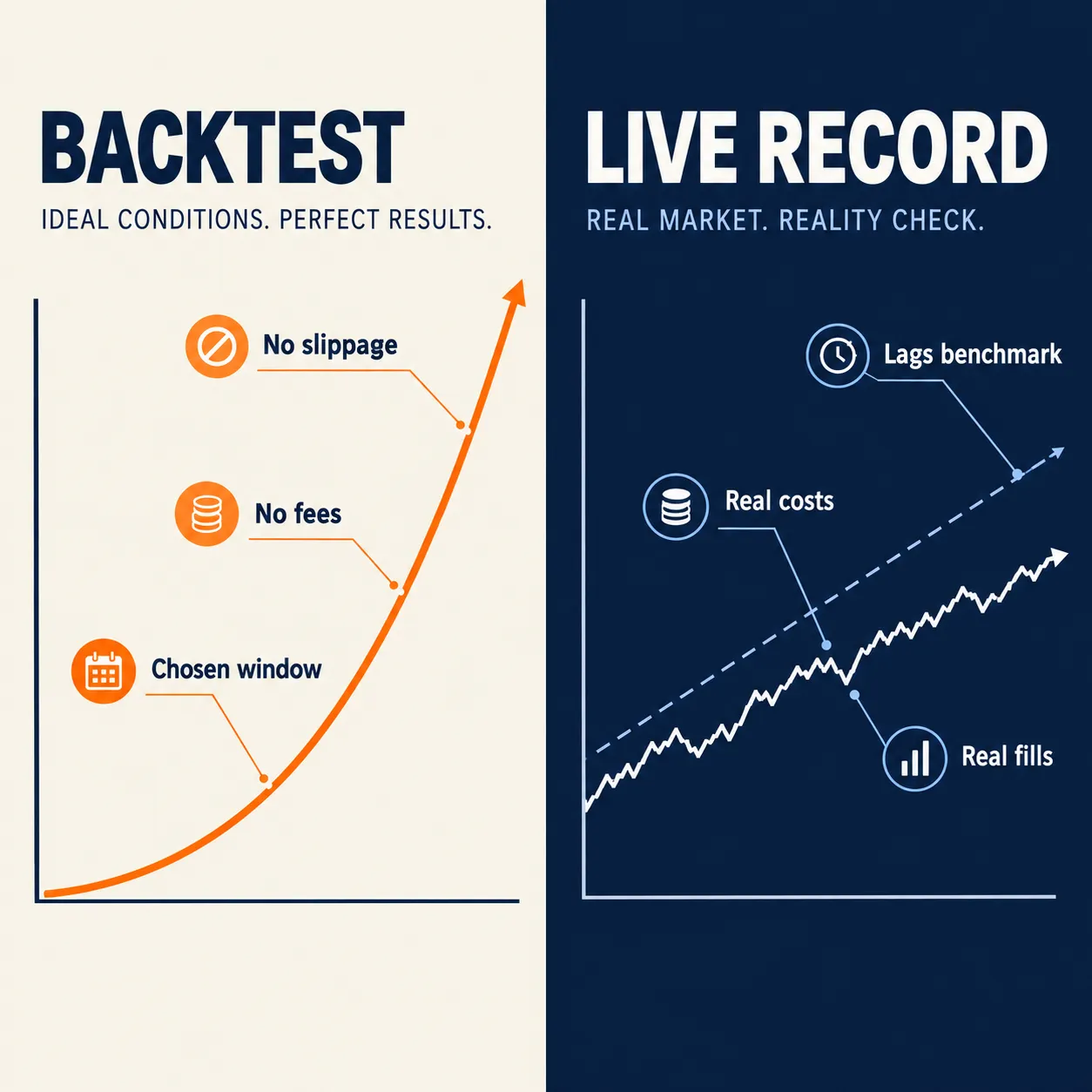
A quarter of outperformance is weather. A decade is climate. One Q1 2026 performance report on machine learning stock selection models shows a composite live return of +7.6%, beating the S&P 500 by 3.2 percentage points, which is encouraging and also three months long. Guides tracking this market note that machine learning edges tend to show up in specific regimes and then decay when conditions change.
Decision rule: if a vendor cannot show you a live record with dates, treat the number as marketing.
What is an AI stock picker and how does it work?
An AI stock picker is software that scores or ranks stocks using models trained on market and company data, then hands you a list of stocks or a buy signal. Most are ranking engines, not autopilots. You still choose size, entry and exit.
What data do AI stock pickers use?
- Price and volume history, so the model can learn support and resistance behavior.
- Fundamentals: earnings, margins, balance sheet information, analyst estimate revisions.
- Alternative data: web traffic, app downloads, job postings, social sentiment.
- Text: filings, transcripts and news, increasingly parsed by language models.
Is an AI stock picker good for beginners?
Yes, as a second opinion. A beginner using an AI stock picker to analyze a stock in seconds and then checking the thesis by hand learns faster than one guessing. A beginner outsourcing every decision to a score learns nothing and blames the app when it breaks.
Backtest vs live record: what proof should an AI stock picker show?
A backtest is the model run over past data. A live record is the model run forward, in public, with timestamps. Ask for the second one, always.
Are backtested returns misleading?
Often, yes. A 2026 machine learning backtesting guide warns that industry estimates from quant firms suggest more than 90% of backtested ML strategies fail to produce positive returns in production, and advises expecting live results 30% to 50% worse than the simulation. A trading blog on the same problem puts it plainly: overfitting to history is why flawless backtests lose money live.
Why do AI stock pickers fail in live trading?
Spreads, slippage, commissions, liquidity gaps, and the human sitting behind the screen. One provider publishing live stats recorded 4,435 trades with a 57.41% win rate between May 5 and June 4, 2026, and a 50% win rate over one seven-day stretch. Real tape is choppier than a clean curve.
An independent tester comparing five AI signal providers found the average win-rate gap between advertised backtests and live results was 14.3 percentage points, with one algorithm advertising 72% and delivering 51% across 147 live trades, while drawdown ran 14.7% live against 8.2% backtested.
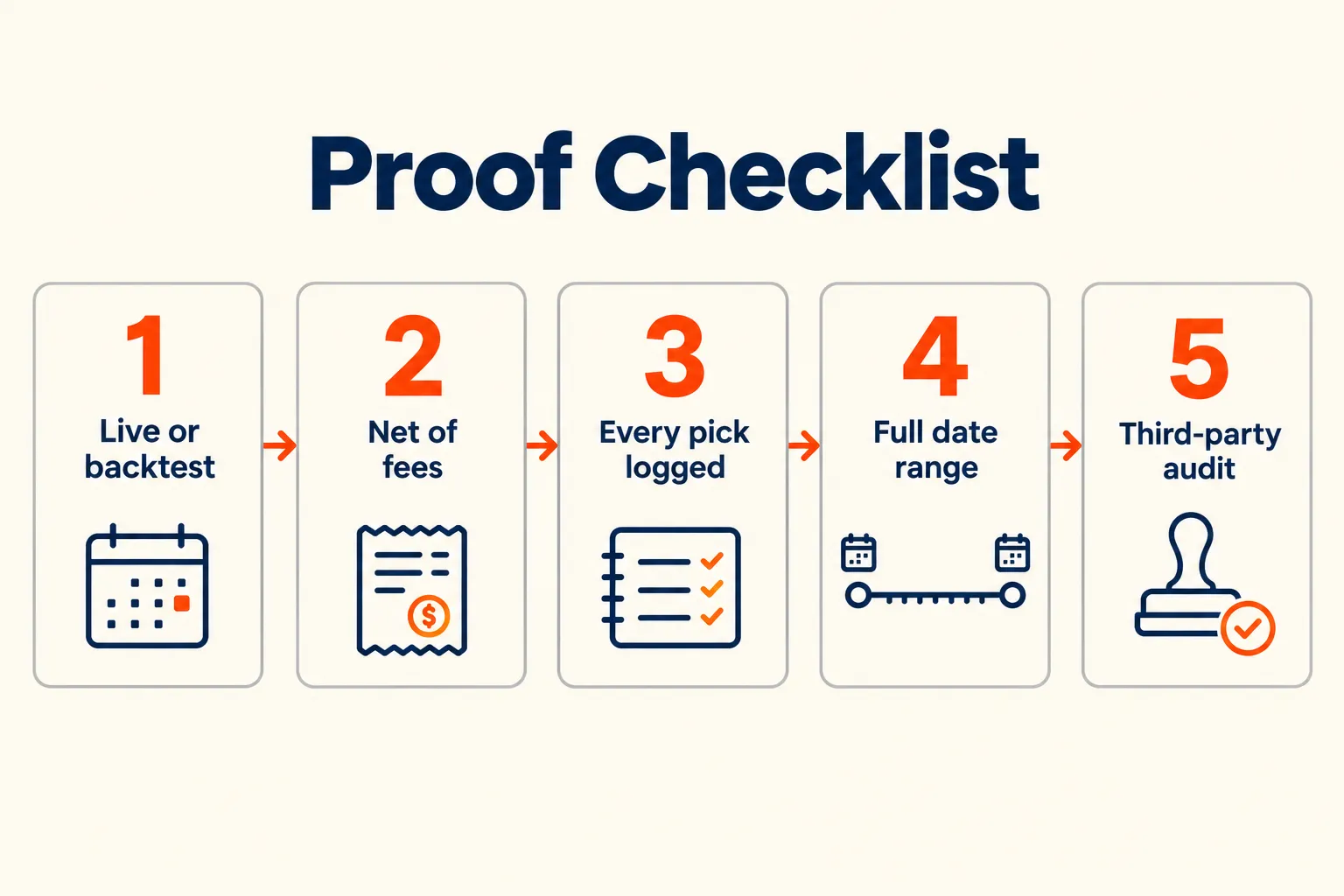
How to verify AI stock picker claims in five minutes
- Is it live or backtested? If the page does not say, assume backtested.
- Net of fees, or gross? Gross numbers quietly add points.
- Is every pick logged with a date, or only the winners?
- What date range, and why that range? January 2017 starts are suspiciously popular.
- Is any of it audited by a third party, or is it self-reported?
No fund manager publishes a backtest as a track record and keeps the job. Retail software does it daily. The SEC's own investor education hub, Investor.gov, says the same thing in duller language: past performance claims need context.
The only live AI stock picking record: what AIEQ shows
AIEQ, the AI-powered equity ETF launched October 17, 2017, is the cleanest live AI stock picking record available because it is a regulated fund with daily pricing. It has returned about 100.2% against roughly 199.7% for the S&P 500, net of its 0.75% expense ratio, as reported in August 2026.
Doubling your money over nine years is not a disaster. It is also half the index, with more complexity and a fee. That is the honest baseline every vendor claim should be measured against.
Can AI predict stock market movements, and how accurate is it?
Direction, sometimes, for short horizons. One platform reports 66% directional accuracy over a 60-day window and a 31.2% annualized return in a 90-day 2026 live test. Short samples. Older ranking systems with decades of live history show smaller, steadier edges: that same source notes Zacks #1 Rank returning 28.1% in 2025 against the S&P 500's 21.3%.
AI stock picker claims checked, tool by tool
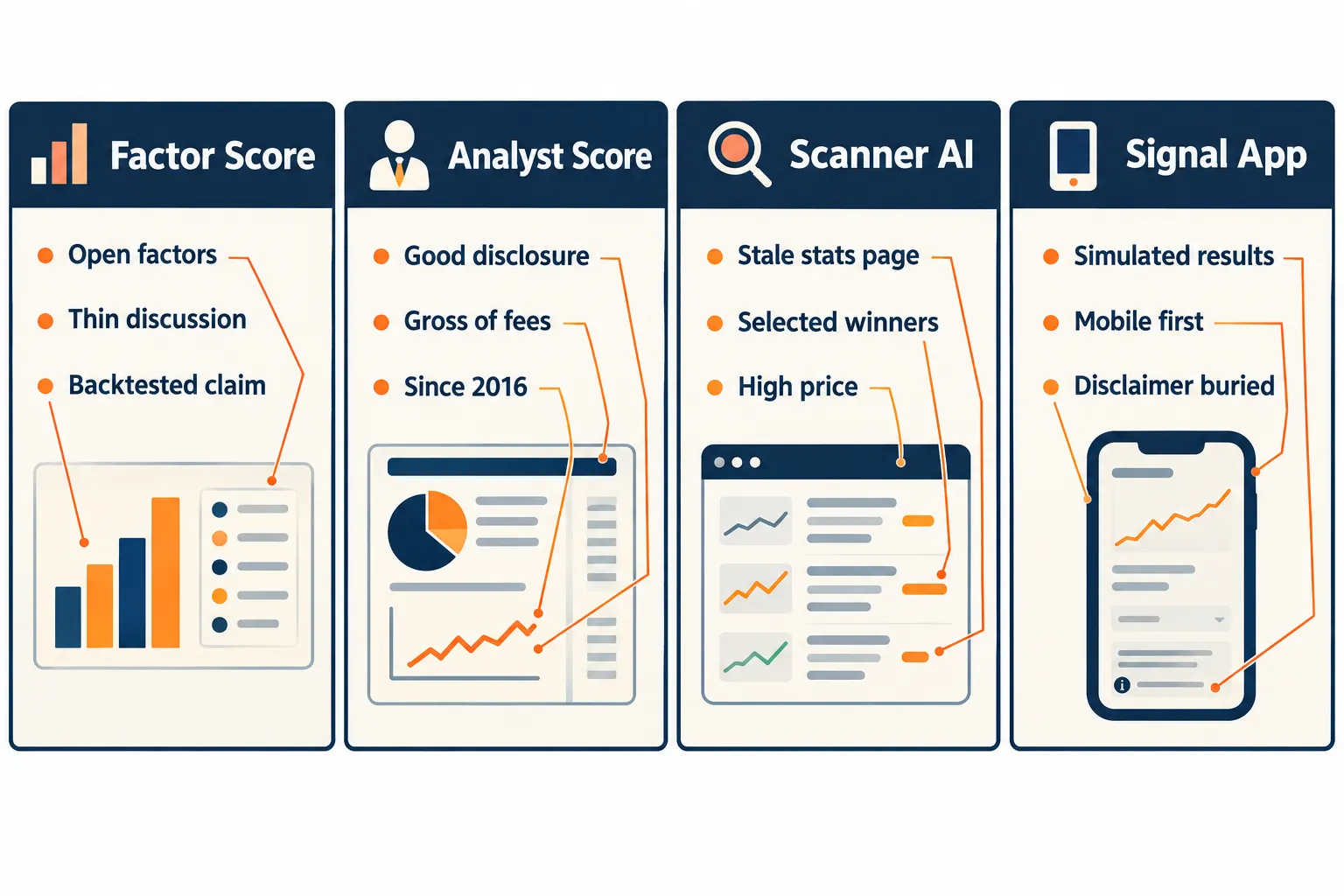
Every claim below is quoted as a claim, with its evidence type graded. Prices were checked.
Danelfin
Danelfin publishes "+376% from January 3, 2017, until June 9, 2025, vs. only +166% of the S&P 500" on its own site. Backtested. Evidence rating: weak to moderate. The factor transparency is genuinely strong, and one roundup notes Danelfin's top-scoring stocks are claimed to beat the market by roughly 14.7% annualized since 2017, also self-reported. More detail sits in our Danelfin review that checked the AI stock score's real track record.
TipRanks Smart Score
TipRanks shows "Total Return +443.5%" on its plans page, backtested since 2016 and gross of fees. The disclosure is clear, which earns credit. Gross of fees still flatters the result.
Seeking Alpha Alpha Picks
The headline we found reads "+400% Gains vs. S&P 500", and the methodology page was blocked when we checked, so the method is unverified. A third-party listing put Premium at $299 per year; we could not confirm it, so treat that as unverified and check the official pricing page.
Trade Ideas Holly
Trade Ideas still has an AI stats page showing 2016 results, with selected winners on the homepage. Evidence rating: weak. The scanner itself is excellent for day traders at $127/mo or $1,068/yr, with a higher tier at $254/mo or $2,136/yr.
Tickeron
Tickeron advertises a "Historical annualized return: 280%", backtested or platform-reported. Evidence rating: weak. Its pricing page returned a 404 when checked, which is not the information a buyer wants.
Prospero.ai: a loud app and simulated numbers
Prospero.ai is the clearest example of how this category markets itself, which is why it deserves a close read rather than a dismissal.
The Prospero landing page is built from benefit headings: "Powerful Results", "Unique Insights", gain an edge with AI-powered analysis, improve your win rate and make more money, improve your win rate and lose less money, be confident in your stock selections. Then the funnel: download the app, whichever platform you use, we've got you covered, plus an investing newsletter and a trading newsletter. One app, newsletter, resources, all pointing at the same promise of leveling the playing field in investing.
Underneath, Prospero's own performance figures are simulated, with the disclaimer "not actual trading results". One 2026 roundup repeats Prospero's company data claiming its picks beat the S&P 500 by an average of 67% over four years with a 54% win rate across nearly 5,000 picks, and a 60% win rate in 2025. Self-reported, partially backtested, not audited. Evidence rating: weak.
The Prospero testimonial wall, the "what they are saying" block, reads like every other one in this market. Lines of the genre "part of the beta test for Prospero and have been using it for my portfolio ever since. It's changed everything" are warm, specific and impossible to verify. That format is the tell, not the evidence. To be fair to Prospero, the app is clean, it is mobile first, it does let you analyze a stock in seconds, and it never hides behind a 404.
Market truth: a product can be useful and its performance claim can still be unproven. Those are two separate purchases.
Kavout and Intellectia AI
Neither makes a big quantified claim, which is a point in their favor. Intellectia's FAQ states backtests are not typical results. Kavout Pro runs $16/mo on annual billing and Intellectia starts around $11.96/mo annual-equivalent; see our Kavout review for the fit.
Where live records do exist, who is publishing them?
A handful of platforms now log picks publicly in real time, which is the only honest way to settle this. Those records are short, but they are records.
- AltIndex reports roughly a 70% to 75% win rate with an average 22% gain over six-month holds, tracked on a public results page.
- An October 2, 2026 market report covered an AI-selected list with six positions up between 34% and 106%, the top name gaining 67.28% since February 1, 2026.
- A 2026 roundup of the best ai stock picker options notes that some AI factor portfolios advertise 48%+ average annual returns over 20+ years, explicitly backtested or company-reported.
What do Stanford researchers say about AI and investing?
Academic work is more careful than any landing page. Stanford Graduate School of Business has published research and Insights pieces on how investors use information and AI, and the throughline is about processing speed and access, not guaranteed edge.
Meet the new quants: the deHaan line of research
Ed deHaan studies how retail investors read disclosures and react to financial information. The deHaan framing matters because it keeps asking who benefits when a tool makes analyzing stocks cheaper. If everyone gets the same model, the edge compresses. That is the quiet part most AI stock picker marketing skips.
Suzie Noh, Chanseok Lee and low-cost advice
Suzie Noh's work on retail investor behavior and Chanseok Lee's research on information processing both land in the same place as deHaan: better information helps, bad incentives still hurt. Stanford Graduate School of Business Insights has covered what AI tells people seeking low-cost financial advice, how large language models are transforming research, and the GenAI divide of who's using ChatGPT to save time at home. Read those before you read another backtest.
What the rest of the 2026 coverage says
- Listicles ranking the 12 best AI investment and stock analysis tools in 2026 rarely grade evidence, only features.
- Executive coverage leans practical: one hedge fund CEO argues you should look to AI for a trade execution boost, not an investing edge.
- Corporate pieces on 20 ways to measure ROI from AI initiatives and roundups of 15 leaders on the economic indicators companies should watch show the same pattern: AI is being bought on promise, measured later.
What is the best AI stock picker for your goal?
There is no single best AI stock picker, only the best fit for your holding period. Day traders need speed, long-term investors need factor transparency, and nobody needs a backtest.
| Trader type | Pick | Why |
|---|---|---|
| Day trader | Trade Ideas Holly | Real-time scanning, fastest surfacing of stocks presenting clean setups |
| Swing trader | TipRanks Smart Score | Analyst and sentiment data blended, weekly cadence fits |
| Scalper | None of these | Use a direct-feed scanner; pickers are too slow |
| Long-term investor | Danelfin | Open factor model, good for a conviction stock list |
AI stock picker vs human financial advisor
Different jobs. An AI stock picker ranks securities. An advisor handles taxes, risk capacity, behavior and planning. A score cannot talk you out of revenge trading at 3:40pm. If you only want cheap diversified exposure, an index fund beats both for cost.
Is there a free AI stock picker worth using?
Yes, a few free tiers do most of the work of their paid versions. Danelfin's free plan is the obvious place to learn about the free app experience before paying, and our own free trading tools and calculators cover sizing and expectancy without a subscription.
The best free ai stock picker for most people is a screener plus a position size rule. Paid tiers earn money when they add data you cannot get free: analyst revisions, flow, institutional holdings. Paying monthly for filters a free tool already gives away is just a subscription habit.
Top 5 features to look for in an AI stock picker
The five things worth paying for, ranked by how often they decide the outcome.
- A published live record with dates. Every pick logged, not the highlight reel.
- Visible factors. You should see why a score moved, not just that it did.
- Fit to your time frame. Daily scores are useless to a scalper.
- Fast time to first useful output. Week one decides whether you keep paying.
- Honest disclaimers. A vendor that says what the model cannot do is telling the truth elsewhere too.
| Feature | Which tools have it | Our note |
|---|---|---|
| Open factor breakdown | Danelfin, TipRanks | Best transparency in the group |
| Real-time scanning | Trade Ideas | Built for intraday, priced accordingly |
| Mobile-first app | Prospero, Intellectia | Easy to use, claims unverified |
| Published live audited record | None confirmed | The category's biggest gap |
What we like and what we don't like about AI stock picks
AI stock picks are a very good filter and a very poor autopilot. Used as a second opinion, they cut hours of screening. Used as instructions, they cut your account.
What we like: speed, consistency, and no mood swings. Looking for missed opportunities across 5,000 names is exactly the job a machine should have, and a score makes you check your own thesis before committing stock picks to real money.
What we don't like: backtests dressed as results, pricing pages that 404, and testimonial walls doing the work that an audited track record should do. Also the obvious one: when every retail investor runs the same model, the edge thins.
Automation and broker APIs are a separate decision; that lives on our sister site, aistocktradingbots.com, and on our best AI trading bots roundup.
What do AI stock picker reviews on Reddit and Trustpilot say?
Real users split the same way our scores do: the tools are handy, the performance claims are doubted. The ai stock picker reddit threads skew skeptical because people post when frustrated. Trustpilot skews toward billing complaints.
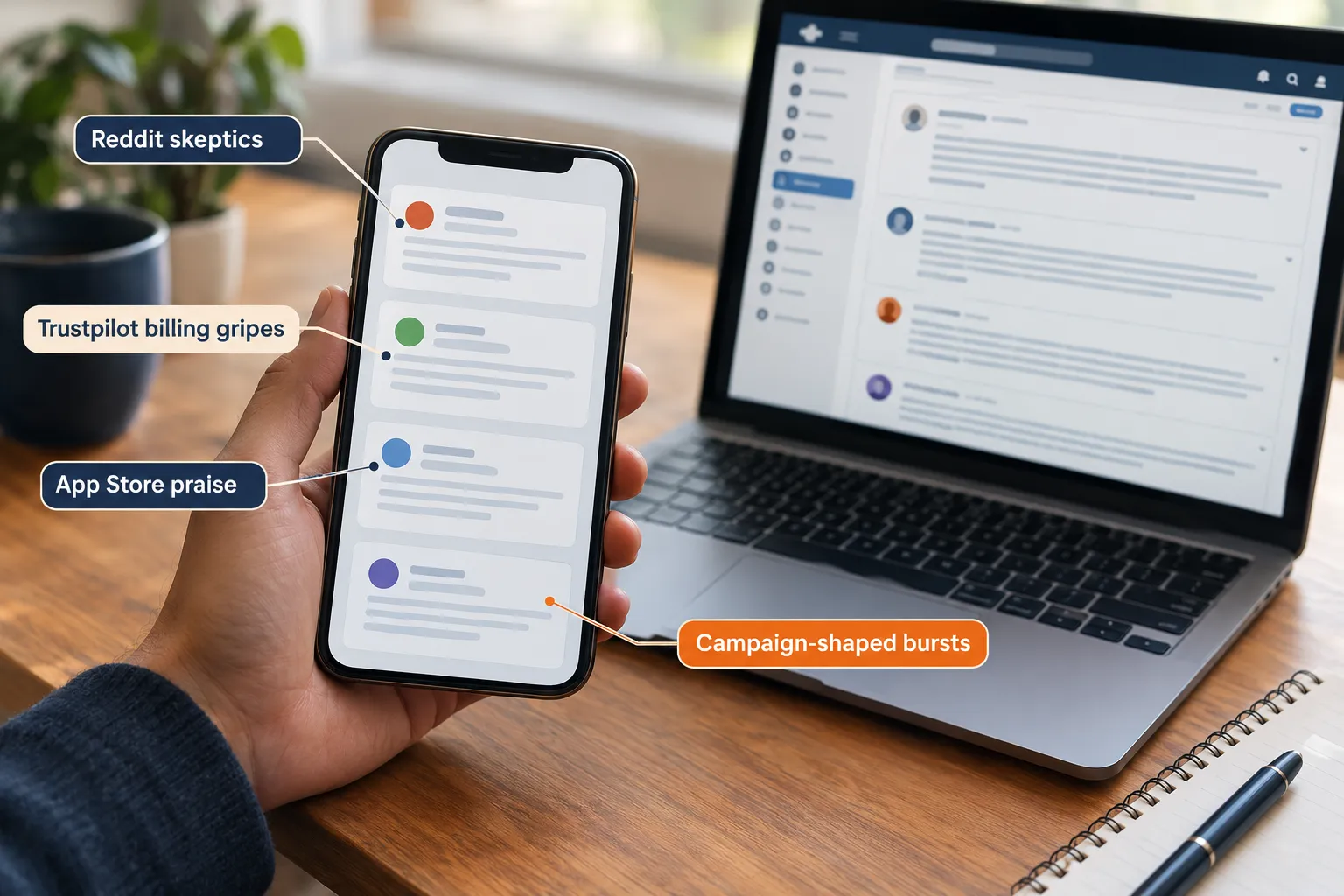
"It's a 'double-check before you buy' tool."Danelfin reviews on Trustpilot
"I subscribed Jan-Jun 2026 and tested 55 of their top-rated picks...Only 10 beat the market over 3 months."Danelfin reviews on Trustpilot
"I purchased an annual subscription on April 13, 2026 for $1,500 USD... My emails were ignored for weeks."Tickeron on Trustpilot
"Highly recommend as a solid resource for new or seasoned investors/traders."Prospero.ai on the Apple App Store
Where users and our Alpha Score agree: these apps are usable and the data is interesting. Where they disagree: app store sentiment for Prospero runs warmer than the evidence behind the numbers justifies, and Danelfin's public discussion is thin enough that one disappointed 55-pick test carries outsized weight.
How the Alpha Score rates these AI stock picker tools
Five pillars, 20 points each: Signal Quality, Transparency, Price-to-Value, Usability, Community Verdict. The score comes from FullStack Alpha desk research plus public user sentiment, and the pillar split is provisional.
Alpha Score breakdown
| Tool | Pillars (Sig / Tra / P2V / Use / Com) | Total |
|---|---|---|
| Trade Ideas | 19 / 15 / 14 / 18 / 19 | 85 |
| Danelfin | 16 / 19 / 15 / 16 / 9 | 75 |
| Seeking Alpha | 16 / 14 / 13 / 16 / 16 | 75 |
| Kavout | 12 / 12 / 16 / 14 / 8 | 62 |
| Intellectia AI | 11 / 9 / 11 / 15 / 11 | 57 |
| TipRanks, Tickeron, Prospero | [SCORE PENDING] | [SCORE PENDING] |
Danelfin's 19 on Transparency is the highest mark on this board. Its 9 on Community Verdict is the lowest, because almost nobody is publicly discussing it. Both are true at once.
How do the claims, prices and competitors compare?
Three tables, one purpose: see the evidence and the cost side by side before you buy.
| Claim as published | Tool | Evidence type | Rating |
|---|---|---|---|
| +376% vs +166% (2017-2025) | Danelfin | Backtest, self-published | Weak-moderate |
| Total Return +443.5% | TipRanks | Backtest, gross of fees | Weak-moderate, good disclosure |
| +400% Gains vs S&P 500 | Seeking Alpha | Method page blocked | Unverified |
| 2016 stats page, selected winners | Trade Ideas | Stale, cherry-picked | Weak |
| Historical annualized return: 280% | Tickeron | Backtest or platform-reported | Weak |
| Simulated, "not actual trading results" | Prospero | Simulation | Weak |
| ~100.2% vs ~199.7% S&P since 2017 | AIEQ ETF | Live, audited fund | Strong |
| Plan | What you get | Best for | Price (Oct 2026) |
|---|---|---|---|
| Danelfin Free | Limited daily scores | Testing the model | $0 |
| Danelfin Plus | Full AI scores | Long-term investors | $22/mo |
| Danelfin Pro | Screener, history | Active investors | $59/mo |
| Danelfin Elite | Full data access | Heavy users | $134/mo |
| Trade Ideas Standard | Real-time AI scanning | Day traders | $127/mo or $1,068/yr |
| Trade Ideas Premium | Holly AI suite | Full-time day traders | $254/mo or $2,136/yr |
| Competitor | Best for | Key strength | Key weakness | Starting price |
|---|---|---|---|---|
| Trade Ideas | Day traders | Fast live scanning | Stale AI stats page | $127/mo |
| Danelfin | Long-term investors | Open factor model | Backtested headline | $0 |
| TipRanks | Swing traders | Analyst data depth | Gross-of-fee claims | Check official page |
| Kavout | Budget screeners | Cheap annual plan | Thin discussion | $16/mo annual |
| Intellectia AI | Beginners | Easy interface | Lowest transparency | $11.96/mo annual |
Compare the wider field in our AI stock tool comparison hub and the model-specific breakdowns in best AI stock predictors.
FullStack Alpha scorecards
Every tool in this article has a full scorecard: pricing, pros and cons, verified user quotes and the Alpha Score breakdown.
FAQ
Can AI really pick stocks?
Yes, AI can rank and select stocks, and some models beat benchmarks in short live windows. What no AI stock picker has shown publicly is a long, audited, after-fee record of beating the S&P 500. AIEQ, the clearest live case, has returned about 100.2% since 2017 versus roughly 199.7% for the index.
Can AI make good stock picks?
Yes, as a screening and ranking layer. AI is strong at processing earnings data, filings and sentiment faster than any analyst. It is weak at regime change, crowding and execution costs, which is where backtested edges die. Use the picks as a watchlist input, then apply your own risk management and position sizing.
Which AI is best for predicting stock prices?
None reliably predicts prices; the honest answer is direction over short horizons. For live-logged signals, AltIndex publishes a public results page. For factor transparency, Danelfin scores highest in our Alpha Score Transparency pillar at 19 out of 20. For intraday scanning, Trade Ideas rates highest overall at 85.
Can ChatGPT pick stocks?
ChatGPT can summarize filings, explain a setup and draft screening criteria, which saves real hours. It has no live market data by default, no audited track record, and it will state a wrong number confidently. Use it to analyze stock narratives and earnings language, not to generate buy signals you act on blind.
What is the best AI stock picker?
It depends on holding period, not quality rankings. Trade Ideas scores 85 for day traders, Danelfin 75 for long-term investors, Seeking Alpha 75 for research depth. Kavout at 62 and Intellectia AI at 57 are cheaper with thinner transparency. Prospero.ai is a clean mobile app with simulated, unaudited performance figures.
Is there a free AI stock picker?
Yes. Danelfin offers a $0 free tier with limited daily scores, and several screeners give away most core filters. A free AI stock picker plus a written risk rule beats a paid tool used without one. Start free for 30 days, log the results, then decide whether paid data actually improves your win rate.
Are AI stock picker claims real?
The numbers usually exist; the framing is the problem. Across the claims we graded, every vendor figure was a backtest, simulation, selected winners list or unverifiable. One independent test found a 14.3 percentage point average gap between advertised and live win rates. Ask for the live log.
Final Verdict: how to use an AI stock picker without getting burned
Treat an AI stock picker as a research analyst with no accountability: useful for surfacing ideas, never the final word. The tools are worth money. The performance claims mostly are not worth belief.
Three common mistakes to stop making today:
- Buying a subscription off a backtest. Ask for the live log first.
- Taking every signal. Watch how those stocks trade for two weeks before committing capital.
- Skipping position sizing because the score was high. A 9/10 rating is not a stop loss.
Do this next: pick one AI stock picker, paper trade its top signals for 30 days, log every result, and compare it against buying the index. Then learn how the signals work before you scale. Process over prediction.
Editor's picks and explore more
- Trading expectancy calculator to test whether your win rate actually pays.
- More AI stock tool reviews on the blog.
Still can't tell which claims are real?
FullStack Alpha has tested 200+ AI stock tools since 2022 and graded the evidence, not the marketing.
Browse the directoryConclusion
The honest state of play in 2026: AI stock picker software is a strong research assistant and an unproven return engine. One live audited record exists at scale, and it trails the index. Everything louder than that is a simulation with a subscription button. Keep the tools, drop the faith, and make the evidence standard your own: live, dated, net of fees, every pick logged.
This is education, not financial advice.
Your market edge starts with the right tool. Stay alpha.
Some links on this page may earn FullStack Alpha a commission at no cost to you.
We test the tools. You get the verdict.
One email a week. What we tested, what scored, and what we'd skip. Written for traders, not for clicks.
More from FullStack Alpha