Best AI for Stock Trading: 9 Tools Ranked by the Job They Do
Last updated: September 25, 2026
The best AI for stock trading isn't one tool. It depends on the job you're hiring it to do: scanning for setups, ranking stocks, digging through fundamentals, or running rules while you sleep. Trade Ideas leads scanning. Danelfin leads explainable scoring. TrendSpider leads automated technical analysis. No tool leads prediction, because prediction isn't a real product category. It's a marketing word.
Quick answer: The best AI stock trading tools split into four jobs: scanning (Trade Ideas), automated technical analysis (TrendSpider), explainable stock scoring (Danelfin), and research synthesis (TipRanks). Free options like Prospero AI and thinkorswim cover a real chunk of what beginners need before anyone spends a dollar. Nine tools below, ranked by the specific job each one does best, with pricing, free tiers, and who each one actually fits.
Key Takeaways
- 9 tools, 4 jobs. Scanning, picking, research, and automation each need a different tool. Nobody wins all four.
- Trade Ideas' Holly AI runs automated scans and backtests strategies across the market in real time, built for active day traders who need speed over depth.
- TrendSpider's paid plans ranged from roughly $54 to $89 a month for Standard up to $214 to $349 a month for Advanced as of September 2026, per the vendor's own pricing page.
- Trade Ideas priced Standard at $127 a month ($1,068 a year) and Premium at $254 a month ($2,136 a year) as of September 2026.
- NEPC's 2026 survey of over 230 firms managing $100 trillion-plus found 0% delegated final investment decisions to AI, even though 82% used it to speed up research.
- Mercer's 2026 survey found 55% of asset managers had integrated AI into at least one investment process, with 91% planning to expand use over the next year.
- Free tools like Prospero AI and thinkorswim cover scanning, charting, and basic signals without a subscription, which makes them the right starting point for most beginners.
What Is the Best AI for Stock Trading Right Now?
There isn't a single best AI for stock trading in 2026, because "best" depends on the job. The best AI stock scanner (Trade Ideas) is not the best AI stock picker (Danelfin), and neither one replaces a research platform like TipRanks or an automation environment like QuantConnect.
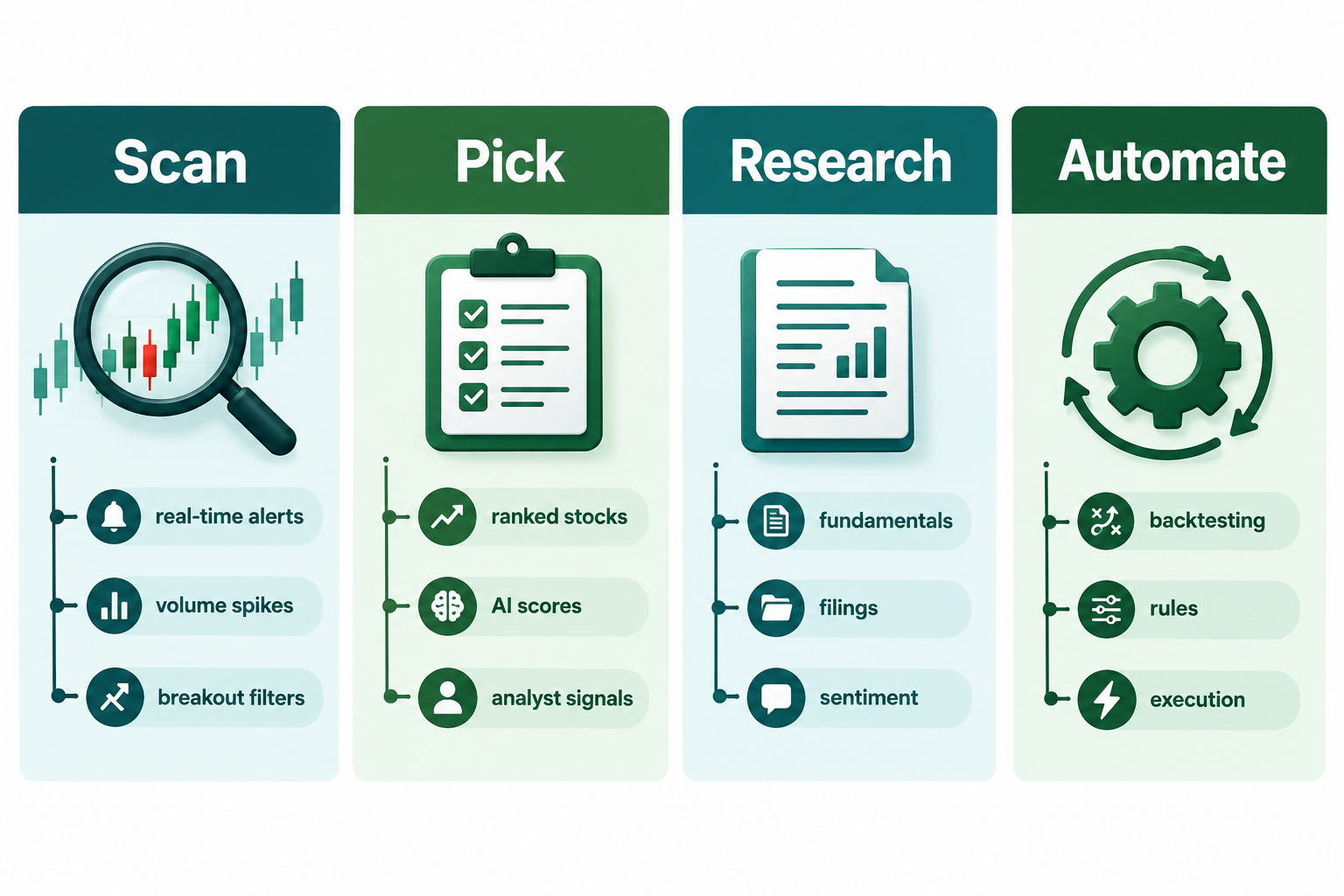
Think of it the way you'd think about a kitchen. A chef's knife, a blender, and an oven all do different jobs. Nobody buys one gadget and calls the kitchen finished. AI stock trading tools work the same way: a scanner finds the setup, a picker ranks the opportunity, a research tool checks the fundamentals, and an automation platform runs the rules once you trust them.
Retail platforms comparing AI trading tools in 2026 keep landing on the same conclusion: the market has split into specialists rather than one dominant, do-everything winner. That's good news for you. It means you don't need the most expensive tool. You need the one that matches the job that's actually slowing you down.
Practical takeaway: Name your bottleneck before you shop. If you can't find setups fast enough, you need a scanner. If you find plenty but can't rank them, you need a picker. If you're drowning in tabs, you need research synthesis, not another chart.
The Best AI Stock Trading Tools, Ranked by the Job They Do
Nine tools, ranked by category, not by hype. Each one earns its spot for a specific job. None of them are the best AI trading software for every trader, and any review that claims otherwise is selling something.
1. Trade Ideas, best AI stock scanner
Trade Ideas built its reputation on Holly, an AI trading assistant that runs simulated strategies across the entire market and surfaces the setups that match. It's real-time, it's fast, and it's built for traders who live in the tape during power hour.
- Price: $127/month or $1,068/year for Standard; $254/month or $2,136/year for Premium, per the vendor's September 2026 pricing page.
- Free tier: No.
- Best for: Active day traders who need speed and a live watchlist over deep fundamentals.
If scanning is your bottleneck, this is the category leader. Read the full breakdown in the best AI stock scanners guide.
2. TrendSpider, best for automated technical analysis
TrendSpider automates the chart work most traders do by hand: trendlines, support and resistance, pattern recognition, and alert-driven strategy testing. It's built for the trader who trusts price action but is tired of drawing the same lines every morning.
- Price: Roughly $54 to $89/month for Standard, $91 to $149 for Premium, $122 to $199 for Enhanced, and $214 to $349 for Advanced, per TrendSpider's own pricing page as of September 2026. Exact cost depends on billing term and any active promotion, and professional users may owe separate exchange data fees.
- Free tier: No, but a trial is typically offered.
- Best for: Swing traders and technical traders who want the chart work automated, not replaced.
3. Danelfin, best explainable AI stock scores
Danelfin scores stocks on a 1-to-10 scale and shows the factors behind the number instead of hiding behind "proprietary AI." That transparency is rare in this category, and it's the reason serious researchers keep it on the shortlist.
- Price: Paid subscription with tiered access to scoring depth; check current pricing on Danelfin's site, since tiers shift.
- Free tier: Limited free access to sample scores.
- Best for: Investors who want a rankable AI stock picker they can actually audit, not just trust blindly.
See how its scoring model works in the Danelfin deep dive.
4. TipRanks, best AI-assisted analyst research
TipRanks aggregates analyst ratings, insider trades, and hedge fund activity, then layers AI-driven "Smart Score" summaries on top. It's less a picker and more a research compressor, useful for anyone who wants a fast read on consensus before digging deeper.
- Price: Core research is free; Premium opens up the AI-scored tools and deeper analyst data.
- Free tier: Yes, meaningful.
- Best for: Investors doing fundamental homework who want analyst sentiment in one place instead of six.
5. Prospero AI, best free AI stock trading signal app
Prospero AI pulls social sentiment, options flow, and news signals into a mobile-first free app. It won't run your process for you, but it's a legitimate entry into free AI stock tools without a subscription wall.
- Price: Free.
- Free tier: The whole product.
- Best for: Beginners and mobile-first traders who want signal awareness before paying for anything.
6. thinkorswim, best free platform depth
Schwab's thinkorswim gives you institutional-grade charting, options analytics, and paper trading at no subscription cost, as long as you hold a funded account. It's not marketed as "AI," but its screening and backtesting tools do real analytical heavy lifting for zero extra dollars.
- Price: Free with a funded Schwab brokerage account.
- Free tier: Effectively the entire platform.
- Best for: Anyone who wants to paper trade a system before risking real money, and never pay a software fee doing it.
7. TradingView, best charts plus community scripts
TradingView's free plan covers solid charting, and its Pine Script community adds thousands of user-built indicators and automated screens on top. It's less a single AI tool and more an open platform where AI-flavored scripts multiply fast.
- Price: Free plan available; paid plans add more indicators, alerts, and data. Check TradingView's current pricing page for tier details.
- Free tier: Yes, genuinely usable.
- Best for: Traders who want to build or borrow a custom setup instead of buying a packaged AI stock picker.
Full breakdown in the TradingView review.
8. QuantConnect, best for building your own AI trading bot
QuantConnect is a cloud platform for coding, backtesting, and deploying your own algorithmic strategies, including ones that call machine-learning libraries. It's not plug-and-play. It's for traders who want to own the logic instead of renting someone else's black box.
- Price: Free to code and backtest; you pay only for live data feeds and cloud compute you actually use.
- Free tier: Yes, for research and backtesting.
- Best for: Traders with coding chops who want a real AI trading bot, not a subscription dashboard.
Read more in the AI trading bots guide.
9. Magnifi, best AI portfolio assistant
Magnifi uses a conversational AI layer to help you search, screen, and build a portfolio using plain-English queries instead of filter menus. It's built for portfolio-level thinking, not intraday setups.
- Price: Subscription-based; pricing tiers are listed on Magnifi's site.
- Free tier: Limited free search functionality.
- Best for: Self-directed investors who think in portfolios and allocations, not single-stock trades.
Best AI Stock Trading Platforms Compared
| Tool | Category | Price (per vendor) | Free Tier | Best For |
|---|---|---|---|---|
| Trade Ideas | AI scanner | $127 to $254/mo | No | Active day trading |
| TrendSpider | Automated analysis | ~$54 to $349/mo by tier | No (trial) | Swing and technical trading |
| Danelfin | Explainable AI scores | Paid, tiered | Limited | Rankable stock picking |
| TipRanks | Analyst AI research | Free core, paid Premium | Yes | Fundamental research |
| Prospero AI | Free signals | Free | Full product | Beginners, mobile |
| thinkorswim | Free platform depth | Free (funded account) | Full product | Paper trading, options |
| TradingView | Charts + scripts | Free plan, paid tiers | Yes | Custom setups, community tools |
| QuantConnect | Build your own bot | Free research, pay for live data/compute | Yes | Coders building bots |
| Magnifi | Portfolio AI | Subscription, tiered | Limited | Portfolio-level investors |
How Do AI Stock Trading Systems Actually Work?
Most AI stock trading tools work by pattern-matching, not forecasting. They ingest price, volume, news, and sometimes options flow, run it through a model trained to recognize prior patterns, and output a score, alert, or signal for a human to act on.
That's the whole trick, and it's not magic. A scanner like Trade Ideas' Holly runs thousands of simulated strategies against live data and flags the ones performing well right now. A scoring tool like Danelfin runs a stock through weighted factors, fundamental, technical, sentiment, and outputs a number you can inspect. Neither one "knows" what happens tomorrow. Both compress a mountain of data into something you can act on in seconds instead of hours.
Practical takeaway: The value of AI stock trading software isn't the AI part. It's the time it saves you from doing that pattern-matching by hand at 2 a.m. with six browser tabs open.
Can AI Really Beat the Stock Market?
No AI tool reliably beats the market on a consistent, repeatable basis, and any platform implying otherwise is selling a story, not a system. What the good tools actually do is compress information and enforce a process, which is a different and more useful thing.
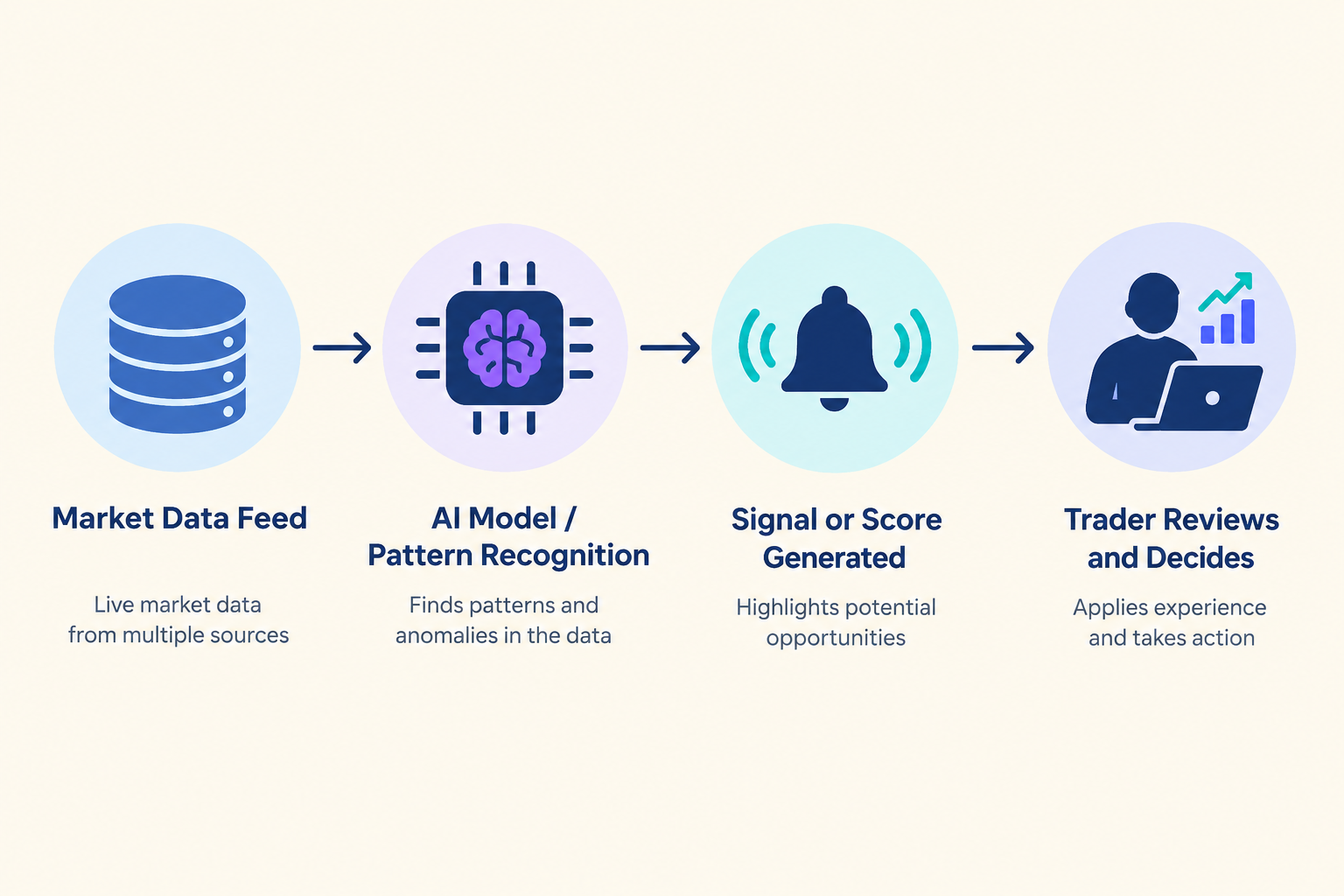
Industry surveys back this up from the institutional side, where the incentive to overstate AI's power is lower than in retail marketing. NEPC's 2026 survey of more than 230 firms managing over $100 trillion in assets found that about 82% used AI to produce research faster and 65% used it for portfolio-management tasks, but 0% delegated the final investment decision to AI. Zero. That's not a rounding error. That's the entire professional industry agreeing that AI supports the decision, it doesn't make it.
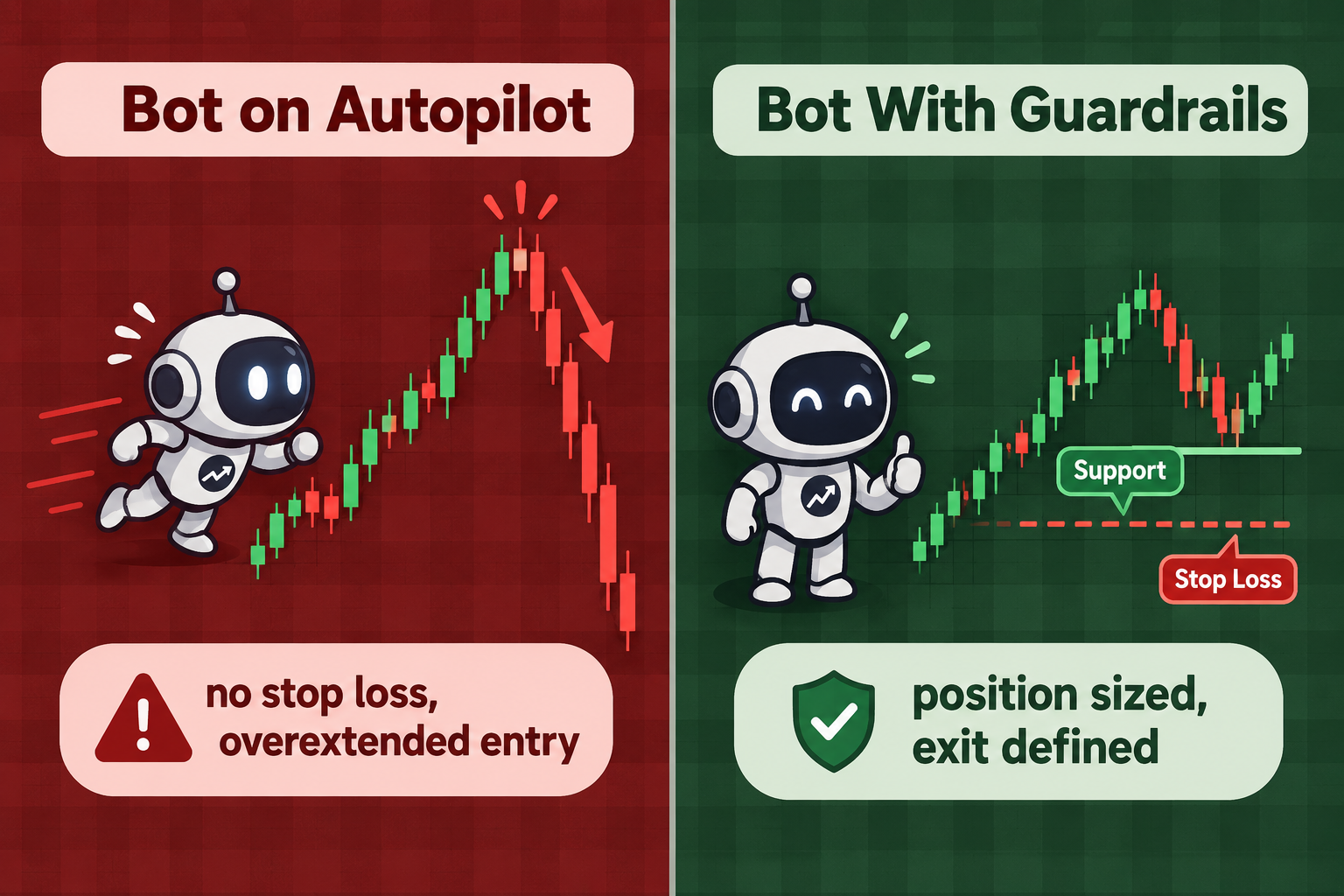
Common mistake: Treating a high AI score or a green alert as a buy signal on its own, with no entry, no stop loss, and no position sizing behind it. A score is an input. It's not a trade plan.
Practical takeaway: Use AI outputs the way a pilot uses instruments. They inform the decision. They don't fly the plane. For more on how these scores hold up under scrutiny, see how accurate AI stock pickers actually are.
Is AI Stock Trading Better Than Human Traders?
AI isn't better or worse than a human trader. It's faster at narrow tasks and worse at judgment, which is why the professionals who use it the most still keep a human making the final call. The comparison itself is a little misleading, since the tools that matter augment a trader instead of replacing one.
Mercer's 2026 AI in Asset Management Survey, conducted in February and March, found 55% of asset managers had integrated AI into at least one investment process, 27% were still piloting it, and 18% hadn't started. Meanwhile 91% planned to increase AI use over the following year. Professionals aren't asking "human or AI." They're asking where AI removes grunt work so the human can spend more time on judgment calls that actually need it.
Practical takeaway: Stop asking if AI trading is "better." Ask which specific task, scanning, scoring, or research, AI can do faster than you, and hand it exactly that task. Keep the decision.
AI Stock Trading for Beginners: How to Start
Start with free tools, a paper trading account, and one job to solve, not five subscriptions and a dashboard you don't understand yet. AI for stock trading rewards a clean process before it rewards a fancy tool.
Here's a realistic first-30-days sequence:
- Open a paper trading account on thinkorswim or a broker with a demo mode. Trade nothing real yet.
- Pick one free signal source, like Prospero AI or TradingView's free charts, and use it daily for two weeks before adding anything else.
- Write down three rules: your entry trigger, your stop loss, and your position size. If the AI tool can't fit into those three rules, it's noise, not signal.
- Paper trade it first. Run the process for at least ten trades before any real money touches it.
Edge case: If you're trading options rather than shares, add a fourth rule for max loss per contract before you touch AI-flagged options flow data at all. Options amplify both the win and the mistake.
Free AI Stock Trading Tools That Actually Work
Free AI stock tools exist, and several of them do real work, not a watered-down teaser. Prospero AI's entire product is free. thinkorswim's full charting and screening suite is free with a funded account. TradingView's free tier covers real charting and access to community-built scripts.
The catch with free AI stock trading tools isn't quality, it's scope. Free tiers usually cap alert frequency, data history, or the number of watchlists you can run. That's a fair trade for zero cost, and it's exactly where most beginners should start before paying for anything. Browse the full rundown in the free AI stock tools guide.
Decision rule: Stay on free tools until you can name the specific limit that's costing you trades, missed alerts, capped watchlists, no backtesting. Pay only to remove that named limit.
Best AI for Day Trading vs Long-Term Investing
Day trading and long-term investing need different AI tools because they're solving different problems on different clocks. A day trader needs speed. A long-term investor needs depth.
For day trading, a scanner like Trade Ideas or a chart-automation tool like TrendSpider earns its keep, because the setup, the breakout, the entry and exit, all happen inside minutes or hours. Choppy tape punishes slow tools. See the best AI tools for day trading for the full field.
For swing and long-term positions, a research and scoring tool like Danelfin or TipRanks does more good, because the edge comes from picking the right basing pattern or fundamental setup and holding through the noise, not reacting to every tick. Explore the AI swing trading tools guide if that's your lane.
Decision rule: Choose your AI tool by your holding period, not by which one has the flashiest dashboard. A five-minute chart tool on a six-month thesis is a mismatch.
How Much Should You Pay for AI Trading Software?
Pay for the tool that removes your actual bottleneck, and nothing before that. Free AI stock tools cover a real amount of ground: scanning, charting, and basic research. Paying comes into play only when a free tool's limit is directly costing you trades.
A rough spend framework:
- $0/month: thinkorswim, TradingView free tier, Prospero AI, QuantConnect's free research and backtesting.
- Low-cost, targeted: Add a single paid tool, like TrendSpider's Standard plan, only when your bottleneck is named and specific.
- Higher-cost, active use: Tools like Trade Ideas' Premium or TrendSpider's Advanced tier make sense once you're trading frequently enough that the extra speed or scan coverage pays for itself in avoided missed setups, not hoped-for edge.
Common mistake: Subscribing to three overlapping tools because each one had a good sales page. That's not building an edge, that's paying rent on confusion.
Practical takeaway: Free stack first. Pay for the bottleneck, not the brand.
What Are the Risks of Using AI for Trading Stocks?
The biggest risk with AI stock trading tools isn't the AI, it's treating a probability output like a certainty and skipping risk management because a score looked convincing. That single habit causes more account damage than any bad tool ever could.
Regulators are watching this closely because retail communication speed is the real concern, not the models themselves. FINRA's rules stay technologically neutral: supervision, recordkeeping, and fair-dealing obligations apply whether a firm uses generative AI or not, and FINRA opened a comment period in mid-2026 specifically about the speed and volume of AI-generated retail communications. In Europe, ESMA flagged AI and tokenization oversight as a new supervisory priority in September 2026.
Other real risks:
- Latency risk: A scan that surfaces a mover four minutes late is a history lesson, not a trade.
- Black-box risk: "Proprietary AI" with no visible method is a red flag, not a feature. Favor tools that show their work, like Danelfin.
- Overfitting risk: A backtest that looks perfect on old data often falls apart on new data. Treat any AI trading bot's backtest as a starting hypothesis, not proof.
- Overreliance risk: Letting an AI trading bot run unattended without a stop loss or a kill switch turns a tool into exit liquidity for someone else's trade.
Practical takeaway: Every AI signal needs a human-set stop loss behind it. No exceptions, no matter how good the score looks.
Why Did My AI Trading Bot Lose Money?
Your AI trading bot most likely lost money because it was run without position sizing, without a stop loss, or on a strategy that was overfit to old data and never tested on fresh conditions. The bot isn't usually the failure point. The rules around it are.
The pattern shows up the same way almost every time: a trader turns on an automated strategy, skips the paper trading step, and lets it run through a choppy tape or an earnings season gap it was never built to handle. The bot did exactly what it was coded to do. Nobody coded for the bad day.
Common mistakes behind bot losses:
- No stop loss coded in. The bot rides a losing position past any reasonable exit.
- Overfitting. A strategy backtested on a bull run gets deployed into a bull trap and can't tell the difference.
- Running it live before paper trading it. Skipping the test phase means you find the bugs with real money.
- Position sizing left at default. One bad signal takes a bigger bite of the account than the plan ever intended.
- Revenge-trading the bot's settings. Tweaking parameters after a loss, mid-trade, turns a system into a slot machine.
Practical takeaway: Before you automate anything, write the exit rule first. If you can't state your stop loss in one sentence, you're not ready to let a bot trade it for you. More on this in do AI trading bots actually work.
Do Professional Traders Use AI, or Is It Just Hype?
Professionals use AI heavily for research and operations, and barely at all for final trade decisions, which tells you exactly where the real value sits. This isn't hype avoidance, it's a documented split.
NEPC's 2026 survey found 82% of firms used AI to produce research faster and 65% used it for portfolio-management tasks like financial modeling, but only around a third used it for trading and risk management, and none let it make the final call. Mercer's 2026 survey found 55% had integrated AI somewhere in their process, with 91% planning to expand that use.
Practical takeaway: The professional playbook is simple to copy: let AI do the reading, keep the deciding.
Can You Make Money With AI Stock Trading?
You can make money trading with the help of AI tools the same way you make money trading without them, through a repeatable process, disciplined risk management, and enough sample size for an edge to show up. No AI stock trading tool makes money by itself, and any platform implying a guaranteed outcome should be an instant red flag.
What AI actually does is remove friction: less time scanning, more time deciding; less time cross-referencing filings, more time acting on what matters. That's a real advantage. It's not a promise.
Practical takeaway: Consistency over hype. Track thirty trades with your AI-assisted process, review the results honestly, then decide if the tool earned its subscription.
How Do You Build an AI Trading Stack Without Overlap?
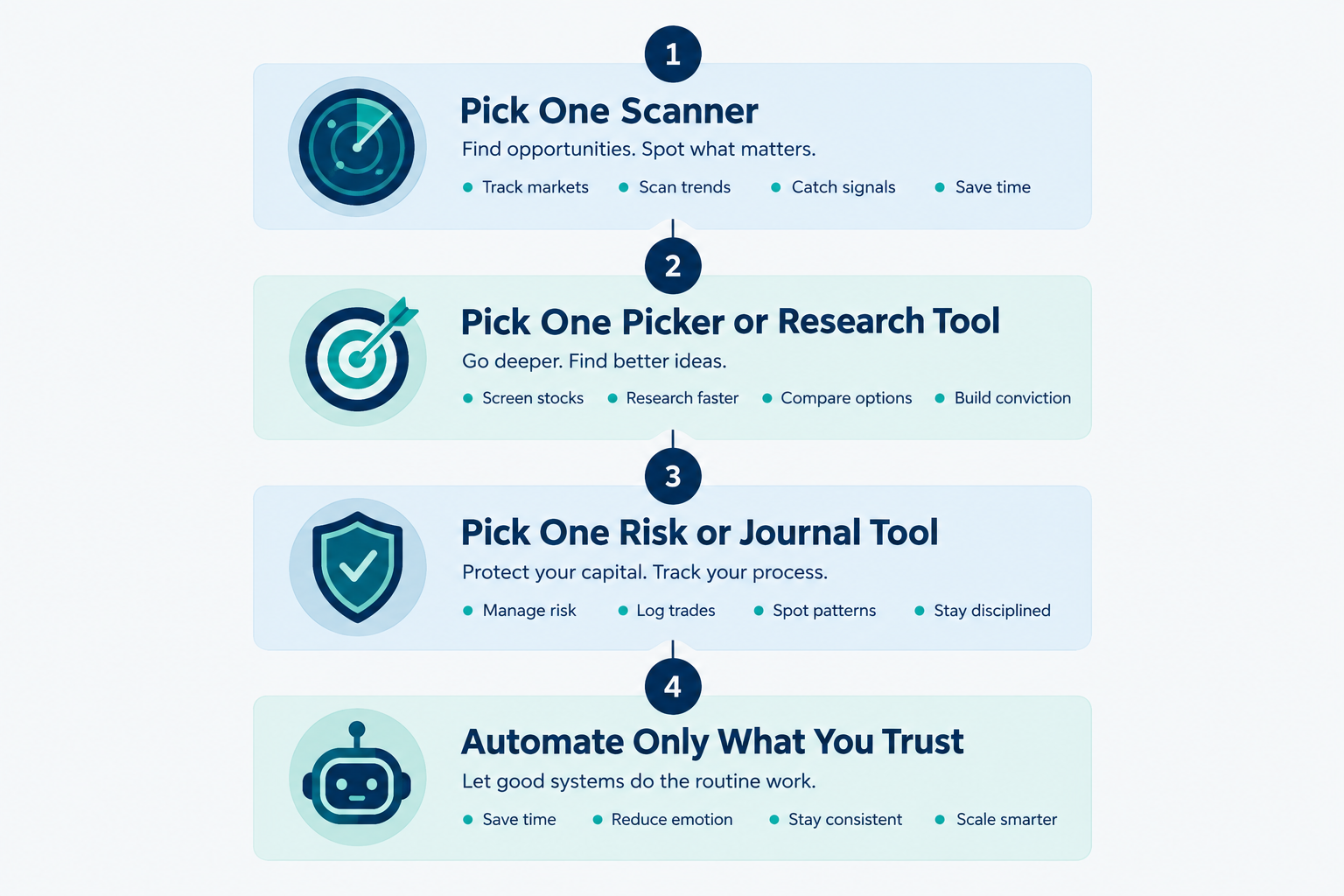
Build your AI trading stack by assigning exactly one tool per job, scanning, picking, research, and execution, and refuse to add a second tool for a job you've already covered. Overlap is where subscriptions pile up and clarity disappears.
A clean four-tool stack for most self-directed traders looks like this:
- One scanner for finding the setup, Trade Ideas or TrendSpider, not both.
- One picker or scorer for ranking ideas, Danelfin or TipRanks.
- One research layer for checking the fundamentals before you commit size.
- One execution or automation layer, whether that's your broker's platform or a coded bot on QuantConnect, once you've proven the strategy on paper.
Decision rule: If two tools in your stack answer the same question, cut one. The watchlist should get shorter as your process gets clearer, not the other way around.
Systems over hacks. A repeatable four-tool stack beats seven browser tabs and a gut feeling every single time.
Verdict: Which AI Trading Tool Fits Your Job
If you're an active day trader chasing the breakout in real time, Trade Ideas' scanning speed is the category leader, full stop. If you're a swing trader tired of drawing your own trendlines, TrendSpider automates the chart work without taking the decision away from you. If you want a rankable, explainable AI stock picker instead of a black box, Danelfin earns that seat. If you're broke and just starting, thinkorswim and Prospero AI cover more ground for free than most paid tools cover for money.
None of these tools predict the market. All of them, used inside a real process with a stop loss and a position size attached, save you time and cut the noise between you and a decision you'd have made anyway, just slower and messier.
Next step: Pick one job, scanning, picking, research, or automation, that's actually slowing you down right now. Match it to one tool from this list. Paper trade the combination for two weeks before a single real dollar moves.
FullStack Alpha tests these tools so you don't burn a quarter finding out which ones are real. Browse the full breakdowns and rankings at aistockpickerapp.com.
This article may contain affiliate links. FullStack Alpha may earn a commission if you sign up through one, at no extra cost to you.
References
Ai Stock Trading Bots - https://www.stockbrokers.com/guides/ai-stock-trading-bots
From Stock Selection To Execution Comparing 11 Ai Trading Platforms In 2026 202608281437 - https://www.fxstreet.com/press-releases/from-stock-selection-to-execution-comparing-11-ai-trading-platforms-in-2026-202608281437
Ai Stock Trading - https://www.liberatedstocktrader.com/ai-stock-trading/
Best Ai Stock Trading Tools In 2026 Software Platforms And Reviews - https://www.tradealgo.com/trading-guides/tools/best-ai-stock-trading-tools-in-2026-software-platforms-and-reviews
Best Ai Stock Trading Bots In 2026 An Independent Review Tested Workflow - https://techbullion.com/best-ai-stock-trading-bots-in-2026-an-independent-review-tested-workflow/
Best Ai Trading Bot 2026 - https://www.tradealgo.com/trading-guides/ai-trading/best-ai-trading-bot-2026
Top Ai Trading Apps Boost Investment - https://hyscaler.com/insights/top-ai-trading-apps-boost-investment/
Top 8 Best Ai Stock And Forex Trading Bots In 2026 Leading Platforms For Smart Investors - https://www.theglobeandmail.com/investing/markets/markets-news/TheNewswire.com/2050124/top-8-best-ai-stock-and-forex-trading-bots-in-2026-leading-platforms-for-smart-investors/
225 Ai Trading Software 2026 How Americans Invest Smarter - https://www.webull.com/blog/225-AI-Trading-Software-2026-How-Americans-Invest-Smarter
Best Ai Trading Platforms 2026 - https://chartinglens.com/blog/best-ai-trading-platforms-2026
We test the tools. You get the verdict.
One email a week. What we tested, what scored, and what we'd skip. Written for traders, not for clicks.
Frequently asked
More from FullStack Alpha