Best Trading Journal 2026: TradeZella vs TraderSync vs Edgewonk

The best trading journal in 2026 is TradeZella for most active traders, with TraderSync as the cheapest serious paid option and Edgewonk as the pick for rule-based discipline tracking.
Quick answer
Most traders lose money for a boring reason: they keep running the same losing setup because nobody is counting. A trading journal counts. Across the four tools in this comparison, TradeZella scores highest on our Alpha Score at 80/100 thanks to 500+ broker connections and AI trade review, TraderSync gets you in the door at $22.46/month on annual billing, Edgewonk runs $197 or $169 per year depending on which line of its own pricing page you read, and Tradervue plus the new LuxAlgo journal cover you for free. Pick based on how you trade, not on which dashboard looks prettiest.
Key Takeaways
- TradeZella scores 80/100 on the Alpha Score, the highest of the four, with Trustpilot at 4.8 from 1,045 reviews.
- TraderSync is the cheapest paid entry at $22.46/month billed annually ($269.52/yr), but its iOS app sits at 2.71 from 84 ratings.
- Edgewonk is annual billing only and its own pricing page shows both $197 and $169 for one year, which is a transparency problem.
- Tradervue still has a free plan, and the open-source LuxAlgo Trade Journal launched September 2026 running on your own computer.
- TradeZella has no free plan and no public free trial, while TraderSync offers 7 days free.
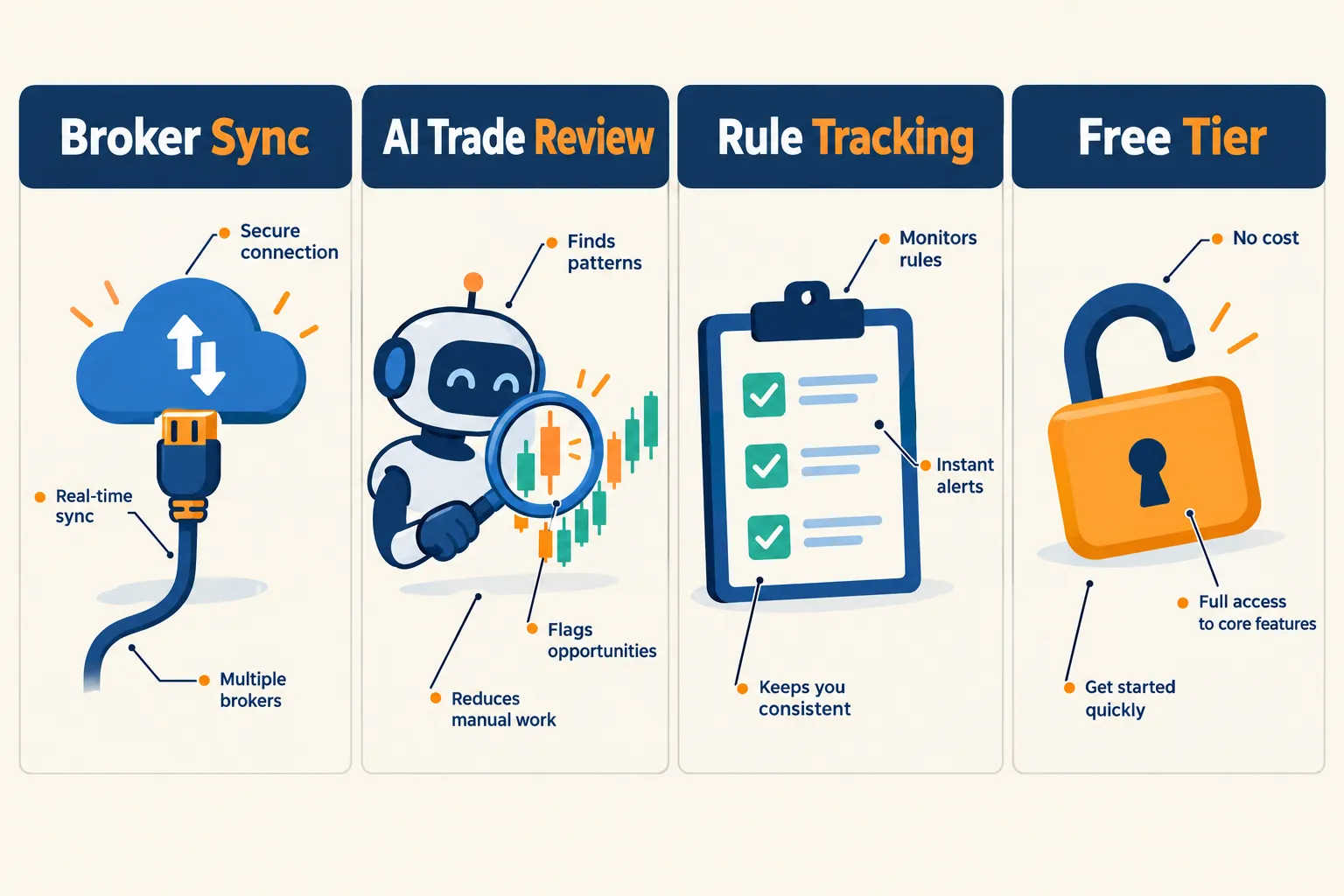
- Broker sync is the whole ballgame. A journal you have to fill in by hand is a journal you stop opening by week three.
What is the best trading journal in 2026?
The best trading journal in 2026 is TradeZella for traders who want automatic broker import plus AI trade review, scoring 80/100 on our five-pillar Alpha Score. TraderSync wins on price, Edgewonk wins on rule enforcement, and Tradervue wins on free.
TradeZella at a glance
Best for: active day and swing traders who want automated import.
- Day trader: Strong fit, high trade volume handled automatically
- Swing trader: Strong fit, notes and playbooks shine here
- Scalper: Okay fit, huge fill counts can clutter
- Long-term investor: Weak fit, too much machinery for few trades
Price: Essential $35/month, or $26/month billed annually.
What users say: Trustpilot 4.8 from 1,045 reviews.
Watch out for: no free plan, and repeated complaints about Interactive Brokers sync reliability.
Four tools, four different buyers. TradeZella is the default recommendation because it removes the friction that kills journaling habits: it connects to 500+ brokers and runs AI insights on trade review, so your job shrinks from data entry to actual thinking. TraderSync is for the trader who wants real analytics without a $531 annual bill. Edgewonk is for the trader whose problem is not data but discipline. Tradervue and LuxAlgo are for the trader whose problem is cash flow.
Decision rule: if you place more than 15 trades a month and your broker is supported, pay for sync. If you place fewer than 15, a free journal is plenty.
)
What is a trading journal app and who needs one?
A trading journal app records every trade you take plus the context around it, then turns that history into statistics you can act on: win rate by setup, average loss by time of day, which mistakes cost the most. Any trader placing real money on repeatable setups needs one.
A spreadsheet logs what happened. A trading journal app tells you why it keeps happening. That is the gap.
Who genuinely needs one:
- Day traders who take 5 to 40 trades a week and cannot recall Tuesday by Friday.
- Swing traders holding days to weeks, where thesis drift is the silent killer.
- Options traders tracking Greeks, expiry, and whether their edge is directional or just short premium luck.
- Prop firm traders who have to hit consistency rules or lose the account.
Who does not need one: the set-and-forget index investor making four trades a year. A notes app covers it.
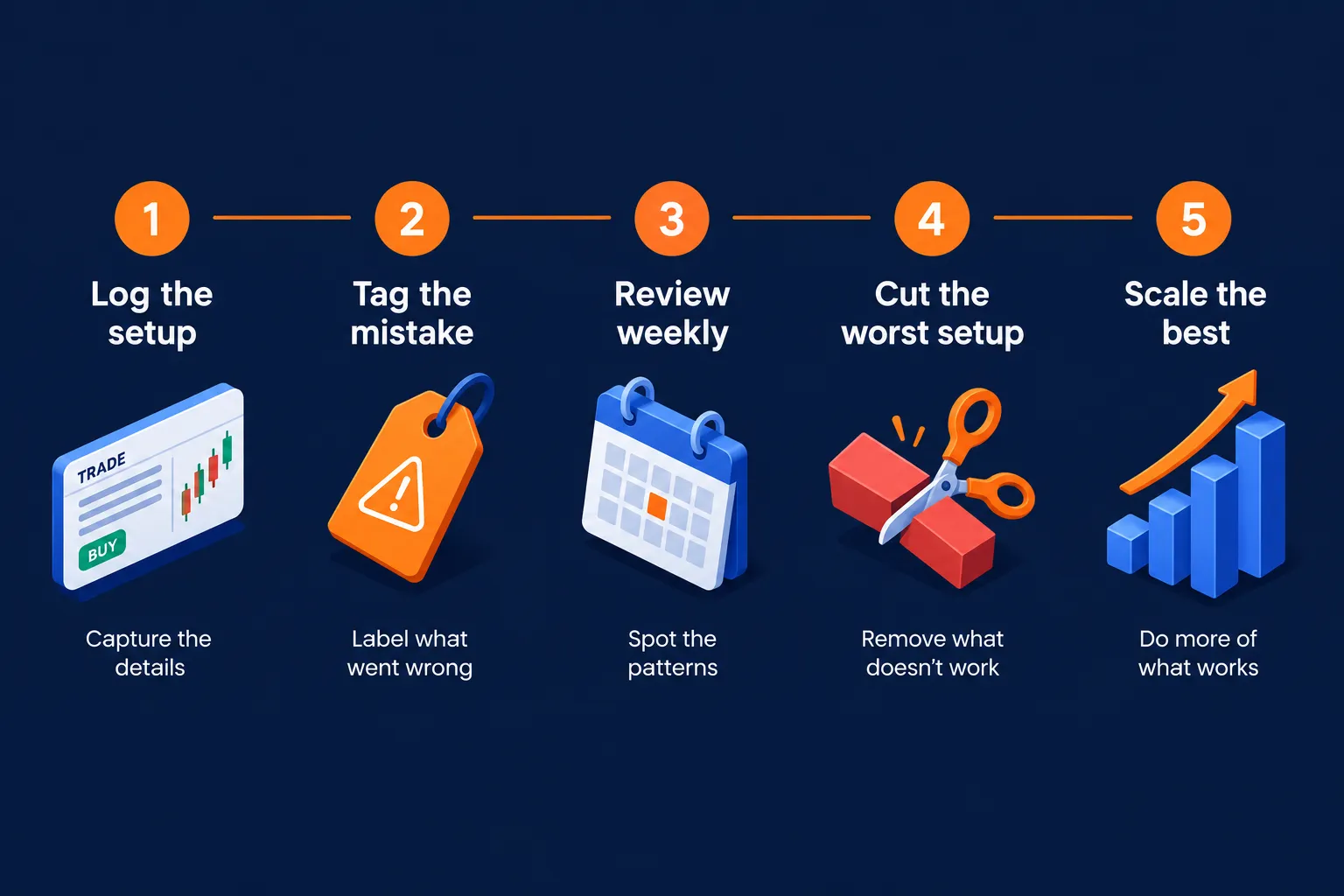
The real mechanism is simple. You log the setup, you tag the mistake, you review weekly, and you cut the worst-performing setup. That is a feedback loop, which is the only thing in trading that reliably compounds. If you want the upstream work, start with how to find a trading edge before you risk a single dollar.
Common mistake: logging entries and exits but not the reason for entry. Without the reason, you cannot separate a bad setup from bad execution.
How much does a trading journal cost in 2026?
A trading journal costs $0 to $99 per month in 2026. Free tiers exist at Tradervue and LuxAlgo, the cheapest credible paid plan is TraderSync at $22.46/month annually, and the ceiling is TradeZella Ultra at $99/month.
Prices below were checked from each vendor's own pricing page.
- TradeZella: Essential $35/mo ($26/mo annual, $315/yr), Pro $59/mo ($44/mo annual, $531/yr), Ultra $99/mo ($74/mo annual, $891/yr). TradeZella's own pricing breakdown notes Essential moved from $29 to $35 and Pro from $49 to $59 in 2026, with Ultra launching new. Annual billing cuts roughly 25%.
- TraderSync: on annual billing, Pro works out to $22.46/mo ($269.52/yr), Premium $37.46/mo ($449.52/yr), Elite $59.96/mo ($719.52/yr). Monthly rates run higher. See the TraderSync pricing page for current tiers and the 7-day free trial.
- Edgewonk: annual billing only, with the pricing page listing both $197 and $169 for a one-year plan. Confirm the live number at edgewonk.com/pricing before you buy. There is a 14-day money-back guarantee.
- Tradervue: Free plan, Silver $29.95/mo, Gold $49.95/mo.
- LuxAlgo Trade Journal: free and open source, launched September 2026, runs locally on your machine.
Edge case worth naming: TradeZella's Essential tier includes one broker connection and 10 strategies. If you trade two accounts, you are pushed to Pro, which doubles your cost. TradeZella's help center pricing article is the place to verify what your tier includes before committing to annual.
TradeZella: best trading journal for most active traders
TradeZella is the best trading journal for most active traders because it combines 500+ broker connections, prop firm sync, backtesting, and AI trade review in one place, and it has the review volume to back it up: Trustpilot 4.8 from 1,045 reviews.
What you actually get on Essential: journaling, analytics, Zella AI, broker import, prop-firm sync, backtesting, one broker connection, 10 strategies, and one automated backtest per month. Pro adds AI agents (auto-tagger, session review, game plan), unlimited strategies and accounts, and 10 automated backtests. Ultra pushes automated backtests to 100 and opens unlimited Mentor Mode and Spaces.
The platform now markets itself as an AI trading partner grounded only in your own data, explicitly stating your trades are not sold or used to train anyone else's model. For a category built on uploading your entire P&L history, that matters.
Who it fits: day traders and swing traders running one or two accounts with a supported broker. Scalpers generating hundreds of fills per session will find the trade list noisy. Long-term investors are overpaying for machinery they will not open.
Two real drawbacks:
- No free plan and no public free trial. You pay before you know if your broker syncs cleanly.
- Interactive Brokers sync complaints are persistent. One Trustpilot reviewer cites "serious reliability and accuracy issues connecting with IBKR." If IBKR is your only broker, test the first month before going annual.
Our full TradeZella review breakdown goes deeper on the tier math.
TraderSync: best budget day trading journal
TraderSync is the best budget day trading journal at $22.46/month on annual billing, with Cypher AI coaching, a strategy checker, and market replay that goes down to 250-millisecond ticks with Level II data on the Elite tier.
That replay feature is genuinely useful for day traders and scalpers. Lower tiers give one-minute replay; Elite lets you re-watch the tape as it actually printed. If your losses come from entry timing rather than setup selection, replay is where you find them.
Independent coverage from TradingJournal.com's TraderSync review breaks down the Cypher AI coaching and analytics depth, and notes that annual billing drops the effective monthly cost substantially versus month-to-month. All tiers include a 7-day free trial rather than a permanent free plan.
Who it fits: cost-conscious day traders and scalpers who want replay and analytics without a $500 annual commitment. Swing traders get plenty here too. Options traders are reasonably served.
Two real drawbacks:
- The iOS app sits at 2.71 from 84 ratings. For a mobile-first audience that is a problem, and you can check the current state on the TraderSync App Store listing.
- A platform migration wiped user notes. A fresh Trustpilot review reports chart markings and journal notes disappearing after a forced move to a new platform. Export your data regularly regardless of which tool you pick.
Compare the specifics in our TraderSync tool profile.
)
Edgewonk: best trading journal for discipline and rules
Edgewonk is the best trading journal for discipline and rules because it is built around tracking whether you followed your own plan, not just whether you made money. It bills annually only, with the pricing page showing both $197 and $169 for a one-year plan.
Edgewonk's design philosophy is older-school and better for one specific problem: you know your setup works, you just keep breaking your rules. The tool scores rule adherence, flags revenge trading patterns, and quantifies what your mistakes cost in dollars. That number is uncomfortable, which is exactly why it changes behavior.
Trustpilot sits at 4.7 from 44 reviews. Small sample, positive tone. One reviewer writes: "Edgewonk is very good all around, plus it is quite simple to use too."
Who it fits: discretionary swing traders and forex traders who already have a system and need enforcement. Day traders get value too. Scalpers with high fill counts will find manual entry painful. Long-term investors do not need it.
Two real drawbacks:
- Annual billing only. As one Trustpilot reviewer puts it plainly: "to subscribe you have to subscribe for an entire year." The 14-day money-back guarantee softens it, barely.
- Its own pricing page conflicts. Two different one-year prices on the same page is sloppy, and it is why Edgewonk's transparency pillar scores lowest among the four. Verify before you pay.
Full details in our Edgewonk review.
Tradervue and the free LuxAlgo journal: best free options
Tradervue's free plan is the best free trading journal app for most stock and options traders, and the open-source LuxAlgo Trade Journal, launched September 2026, is the best free option for traders who want their data staying on their own computer.
Tradervue has been the industry baseline for over a decade. Import speed is its quiet strength. One Trustpilot reviewer: "I uploaded 499 trades (2024 and 2025) in less than 10 minutes." Paid tiers run Silver $29.95/mo and Gold $49.95/mo.
LuxAlgo's journal is free, open source, and runs locally. No subscription, no cloud upload, no vendor who can migrate your notes into oblivion. The tradeoff is you maintain it yourself and there is no support desk.
Who free fits: new traders, low-frequency swing traders, anyone testing whether journaling sticks before spending money. Do not run a 40-trade-a-week day trading operation on a free tier and then complain about missing features.
Two real drawbacks for Tradervue:
- Trustpilot is 2.4 from only 10 reviews. Thin and negative. That is why its community pillar scores 9/20, the lowest number in this entire comparison.
- The interface shows its age next to TradeZella's AI-assisted review.
Our Tradervue deep dive covers the free-to-paid upgrade math.
Can I use a spreadsheet instead of trading journal software?
Yes, a spreadsheet works as a day trading journal if you place fewer than about 20 trades a month and you are disciplined about filling it in. Past 20 trades a month, manual entry becomes the reason you quit journaling.
A spreadsheet gives you total control and costs nothing. It also gives you zero automation, no screenshot attachment, no tag-based filtering, and no equity curve unless you build one. The real cost is not the software fee, it is the 20 minutes a day you spend typing fills instead of reviewing setups.
Choose a spreadsheet if: you trade a handful of swing positions, you want custom metrics nobody else offers, or you are learning what metrics even matter.
Choose an automated trading journal if: your broker is supported, you trade intraday, or you have already abandoned two spreadsheets.
Common mistake: building an elaborate spreadsheet with 40 columns. You will fill in six of them. Start with entry, exit, setup name, mistake tag, and a one-line note.
Automated trading journal vs manual: which should you use?
Use an automated trading journal if your broker syncs and you trade frequently, because the habit survives. Use manual entry if your edge depends on notes the broker cannot see, like your read on the tape or your emotional state at entry.
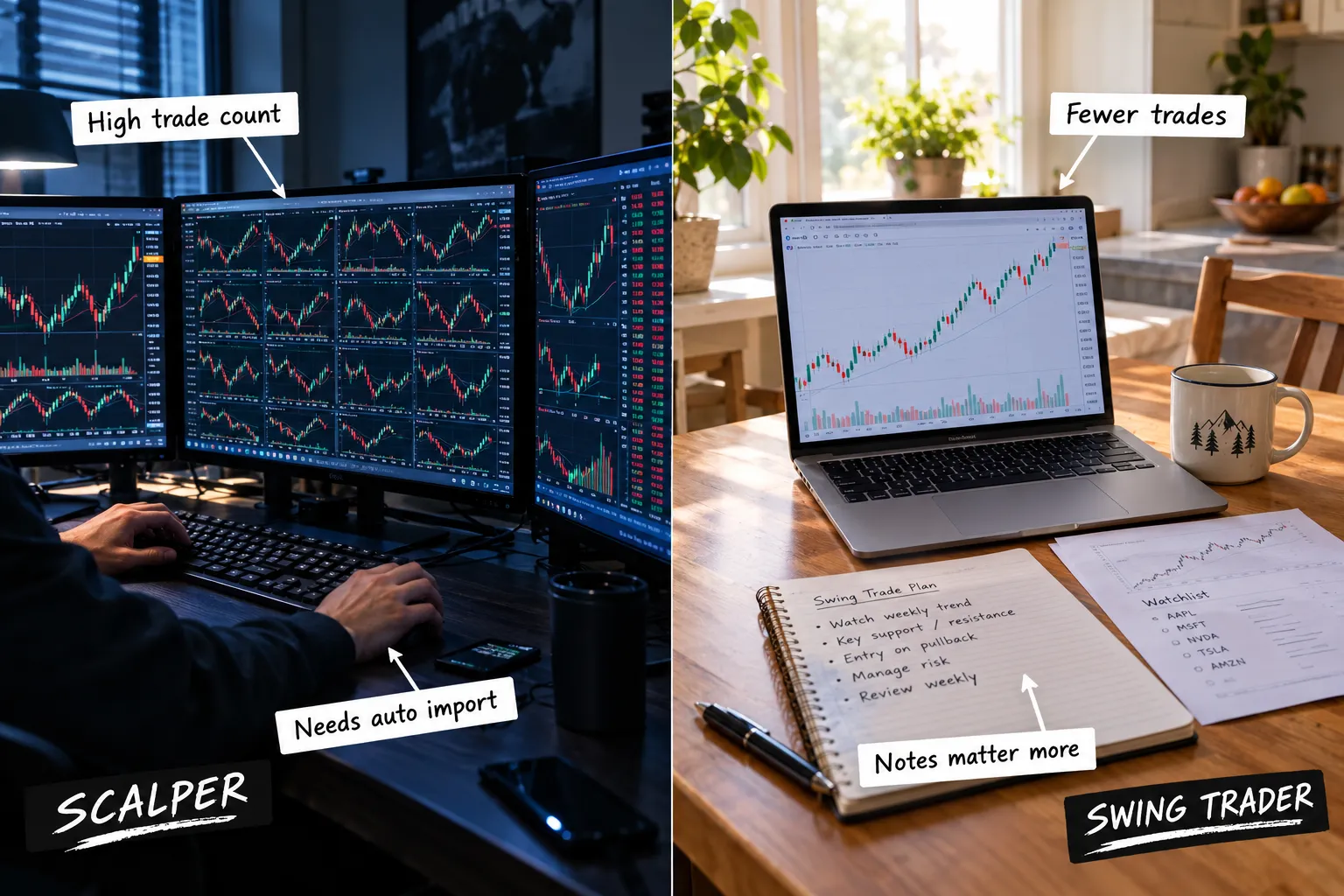
Honest answer: the best setups use both. Auto-import handles the numbers. You add the story.
| Approach | Strength | Weakness | Best for |
|---|---|---|---|
| Automated sync | No data entry, nothing missed | Sync breaks, no context | Day traders, scalpers |
| Manual entry | Forces reflection on each trade | Skipped on busy days | Low-frequency swing traders |
| Hybrid | Numbers auto, notes manual | Needs 10 min daily | Most serious traders |
Edge case: prop firm traders often cannot connect their firm's platform directly. TradeZella's prop-firm sync covers several, but verify yours specifically before paying annual.
Trading journal not syncing with broker: how do you fix it?
Broker sync failures usually come from one of four causes: an expired broker password or two-factor token, a broker that changed its API, an unsupported account type like a cash or prop account, or a file format mismatch on manual CSV import. Reconnect first, then fall back to CSV.
The fix sequence, in order:
- Disconnect and reconnect the broker in your journal's settings. Most "sync broken" tickets die here.
- Check two-factor authentication. Rotating tokens break stored connections constantly.
- Confirm your account type is supported. Futures, forex, and prop accounts are frequently excluded from stock-broker integrations.
- Export a CSV from the broker and import manually. Tradervue's import handled 499 trades in under 10 minutes according to one user, so manual is not a disaster.
- Export your journal data monthly regardless. The TraderSync migration that wiped notes is the argument for this.
Does TradeZella work with all brokers? No. It connects to 500+, which covers most retail brokers in the US, but IBKR users specifically report accuracy problems. Test your broker on a monthly plan before going annual.
What features should the best trading journal have?
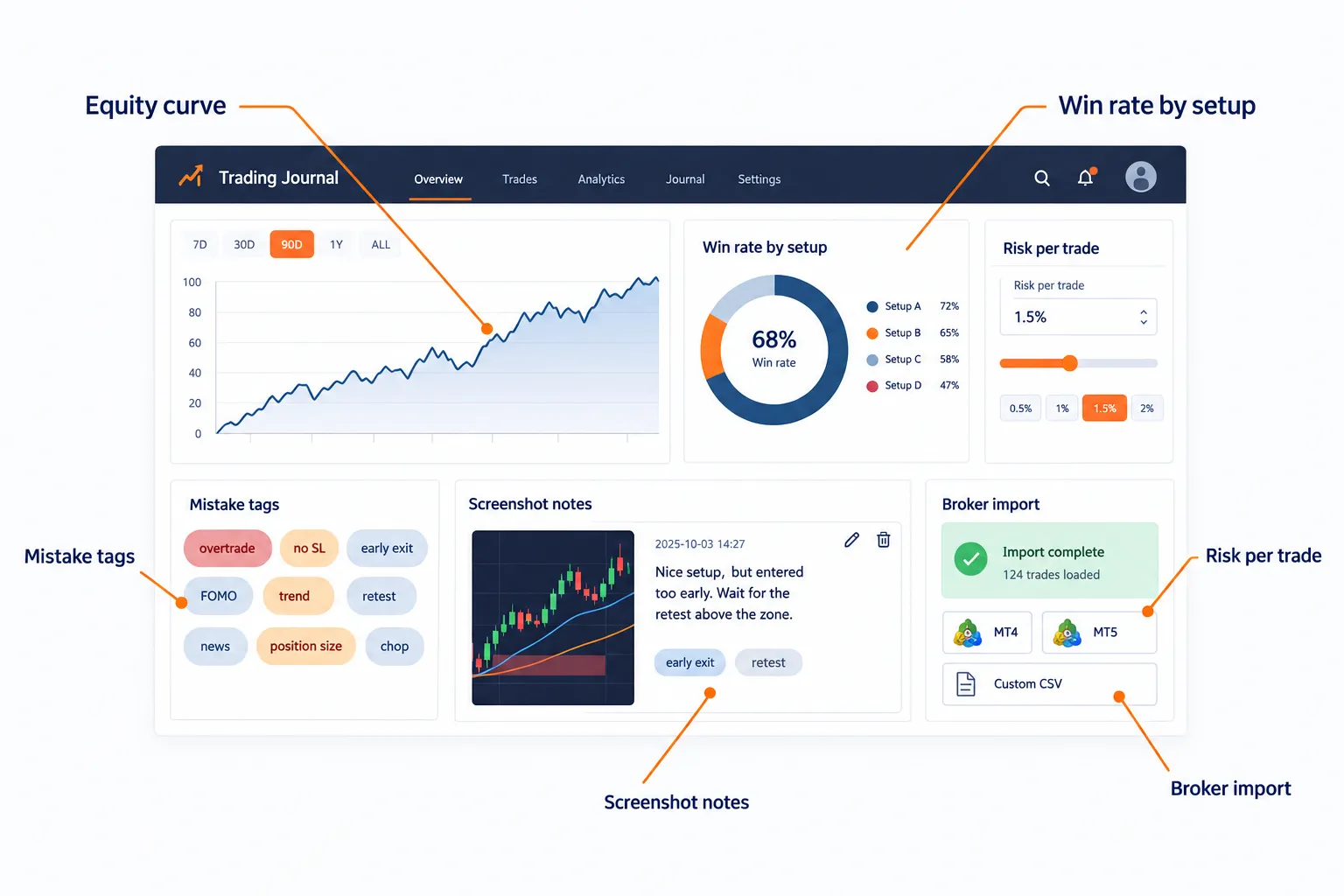
The best trading journal needs six things: automatic broker import, tag-based filtering, screenshot attachment, an equity curve, per-setup statistics, and a mistake log. Everything else is decoration.
Here are the five that move the needle most.
1. Automatic broker import
Removes the single biggest reason journals get abandoned. TradeZella leads with 500+ connections; TraderSync and Tradervue both import well.
2. Per-setup statistics
Win rate on your whole account is useless. Win rate on your breakout setup versus your reversal setup tells you what to stop trading. Every tool here does this; TradeZella and TraderSync do it with the least work.
3. Mistake and emotion tagging
Edgewonk's specialty, and the feature that turns a record into a correction. Tag "chased entry" 14 times and the pattern stops being deniable.
4. AI trade review
TradeZella's Zella AI and TraderSync's Cypher AI both read your history and flag patterns. Useful, not magic. Treat it as a second opinion, the same way you would treat any AI trading signal.
5. Backtesting and replay
TradeZella offers automated backtesting (1/month on Essential, 100/month on Ultra). TraderSync Elite offers 250ms tick replay with Level II. For intraday traders, replay beats backtesting. If you want to do this properly, read how to backtest a trading strategy without fooling yourself.
)
Best trading journal for day traders, swing traders and scalpers
The best trading journal for day traders is TradeZella (volume handled automatically) or TraderSync Elite (tick-level replay). Swing traders get the most from Edgewonk or TradeZella. Scalpers need pure automation, which means TradeZella or TraderSync.
The difference is trade count and what you need to review.
- Day traders: 10 to 40 trades a week. Manual entry is out. You need auto-import plus session-level review. Pair it with the right platform from our day trading tools roundup.
- Swing traders: 2 to 10 trades a week, held days to weeks. Notes matter more than fill data. Edgewonk's rule tracking fits well. See our swing trading tools list for the research side.
- Scalpers: 50+ fills a session. Only automation survives. Expect to group fills by position or your trade list becomes unreadable. The mechanics differ enough that scalp trading versus swing trading is worth reading first.
- Options traders: you need expiry, strike, and strategy-type tracking. TradeZella and TraderSync both handle multi-leg; verify spread handling on your specific strategies.
Decision rule: more than 100 trades a month means automation is non-negotiable. Fewer than 20 means a free plan is fine.
How long does it take to see results from keeping a trading journal?
Expect 30 to 60 trades before the data says anything reliable, and roughly 90 days before behavior changes stick. The first useful insight usually shows up around trade 20, when one setup is obviously carrying your P&L.
Small samples lie. Ten trades cannot distinguish skill from luck. Thirty to sixty trades across similar market conditions start to show a signal.
The realistic timeline:
- Weeks 1 to 2: you build the habit. Zero insights. Log anyway.
- Weeks 3 to 6: one setup clearly outperforms. Usually your most boring one.
- Weeks 7 to 12: mistake tags cluster. You find out that 70% of your losses share one cause, often a time of day or a position size.
- Month 4 onward: you cut the worst setup and the equity curve smooths out.
Common mistake: reviewing daily and over-reacting. Review weekly for patterns, monthly for decisions. Daily review turns into emotional noise.
What do real users say about TradeZella, TraderSync, Edgewonk and Tradervue?
Real users rate TradeZella highest (Trustpilot 4.8 from 1,045), Edgewonk second (4.7 from 44), TraderSync third (4.2 from 323, with iOS at 2.71 from 84), and Tradervue last (2.4 from only 10 reviews). Ratings checked.
"The company is always innovating and responds to any questions quickly."
TradeZella user, Trustpilot
"serious reliability and accuracy issues connecting with IBKR."
TradeZella user, Trustpilot
"Tradesync new platform SUCKS... all the trades I journaled with markings and notes on the chart are all gone"
TraderSync user, Trustpilot
"Exceptional Support from Betza and TraderSync"
TraderSync user, Trustpilot
"to subscribe you have to subscribe for an entire year"
Edgewonk user, Trustpilot
"I uploaded 499 trades (2024 and 2025) in less than 10 minutes."
Tradervue user, Trustpilot
Where users and our score agree: TradeZella's support and development pace are genuinely strong, matching its 17/20 community pillar. Tradervue's thin, negative review base matches its 9/20.
Where they disagree: TraderSync's 4.2 web rating looks fine until you see 2.71 on iOS. The desktop product is better than the mobile one, and the aggregate hides that.
What we like, and what we don't
The four journals here all solve the core problem: they tell you which trades are working. Where they split is price structure, sync reliability, and mobile quality.
What we like:
- TradeZella's 500+ broker connections plus prop-firm sync removes the biggest habit-killer.
- TraderSync's $22.46/month annual entry undercuts everything comparable.
- Edgewonk quantifies the dollar cost of your own rule breaks.
- Tradervue's import speed and a free plan that is actually usable.
- LuxAlgo's open-source journal keeps your P&L history on your own machine.
What we don't like:
- TradeZella has no free plan, no public trial, and raised Essential from $29 to $35 in 2026.
- TraderSync's 2.71 iOS rating and a migration that deleted user notes.
- Edgewonk's annual-only billing and two conflicting prices on its own page.
- Tradervue's 2.4 Trustpilot from 10 reviews is too thin to lean on.
- Every tool here charges more for multiple accounts. Multi-account traders get squeezed.
Watch out for
Annual billing locks you in before you know if your broker syncs cleanly. Start monthly, confirm the import works for one full month, then switch to annual. And export your journal data every month, because the TraderSync migration complaint proves vendor-side data loss is real.
How the Alpha Score rates these journals
TradeZella leads at 80/100, Edgewonk follows at 73, TraderSync at 71, and Tradervue at 69. The spread is narrow because all four do the core job; the differences are in price structure, mobile quality and community depth.
Alpha Score Breakdown
TradeZella: 80/100
Signal Quality 16/20 · Transparency 16/20 · Price-to-Value 14/20 · Usability 17/20 · Community Verdict 17/20
Edgewonk: 73/100
Signal Quality 16/20 · Transparency 13/20 · Price-to-Value 15/20 · Usability 16/20 · Community Verdict 13/20
TraderSync: 71/100
Signal Quality 15/20 · Transparency 15/20 · Price-to-Value 16/20 · Usability 12/20 · Community Verdict 13/20
Tradervue: 69/100
Signal Quality 15/20 · Transparency 16/20 · Price-to-Value 15/20 · Usability 14/20 · Community Verdict 9/20
The score comes from FullStack Alpha desk research plus public user sentiment, and the pillar split is provisional.
Read the low pillars as real weaknesses. TraderSync's 12/20 usability is the iOS app. Edgewonk's 13/20 transparency is the conflicting price. Tradervue's 9/20 community is a 10-review Trustpilot page at 2.4.
Price tiers, competitors and who each journal is for
TradeZella costs the most and does the most. TraderSync costs the least among serious paid tools. Edgewonk is a flat annual fee. Tradervue and LuxAlgo are free. Confirm current prices on each official pricing page.
Price tier comparison
| Plan | What you get | Best for | Price |
|---|---|---|---|
| TradeZella Essential | 1 broker, 10 strategies, Zella AI, 1 backtest/mo | Single-account day traders | $35/mo or $315/yr |
| TradeZella Pro | Unlimited accounts, AI agents, 10 backtests/mo | Multi-account traders | $59/mo or $531/yr |
| TradeZella Ultra | 100 backtests/mo, unlimited Mentor Mode | Coaches and teams | $99/mo or $891/yr |
| TraderSync Pro | Analytics, 1-min replay, 7-day trial | Budget day traders | $22.46/mo annual |
| TraderSync Elite | 250ms tick replay, Level II, Cypher AI | Scalpers | $59.96/mo annual |
| Edgewonk 1-year | Rule tracking, mistake cost, 14-day refund | Discretionary swing traders | $197 or $169/yr (page conflicts) |
| Tradervue Free | Basic journaling, fast import | Beginners | $0 |
| LuxAlgo Journal | Open source, runs locally | Privacy-first traders | $0 |
Competitors at a glance
| Tool | Best for | Starting price | Key strength | Key weakness |
|---|---|---|---|---|
| TradeZella | Most active traders | $26/mo annual | 500+ brokers, AI review | No free plan, IBKR issues |
| TraderSync | Budget day traders | $22.46/mo annual | Tick replay, Cypher AI | 2.71 iOS rating |
| Edgewonk | Rule discipline | $169 to $197/yr | Mistake cost tracking | Annual only, price conflict |
| Tradervue | Free journaling | $0 | Fast CSV import | 2.4 Trustpilot, 10 reviews |
| LuxAlgo Journal | Privacy | $0 | Open source, local | No support desk |
Feature availability
| Feature | Which tools have it | Our note |
|---|---|---|
| Auto broker sync | TradeZella, TraderSync, Tradervue | TradeZella leads at 500+ |
| AI trade review | TradeZella, TraderSync | Second opinion, not gospel |
| Backtesting | TradeZella | 1/mo on Essential, 100/mo Ultra |
| Tick-level replay | TraderSync Elite | 250ms with Level II |
| Rule adherence scoring | Edgewonk | Its whole reason to exist |
| Prop firm sync | TradeZella | Verify your specific firm |
| Free tier | Tradervue, LuxAlgo | Fine under 20 trades/mo |
Who each journal is for
| Trader type | Pick | Why |
|---|---|---|
| Day trader | TradeZella | Volume handled automatically |
| Scalper | TraderSync Elite | Tick replay finds entry errors |
| Swing trader | Edgewonk | Rule tracking beats fill data |
| Options trader | TradeZella or TraderSync | Multi-leg handled; verify spreads |
| Prop firm trader | TradeZella | Prop-firm sync included on Essential |
| Beginner | Tradervue Free | Build the habit before you pay |
| Privacy-focused | LuxAlgo Journal | Data never leaves your machine |
FullStack Alpha scorecards
Every tool in this article has a full scorecard: pricing, pros and cons, verified user quotes and the Alpha Score breakdown.
FAQ
What is the 3 5 7 rule in trading?
The 3-5-7 rule is a risk management guideline: risk no more than 3% of your account on a single trade, no more than 5% on a single theme or correlated group, and keep total open risk under 7%. It is a position sizing framework, not a strategy, and a trading journal is how you verify you actually followed it.
What's the best trading journal app?
TradeZella is the best trading journal app for most active traders in 2026, scoring 80/100 with 500+ broker connections, AI trade review and a Trustpilot rating of 4.8 from 1,045 reviews. TraderSync is the better pick at $22.46/month annually, and Edgewonk suits traders whose main problem is breaking their own rules.
Is there a free trading journal?
Yes. Tradervue offers a free plan with usable journaling and fast CSV import, and the LuxAlgo Trade Journal launched in September 2026 as a free, open-source tool that runs on your own computer. Both work well under roughly 20 trades a month. TradeZella has no free plan; TraderSync gives 7 days free.
What should I put in my trading journal?
Log entry and exit price, position size, setup name, your reason for entering, a screenshot of the chart, and one mistake tag if you broke a rule. Six fields beats forty. Add your emotional state at entry if you suspect psychology is the leak, because that is where most repeated losses actually originate.
Which online trading journal is the best?
TradeZella leads our rankings at 80/100 for broker sync breadth and AI trade review. Edgewonk scores 73 for rule-based discipline tracking, TraderSync 71 for value and tick replay, and Tradervue 69 with the strongest free tier. The right pick depends on trade frequency and budget, not on overall score alone.
Is TradeZella worth it?
TradeZella is worth it if you place more than 15 trades a month and your broker connects cleanly, because $26/month on annual billing buys automated import, backtesting and prop-firm sync. It is not worth it if you trade rarely, if Interactive Brokers is your only account, or if you want to test before paying.
TradeZella vs TraderSync: which is better?
TradeZella is better overall at 80/100 versus 71, with broader broker sync, stronger reviews (4.8 from 1,045 against 4.2 from 323) and better usability. TraderSync is better on price at $22.46/month annually versus $26, and better for scalpers thanks to 250-millisecond tick replay with Level II data on its Elite tier.
Is Edgewonk or Tradervue better for options and futures journaling?
Edgewonk handles rule tracking and mistake costing better, which suits futures traders working a defined plan. Tradervue's free tier and fast import suit options traders logging high contract counts cheaply. For multi-leg options specifically, TradeZella or TraderSync handle the structure more cleanly than either of these two. This is education, not financial advice. Your market edge starts with the right tool. Stay alpha. Some links in this article may earn FullStack Alpha a commission at no cost to you.
Final Verdict: which trading journal should you pick?
Pick TradeZella if you trade actively and your broker is supported, it scores 80/100 and removes the friction that kills journaling. Pick TraderSync if $22.46/month is your ceiling. Pick Edgewonk if your problem is discipline, not data. Pick Tradervue or LuxAlgo if you need free.
The best trading journal is the one you still open in month three. That is the only test that matters. A $99 Ultra subscription you abandoned in February loses to a free Tradervue account you update every Friday.
Start monthly, confirm your broker syncs cleanly for 30 days, then commit annually. Export your data every month. And review weekly, not daily, because daily review is just anxiety with a spreadsheet.
Systems over hacks. The journal is the system.
Still not sure which journal survives your actual trading week?
FullStack Alpha has tested 200+ AI stock tools since 2022, and the directory sorts them by price, strategy and what they really do.
We test the tools. You get the verdict.
One email a week. What we tested, what scored, and what we'd skip. Written for traders, not for clicks.
More from FullStack Alpha