Deepvue vs MarketSurge: The CANSLIM Screener Showdown
Quick answer
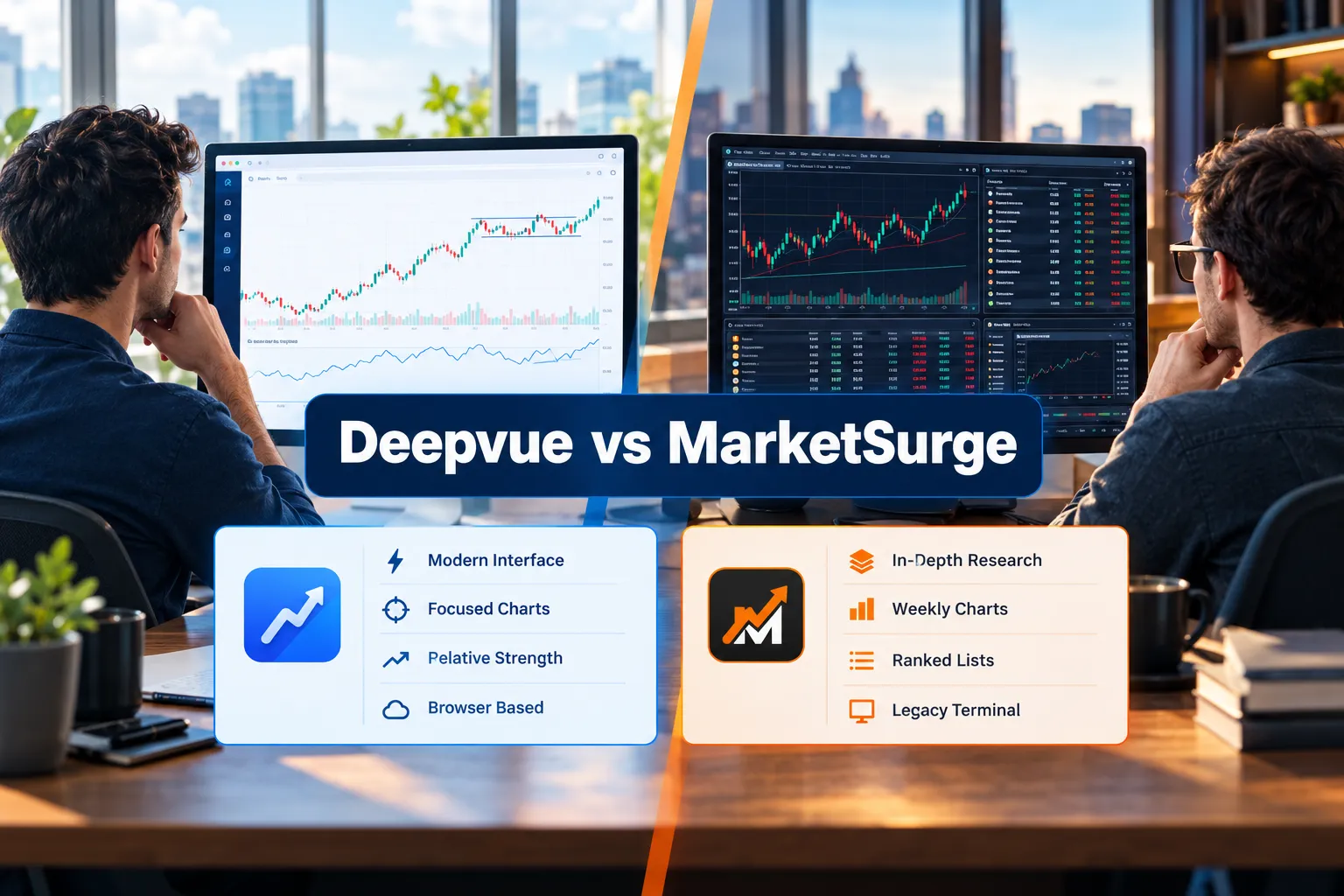
Deepvue wins on price and modern workflow, MarketSurge wins on data pedigree and proven user base. That's the short version of Deepvue vs MarketSurge: The CANSLIM Screener Showdown. MarketSurge costs $149.95 per month or $1,499 per year, and Deepvue positions itself directly as the cheaper challenger built for the same growth-stock method. If you want IBD-grade rankings and a large mobile user base, MarketSurge. If you want a lighter, faster chart and screener stack at a lower monthly bite, Deepvue is the one to test first.
Key Takeaways
- MarketSurge price: $149.95 monthly or $1,499 annually on the official site.
- Trial confusion is real: MarketSurge's page advertises "Try 30 days for $24.95" while its own FAQ offers "try it for 6 weeks for only $49.95".
- Deepvue markets itself as the direct swap, with dedicated pages for MarketSurge users and a strategy-based screener library.
- App sentiment favors MarketSurge: 4.71 stars from 8,632 iOS ratings (v6.11, September 25, 2026), while investors.com holds just 2.5 on Trustpilot from 9 reviews.
- Alpha Scores: MarketSurge 72/100, Deepvue 65/100. Deepvue's low pillar is Community Verdict at 8/20 because public discussion is thin.
- Neither is AI-first. MarketSurge leans on "100+ new technical indicators," not machine learning.
- TradingView scores 95/100 in our system and may replace the charting half of either tool.
Deepvue vs MarketSurge: which CANSLIM screener wins?
MarketSurge wins on our scorecard at 72 out of 100 versus 65 for Deepvue, mostly because IBD's ranking data has decades behind it and an iOS app with 8,632 ratings. Deepvue wins on cost and speed of setup. Pick based on which problem is actually hurting you: price or pedigree.
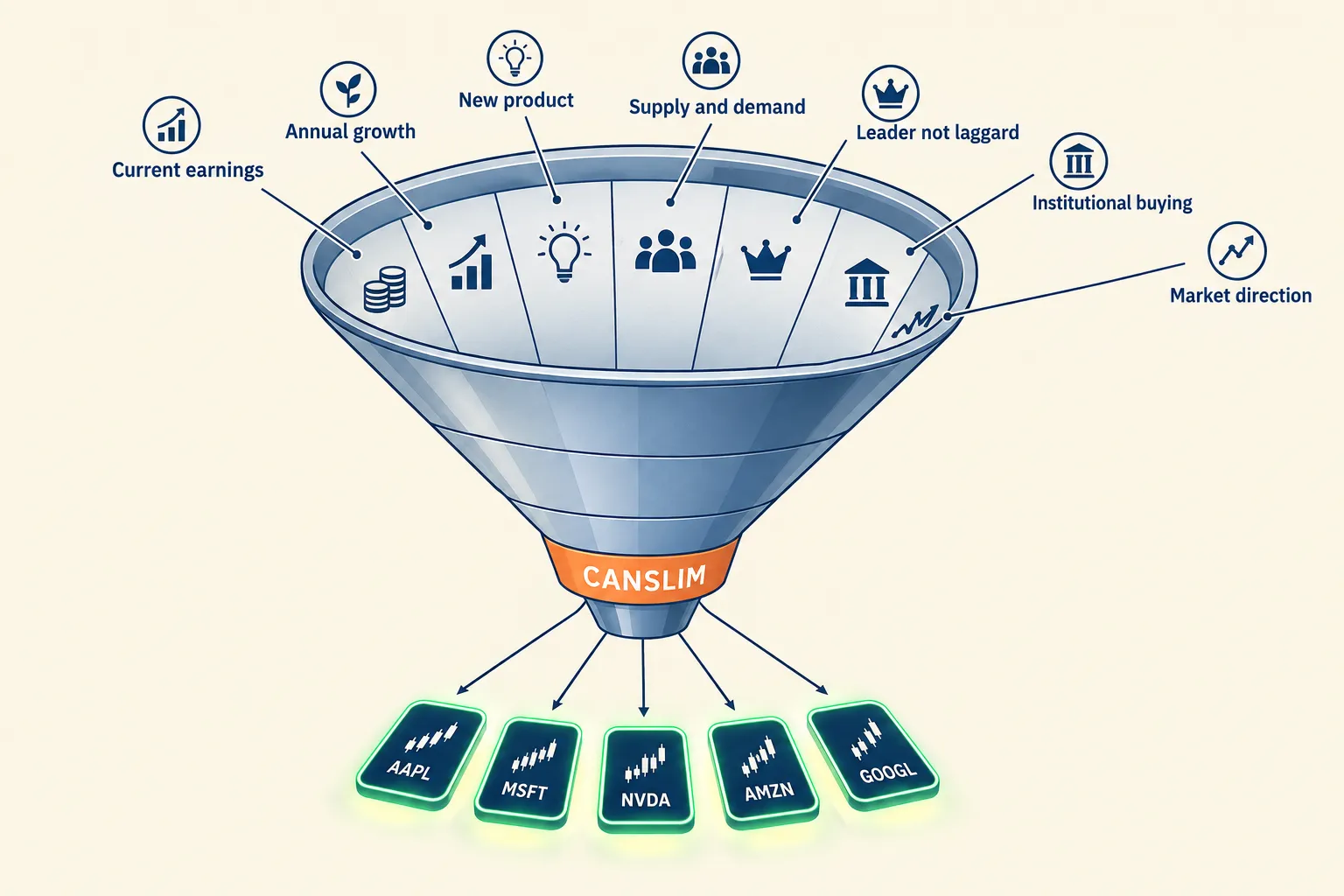
CANSLIM, for anyone new here, is William O'Neil's seven-part growth framework: current earnings, annual earnings, new products, supply and demand, leader not laggard, institutional sponsorship, and market direction. MarketSurge is the tool IBD built around that method. Deepvue is one of the newer platforms that decided the method doesn't need to cost $1,499 a year.
Deepvue at a glance
Best for: Swing traders running a growth-stock process.
- Day trader: Okay fit, intraday tools exist but are secondary.
- Swing trader: Strong fit, base and breakout screening is the core.
- Scalper: Weak fit, built for daily and weekly timeframes.
- Long-term investor: Okay fit, fundamentals help but turnover is high.
Price: Not verified by our desk, see Deepvue's pricing page.
Watch out for: Very thin public review history.
What is Deepvue and how does it work?
Deepvue is a web-based market research platform built around growth-stock screening, charting, and relative strength ranking, aimed squarely at traders who follow the CANSLIM method. It runs in a browser, so there's no heavy desktop install.
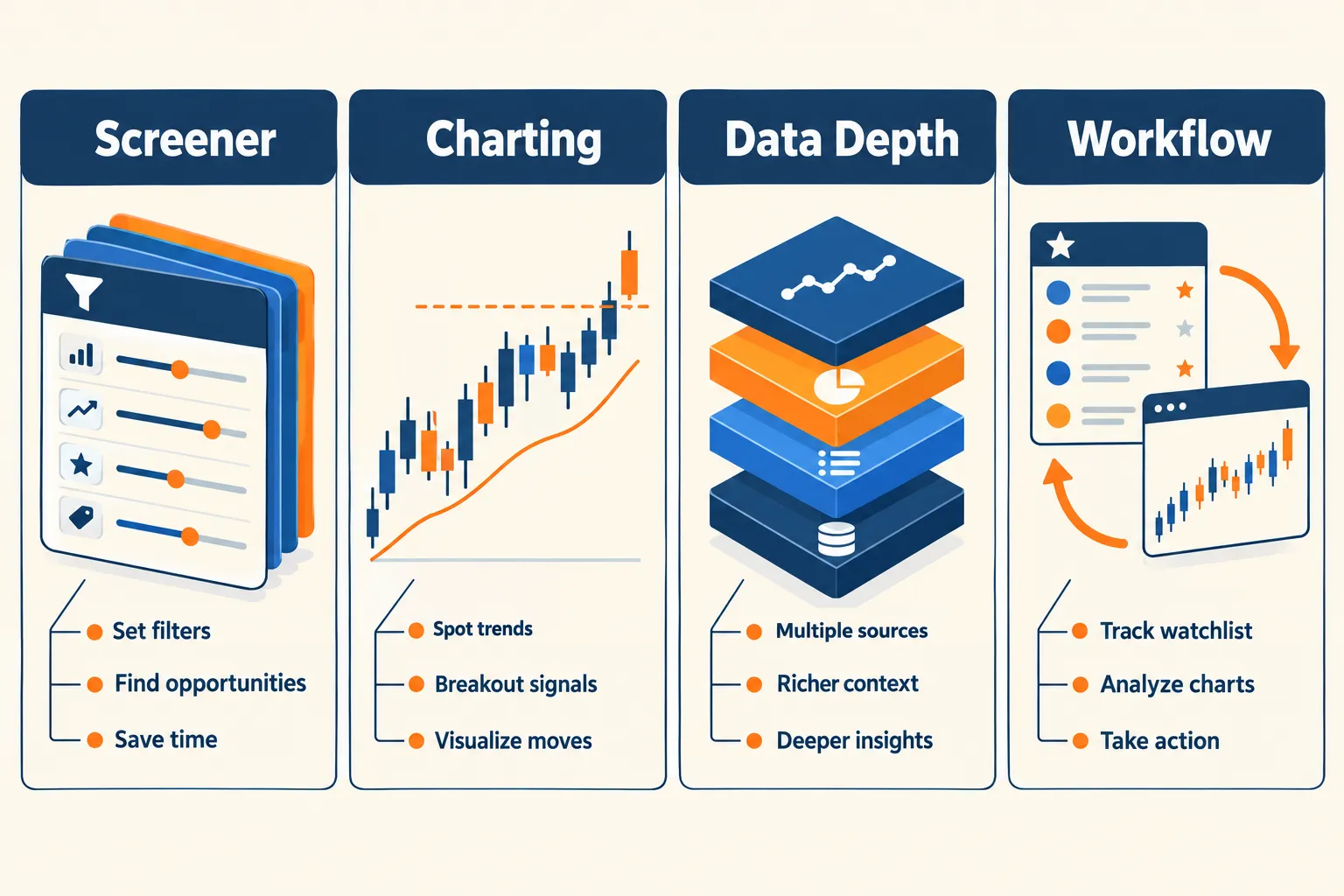
The workflow is simple. You start with a screen, review the resulting chart list, save the ones with a clean setup to a watchlist, then watch for the breakout. Deepvue publishes a CANSLIM stock screener and a broader stock screener by strategy library so you're not building filters from scratch on day one. Extras include Top Movers, a COT and NAAIM dashboard for positioning data, a Theme Tracker, Custom Themes, a Home combo list view, and a Market Breadth read. Deepvue LLC lists hello@deepvue.com as its contact and operates from the United States.
Practical takeaway: treat Deepvue as a screener plus chart workbench, not an oracle. The app surfaces candidates. You still decide the entry and exit.
Can Deepvue find CANSLIM stocks automatically, and how accurate is it?
Deepvue can automate the quantitative half of CANSLIM: earnings growth, relative strength, volume behavior, and institutional accumulation proxies. It cannot automate the qualitative half, so no screener on earth grades "new product or service" for you.
Accuracy depends on what you mean. A screen is accurate when the output actually matches the filter you set, and that's the fair test. Deepvue's own page for CANSLIM traders walks through how the criteria map to filters. What no screener can promise is that the list goes up. Roughly 70% of active day traders lose money, and a better screener doesn't change that math. Risk management does.
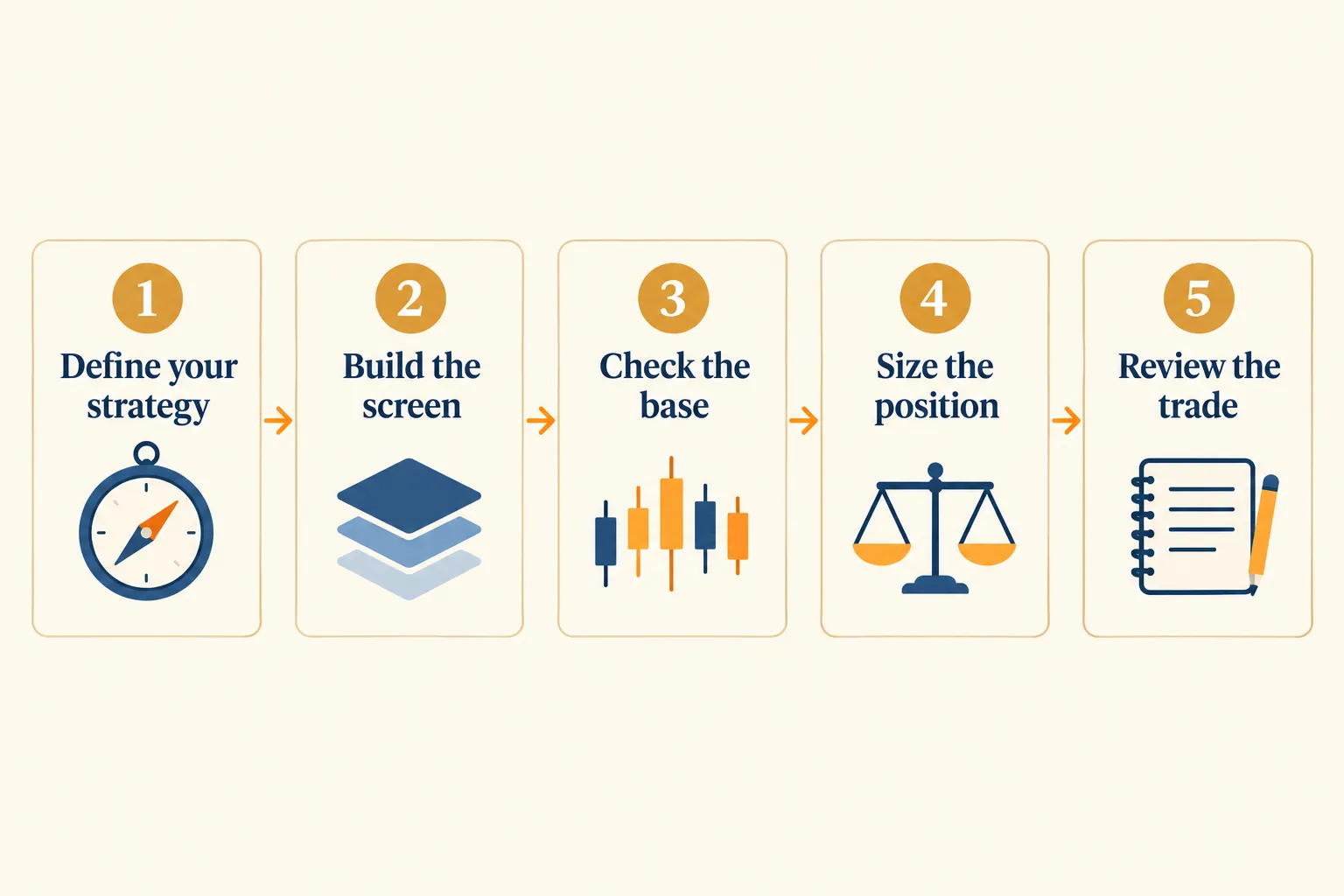
Common mistake: stacking 14 filters until the screen returns three stocks, then calling those three a thesis. That's analysis paralysis wearing a lab coat. Five good filters beat fifteen. Our breakdown of the five filters that cut 200 tickers down to five covers the trimming logic.
What is MarketSurge and who is it for?
MarketSurge is Investor's Business Daily's charting and screening platform, the successor to MarketSmith, built for growth investors who want IBD's proprietary ratings baked into every chart. It suits swing traders and intermediate-to-long-hold growth investors with a real budget.
MarketSurge is not marketed as AI. The sell is "100+ new technical indicators" plus IBD's rating system, annotated charts, and Screener templates that encode O'Neil's rules. Day traders get less out of it. Scalpers get almost nothing. Long-term investors who care about relative strength get plenty.
Deepvue pricing vs MarketSurge pricing in 2026
MarketSurge costs $149.95 per month or $1,499 per year, per the official MarketSurge site. Deepvue costs $49 a month or $490 a year, with real-time data included (per deepvue.com).
Deepvue pricing: one subscription with two billing options. Monthly is $49, which adds up to $588 a year. Yearly is $490 paid once, about $40.83 a month, and saves $98. Both include the charts (85+ drawing tools, bar replay), the screener (1,150+ data points and 80 top-trader presets), watchlists, the AI terminal and real-time data. That makes Deepvue roughly a third of MarketSurge's $1,499 a year, which is the whole case for testing it first.
That gap is the entire pitch. Deepvue's MarketSurge comparison page and its MarketSurge alternatives roundup both lead with cost. Independent writeups echo the framing, with ChartingLens listing MarketSurge alternatives and Scanr comparing itself to MarketSurge on the same price-versus-depth axis.
Watch out: the trial offers contradict each other
MarketSurge's landing page promotes "Try 30 days for $24.95," while the FAQ on that same page says "try it for 6 weeks for only $49.95." Two different offers, one page. Screenshot whichever one you sign up under and read the renewal terms before you hand over a card.
Is there a Deepvue free trial or demo available?
Deepvue's pricing section shows two paid plans, $49 a month or $490 a year, and no free tier, so treat the first month as your trial and cancel if it does not earn its keep. MarketSurge, by contrast, runs paid intro offers rather than a true free trial.
If you want zero-dollar practice first, start with our free AI stock screeners list and paper trade it first. Build the rules before you rent the terminal.
How do their screeners, charts and growth stock data compare?
MarketSurge has deeper proprietary rankings and longer historical chart annotation. Deepvue has a faster, cleaner interface and strategy presets that get you to a usable list sooner. Both cover the same CANSLIM ground from different angles.
| Feature | Deepvue | MarketSurge | Our note |
|---|---|---|---|
| CANSLIM preset screens | Yes, strategy library | Yes, IBD templates | MarketSurge presets carry IBD's own ratings |
| Proprietary stock ratings | Relative strength focus | IBD Composite and related | Pedigree edge to MarketSurge |
| Chart annotation depth | Clean, modern | Dense, historical | Preference, not a winner |
| Theme Tracker and Custom Themes | Yes | No direct equivalent | Useful for rotation reads |
| COT and NAAIM positioning | Yes | No | Nice extra for Market Breadth context |
| Mobile app | iOS and Android apps | iOS app, 8,632 ratings | MarketSurge is more proven on phones |
| Starting price | $49/mo or $490/yr | $149.95/mo | Checked |
Deepvue's features page and its TC2000 comparison show the platform competing on speed and breadth rather than legacy data. For swing-specific workflow, our piece on the stock screener for swing trading replacing manual picks covers how to chain a screen into a watchlist without drowning.
Deepvue vs Finviz and Deepvue vs TradingView: do you need all three?
No. Finviz is the free-to-cheap first pass, Deepvue is the strategy-specific screener, and TradingView is the chart. Running all three is tool overload with a monthly invoice attached.
- Finviz: fast, broad, cheap. Great for a rough filter. Weaker on CANSLIM-specific ranking and base detection. Our Stock Rover vs Finviz screener comparison covers that value question in detail.
- TradingView: scores 95/100 on our Alpha Score, the highest charting tool we rate. If Deepvue's charts feel limited, pair, don't replace.
- Deepvue: the middle layer, strategy presets plus relative strength ranking.
Decision rule: pick one screener and one chart. Two tools, one process. Signal over noise.
Is Deepvue good for beginners or experienced traders?
Deepvue suits intermediate traders who already know what a base looks like. Beginners can use it, but the presets will hand you setups you can't yet evaluate, which is a faster way to lose money than having no tool at all.
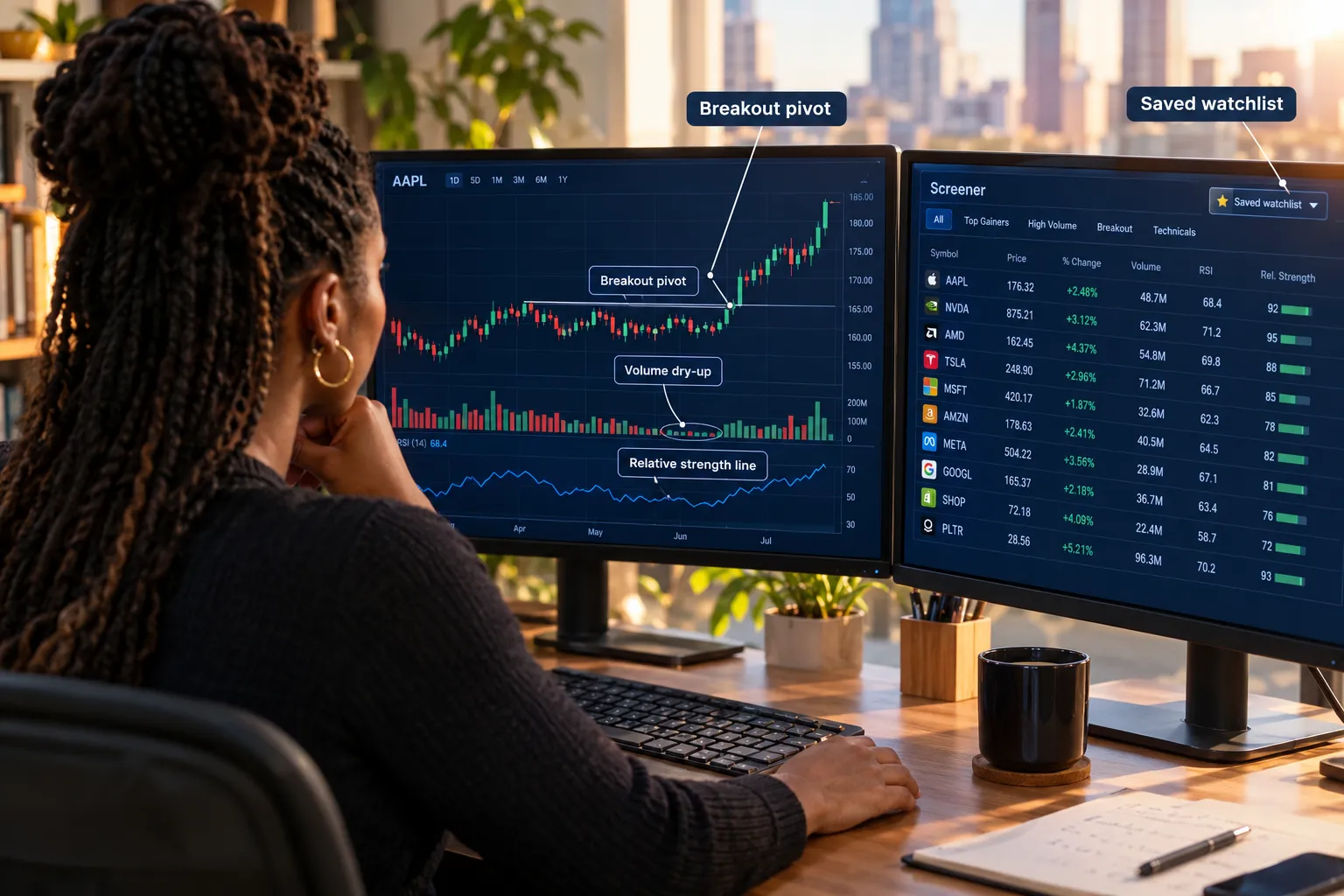
Experienced CANSLIM traders get the most value because they already know which filters matter and can judge a chart in four seconds. Beginners should start with the method, then the terminal. Our guide on what beginners get wrong about AI for stock market research names the usual traps, and the stock market terms glossary explains jargon like basing, gap fill, and support and resistance in plain English.
Deepvue not showing results and other common mistakes
If Deepvue returns an empty screen, the filters are almost always too tight, not broken. Loosen one criterion at a time and re-run before you email support.
Troubleshooting order that works:
- Widen earnings growth. A 50% quarterly minimum returns nothing in a weak tape.
- Check your market cap and price floors. Low float names get excluded by default settings.
- Confirm the market filter. If the overall market is in a correction, a CANSLIM screen is supposed to go quiet. That's the system working.
- Reload the web app. Browser-based tools cache stale data more often than desktop clients.
- Contact Deepvue support at hello@deepvue.com if results stay blank with loose filters.
Mistakes users make with either platform: chasing an overextended breakout, ignoring position sizing, revenge trading after getting stopped out, and treating a screen hit as a buy signal. Play stupid games.
Does Deepvue work with real money trading, and is it desktop or mobile?
Deepvue is research software, not a broker, so it does not execute trades. You place orders in your brokerage account, whether that's IBKR, Fidelity, or whoever holds your cash. Deepvue runs in a browser on desktop, and you should confirm current mobile app status on Deepvue's own site before relying on a phone workflow.
MarketSurge has the clear mobile advantage today: an iOS app rated 4.71 from 8,632 ratings on version 6.11 (September 25, 2026). That's a real user base, not a launch-week burst. For automation, bots, and broker APIs, that lives on our sister site aistocktradingbots.com rather than here.
Top 5 favorite features in Deepvue vs MarketSurge
Five features earn their keep across both platforms: strategy presets, relative strength ranking, base pattern visualization, positioning data, and a saved watchlist that syncs to the chart.
- Strategy presets. Deepvue's by-strategy screener library removes the blank-page problem. MarketSurge's IBD Screener templates do the same with house ratings attached.
- Relative strength ranking. The leader-not-laggard test, quantified. Both deliver.
- Base and consolidation view. MarketSurge's annotated history is deeper. Deepvue's is cleaner to read fast.
- Positioning context. Deepvue's COT and NAAIM dashboard plus Market Breadth gives a top-down read MarketSurge doesn't match.
- Watchlist to chart loop. The unglamorous one that actually saves hours. Both do it well.
How the Alpha Score rates Deepvue and MarketSurge
MarketSurge scores 72 out of 100 and Deepvue scores 65. The score comes from FullStack Alpha desk research plus public user sentiment, and the pillar split is provisional.
The Alpha Score Breakdown
MarketSurge scores 72 out of 100 across five pillars, 20 points each.
Signal Quality 17 / 20
Transparency 13 / 20
Price-to-Value 12 / 20
Usability 15 / 20
Community Verdict 15 / 20
Deepvue scores 65 out of 100 across the same five pillars.
Signal Quality 15 / 20
Transparency 13 / 20
Price-to-Value 14 / 20
Usability 15 / 20
Community Verdict 8 / 20
Deepvue's 8 out of 20 on Community Verdict is the honest problem. Almost nobody is publicly discussing it. That's not proof the software is bad, but it does mean you're buying without a crowd of strangers to corroborate your decision. MarketSurge's 12 on Price-to-Value is its own real weakness: $1,499 a year is a lot of screener.
What do real users say about Deepvue and MarketSurge?
MarketSurge has thousands of public ratings and a sharp split between app praise and billing complaints. Deepvue sentiment is thin, with no verified quotes on file from our desk.
"Best investing tool! Thank you for providing this app and these services."
Apple App Store, MarketSurge Stock Research
"It's laggy, using different dataset therefore no consistency between app and web version"
Apple App Store, MarketSurge Stock Research
The gap between sources is the finding. MarketSurge's iOS rating sits at 4.71 from 8,632 ratings, while investors.com carries a 2.5 Trustpilot rating from just 9 reviews. App Store prompts fire after good moments. Trustpilot collects billing anger. Both are true.
Where users and our score agree: MarketSurge's data quality is strong, and its price stings. Where they disagree: the app-versus-web data inconsistency that one reviewer flagged doesn't show up in the headline rating at all. On Deepvue, there's simply not enough public volume to confirm or contradict anything, which is exactly why its Community Verdict pillar reads low.
Who should pick Deepvue and who should pick MarketSurge?
| Trader type | Pick | Why |
|---|---|---|
| Swing trader on a budget | Deepvue | Strategy presets at a lower monthly cost |
| CANSLIM purist | MarketSurge | IBD ratings are the reference standard |
| Day trader | Neither alone | Pair with TradingView for execution charts |
| Scalper | Neither | Both are daily and weekly timeframe tools |
| Long-term growth investor | MarketSurge | Deeper historical chart annotation |
| Competitor | Best for | Starting price | Key strength | Key weakness |
|---|---|---|---|---|
| TradingView | Charting everyone | See official pricing | Alpha Score 95, best charts we rate | Light on CANSLIM ranking |
| TrendSpider | Automated technicals | See official pricing | Pattern automation | Learning curve |
| TC2000 | Custom scan builders | See official pricing | Deep scripting | Dated interface |
| Finviz | Quick free passes | Free tier available | Speed and breadth | Shallow fundamentals |
| MarketSurge | CANSLIM data purists | $149.95/mo | IBD ratings | Price and trial confusion |
FullStack Alpha scorecards
Every tool in this article has a full scorecard: pricing, pros and cons, verified user quotes and the Alpha Score breakdown.
FAQ
How much does Deepvue cost?
Deepvue costs $49 a month, or $490 a year billed once (about $40.83 a month), and both plans include everything: charts, the screener, watchlists, the AI terminal and real-time data with no add-on fees (per deepvue.com). For comparison, MarketSurge lists $149.95 per month or $1,499 per year.
Is Deepvue good?
Deepvue scores 65 out of 100 on our Alpha Score, which makes it a solid value pick with one real caveat: public user sentiment is thin, scoring 8 out of 20 on Community Verdict. The screening and charting work well for swing traders running CANSLIM. You're just buying without a large crowd of reviews behind you.
Is there a free version of Deepvue?
No. Deepvue lists two paid plans, $49 a month or $490 a year, with no free tier on its pricing section. You can cancel the monthly plan anytime. Free alternatives exist if you want to practice the method first at zero cost.
What are people saying about Deepvue?
Public discussion is limited. Our desk found no verified Reddit threads or review-site quotes with permalinks for Deepvue, which is why its Community Verdict pillar sits at 8 out of 20. MarketSurge, by contrast, has 8,632 iOS ratings averaging 4.71.
Is MarketSurge worth it?
MarketSurge is worth $149.95 per month if you trade CANSLIM actively and use IBD's ratings as your primary ranking input. It's hard to justify for casual investors or anyone who checks charts weekly. Two drawbacks: the price, and the contradictory trial offers on its own page.
Deepvue vs MarketSurge: which is better for CANSLIM?
MarketSurge is better for CANSLIM data fidelity because IBD's ratings are the method's reference implementation. Deepvue is better for cost-conscious traders who want the same screening logic without the $1,499 annual bill. Score: MarketSurge 72, Deepvue 65.
Is Deepvue better than TradingView?
No, not for charting. TradingView scores 95 out of 100 in our system and is the stronger chart platform. Deepvue is better at strategy-specific growth screening. Many traders use one of each rather than choosing.
Does Deepvue have a mobile app?
Yes. Deepvue lists an iOS app, an Android app and a Chrome extension on its site, but it has far fewer public app ratings than MarketSurge. MarketSurge has a proven iOS app with 8,632 ratings. This is education, not financial advice. Your market edge starts with the right tool. Stay alpha. Some links on this page may earn FullStack Alpha a commission at no extra cost to you.
Final verdict: Deepvue or MarketSurge?
MarketSurge takes the score at 72 to 65, and it's the safer buy if budget isn't the binding constraint. Deepvue is the challenger worth a 30-day test specifically if its published price undercuts MarketSurge's $149.95 per month, which its own page for MarketSurge users claims it does.
Run one of them for 30 days with three filters, a written stop loss rule, and a position sizing cap. Let the results argue. The trend is your friend, but only if you have a process to follow it with. Systems over hacks.
Still can't tell if a $1,499 screener is worth it?
Two tools compared here. 200+ catalogued in the FullStack Alpha directory, sorted by category, price and use case.
We test the tools. You get the verdict.
One email a week. What we tested, what scored, and what we'd skip. Written for traders, not for clicks.
More from FullStack Alpha