How Does Danelfin Compare to Magnifi for Picking Stocks With AI?
Reviewed by Jay Rocco, Chief Editor
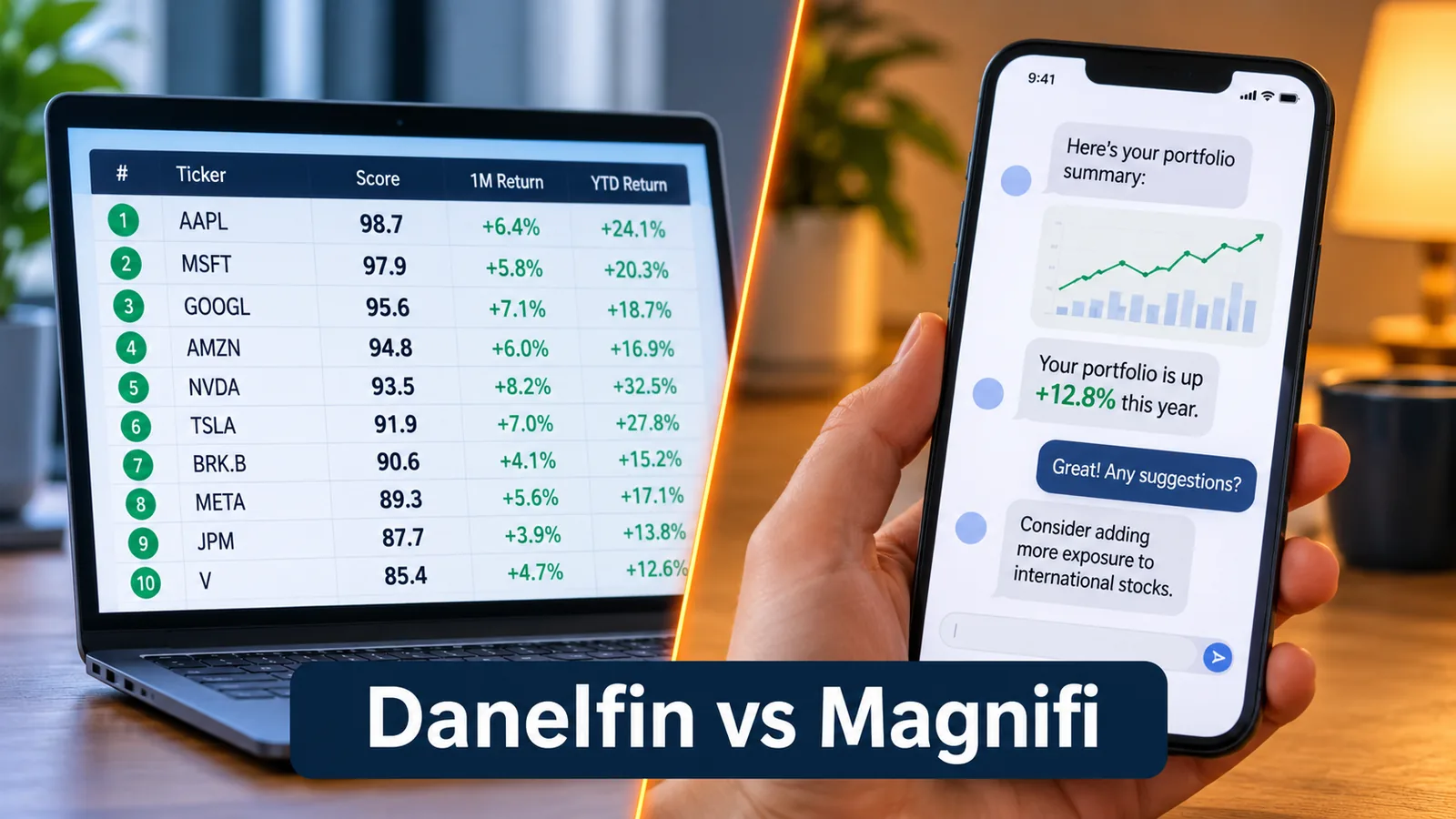
Quick Answer: Danelfin vs Magnifi comes down to what you're actually trying to do. Danelfin wins if you want a numbers-driven ranking system that scores every stock from 1 to 10 and tells you the odds it beats the market; Magnifi wins if you want a conversational research assistant that looks at your real portfolio and answers plain-English questions about it.
Neither one hands you a stock tip and a yacht. Both are tools, not oracles, and both require a process wrapped around them. Here's the breakdown.
Key Takeaways
- Danelfin's AI Score processes more than 600 technical, 150 fundamental, and 150 sentiment indicators, generating roughly 10,000 features per security per day.
- Danelfin's published Best Stocks Strategy backtest shows a +456% cumulative return from March 29, 2017 through September 3, 2026, versus +228% for the S&P 500 over the same stretch, a backtest, not a live track record.
- Magnifi's Premium tier costs $99 per year (about $8.25/month) and adds portfolio forecasting and brokerage-linked diagnostics.
- Danelfin's listed annual pricing shows Plus at $156/year and Pro at $35/month, though some 2026 reviews cite standard rates near $264 for Plus and $708 for Pro before discounts, verify the price at checkout.
- Danelfin launched a natural-language Stock Screener on October 28, 2026, covering 80+ filters and forecast horizons of 1, 3, 6, and 12 months.
- TIFIN's October 27, 2026 acquisition of SharingAlpha plans to fold 15,000+ professional fund analysts into Magnifi's data layer.
- On FullStack Alpha's Alpha Score, Danelfin lands at 75/100, led by a 19/20 Transparency score but dragged down by a 9/20 Community Verdict, almost nobody is talking about it publicly.
Danelfin vs Magnifi, which is better for picking stocks with AI?
Danelfin is built specifically to rank and score individual stocks; Magnifi is built to answer questions about stocks, ETFs, and your existing portfolio. In a danelfin vs magnifi head-to-head for pure stock selection, Danelfin is the sharper tool because scoring is its entire reason for existing.
Think of it like comparing a stock screener to a research librarian. Danelfin hands you a ranked list with a confidence number attached. Magnifi sits down with you, asks what you're trying to solve, and pulls together an answer that might include a stock, an ETF, or a suggestion to rebalance.
Market Truth: A ranking engine and a chat assistant solve different problems. Comparing them head-to-head only makes sense if you're honest about which problem you actually have, "what should I buy" or "help me understand what I already own."
Practical takeaway: If your watchlist needs a score, use Danelfin. If your portfolio needs a check-up, use Magnifi. Some traders need both, and that's fine. Running one tool for everything is the real mistake.
Danelfin vs Magnifi comparison table
| Feature | Danelfin | Magnifi |
|---|---|---|
| Core method | AI Score (1-10), 600+ technical/150 fundamental/150 sentiment signals | Natural-language Q&A assistant over your linked accounts |
| Free plan | Limited free score access | Free tier available; Premium adds forecasting |
| Pricing | Plus $156/yr; Pro $420/yr; Elite $960/yr (after a 40% cut) | Premium $99/yr ($8.25/mo) or $14/mo |
| Best for | Ranking individual stocks by predicted outperformance | Portfolio diagnostics, fee analysis, plain-English research |
| Forecast horizon | 1, 3, 6, 12 months | Scenario and portfolio-level forecasting |
| Brokerage linking | No direct account aggregation | Yes: Fidelity, Schwab, Robinhood, Vanguard, more |
Hunting for a lower price? Check our AI stock tool deals page.
How does Danelfin pick stocks? Top 5 features and one real drawback
Any danelfin vs magnifi decision starts with how each one thinks. Danelfin ranks stocks using a predictive model, not a chatbot, scoring each security from 1 to 10 on its probability of beating a benchmark over the next three months. That's the whole engine: a probability estimate, not a prediction of price.
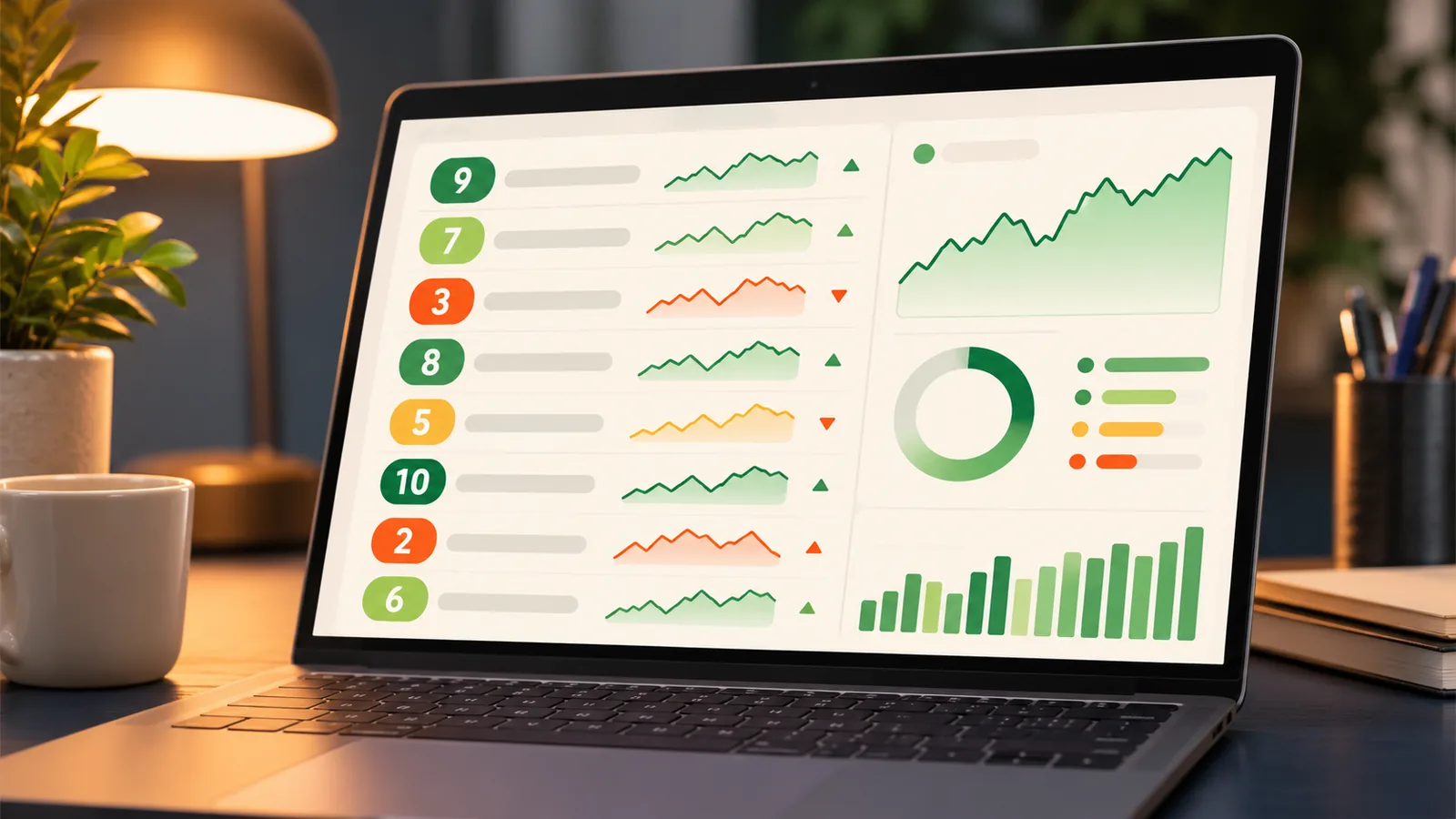
Five features worth knowing:
- The AI Score itself. A 1-to-10 rank estimating the odds a stock outperforms the S&P 500 (U.S.) or STOXX Europe 600 (Europe) over roughly three months.
- Deep feature engineering. The model trains on about 252 U.S. market days (504 for European stocks) and builds close to 10,000 features per security per day across hundreds of decision trees.
- The new Stock Screener (October 28, 2026). Type a request in plain English and it filters across 80+ factors, valuation, dividends, sentiment, risk, AI Score, and lets you save the results as a portfolio.
- Portfolio Forecast. Launched October 8, 2026, this projects average, high, and low outcomes across multiple timeframes with a 68% confidence range, a model output, not a promise.
- Published backtests. The Best Stocks Strategy update (through September 3, 2026) reports a +456% cumulative return since March 2017, against +228% for the S&P 500. A backtest is history reorganized to look clean. It is not a live account statement.
The real drawback: Danelfin's community footprint is thin. FullStack Alpha's Alpha Score gives it a 9/20 on Community Verdict, the transparency and engineering are strong, but there just isn't much public chatter to corroborate real-world results. Read the full Danelfin review before committing a subscription.
Decision rule: If you want a ranked watchlist with a documented methodology, Danelfin fits. If you need forums full of user war stories before you trust a tool, it isn't there yet.
How does Magnifi pick stocks? Top 5 features and one real drawback
Here is the other half of the danelfin vs magnifi story. Magnifi doesn't rank stocks the way Danelfin does. It answers questions in natural language about stocks, funds, fees, and your actual linked portfolio, functioning more like a research assistant than a scoring engine.
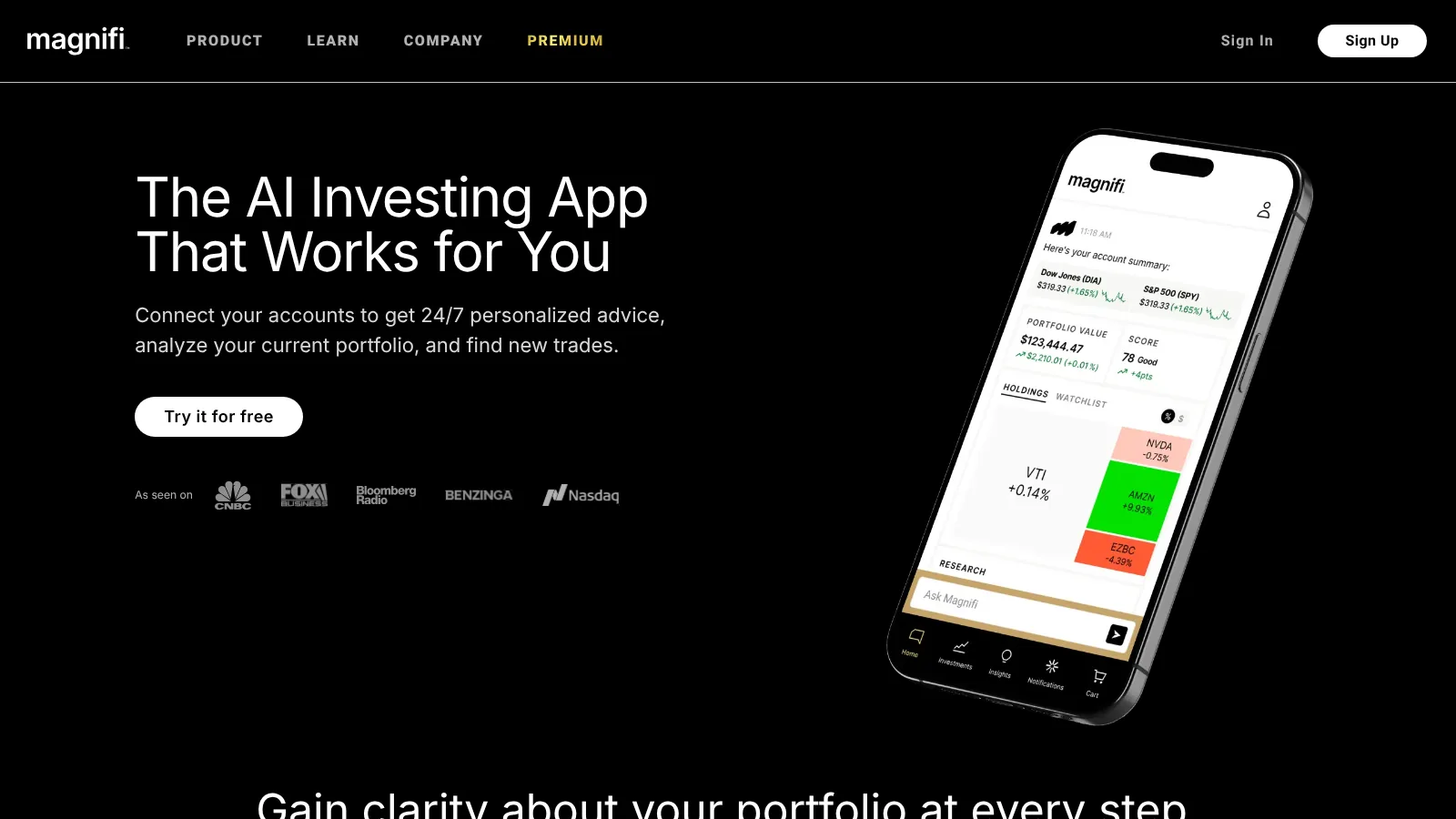
Five features worth knowing:
- Conversational search. Ask about a stock, an ETF, a sector, or "why does my portfolio have so much tech exposure," and Magnifi answers directly.
- Brokerage aggregation. Links to Fidelity, Schwab,
Robinhood, Vanguard, and others to analyze fees, overlap, allocation, and concentration risk.
- Scenario and portfolio forecasting. Premium opens up predictive modeling and weekly portfolio health-check summaries.
- Proprietary research integrations. Premium pulls in outside research layered on top of the chat interface.
- Expanded data via TIFIN's SharingAlpha acquisition. As of October 27, 2026, Magnifi's parent company TIFIN acquired SharingAlpha, planning to integrate 15,000-plus professional fund analysts into the platform. The real-world payoff for retail stock picking wasn't independently confirmed as of this writing.
The real drawback: Magnifi's output quality depends entirely on how you phrase the question and how well your accounts are linked. It's a conversational layer, not a ranking system, if you want a straight numeric score on 500 stocks overnight, that's not the job it's built for. For a deeper breakdown, see the full Magnifi review.
Decision rule: If you already have a scattered portfolio across three brokers and want someone to explain what you actually own, Magnifi earns its subscription. If you want a cold, ranked list of what to buy next, it's the wrong tool for that specific job.
How much do Danelfin and Magnifi cost?
Price is where danelfin vs magnifi looks closer than it is. Danelfin runs $156 a year for Plus and $420 a year for Pro after a 40% price cut; Magnifi's Premium tier is a flat $99 a year. Both publish discounted annual pricing that can shift at checkout, so confirm the number before you enter a card.
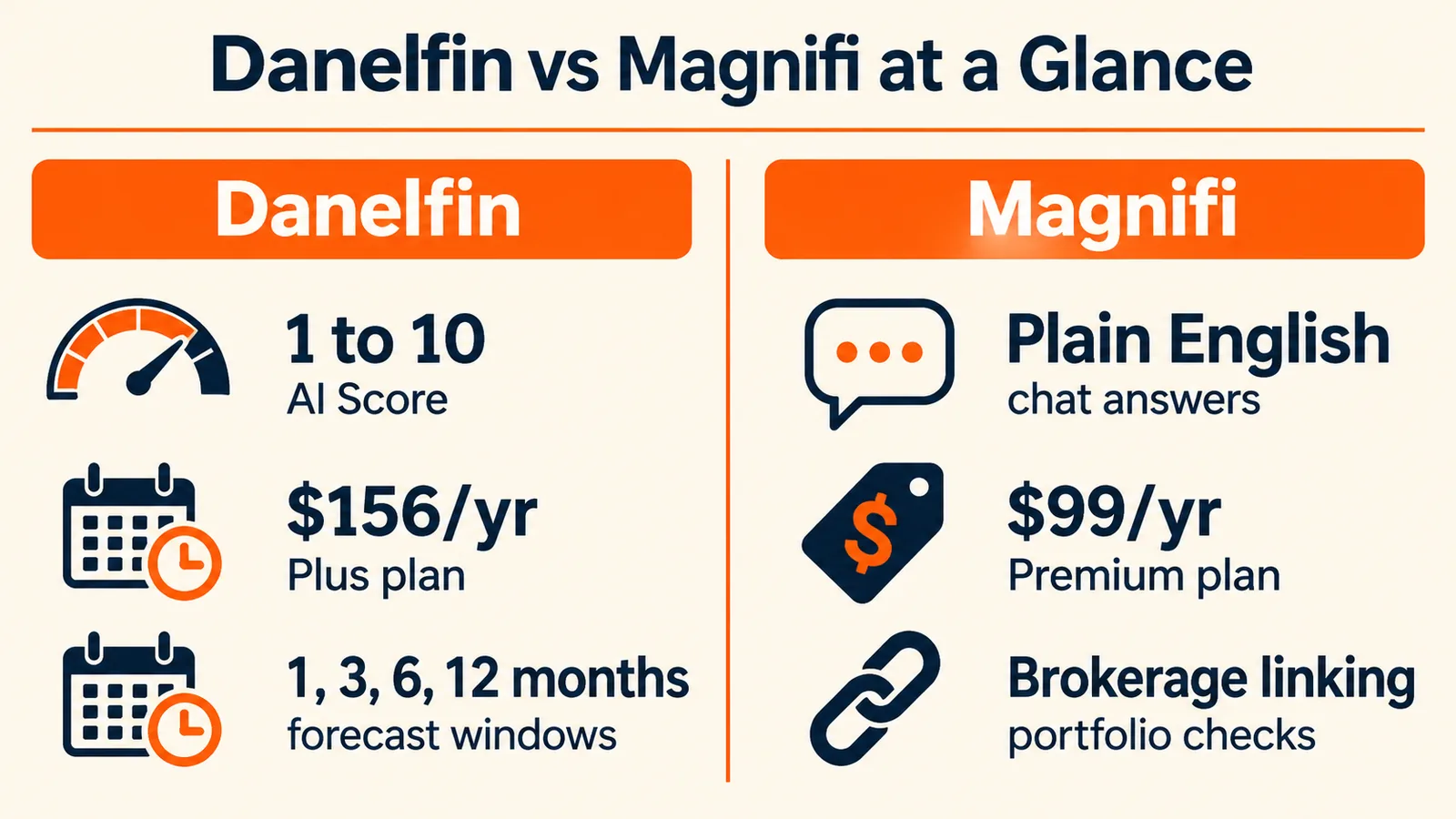
- Danelfin: Plus listed at $156/year ($13/month promotional), Pro at $35/month under the current annual offer, with a 40% off annual discount advertised. Other 2026 reviews cite standard (non-promotional) prices closer to $264 for Plus, $708 for Pro, and $1,608 for Elite. Is Danelfin free? There's a limited free score view, but full features sit behind a paywall.
- Magnifi: Premium costs $99/year, about $8.25/month, and includes scenario analysis, forecasting, and brokerage-linked diagnostics. A free tier exists with reduced functionality.
Common mistake: Comparing the promotional price of one tool to the standard price of the other. Danelfin's headline "$13/month" is a discounted annual rate, not the sticker price. Always check the renewal terms, not just the landing-page banner.
What do real users say about Danelfin and Magnifi?
On user sentiment, danelfin vs magnifi is a quiet fight. 
Magnifi's user base skews toward portfolio-management use cases rather than active stock-picking communities, which makes head-to-head Reddit comparisons harder to find than you'd expect for a tool backed by a firm the size of TIFIN.
Edge case: A thin community footprint doesn't automatically mean a tool is bad. It can mean a tool is newer, narrower, or used quietly by people who don't post reviews. It does mean you should weight the vendor's own claims a little less and your own paper-trading results a little more.
Danelfin vs Magnifi, which one is more accurate?
Accuracy is the question everyone asks about danelfin vs magnifi. Neither company publishes an independently audited, forward-tested accuracy rate that can be verified by a third party, so "more accurate" isn't a question either tool can currently answer with hard proof. What Danelfin does publish is a backtested strategy result, +456% since March 2017 versus +228% for the S&P 500 through September 2026, which is a historical simulation, not a live record.
Magnifi doesn't publish comparable backtest figures because it isn't structured as a ranking engine in the first place; its value sits in research synthesis and portfolio analysis, not predictive scoring.
Practical takeaway: Don't mistake a backtest for a crystal ball. Paper trade any signal from either platform for 30 days before putting real money behind it. Discipline beats prediction every time a backtest looks too good.
Is Danelfin actually worth it for picking stocks?
Danelfin is worth it if you want a documented, numbers-based scoring system and you're willing to pay for the Plus or Pro tier to open up full functionality. It's a weaker fit if you want crowd-sourced validation before you trust a tool, since the public discussion volume is thin.
The AI Score's transparency is a real strength, Danelfin shows its factor model instead of hiding behind "proprietary AI," which is more than most of this market offers. That earns it the top Transparency score on FullStack Alpha's Alpha Score breakdown. But a strong methodology doesn't erase the fact that few outside voices have stress-tested it in public yet.
Can Magnifi help beginners pick stocks?
For beginners, danelfin vs magnifi usually tilts one way. Yes, Magnifi is more beginner-friendly for general investing questions because it answers in plain English instead of requiring you to interpret a numeric score. A new trader who doesn't yet know what "P/E ratio" or "sector concentration" means can just ask Magnifi and get a direct explanation.
Danelfin, by contrast, assumes some comfort with scoring systems and backtests, it's less forgiving if you don't already know what you're looking at.
Decision rule: Choose Magnifi if you're still learning the vocabulary. Choose Danelfin once you know what a benchmark is and want a ranked list to work from.
What are the differences between Danelfin and Magnifi features?
The core difference in any danelfin vs magnifi comparison is input versus output: Danelfin takes market data and outputs a score, while Magnifi takes a question and outputs an explanation. Danelfin's new Stock Screener (80+ filters, natural-language input) narrows that gap slightly, but the underlying design intent is still different.
| Capability | Danelfin | Magnifi |
|---|---|---|
| Score every stock in a sector | Yes | No |
| Explain your existing portfolio's fee drag | No | Yes |
| Natural-language screening | Yes (new, October 2026) | Yes (core feature) |
| Multi-year backtest publishing | Yes | No |
Are there better AI stock picker alternatives to these two?
Yes. The AI stock-picking category is crowded, and Danelfin and Magnifi aren't the only two worth testing. 
For a direct comparison involving one of these two tools and a third competitor, see Danelfin vs Seeking Alpha and Danelfin vs Tickeron, compared side by side. If you want a broader category view, AltIndex vs Danelfin is another useful angle, and the full compare AI stock tools directory lets you line up more options side by side.
Does Magnifi work for day trading or just long term?
Time frame settles a lot of danelfin vs magnifi arguments. Magnifi is built for long-term portfolio research and diagnostics, not for intraday or day-trading decisions. There's no real-time scanner, no tape-reading function, and no fast-twitch alert system, it's a research conversation, not a trading terminal.
Common mistake: Expecting Magnifi to replace a scanner during power hour. It won't. It's better suited to a Sunday-night portfolio review than a 9:35 AM breakout call.
Does Danelfin recommend specific stocks?
Danelfin doesn't publish a single static "buy list", the AI Score updates continuously as new data flows in, so any specific ticker mentioned today could shift tomorrow. The company does publish category pages and sector screens through its blog and platform, but treating any score as a standing recommendation misreads how the model works.
Practical takeaway: Pull a fresh screen before acting, not a cached list from last week. Scores move with the market.
What mistakes do people make with AI stock pickers?
The same mistakes show up on both sides of danelfin vs magnifi. The biggest mistake is treating an AI Score or a chatbot answer as a finished trade plan instead of one input into a bigger process. A score is not a stop loss. A chat answer is not a position size.
- Skipping risk management. No AI score replaces a stop loss or position sizing rule.
- Chasing the score instead of the setup. A high AI Score on an overextended stock is still an overextended stock.
- Treating a backtest like a guarantee. Danelfin's +456% figure is historical, not a forward promise.
- Overtrading on every alert. Signal over noise, pick a few trusted inputs and ignore the rest.
- Skipping the paper trade step. Run any new signal on paper before funding it.
Can you really make money with Magnifi predictions?
Magnifi's forecasting features model scenarios and probabilities; they do not guarantee returns, and no credible AI tool does. Scenario analysis and portfolio diagnostics can sharpen decisions, but the outcome still depends on execution, risk management, and discipline, the trader, not the chatbot, owns the result.
Which platform is best for beginners: Danelfin or Magnifi?
Magnifi is the friendlier on-ramp for a true beginner because it explains things conversationally; Danelfin is better once you understand scores, benchmarks, and backtests well enough to build a system around them. Neither replaces the work of learning what a stop loss or a support level actually is.
Who should pick Danelfin, who should pick Magnifi, and who should use both?
Pick Danelfin if you want a ranked, numbers-first shortlist of stocks to research further. Pick Magnifi if you want a research assistant that understands your actual linked portfolio. Use both if you want a scored watchlist from Danelfin and a sanity check on your overall allocation from Magnifi.

That's not a cop-out answer, it's how a lot of self-directed traders actually run their stack: one tool for sourcing ideas, one tool for managing the whole account. Systems over hacks. The tool doesn't make the plan; you do.
What do the numbers say about Danelfin and Magnifi?
Which AI Stock Tool Fits You? Quick Quiz
Danelfin vs Magnifi, which should you pick?
The danelfin vs magnifi debate isn't really a fight, it's a mismatch of job descriptions. Danelfin scores stocks. Magnifi explains portfolios. Pick based on the question you're actually asking, not the tool with the louder marketing page.
Next step: Paper trade one signal from whichever tool fits your need for 30 days before funding it with real money. Process over prediction, every time. For a wider field of AI tools to test against each other, browse the compare AI stock tools directory, or look at how these platforms stack up against alternatives like Magnifi vs other tools and the AI tools traders won't admit they're using.
200+ AI stock tools are catalogued in the FullStack Alpha directory, filterable by category, price, and use case.
Compare the full field → aistockpickerapps.com
This article may contain affiliate links. FullStack Alpha may earn a commission if you subscribe through a link above, at no extra cost to you.
References
- Stock Market News. danelfin.com.
- Can AI Pick Stocks: 5 AI Investing Apps To Try. money.usnews.com.
- Danelfin AI Score Stock Page. danelfin.com.
- AI Stock Analysis. danelfin.com.
- Danelfin Team. danelfin.com.
Prices are subject to change as fast as AI technology.
We test the tools. You get the verdict.
One email a week. What we tested, what scored, and what we'd skip. Written for traders, not for clicks.
Frequently asked
More from FullStack Alpha