Kavout vs Intellectia AI: The Cheapest AI Stock Picker Compared

Quick answer
Kavout vs Intellectia AI comes down to one question: do you want a quiet second opinion or a wall of signals? Pick Kavout if you want a cheap, readable AI rating you can glance at before you place a trade, starting free and running $16 a month on annual billing. Pick Intellectia AI if you want the lowest entry price in this matchup at $11.96 a month annually, a $1 trial, and the widest toolkit, including SwingMax swing-trade signals. Neither one publishes a live, audited track record, so treat both as research assistants, not autopilots.
Key Takeaways
- Intellectia AI is cheaper at the door. Its entry plan runs $11.96 a month on annual-equivalent pricing, against Kavout Pro at $16 a month annually ($20 month to month). That is roughly a $48 a year gap.
- Kavout is the only one of the two with a genuinely free tier. Ten credits, no card, enough to pressure-test the Kai Score on a few tickers before you spend anything.
- Intellectia AI's $1 trial is the cheapest full-toolkit test in this category. One dollar buys you access to the signal stack instead of a demo video.
- Their public sentiment tells two different stories. Intellectia AI holds a 4.72 rating from 442 ratings on the Apple App Store, and a 2.9 from 35 reviews on Trustpilot. Kavout has exactly 1 Trustpilot review, which is not a sample, it is an anecdote.
- Win-rate marketing is the weak spot. Intellectia AI's advertised win rates are framed off maximum possible profit, and one Trustpilot reviewer who followed the published stops and targets described results closer to 55%. Vendor-claimed, not audited.
- FullStack Alpha Alpha Scores: Kavout 62 out of 100, Intellectia AI 57 out of 100. Both land below Danelfin at 75 and Motley Fool Stock Advisor at 69 on the same 100-point scale.
- At the $39 tier they are nearly the same price. Kavout Premium is $39 a month annually, Intellectia AI's third tier is $39.96. At that level, pick on features, not dollars.
- The Kavout vs Intellectia AI decision is cheap to test: Kavout has a free plan and Intellectia charges $1 for its trial.
Quick comparison table
| Product | Entry price | Free or trial | Core AI output | Platforms | Alpha Score | Best for |
|---|---|---|---|---|---|---|
| Kavout | $16/mo annual ($20 month to month) | Free plan, 10 credits | Kai Score machine-learning stock rating + InvestGPT research assistant | Web | 62/100 | Budget investors who want one clear AI rating before a trade |
| Intellectia AI | $11.96/mo annual-equivalent | $1 trial | AI stock picks, SwingMax swing signals, technical and fundamental analysis, AI assistant | Web, iOS | 57/100 | Active swing traders who want many signal tools in one app |
Higher tiers: Kavout Premium $39/mo annual. Intellectia AI $23.96, $39.96 and $71.96 per month on annual-equivalent pricing. Confirm current prices on each official pricing page. Use this quick Kavout vs Intellectia AI table to see the price and fit gap at a glance.
Kavout vs Intellectia AI: which is the cheapest AI stock picker worth paying for?
Intellectia AI is cheaper on the sticker. Kavout is cheaper to find out whether you actually want it. Those are two different kinds of cheap, and most people confuse them.
Here is the math, since nobody else seems willing to do it. Intellectia AI's entry plan at $11.96 a month on annual billing works out to about $143.52 for the year. Kavout Pro at $16 a month annually is $192. You save roughly $48 a year by going with Intellectia AI, which is about four coffees and a sandwich. If $48 a year is the deciding factor in your tool stack, the tool stack is not your problem.
What actually matters is the cost of being wrong. Kavout lets you open a free account with 10 credits and get a Kai Score on real tickers before any card touches the form. Intellectia AI charges $1 for a trial, which is close enough to free that the distinction is academic, and in exchange you get to test the whole signal library instead of a sliver of it.
Decision rule: if you research fewer than five names a week and want one number to sanity-check your own thesis, Kavout. If you trade swings weekly and want scanners, signals and analysis in one place, Intellectia AI.
The common mistake here is picking by price and then paying twice. Traders sign up for the $11.96 plan, discover they wanted a simple rating rather than six feeds of signals, and buy a second subscription three weeks later. Two cheap tools cost more than one right one. Before you subscribe to either, write down the single question you want answered. If it is "is this name strong or weak right now," that is a rating problem. If it is "what should be on my watchlist tomorrow," that is a scanner problem.
Try Kavout free → · Start the Intellectia AI $1 trial →
What is Kavout AI and how does the Kai Score work?
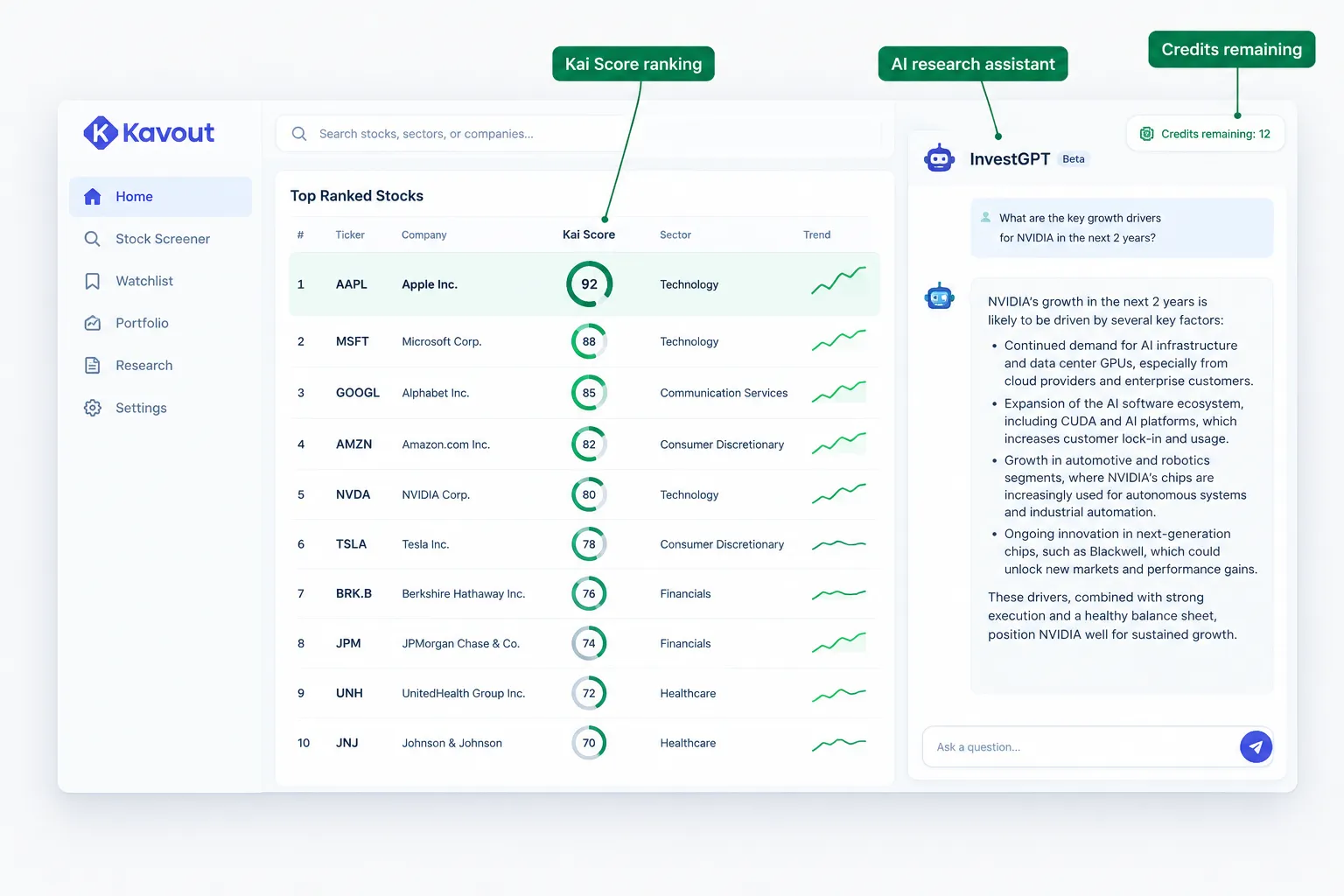 In any Kavout vs Intellectia AI matchup, the Kai Score is Kavout's core: one ranking you can check in seconds.
Kavout is an AI stock research platform built around the Kai Score, a machine-learning rating that ranks stocks on a simple scale so you can see at a glance whether the model likes a name or not. Alongside it sits InvestGPT, an AI research assistant that answers questions about stocks and markets in plain English.
Think of the Kai Score the way you'd think of a nutrition label. It does not cook dinner for you. It tells you, in one glance, whether what you are about to eat is closer to salmon or closer to a gas station hot dog. You still decide whether you are hungry.
What you get
- Kai Score. A single machine-learning ranking per ticker. Fast to read, hard to misinterpret, which is the point.
- InvestGPT. Ask a question about a company, a sector, or a market condition and get a written answer instead of a chart you have to decode.
- AI stock picks and screeners. Lists built off the model's rankings, so you can start from a shortlist rather than 7,000 tickers.
- Research summaries. Condensed takes so you are not reading a 10-K at 11pm.
The part Kavout does not tell you
Kavout does not publish a live, verified track record for its AI picks. That is not a small gap. The whole premise of a quantitative rating is that it has been measured over time, in public, through at least one ugly market. Without that, the Kai Score is a well-built opinion.
How to use it anyway: treat the Kai Score as a tiebreaker, not a trigger. You find a clean setup on your own, basing under resistance, tight consolidation, volume drying up. Then you check the score. If the model agrees, size normally. If the model disagrees, size smaller or pass. The score adjusts your conviction, it does not create it.
Who Kavout is for
Self-directed investors and swing traders on a budget who already have a process and want one more data point. If you are using it to decide what to buy because you have no idea what to buy, you are using it backwards.
What is Intellectia AI and what does it include?
 That breadth is the main reason Intellectia sits on the other side of the Kavout vs Intellectia AI question.
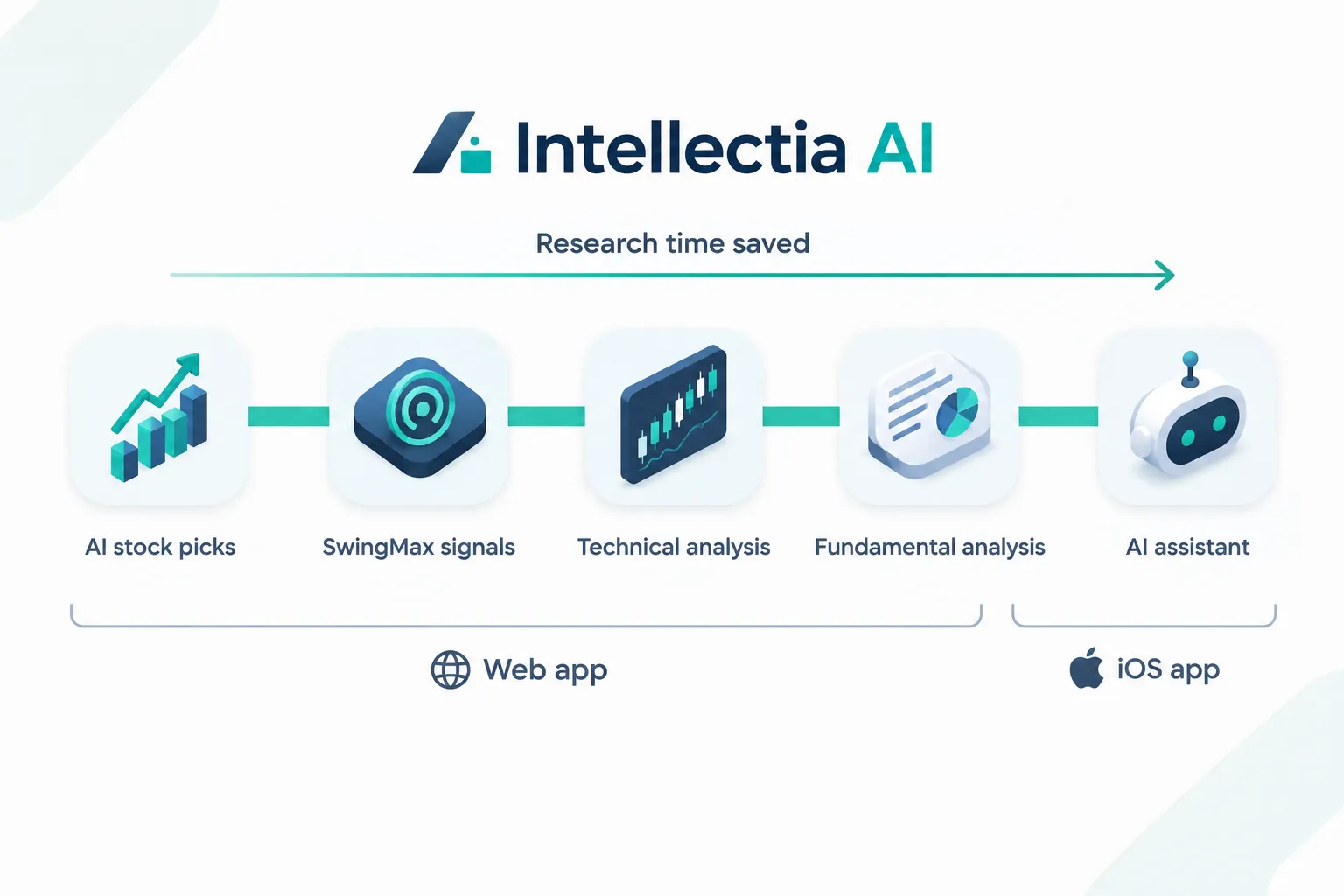
Intellectia AI (intellectia.ai) is an AI trading signals and stock research platform that bundles AI stock picks, swing trading signals under the SwingMax name, technical and fundamental analysis tools, and an AI research assistant. It runs on web and iOS, uses a 400-credit system per plan, and offers a $1 trial.
Where Kavout gives you one number, Intellectia AI gives you a buffet. That is the appeal and the risk in the same sentence.
What's in the box
- AI stock picks. Model-generated ideas with entry context rather than a bare ticker.
- SwingMax swing signals. Setups aimed at multi-day holds, with stops and targets attached, which at least forces the question of risk-reward before you click.
- Technical analysis tools. Price action, support and resistance, trend reads packaged for people who do not want to draw every line themselves.
- Fundamental analysis. Earnings and financial context next to the chart, so you are not trading a biotech into an FDA date blind.
- AI research assistant. Natural-language questions, written answers, same idea as InvestGPT.
- iOS app. Rated 4.72 from 442 ratings on the Apple App Store. Mobile is where most retail traders actually live, so this counts.
The accuracy problem, stated plainly
Intellectia AI markets win rates calculated from maximum possible profit, meaning the measurement assumes you exited at the best available price on the move. Nobody does that. Not you, not me, not the person posting screenshots.
One Trustpilot reviewer who followed the published stops and targets as written reported something nearer 55%. That is one reviewer, not a study, and both numbers are vendor-adjacent rather than audited. The useful lesson is structural: a win rate measured against the perfect exit is a measurement of the model's best day, not your account's average day. The U.S. Securities and Exchange Commission's investor education arm makes the same general point about performance claims, which is that advertised results you cannot independently verify should carry less weight in your decision (investor.gov).
Decision rule: if a tool's advertised win rate does not state the exit rule used to calculate it, discount the number by default. We dug into why those figures mislead in AI stock prediction: 3 reasons the accuracy number lies.
Who Intellectia AI is for
Active swing traders who want many signals in one app and have the discipline to ignore most of them. If you cannot say no to a signal, more signals will cost you money.
Start the $1 Intellectia AI trial →
Kavout pricing vs Intellectia AI pricing in 2026
Intellectia AI wins the entry price. Kavout wins the free tier. At the mid tier they are effectively tied, and at the top tier Intellectia AI gets expensive fast. On sticker price alone, Kavout vs Intellectia AI is closer than most readers expect: $16 against $11.96 a month on annual billing.
| Tier | Kavout | Intellectia AI |
|---|---|---|
| Free | Free plan, 10 credits | None (the $1 trial stands in) |
| Trial | Free plan serves as the trial | $1 trial |
| Entry paid | Pro $16/mo annual, $20 month to month | $11.96/mo annual-equivalent |
| Mid | Premium $39/mo annual | $23.96/mo and $39.96/mo annual-equivalent |
| Top | Premium is the ceiling | $71.96/mo annual-equivalent |
| Credits | 10 on free plan | 400 per plan |
Prices checked.
What the numbers mean in practice
- Annualized entry cost: about $143.52 for Intellectia AI, $192 for Kavout Pro, $240 if you pay Kavout monthly. Paying Kavout month to month costs you $48 a year over the annual rate, the same amount you'd save by choosing Intellectia AI instead. Billing cycle matters as much as brand here.
- The $39 crossover: Kavout Premium at $39 and Intellectia AI's $39.96 tier are a rounding error apart. Once you are at that level, compare features and ignore the price tag.
- The $71.96 tier is a different conversation. That's $863.52 a year. For that money, you should expect a verified record, not a broader feature list. Ask what the top tier gives you that the $39.96 tier does not, and whether you will realistically use it in a choppy tape.
Credits are the hidden meter
Both platforms run on credits, which is the SaaS version of a taxi meter. Kavout's free 10 credits disappear quickly if you research three or four names in a sitting. Intellectia AI's 400 credits sound generous until you discover how fast you burn them clicking through every signal that appears.
Practical fix: before you upgrade, track one week of actual usage. Count how many distinct tickers you genuinely researched, not how many you clicked. Most traders research six to ten names a week and click forty. Buy the plan that fits the six to ten.
How accurate are Kavout and Intellectia AI picks?
Neither publishes a live, independently audited track record, so the honest answer is that nobody outside those two companies knows. That is the single most important line in this comparison. Neither side of Kavout vs Intellectia AI publishes a live, audited track record, so treat both as a second opinion.
Here is what exists:
- Kavout: no published live track record for its AI picks. The Kai Score is presented as a machine-learning ranking without a public, time-stamped performance ledger you can inspect.
- Intellectia AI: win rates marketed from maximum possible profit, plus one Trustpilot reviewer's account of roughly 55% when following the actual stops and targets. Both are vendor-claimed or single-user reports, not audited results.
Why max-profit win rates are the oldest trick in the category
Imagine a fitness app that measures your progress by your single best rep of the month. Technically true. Completely useless for predicting next Tuesday. A win rate calculated from the maximum possible profit on a move does the same thing, because it quietly assumes you sold the exact high.
Your real results depend on three things the model does not control: where you enter, where your stop sits, and whether you hold through the first red candle. Position sizing will move your equity curve more than the difference between a 55% and a 65% signal hit rate. The research backs the behavioral half of that: the Financial Industry Regulatory Authority has long flagged overtrading and performance-chasing as common, costly retail habits (finra.org).
A three-step way to test either tool yourself
- Paper trade it first for 30 days. Log every signal or score you would have acted on, including the ones you skipped. Skipped trades are data.
- Record entry, stop, target and outcome. No stop, no entry. If the tool does not give you a stop, you set one before you place the trade.
- Compare the tool's calls against your own. If the AI's picks and your picks agree 80% of the time, you are paying for reassurance. Reassurance has a price, just know you are buying it.
Edge case worth flagging: both tools will look brilliant in a strong trending market, because almost everything looks brilliant when the trend is your friend. Judge them in a choppy tape, when half the breakouts turn into a bull trap and the gap fills before lunch. That's the real exam.
Comparison table: Kavout vs Intellectia AI side by side
| Factor | Kavout | Intellectia AI |
|---|---|---|
| Core product | Kai Score AI stock rating | AI signals and picks across multiple modules |
| AI assistant | InvestGPT | Built-in AI research assistant |
| Swing trading signals | Not a dedicated module | SwingMax |
| Technical analysis tools | Screeners and research summaries | Dedicated technical tools |
| Fundamental analysis | Research summaries | Dedicated fundamental tools |
| Free plan | Yes, 10 credits | No |
| Trial | Free plan | $1 |
| Entry price | $16/mo annual, $20 monthly | $11.96/mo annual-equivalent |
| Top price | $39/mo annual | $71.96/mo annual-equivalent |
| Credits | 10 on free tier | 400 per plan |
| Mobile app | Web-first | Web and iOS |
| App Store rating | Not applicable | 4.72 from 442 ratings |
| Trustpilot | 2.9-level sentiment not established, 1 review total | 2.9 from 35 reviews |
| Published live track record | No | No, win rates marketed from max possible profit |
| Alpha Score | 62/100 | 57/100 |
| Best fit | AI second opinion before a trade | Many signal tools in one app |
All ratings and prices checked.
Top 5 favorite features in Kavout vs Intellectia AI
Five features in this matchup earn their keep. The rest is packaging.
1. Kavout's Kai Score (Kavout). One number, readable in two seconds, applied consistently across names. Speed of interpretation is an underrated feature. A rating you understand instantly gets used. A dashboard with 14 panels gets admired and abandoned.
2. Intellectia AI's SwingMax signals (Intellectia AI). Swing setups that arrive with stops and targets attached. Even if you override every one of them, the format forces you to define entry and exit before you commit, which is more structure than most traders impose on themselves.
3. InvestGPT plain-English answers (Kavout). Asking "why did this name sell off into earnings" and getting a paragraph back beats hunting through three tabs. Good for beginners, good for anyone short on time during earnings season.
4. Intellectia AI's $1 trial (Intellectia AI). The cheapest way in this category to test a full toolset rather than a trimmed demo. One dollar to answer "will I actually open this app on a Tuesday morning" is the best spend in this entire article.
5. Kavout's free 10-credit plan (Kavout). No card, no commitment, real tickers. Free tiers count heavily in Price-to-Value scoring for a reason: they let the product argue for itself.
What did not make the list: every "AI-powered" label applied to a feature that is a filter with a new coat of paint. For more on separating the two, see AI stock screeners vs the old filters you're still wasting time on.
What we like about Kavout
Kavout's strength is restraint. It gives you a rating and an assistant, then gets out of the way.
✅ Pros
- Free plan with 10 credits lets you test the Kai Score before you pay a cent
- Pro at $16 a month on annual billing is one of the lowest entry prices for an AI stock picker
- The Kai Score is a quick, easy-to-read ranking for any ticker, with no interpretation tax
- InvestGPT answers research questions in plain English instead of handing you another chart
- Users describe the interface as clear and well laid out, useful as a second opinion before a trade
The thing worth paying for is cognitive quiet. Most traders do not suffer from too little information. They suffer from analysis paralysis caused by six scanners disagreeing. A single rating, used as a tiebreaker on setups you found yourself, reduces decisions rather than multiplying them.
Quick example: you have three names basing near support, and your rule says you only take one. Pull the Kai Score on all three, take the strongest, skip the others. That is a 90-second use of the tool that improves a decision you were going to make anyway.
What we don't like about Kavout
The gaps are about proof and ceiling, and they are real.
❌ Cons
- No published live track record for its AI picks. You are asked to trust a quantitative rating with no public, time-stamped ledger behind it. For a product whose entire pitch is machine learning, that is the wrong thing to leave out.
- Exactly 1 Trustpilot review. One review is not sentiment, it is a coin flip. There is almost nothing independent to corroborate the experience, which drags the Community Verdict pillar hard.
- The free plan's 10 credits run out fast. Research three or four names in one sitting and you are at the paywall before you have formed an opinion about the product.
- Thin feature set if you want signals. No dedicated swing signal module, no mobile app in the mix. If your workflow is "scan, signal, execute," Kavout is only doing the middle part.
Who should skip Kavout: day traders and anyone who needs intraday speed. A rating is a slow-moving judgment. It will not help you during power hour.
What we like about Intellectia AI
Intellectia AI is the better deal if breadth is what you are buying, and the $1 trial makes that easy to verify.
✅ Pros
- Lowest entry price in this comparison at $11.96 a month on annual billing
- The $1 trial makes it genuinely cheap to test the full toolset, not a trimmed demo
- Wide toolkit in one app: AI stock picks, SwingMax swing signals, technical and fundamental analysis, AI assistant
- Strong Apple App Store rating of 4.72 from 442 ratings, which reflects real phone users rather than a landing page
- Users report it cuts research time and helps narrow a watchlist before a trade
The research-time claim is the one I'd take seriously. If you currently spend 90 minutes a night building a watchlist and the app gets you to a shortlist in 20, that's 70 minutes back. At $11.96 a month, the time math works even if you override most of the signals. Swing traders comparing options should also read 7 AI tools swing traders are using to catch moves before everyone else.
Get the $1 Intellectia AI trial →
What we don't like about Intellectia AI
Two problems, and one of them is about how the product talks about itself.
❌ Cons
- Win rates marketed from maximum possible profit. That framing assumes a perfect exit, which no human executes. One Trustpilot reviewer following the published stops and targets described results closer to 55%. Vendor-claimed figures measured this way should not drive a purchase decision.
- Trustpilot sits at 2.9 from 35 reviews, well below the 4.72 App Store rating from 442 ratings. That gap is the finding. App Store prompts tend to fire after good moments inside the app, while Trustpilot collects people with billing and expectation complaints. A product can be pleasant to use and still frustrate people at renewal.
- The paywall and credit system frustrate some App Store users. Hitting a credit wall mid-research is the fastest way to resent a subscription.
- Signal volume invites overtrading. This is a user problem more than a product flaw, but the product does not help. More signals means more chances to chase something already overextended.
Who should skip Intellectia AI: anyone who has caught themselves revenge trading after a loss. A firehose of setups handed to a trader with no rules is a bad combination. Fix the rules first.
What do Kavout reviews and Intellectia AI reviews say?
Public sentiment is thin for Kavout and split for Intellectia AI, so neither one gives you a clean read. Public sentiment in the Kavout vs Intellectia AI comparison is lopsided: Kavout has 1 Trustpilot review, Intellectia AI has 35.
Kavout: 1 Trustpilot review total. The qualitative feedback that exists describes a clear, well laid out platform that works as a second opinion before a trade. That matches what the product is, and it tells you almost nothing about durability, billing, or support at scale. Scoring rule applies here: thin discussion scores low even when a tool is good, because there is nothing to corroborate.
Intellectia AI: 4.72 from 442 ratings on the Apple App Store, 2.9 from 35 reviews on Trustpilot. Themes we can state from the public record: users value the time saved on research and the breadth of tools, and the complaints cluster around the paywall, the credit system, and win-rate expectations not matching outcomes.
How to read a split like that
Read the rating source's bias before you read its number.
- App Store ratings skew positive because prompts appear after a good in-app moment. Useful for judging the mobile experience.
- Trustpilot skews negative because people arrive there to complain about billing and cancellation. Useful for judging what happens after the honeymoon.
- Reddit skews negative but unsolicited, which makes it useful for real usage patterns. Public discussion of both products remains thin there.
A product rated 4.7 on mobile and 2.9 on Trustpilot is not a contradiction. It usually means the app is enjoyable and the commercial relationship is not. Check the cancellation path before you pay for a year.
Kavout AI stock picker alternatives: Danelfin AI and others
If transparency is your top priority, Danelfin scores higher than both tools in this comparison, at 75 out of 100 on the FullStack Alpha Alpha Score. If neither side of Kavout vs Intellectia AI fits your process, these alternatives cover the same job.
- Danelfin (Alpha Score 75/100). Scores 19 out of 20 on Transparency, the highest on our board, because it publishes the factors behind its AI score instead of saying "proprietary model" and stopping. The counterweight: Community Verdict sits at 9 out of 20, because almost nobody is discussing it publicly. Strong method, thin crowd.
- Motley Fool Stock Advisor (Alpha Score 69/100). Long-horizon stock recommendations rather than swing signals. Transparency on methodology is thin at 13 out of 20, and the renewal price is the catch. Different job entirely, so compare it only if your holding period is years.
- Broader field. There are over 200 AI stock tools catalogued in the FullStack Alpha directory, and a meaningful share of them are a public language model with a dashboard bolted on. Our AI trading platforms hub sorts them by what they actually do.
Decision rule: if you cannot see the factors behind a score, you are buying confidence, not information. That does not make the tool worthless. It does mean you should pay less for it, and never size a position on it alone.
How the Alpha Score rates Kavout and Intellectia AI
Kavout scores 62 out of 100. Intellectia AI scores 57 out of 100. Both are built from desk research plus public user sentiment, with the pillar split still provisional and therefore not published yet. On the Alpha Score, Kavout vs Intellectia AI ends Kavout 62, Intellectia AI 57. The score comes from FullStack Alpha desk research plus public user sentiment, and the pillar split is provisional.
| Tool | Alpha Score | Pillar split | Basis |
|---|---|---|---|
| Kavout | 62/100 | Provisional, not yet published | Desk research plus public user sentiment |
| Intellectia AI | 57/100 | Provisional, not yet published | Desk research plus public user sentiment |
The Alpha Score runs on five pillars worth 20 points each: Signal Quality, Transparency, Price-to-Value, Usability and Community Verdict. Here is what the totals reflect without inventing numbers we have not finalized.
Why Kavout sits at 62. Price-to-Value is the pillar carrying it. A free tier plus a $16 annual entry price does real work, and the Kai Score plus InvestGPT delivers something useful inside the first session. What holds it back: no published live track record, which is a Transparency and Signal Quality problem at once, and a single Trustpilot review, which leaves Community Verdict with nothing to stand on.
Why Intellectia AI sits at 57. The toolkit is broad, the $1 trial is close to frictionless, and the iOS app is well received at 4.72 from 442 ratings. The drag comes from win rates framed off maximum possible profit, which is a Transparency issue by design rather than by omission, plus a 2.9 Trustpilot score from 35 reviews and credit-wall complaints that hit Usability.
Neither score says "do not buy." A 62 and a 57 say "useful, unproven, cheap enough to test." For context, the same methodology put Danelfin at 75 and Motley Fool Stock Advisor at 69.
Full methodology lives in our about page.
FullStack Alpha scorecards
Every tool in this article has a full scorecard: pricing, pros and cons, verified user quotes and the Alpha Score breakdown.
FAQ
Is Kavout free?
Yes, Kavout offers a free plan with 10 credits, which is enough to pull a Kai Score on a handful of tickers and test InvestGPT before paying. The credits run out quickly if you research several stocks in one sitting. Paid plans start at $16 a month on annual billing.
How much does Kavout cost?
Kavout Pro is $16 a month billed annually, or $20 month to month. Kavout Premium is $39 a month billed annually. There is also a free plan with 10 credits. Annualized, Pro runs about $192 a year versus $240 if you pay monthly (prices checked).
Is Intellectia AI legit?
Intellectia AI is a real, operating AI stock research and signals platform at intellectia.ai, with a 4.72 rating from 442 ratings on the Apple App Store and a 2.9 from 35 reviews on Trustpilot. The legitimate criticism is about its marketing rather than its existence: advertised win rates are calculated from maximum possible profit, and it publishes no independently audited live track record.
Is Intellectia AI worth it?
At $11.96 a month on annual billing with a $1 trial, Intellectia AI is worth testing if you are an active swing trader who will use multiple signal tools and already has written entry, stop and exit rules. It is not worth it if you want one simple rating, or if extra signals tempt you into overtrading. Spend the $1 before you spend $143.52.
What is the Kai Score?
The Kai Score is Kavout's machine-learning stock rating, a single ranking that summarizes how the model views a given stock so you can read it at a glance. It works best as a tiebreaker on setups you found yourself, not as a buy trigger. Kavout does not publish a live, audited track record for the score.
Which is cheaper, Kavout or Intellectia AI?
Intellectia AI is cheaper to subscribe to, at $11.96 a month on annual-equivalent pricing versus Kavout Pro at $16 a month annually, a gap of roughly $48 a year. Kavout is cheaper to try, because its free 10-credit plan requires no payment at all, while Intellectia AI charges $1 for its trial.
What is the most accurate AI stock picker?
No AI stock picker can be ranked "most accurate" with confidence, because very few publish live, independently audited results, and advertised win rates often assume perfect exits. Among tools we score, Danelfin rates highest on Transparency at 19 out of 20 because it publishes the factors behind its score. Accuracy claims you cannot verify should carry less weight than price, usability and whether the tool fits your process.
Can either tool trade for me automatically?
No. Kavout and Intellectia AI are research and signal platforms, not brokers or automated trading systems. You place your own orders, set your own stops, and carry your own risk. Treat both as a second opinion, not an autopilot.
Final verdict: who should pick Kavout and who should pick Intellectia AI?
Pick Kavout if you are a self-directed investor or swing trader who already finds your own setups and wants one clear AI rating to confirm or challenge your read. Free plan first, then Pro at $16 a month annually if the Kai Score earns a spot in your routine. It is the better choice for beginners, because a single number is harder to misuse than fourteen signals. Our Kavout vs Intellectia AI verdict: Kavout for a cheap second opinion, Intellectia AI for the most signal tools at the lowest entry price.
Pick Intellectia AI if you trade swings actively, live on your phone, and want picks, SwingMax signals, technical and fundamental tools and an AI assistant in one place for $11.96 a month. Spend the $1 first. It is the better choice for traders who already have written rules and will use the breadth instead of drowning in it.
Pick neither if you want a verified track record before you pay. Neither publishes one. If audited performance is your bar, you are shopping in the wrong price tier, and you should know that going in rather than discovering it in month three.
If you are still torn, do this: open Kavout's free plan and Intellectia AI's $1 trial in the same week. Run both against the same five tickers from your watchlist. Log which tool you opened on the second day without being prompted. That app is the one you will actually use, and usage beats features every time. Systems over hacks.
Related reading
- 15 AI investment tools that are replacing traditional research in 2026
- AI trading signals: how accurate are they really
- AI trading software: what you pay for vs what you get
Start free or for $1 and test before you pay
You do not need to guess which one fits. Both doors are cheap.
🛒 Start the Intellectia AI $1 trial →
Give each one 30 days, log every signal you act on and every one you skip, and let your own records make the argument. Cut the noise, keep the alpha.
Two tools compared here. 200+ catalogued in the FullStack Alpha directory, sorted by category, price and use case.
Compare the full field → aistockpickerapps.com
This is education, not financial advice.
Your market edge starts with the right tool. Stay alpha.
Some links in this article are affiliate links, which may earn FullStack Alpha a commission at no extra cost to you. Scores and rankings are never influenced by payment. Nothing here is investment advice.
We test the tools. You get the verdict.
One email a week. What we tested, what scored, and what we'd skip. Written for traders, not for clicks.
More from FullStack Alpha