Fiscal AI vs Koyfin: Which Research Terminal Fits AI Work
Quick answer
Fiscal AI vs Koyfin comes down to one question: do you want to look at data or talk to it? Koyfin wins for most self-directed investors because the free plan is real, the dashboards are deeper, and Plus runs $39 a month with Premium at $79. Fiscal AI wins if your research already lives inside an AI assistant, because its MCP connector pipes company financials, segment data, filings, and transcripts straight into that assistant. Koyfin scores 85 out of 100 on the FullStack Alpha Alpha Score. Fiscal AI scores 72.
Key Takeaways
- Koyfin Plus is $39 a month, Premium is $79 a month, and both offer annual billing at up to 30% off (the exact annual number shows at checkout). Advisor Core jumps to $209 and Advisor Pro to $299.
- Fiscal AI's pricing page shows no prices, only a 7-day free trial on Terminal and MCP at signup. Third-party reviews report Pro near $49 a month ($468 a year) and Enterprise near $249 a month, so confirm at signup. If those reported figures hold, $468 a year works out to about $39 a month.
- Koyfin has a genuine free tier. Fiscal AI has no free plan on its pricing page, only a 7-day free trial on Terminal and MCP at signup.
- The MCP connector is Fiscal AI's actual differentiator. Model Context Protocol is the open standard Anthropic published in November 2024 for wiring AI assistants to outside data, and Fiscal AI uses it to let Claude and other MCP clients query its financial database.
- Reddit's nickname for Koyfin is "a poor man's Bloomberg." Bloomberg Terminal seats are widely reported in the high-$20,000s to low-$30,000s per user per year, so the comparison isn't flattery, it's arithmetic.
- Fiscal AI's Trustpilot sample is thin: about 24 reviews averaging 4.3 stars, most clustered in a February 2026 burst. Good sentiment, tiny sample, and clustered timing is weak evidence.
- Koyfin covers more asset classes. Global equities, ETFs, mutual funds, fixed income, currencies, and commodities, plus macro and model portfolios. Fiscal AI is narrower and deliberately so, built around company fundamentals.
- The Fiscal AI vs Koyfin choice is cheap to test: Koyfin has a free plan and Fiscal AI offers a 7-day free trial.
Quick comparison table
| Product | Price | AI capability | Data breadth | Free access | Best For |
|---|---|---|---|---|---|
| Koyfin | Free $0; Plus $39/mo; Premium $79/mo; Advisor Core $209/mo; Advisor Pro $299/mo (annual up to 30% off) | Not the headline feature | Global equities, ETFs, mutual funds, fixed income, FX, commodities, macro | Yes, real free plan | Self-directed investors and advisors who want deep fundamentals plus custom dashboards |
| Fiscal AI | Not listed publicly; 7-day free trial; Pro reported near $49/mo | AI-first, plus MCP connectors into your own assistant | Company financials, KPIs, segments, filings, earnings transcripts | Reported as $0 tier and/or 7-day trial | Fundamental equity investors who run research through Claude or another AI assistant |
Try Koyfin Free → | Start with Fiscal AI → This Fiscal AI vs Koyfin table puts price, data and AI features side by side.
Fiscal AI vs Koyfin: which research terminal is better for AI work?
Fiscal AI is better for AI work. That's not a close call, and it's also not the whole story.
Fiscal AI was built with the assumption that an AI assistant is part of your workflow. Its MCP connectors exist so the model you already pay for can pull Fiscal AI's financial data without you copying numbers into a chat window like it's 2023. Koyfin was built on the assumption that you are the analyst and the screen is your instrument panel.
Both assumptions are defensible. Only one of them matches the way you work.
The decision rule: if you open Claude or ChatGPT before you open a browser tab, Fiscal AI's architecture saves you real time. If you open a dashboard, scan eight tiles, and know within 20 seconds whether a name is worth more work, Koyfin is the better $39.
Here's the uncomfortable part for the AI-first crowd. An AI assistant answering a question about gross margin trend is only as good as the data behind it and your ability to sanity-check the answer. Garbage in, confident garbage out. If you can't eyeball a financial statement and spot when a number looks wrong, the conversational interface isn't helping you, it's hiding things from you. Process over prediction applies to research tools too.
Common mistake: buying the AI tool to skip the learning. Investors who understand fundamentals get more out of Fiscal AI than investors who hope Fiscal AI will supply the understanding. If you're newer, start with the structured view, learn what the line items mean, then add the assistant. Our breakdown of what beginners get wrong about AI stock research covers that trap in more depth.
What is Fiscal AI and how does its AI research work?
Fiscal AI (fiscal.ai) is an AI-powered fundamental research terminal for stock investors. It serves company financials, KPI and segment data, SEC filings, and earnings call transcripts, and it ships MCP connectors that bring that data into whatever AI assistant you already use. That AI-first design is the core of the Fiscal AI vs Koyfin split.
Three pieces make up the product:
1. The Terminal. Standardized financial statements, valuation metrics, segment breakdowns, and company-specific KPIs. This is the part that competes head-on with Koyfin's fundamentals screens, and it's narrower by design. Fiscal AI isn't trying to be your macro dashboard.
2. The AI layer. You ask questions in plain English about a company's financials and get answers drawn from the underlying dataset rather than from the open internet. The pitch is that you spend less time hunting for the right cell in the right filing.
3. The MCP connectors. The genuinely new thing, covered in its own section below.
The segment and KPI data deserves attention. Pulling, say, a cloud provider's revenue by reportable segment over 20 quarters, or a retailer's same-store sales trend, is the kind of task that eats an afternoon with SEC EDGAR filings and a spreadsheet. Having it pre-standardized is worth paying for if you do that work weekly.
Who it's for: fundamental equity investors, analysts, and research-focused users who want AI-assisted deep statement and KPI analysis, and who want to query financial data from inside their AI tools.
Who it's not for: traders who need macro context, fixed income, FX, commodities, or mutual fund coverage. Also not for anyone who wants to test a terminal for a month before paying, since the free access story is murky.
Edge case worth flagging: Trustpilot reviewers report finding occasional data errors, and also report that support fixed them quickly. Both halves matter. Fast fixes are a real sign of a team that cares. Errors existing at all means you verify anything you're about to size a position around. Any dataset has them... the question is whether you treat the terminal as gospel or as a first draft.
What is Koyfin and who is it built for?
Koyfin is a web-based market research terminal for fundamentals-first investors, covering financial statements, analyst estimates, valuation multiples, custom dashboards, and charting across global equities, ETFs, mutual funds, fixed income, currencies, and commodities, plus macro data and model portfolios. On the Koyfin side of Fiscal AI vs Koyfin, the pitch is depth and dashboards, not a chatbot.
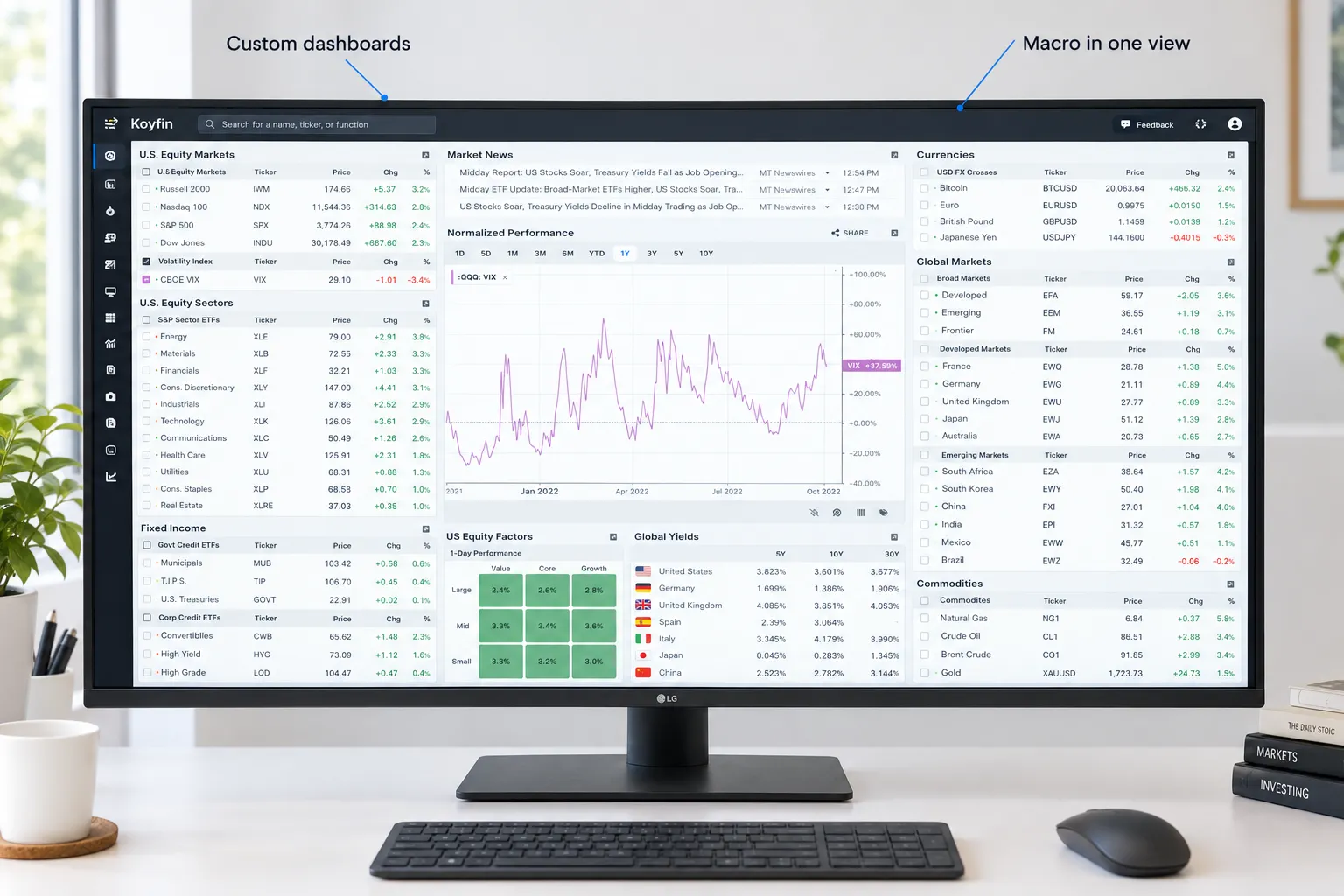
Reddit calls it a poor man's Bloomberg. That's the most useful four-word summary anyone has written about it, because it tells you both what you get and what you're giving up. You get institutional-grade breadth of data and layout control. You give up the chat, the messaging network, the execution, and the five-figure invoice.
What the platform actually does well:
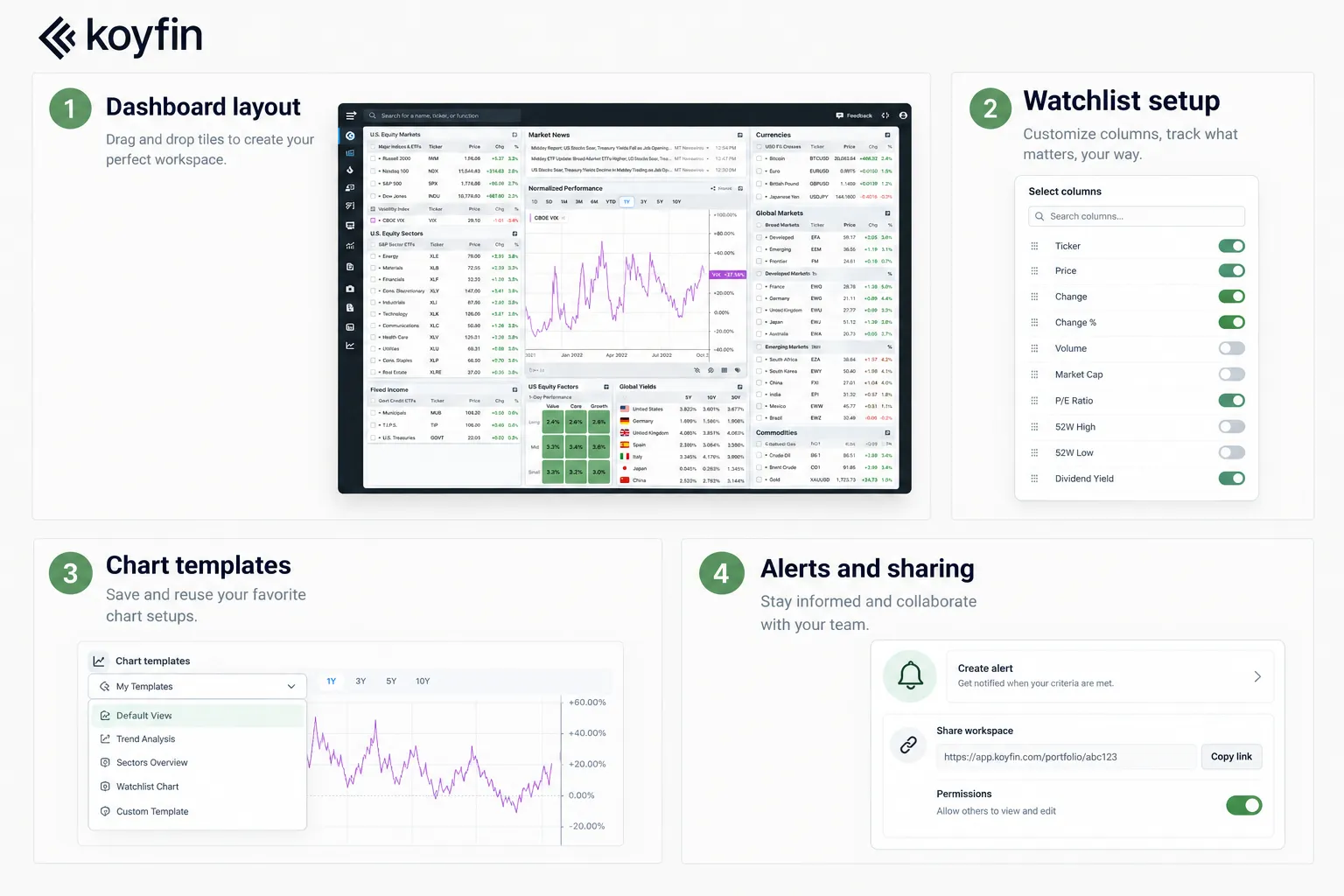
- Custom dashboards. You build the screen. Price chart here, estimate revisions there, a yield curve tile in the corner, a watchlist rail down the side. Save it, reuse it every morning.
- Analyst estimates and revisions. Consensus numbers alongside historical actuals, which is where you spot a company quietly beating or missing a lowered bar.
- Macro in one place. Sovereign yields, currencies, commodities, and economic series next to your equity work, so you aren't tab-hopping to figure out what the tape is reacting to.
- Funds and fixed income. ETF and mutual fund coverage, which matters if your portfolio isn't 100% single names.
- Advisor tooling. Portfolio analytics and client reporting on the Advisor Core and Advisor Pro tiers.
Who it's for: individual investors, analysts, and financial advisors who need flexible market data, portfolio analytics, and client reporting in one platform.
Who it's not for: someone who wants an AI research assistant as the primary interface. AI isn't Koyfin's headline feature, and pretending otherwise would be dishonest.
Quick example of the difference: you want to know whether a semiconductor name's multiple is stretched relative to its own five-year history and its peers. In Koyfin, that's a saved dashboard tile you glance at. In Fiscal AI, that's a question you type. Same answer, different muscle memory.
Fiscal AI pricing vs Koyfin pricing: what does each cost in 2026?
Koyfin runs $0, $39, $79, $209, or $299 a month depending on tier, with annual billing discounted up to 30%. Fiscal AI shows no prices on its pricing page, only a 7-day free trial; third-party reviews report Pro near $49 a month ($468 a year) and Enterprise near $249 a month. Price transparency is the clearest gap in Fiscal AI vs Koyfin: Koyfin lists every tier, Fiscal AI shows no prices before signup.
| Tier type | Koyfin | Fiscal AI |
|---|---|---|
| Free | $0/mo | No free plan; 7-day trial |
| Entry paid | Plus, $39/mo | Pro, about $49/mo (reported) |
| Mid paid | Premium, $79/mo | n/a |
| Pro / firm | Advisor Core $209/mo; Advisor Pro $299/mo | Enterprise, about $249/mo (reported) |
| Annual discount | Up to 30% off, exact price at checkout | Not published |
A few things the raw numbers hide.
Koyfin's annual math. At a full 30% discount, $39 a month becomes roughly $27 a month, around $328 for the year. Premium at $79 becomes roughly $55 a month, around $663. Those are my calculations from the stated discount, not quoted prices, so confirm at checkout. The honest read: Koyfin's effective annual entry price undercuts Fiscal AI Pro by a meaningful margin.
Fiscal AI's annual math is harder to judge. It doesn't publish prices, so you see the real number only at signup. Reported figures put Pro near $468 a year, about $39 a month.
The jump to firm pricing is where both get expensive. Koyfin Advisor Pro at $299 a month is $3,588 a year. Fiscal AI Enterprise, reported near $2,388 a year, looks cheaper on paper, but it's a different product aimed at a different buyer. Advisors paying $299 are buying client reporting and portfolio analytics, not a research assistant.
The context nobody mentions on the pricing page: a Bloomberg Terminal seat is widely reported in the high-$20,000s to low-$30,000s per user per year. Koyfin Premium at $79 a month is roughly 3% of that. Fiscal AI Pro, reported near $49, is less. Arguing over a $10 monthly difference between these two while the institutional benchmark costs 30 times more combined is, charitably, missing the forest.
Decision rule on price: if budget is the binding constraint, Koyfin Plus on annual billing is the cheapest serious terminal here. If the AI connector saves you two hours a week, Fiscal AI Pro, reported near $49 a month, pays for itself before you finish your second cup of coffee.
For a wider price-to-value sweep across this category, we compared the field in 15 AI investment tools that are replacing traditional research in 2026.
Is Fiscal AI free, and does Koyfin have a free plan?
Koyfin has a real free plan at $0 a month. Fiscal AI has no free plan on its pricing page, only a 7-day free trial on Terminal and MCP at signup. For a free test of Fiscal AI vs Koyfin, start with Koyfin's free plan, then run Fiscal AI's 7-day trial on the same three research questions.
Koyfin's free tier lets you build dashboards, pull fundamentals, and decide whether the paid tiers are worth it before you hand over a card. That's the single most underrated feature in this comparison. A free tier that does 60% of the job is how a tool earns trust.
Fiscal AI is messier. Its published tier list shows Free at $0. At the same time, multiple reviews describe no free plan, a 7-day trial only, and pricing that doesn't appear until you begin signup. Both can be true if the free tier is heavily limited or was introduced after those reviews, or if the pricing page changed. What I won't do is pretend the picture is clean.
What to do about it: open fiscal.ai, start the signup, and read the actual tier screen before you enter payment details. If a $0 plan exists, take it. If it's a 7-day trial, treat the week like a trial should be treated. Pick three real research questions you've been putting off, answer them inside the tool, and see whether the output beats what you'd get for free elsewhere.
Common mistake: burning a 7-day trial poking around the interface, then subscribing because you "didn't get to test it properly." A trial without a test plan is a free sample, not an evaluation. Write your three questions down before day one.
How does the Fiscal AI MCP connector change research for AI users?
The MCP connector lets your AI assistant query Fiscal AI's financial database directly, so the model answers from structured company data instead of guessing or scraping. MCP is the one feature in Fiscal AI vs Koyfin that Koyfin does not match head on.

Model Context Protocol is an open standard Anthropic published in November 2024 for connecting AI assistants to external tools and data sources. Think of it as a standardized power outlet. Before MCP, every data source needed its own custom adapter for every AI app. With MCP, a data provider builds one connector and any MCP-compatible client can plug in.
What that changes in practice:
- No more copy-paste archaeology. You stop pasting income statements into a chat window and hoping the model reads the columns correctly.
- The model cites structured data. An assistant pulling from a standardized financial database is far less likely to hallucinate a revenue figure than one working from memory or a random web page.
- Multi-step questions get usable. "Compare operating margin across these four names over the last eight quarters and flag the one with the worst trend" is a reasonable ask when the data pipe is live.
- Your workflow stays in one place. If you already write research notes in an AI client, the data comes to you.
The honest caveats. MCP setup assumes you're comfortable configuring a connector, which is a small technical hurdle that will stop some people cold. The connector delivers data, not judgment, so a wrong question still produces a confident wrong answer. And you're now paying for two subscriptions: the AI assistant and the terminal feeding it.
Decision rule: the MCP connector is worth it if you already run an AI assistant daily and your bottleneck is getting clean numbers into it. If your bottleneck is knowing which numbers matter, fix that first with a structured terminal.
Comparison table: Fiscal AI vs Koyfin side by side
| Feature | Fiscal AI | Koyfin |
|---|---|---|
| Core identity | AI-first fundamental research terminal | Fundamentals-first market research terminal |
| Entry paid price | About $49/mo (reported; not on pricing page) | $39/mo (annual up to 30% off) |
| Top retail tier | Enterprise, about $249/mo (reported) | Premium $79/mo |
| Advisor tiers | Enterprise only | Advisor Core $209/mo; Advisor Pro $299/mo |
| Free access | $0 tier listed; 7-day trial also reported | Confirmed $0 plan |
| AI assistant | Yes, headline feature | Not the headline feature |
| MCP connector | Yes | No |
| Company financials | Yes, deep | Yes, deep |
| Segment and KPI data | Yes, a core strength | Available, less specialized |
| Earnings transcripts | Yes | Varies by tier |
| Analyst estimates | Yes | Yes, with revisions |
| Fixed income, FX, commodities | No | Yes |
| Mutual funds and ETFs | ETFs limited; funds no | Yes |
| Macro data | Minimal | Yes, strong |
| Custom dashboards | Limited | Yes, a core strength |
| Client reporting | Enterprise | Advisor tiers |
| Public review volume | Thin (about 24 Trustpilot reviews, 4.3 stars) | Broad, including long-running Reddit discussion |
| Alpha Score | 72/100 | 85/100 |
Top 5 favorite features in Fiscal AI vs Koyfin
1. Koyfin's custom dashboards. The ability to build one screen that answers your five recurring questions is the difference between research and wandering. Set it once, use it every morning, stop re-deriving the same context.
2. Fiscal AI's MCP connector. The only feature here that genuinely didn't exist in retail tooling two years ago. If you've already built an AI-assisted workflow, this is the piece that makes it stop feeling like a toy.
3. Koyfin's macro tiles. Yields, currencies, and commodities next to your equity work. Most retail investors analyze companies in a vacuum and then get confused when a perfectly good name sells off with the sector. Context is cheap insurance.
4. Fiscal AI's segment and KPI data. Standardized, pre-pulled segment revenue and company-specific metrics. This is the stuff that lives buried in filings and 10-K footnotes, and having it in a clean table is a real time saver.
5. Koyfin's free plan. Boring, unglamorous, and the most consumer-friendly thing in this entire comparison. You can validate the tool before you pay. Every vendor should do this.
What we like about Fiscal AI
- It picked a lane. AI-assisted fundamental equity research, done properly, instead of a dashboard with a chatbot bolted to the corner for the press release.
- The MCP connectors are a real architectural choice. Building on an open standard rather than locking you into a proprietary chat window respects how people actually work.
- Users say fundamental research is far easier than free sites. Trustpilot reviewers compare it favorably to Yahoo Finance and Google Finance, which is a low bar for data depth but a high bar for convenience.
- Support reportedly fixes data errors quickly. Reviewers mention reporting mistakes and seeing them corrected. A responsive data team is worth more than a perfect marketing page.
- A 7-day trial exists. You can touch the Terminal and the MCP setup before paying.
What we don't like about Fiscal AI
- The pricing story is inconsistent. A $0 tier appears in the published tiers while reviewers describe pricing hidden behind signup and a trial-only path. Clarity is free. Charge what you want, just say it on the page.
- Seven days is a thin window. Evaluating a research terminal properly takes an earnings cycle, not a week. Koyfin's free tier lets you take your time.
- The review sample is small and clustered. About 24 Trustpilot reviews at 4.3 stars, with many posted in a single February 2026 burst. That pattern is thin evidence, whatever the average says.
- Narrow asset coverage. No meaningful fixed income, FX, commodities, or mutual fund data. If your process touches more than single-name equities, you'll need a second tool.
- Pro costs more than Koyfin Plus for less breadth. $49 against $39. You're paying a premium for the AI layer, so make sure you'll use it.
What we like about Koyfin
- The free plan is real. Build dashboards, pull fundamentals, decide later. That's how you earn a subscription.
- Transparent pricing. $39 and $79 are printed where you can see them. No "contact sales," no signup wall.
- Genuine data depth. Financial statements, estimates, valuation multiples across global equities, ETFs, mutual funds, and fixed income.
- Dashboard and charting flexibility that earned the "poor man's Bloomberg" nickname on Reddit. Users who've sat in front of the real thing made that comparison voluntarily, which is the only kind of praise worth quoting.
- Macro and equities in one window. Yields, currencies, commodities, and economic series sitting next to your watchlist.
- Advisor tooling that actually serves advisors. Portfolio analytics and client reporting on the $209 and $299 tiers, which is a different job from retail research and is treated as one.
What we don't like about Koyfin
- AI isn't the headline feature. If conversational research is your workflow, Koyfin will feel like a beautiful library with no librarian. Fiscal AI leans much harder into AI and MCP.
- No MCP connector. Your AI assistant can't query Koyfin's data directly, so you're back to copy-paste if you want the model involved.
- Advisor tiers get expensive fast. $209 and $299 a month is $2,508 to $3,588 a year. Justifiable for a practice billing clients, steep for a solo investor who just wants more data.
- The learning curve is real. Depth has a cost. A brand-new investor opening Koyfin for the first time sees a lot of tiles and not much guidance about which three matter. Budget a weekend.
What do real users say about Fiscal AI and Koyfin?
Public sentiment is broad and positive for Koyfin, and positive but thin for Fiscal AI. The gap in evidence quality is wider than the gap in star ratings. User sentiment in Fiscal AI vs Koyfin is thin on both sides, so read it as a signal, not a verdict.
Koyfin. The recurring community label is "a poor man's Bloomberg," used across Reddit investing threads. That's an unsolicited comparison from people who know what a Bloomberg Terminal does, and Reddit skews negative by nature, so a nickname that sticks positively there carries weight. Discussion volume is substantial, which means a prospective buyer can actually find corroborating opinions rather than one vendor-shaped testimonial page.
Fiscal AI. Trustpilot reviewers call it "the Bloomberg for retail investors," with a 4.3-star average from roughly 24 reviews. Reviewers praise how much easier fundamental research is compared with free sites, and several note that support corrected reported data mistakes quickly.
Now the part the marketing page won't tell you. Twenty-four reviews is not a sample, it's a focus group. Many of them landed in one February 2026 cluster, and clustered timing usually means a review campaign rather than organic accumulation. None of that makes the reviews false. It makes them insufficient. Trustpilot also skews complaint-heavy by design, so a 4.3 there is a decent signal... just a quiet one.
How to read this yourself: look for the gap between solicited and unsolicited sources. Vendor-prompted reviews cluster and praise. Reddit threads sprawl and complain. When both tell the same story, you've learned something. When only one source exists, you've learned that you need to run your own trial.
Fiscal AI alternatives and Koyfin competitors worth a look
Neither of these is the only option, and both sit in a crowded category. Five worth checking before you commit a card:
- TIKR Terminal. Global fundamentals and estimates with a similar "institutional data at retail prices" pitch. The closest direct substitute for Koyfin's fundamentals work.
- Stock Analysis. Fast, clean, and generous on the free side for screening and financial statements. If Koyfin's free tier feels like too much screen, start here.
- Simply Wall St. Visual-first fundamentals with the snowflake charts. Better for learning what the metrics mean than for deep statement work.
- Seeking Alpha Premium. Quant grades, estimate revisions, and a firehose of written analysis. Different product, overlapping job.
- Morningstar Investor. Strongest on funds and ETFs, weakest on anything resembling a trading workflow.
Pricing changes often on all five, so check current plans directly rather than trusting a number in any article, including this one.
If your work leans more toward timing and setups than fundamentals, these research terminals are the wrong aisle entirely. Look at AI trading platforms and our rundown of AI tools swing traders are using to catch moves early instead.
How the Alpha Score rates Fiscal AI and Koyfin
Koyfin scores 85 out of 100. Fiscal AI scores 72 out of 100. On the Alpha Score, Fiscal AI vs Koyfin ends Koyfin 85, Fiscal AI 72. The score comes from FullStack Alpha desk research plus public user sentiment, and the pillar split is provisional.
The Alpha Score runs on five pillars worth 20 points each: Signal Quality, Transparency, Price-to-Value, Usability, and Community Verdict. No stars, because one number hides which part of a tool is weak.
Why the 13-point gap, in plain terms:
Koyfin's advantages are structural. Published prices, a working free plan, deeper asset coverage, and years of unsolicited public discussion to corroborate the claims. Those are Transparency, Price-to-Value, and Community Verdict points that don't depend on taste.
Fiscal AI's 72 reflects a genuinely interesting product with thinner proof. The MCP connector is the most forward-looking feature in this comparison. The pricing presentation is inconsistent, the trial is short, the asset coverage is narrow, and the public review base is about 24 entries clustered in one month. A 72 means "worth your attention with named reservations," not "avoid."
Scores carry a last-tested date, and the pillar breakdown will be published once hands-on testing is complete. We don't fill gaps with plausible numbers.
FullStack Alpha scorecards
Every tool in this article has a full scorecard: pricing, pros and cons, verified user quotes and the Alpha Score breakdown.
FAQ
How much does Fiscal AI cost?
Fiscal AI doesn't list prices on its pricing page; you see them after starting the 7-day free trial on Terminal or MCP. Third-party reviews report Pro near $49 a month and Enterprise near $249 a month, so confirm at signup.
Is Fiscal AI free?
No. Its pricing page lists no free plan, only a 7-day free trial on Terminal and MCP at signup. Koyfin is the one with a real free plan.
What does Fiscal AI do?
Fiscal AI is an AI-powered fundamental research terminal covering company financials, KPI and segment data, SEC filings, and earnings call transcripts. Its MCP connectors let you query that financial data from inside your own AI assistant instead of copying numbers into a chat window.
Is Koyfin better than Fiscal AI for beginners?
Yes, mainly because of the free plan. Koyfin lets you learn the data at $0 before committing, where Fiscal AI's reported 7-day trial puts a clock on you. Koyfin's depth does bring a learning curve, so expect to spend a weekend building your first dashboard.
Does Fiscal AI work with Claude through MCP?
Yes. Fiscal AI ships MCP connectors, and Model Context Protocol is the open standard Anthropic published in November 2024 for connecting AI assistants to external data. Any MCP-compatible client, Claude included, can connect to it once configured.
Is Koyfin worth it?
For fundamentals-focused investors, yes. Plus at $39 a month delivers financial statements, analyst estimates, valuation multiples, macro data, and custom dashboards across global equities, ETFs, funds, and fixed income. Test the free plan first, since it costs nothing to find out.
What is the best alternative to Bloomberg for retail investors?
Koyfin is the most common answer among retail investors, and Reddit users nickname it "a poor man's Bloomberg." Bloomberg Terminal seats are widely reported in the high-$20,000s to low-$30,000s per user annually, against Koyfin Premium at $79 a month. TIKR Terminal and Stock Analysis are the next closest options.
Can I use Fiscal AI and Koyfin together?
Yes, and they overlap less than you'd expect. Koyfin handles dashboards, macro, and multi-asset breadth, while Fiscal AI handles AI-assisted company work and feeds your assistant through MCP. Combined cost on entry tiers is $88 a month, which only makes sense if you'll genuinely use both.
Which one is cheaper over a year?
Koyfin. Plus at $39 a month with up to 30% off annual billing works out to roughly $328 a year by my calculation, against Fiscal AI Pro's reported $468. Confirm Koyfin's exact annual figure at checkout, since the discount is stated as a maximum.
Do either of these tools pick stocks for me?
No. Both are research terminals that supply data, financial statements, estimates, and analysis tools. Neither issues buy or sell recommendations, and neither will replace your own position sizing and risk management.
Final verdict: who should pick Fiscal AI and who should pick Koyfin?
Pick Koyfin if you want the most data for the least money with the least risk. The free plan means you can test it this afternoon for nothing. Plus at $39 covers most self-directed investors, Premium at $79 covers the ones running concentrated portfolios who want estimates and revisions, and the Advisor tiers at $209 and $299 exist if you're reporting to clients. It's the default answer for most readers of this site. Our Fiscal AI vs Koyfin verdict: Koyfin for most self-directed investors, Fiscal AI for AI-first research workflows.
Pick Fiscal AI if your research already runs through an AI assistant and your bottleneck is data access, not data interpretation. Pro, reported near $49 a month, buys you segment data, KPIs, filings, transcripts, and the MCP connector that makes your assistant genuinely useful on company fundamentals. If you're an analyst-type who writes notes in Claude, this is the tool that fits your hands.
Pick both if you've got $88 a month and a real research process. They overlap less than the category suggests. Koyfin is the instrument panel, Fiscal AI is the research assistant. Most people don't need both, and most people who buy both will use one.
Pick neither if you're looking for a tool that tells you what to buy. Neither of these does that, which is a compliment. Research terminals give you the inputs. The judgment is still your job, and the day you outsource it to a chat window is the day your process stops being yours.
Three practical next steps, in order: open Koyfin's free plan today and build one dashboard with the five metrics you check most. Write down three research questions you've been avoiding. Then run Fiscal AI's trial against those three questions and see whether the answers justify roughly $49 a month. Cut the noise, keep the alpha.
Start with the free plan or the free trial
Two tools compared here. 200+ catalogued in the FullStack Alpha directory, sorted by category, price and use case.
Compare the full field → aistockpickerapps.com
Sources
- Koyfin pricing and product pages, koyfin.com (2026)
- Fiscal AI pricing and product pages, fiscal.ai (2026)
- Trustpilot reviews for Fiscal AI, approximately 24 reviews at 4.3 stars (February 2026 cluster)
- Anthropic, Model Context Protocol announcement (November 2024)
- SEC EDGAR company filings search, sec.gov
Your market edge starts with the right tool. Stay alpha.
Disclosure: some links in this article are affiliate links, which may earn FullStack Alpha a commission at no cost to you.
We test the tools. You get the verdict.
One email a week. What we tested, what scored, and what we'd skip. Written for traders, not for clicks.
More from FullStack Alpha