

Short on time? The Koyfin Alpha Score scorecard breaks the 85/100 down by pillar, with pricing and the verdict, in about 90 seconds.
See the score
Koyfin review verdict: The free tier genuinely beats several paid research subscriptions on macro dashboard depth, screener reach, and global coverage, for fundamentals-first investors who don't need a decade of financial history.
Key Takeaways
- Free tier ($0): Ships advanced charting, macro dashboards, portfolio tracking, and a global stock screener, more capability than multiple paid research tools at any price
- Two-year cap: Free plan historical financials stop at two years, too shallow to judge a business across a full cycle
- Count limits: Free users are capped at two watchlists, two custom dashboards, and two saved charts or screens
- Essential tier ($39/month): Raises historical financials to ten years, removes every count limit, and is the clear upgrade path for anyone valuing a business seriously
- Price-to-Value pillar score: 19/20, the strongest pillar in Koyfin's Alpha Score of 85/100, and the number that carries the article's central argument
- Community Verdict pillar score: 13/20, the weakest pillar; public discussion of Koyfin is thin, which makes independent validation harder than it should be
Koyfin Review: What Does the Free Tier Actually Include?
The free plan ships four genuinely useful research capabilities at no cost: advanced charting, macro and market dashboards, portfolio tracking, and a global stock screener. Each one does real work.
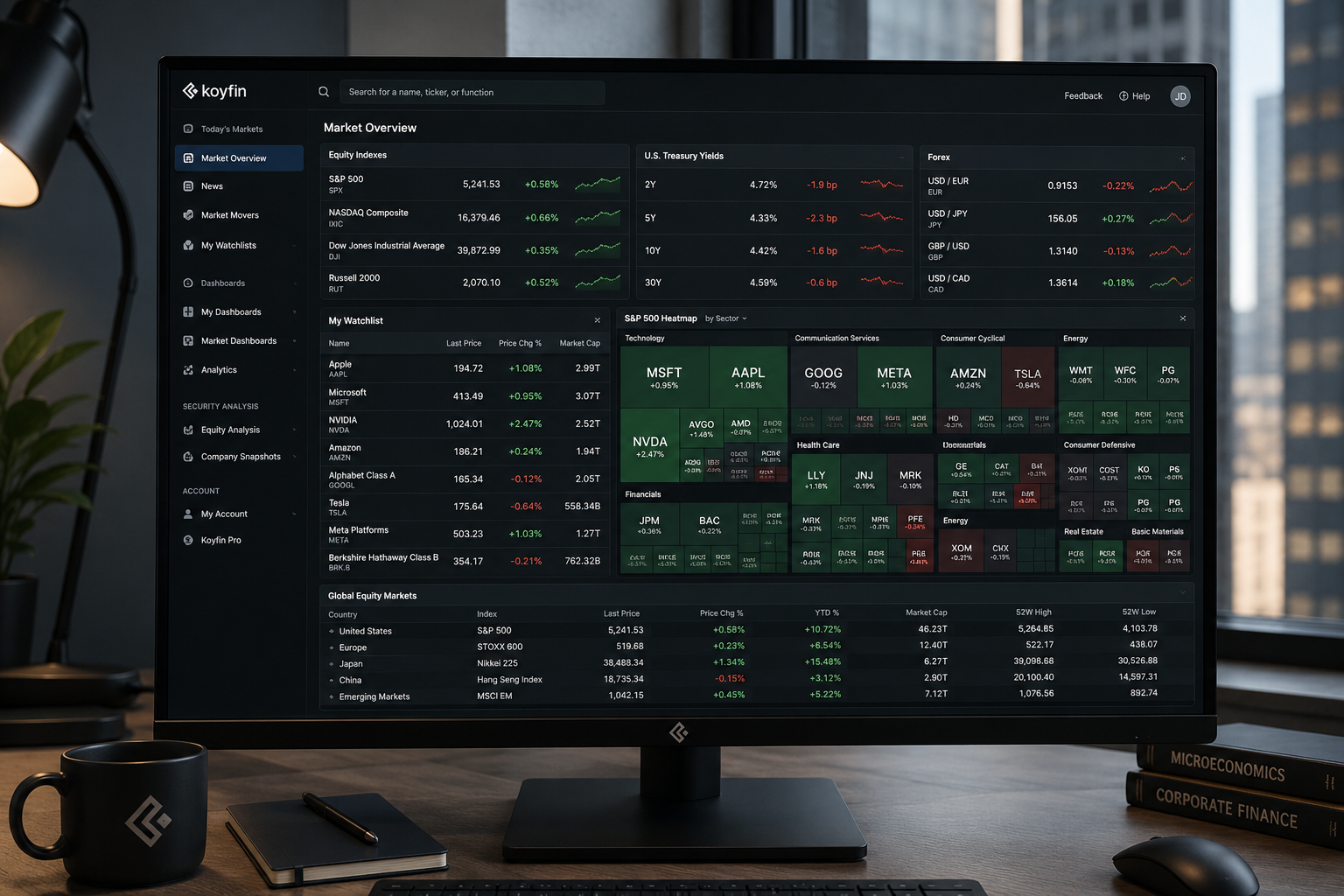
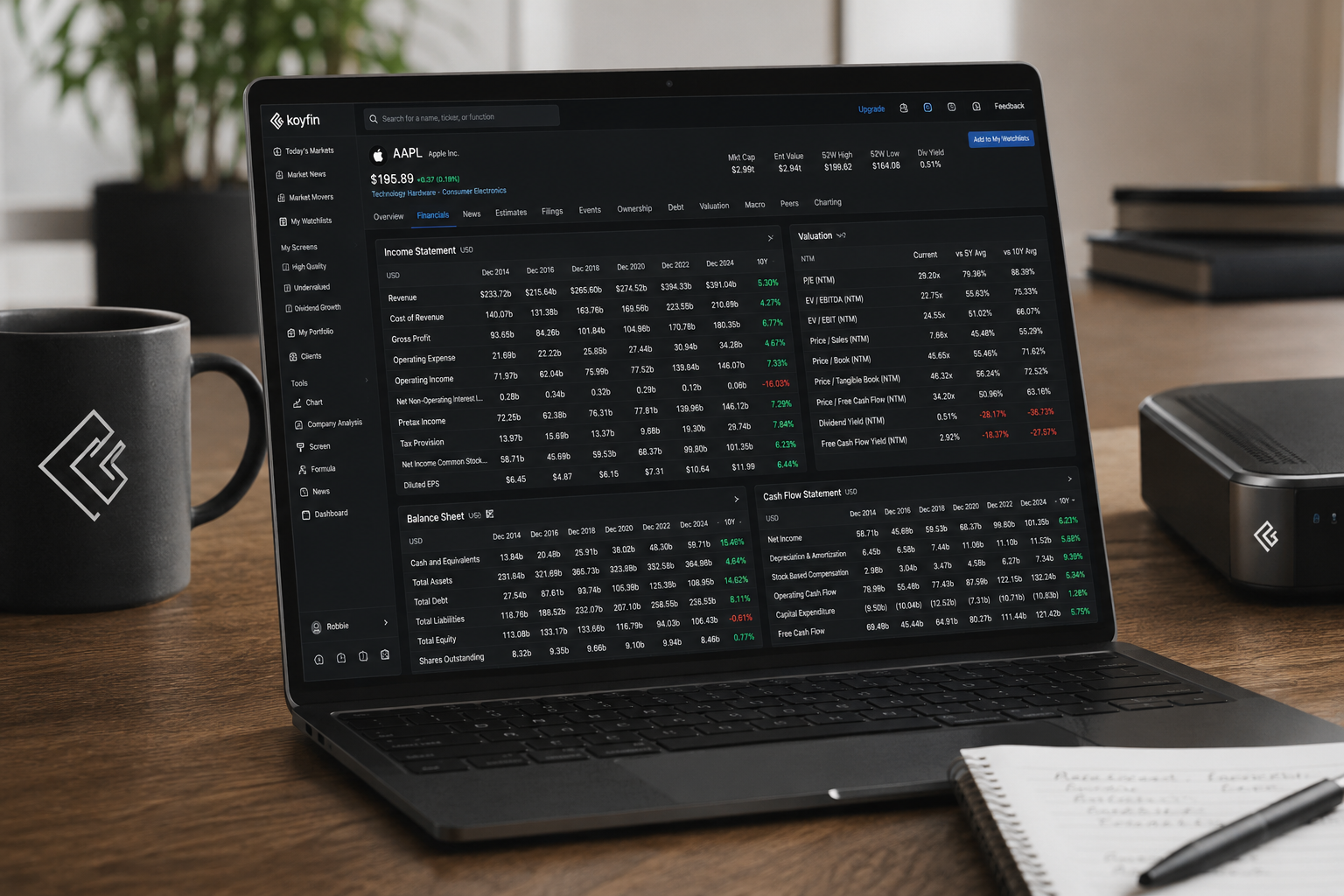
Advanced charting goes well beyond what most retail investors expect from a free tool. You can overlay fundamental data, revenue, earnings per share, free cash flow, directly onto price charts, which is a feature most platforms charge for. Technical indicators are included, but the differentiation here is the ability to chart financial statement line items over time, which is the kind of thing a fundamentals investor actually needs.
Macro and market dashboards are where the free tier punches hardest. Koyfin aggregates economic indicators, sector performance, yield curves, credit spreads, and global market data into configurable panels. You can build a macro view that would cost real money to replicate on most institutional-facing platforms. For investors who want to understand the environment a business operates in, not just the business itself, this is genuinely valuable.
Portfolio tracking lets free users monitor holdings, track performance, and view aggregate metrics across a portfolio. It's not a broker integration that auto-imports trades; you're entering positions manually. But the analytics on top of those positions, sector exposure, performance attribution, valuation metrics across the book, are more sophisticated than what most brokerage platforms offer natively.
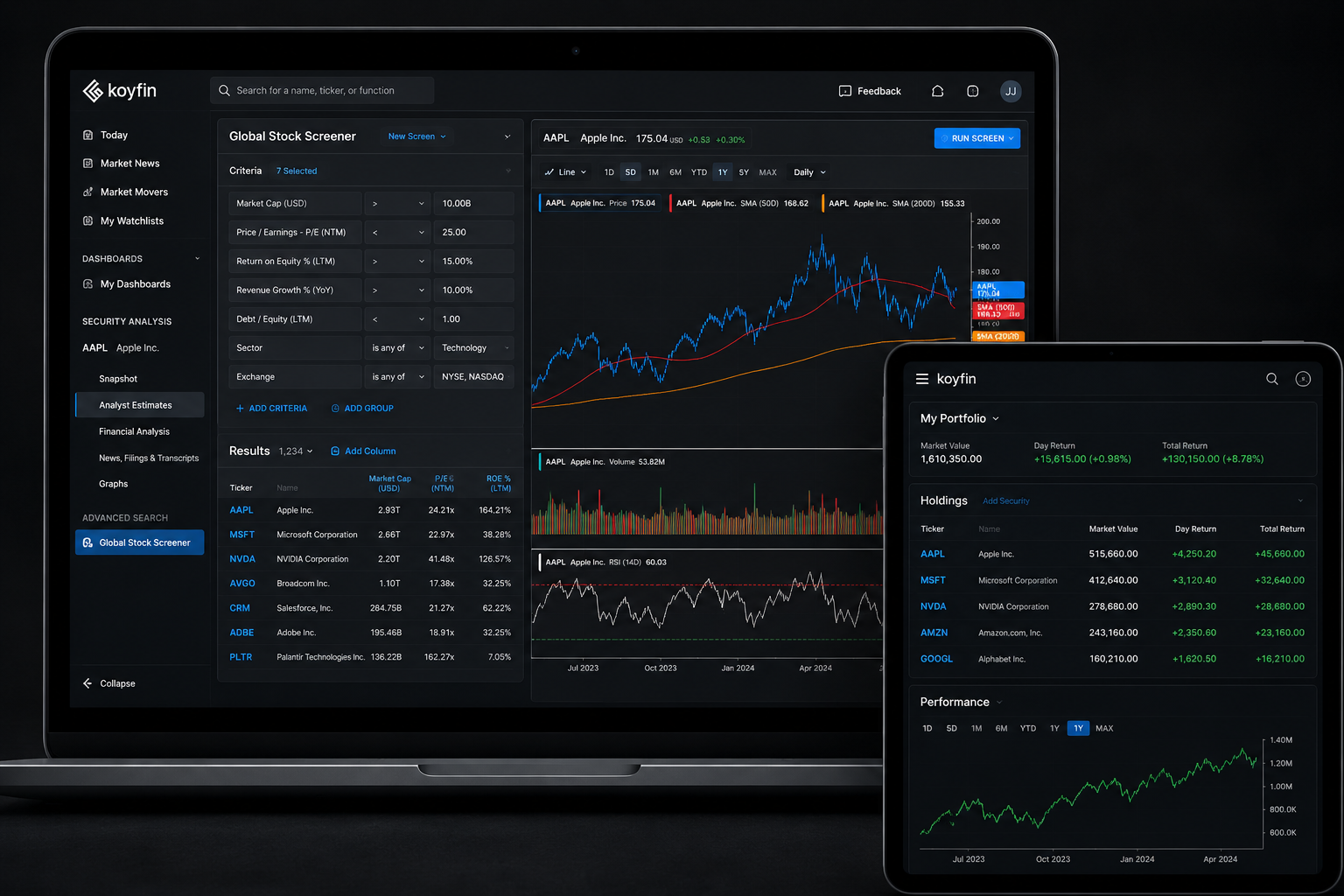
The global stock screener covers equities across US and international markets with fundamental filters: P/E, EV/EBITDA, revenue growth, debt ratios, dividend yield, and more. The filter set is wide enough to do real work. You can screen for value characteristics, quality metrics, or growth parameters across thousands of names globally. That's a meaningful capability for a free tool.
The claim in the title isn't marketing. This is a lot of research infrastructure for zero dollars.
Does the Free Tier Really Beat Paid Rivals?
Yes, on specific dimensions, and no, on others. The honest answer is conditional, and it depends entirely on what kind of research you're doing.
Where the free tier wins:
The macro dashboard depth on Koyfin's free plan outperforms what you'd get from several paid subscriptions in the $10,$30/month range. Tools that charge for basic economic data dashboards, yield curve trackers, sector rotation views, global equity performance, are being undercut by a product that gives this away. If macro context is central to your investment process, the free tier delivers more than you're paying for elsewhere.
The screener reach is similarly strong. A global fundamental screener with the filter depth Koyfin offers at no cost beats the free tiers of several dedicated screening platforms and matches or exceeds what some paid screeners provide. For investors building a watchlist from scratch using fundamental criteria, this is the right tool and the price is hard to argue with.
Portfolio tracking breadth, the ability to see aggregate valuation metrics, sector exposure, and performance across a manually entered book, is more sophisticated than what most retail brokerage platforms show you natively. Investors who piece research together across a broker platform, a spreadsheet, and free data sites will find the free Koyfin portfolio view consolidates a lot of that work.
Global coverage is a genuine differentiator. Many retail research tools are US-centric. Koyfin covers equities across multiple international markets at the free tier, which matters for investors who look beyond domestic names.
Where the free tier loses:
Historical depth is the clearest gap. Two years of financial history is not enough to evaluate a business across a cycle. If you're trying to understand how a company performed through 2020, through a rate cycle, or across a full economic expansion and contraction, two years tells you almost nothing useful. This is a real limitation, not a minor inconvenience.
Filings and earnings transcripts are withheld entirely from the free plan. For investors whose process involves reading 10-Ks, 10-Qs, and listening to what management actually said on earnings calls, the free tier hits a wall. You'll need to go elsewhere, SEC EDGAR for filings, a separate transcript service, which fragments the workflow.
The conditional verdict:
The free tier beats paid rivals for a fundamentals investor who monitors a focused watchlist, wants macro context, and screens globally for ideas, but doesn't need deep historical financials or primary source documents. That's a real and common investor profile.
It does not beat paid rivals for an analyst valuing a business across a full cycle, building a discounted cash flow model, or needing earnings transcripts as part of their process. For that reader, the free tier is a starting point, not a destination.
Where Does the Free Plan Stop?
The caps are specific, and each one blocks something meaningful in practice.
Two years of historical financials. This is the most consequential limit. Two years of income statement, balance sheet, and cash flow data is enough to see recent trends but not enough to understand a business through a cycle. You cannot assess how a company managed its balance sheet through a recession, how margins behaved across a full expansion, or whether current returns on capital are structurally durable or cyclically inflated. Anyone doing serious fundamental valuation needs at least seven to ten years of data. The Essential tier raises this to ten years.
One year of forward estimates. Consensus estimates for revenue and earnings are available one year out on the free plan. For investors who want to see how the street is modeling a business two or three years forward, which matters for growth-oriented valuation, this cap is binding.
Two watchlists. If you're monitoring a handful of names across one or two themes, two watchlists is workable. If you're running a more structured process, a core portfolio, a watchlist of candidates, a macro monitor, you'll hit this ceiling quickly.
Two custom dashboards. The macro dashboard capability is one of the free tier's strongest features. Being limited to two custom configurations means you can't build separate views for different sectors, geographies, or research workflows without overwriting something you've already built.
Two saved charts or screens. Every time you configure a useful screen or chart setup, saving it is how you make it repeatable. Two saves means you're either rebuilding setups manually or choosing which two are worth keeping. That's friction that compounds over time.
No filings, no earnings transcripts, no premium news. These aren't partial, they're absent. Free users cannot access SEC filings through Koyfin, cannot read earnings call transcripts, and don't get premium news feeds. For a research process that depends on primary source documents, this is a genuine gap that requires supplementing with other tools.
Koyfin Pricing Comparison
Figures sourced from koyfin.com/pricing. Verify before subscribing, pricing is subject to change.
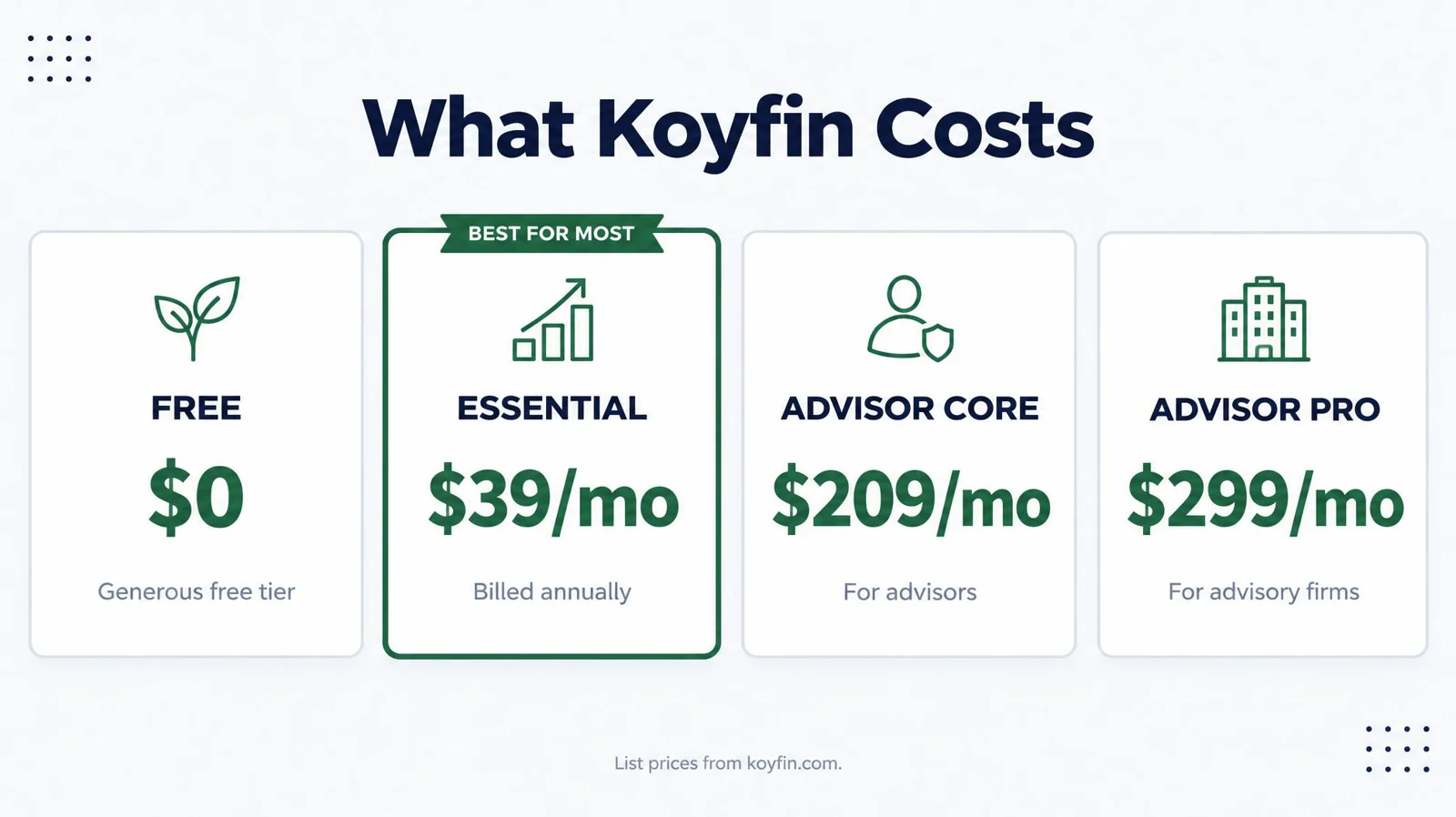
| Plan | Monthly Price | Annual Price | Years of Financials | Watchlists | Dashboards | Saved Charts/Screens | Filings & Transcripts |
|---|---|---|---|---|---|---|---|
| Free | $0 | $0 | 2 years | 2 | 2 | 2 | No |
| Essential | $39/mo | ~$468/yr | 10 years | Unlimited | Unlimited | Unlimited | No |
| Premium | $79/mo | ~$948/yr | 10+ years | Unlimited | Unlimited | Unlimited | Yes |
| Advisor Core | $209/mo | N/A (monthly) | Full | Unlimited | Unlimited | Unlimited | Yes |
| Advisor Pro | $299/mo | N/A (monthly) | Full | Unlimited | Unlimited | Unlimited | Yes |
Annual billing saves up to 30% across paid tiers. Advisor tiers add client reporting and professional workflow features.
Who Should Upgrade to Essential and Who Should Not?
The Essential tier at $39/month is the right call for a specific reader and the wrong call for another. Here's how to tell which one you are.
Upgrade to Essential if:
You're valuing a business across a full cycle. Ten years of financial history is the minimum for understanding how a company's margins, returns on capital, and balance sheet have behaved through different environments. If you're building any kind of fundamental model, even a simple one, two years of data is not enough and ten years is the floor. Essential gets you there.
You're tracking more than two portfolios or research lists. Anyone running a core portfolio alongside a watchlist of candidates, a macro monitor, and a sector-specific screen will hit the free tier's count limits within the first week of serious use. The unlimited watchlists, dashboards, and saved screens on Essential are not a luxury, they're the basic infrastructure for an organized research process.
You're doing this regularly. At $39/month (less with annual billing), Essential is a fraction of what institutional data terminals charge for comparable fundamental data. If you're spending meaningful time on investment research, the cost-per-hour of better data is low.
Stay on the free tier if:
You're monitoring a small, stable set of names with a macro dashboard. If your process is watching ten to fifteen positions you already know well, checking macro conditions periodically, and running an occasional screen for new ideas, the free tier handles all of that. Two watchlists, two dashboards, and two years of financials is enough for a light-touch monitoring workflow.
You're still figuring out whether Koyfin fits your process. The free tier is a genuine product, not a crippled demo. Use it long enough to know whether you'll actually use the additional features before paying for them.
How Does Koyfin Compare to a Charting Platform?
Koyfin is built for fundamentals, dashboards, and long-horizon data. It is not built for intraday execution or technical trading workflows.
If your process involves reading tick data, watching Level 2 order flow, running intraday scans, or executing off a chart, Koyfin is not the tool for that work. A dedicated charting platform built around real-time data and execution-adjacent features will serve that workflow better. This isn't a weakness in Koyfin, it's a scope difference. The platform is designed for a different job.
For the fundamentals-first investor who wants to understand a business, monitor a macro environment, and screen for ideas globally, Koyfin does that job well. For the active trader who needs intraday precision, a charting platform is the right primary tool, and Koyfin, if used at all, sits alongside it as a research layer rather than a replacement.
If you're curious about how AI-powered research tools fit into a broader investment workflow, the breakdown at aistockpickerapps.com/blog/ai-stock-analysis-tools-that-catch-red-flags-before-they-cost-you covers where these tools add signal and where they add noise.
The Alpha Score Breakdown
Koyfin scores 85 out of 100 across five pillars, 20 points each.
| Pillar | Score |
|---|---|
| Signal Quality | 17 / 20 |
| Transparency | 18 / 20 |
| Price-to-Value | 19 / 20 |
| Usability | 18 / 20 |
| Community Verdict | 13 / 20 |
| Total | 85 / 100 |
Signal Quality, 17/20. The fundamental data is accurate, the screener surfaces real results, and the macro dashboards pull from legitimate sources. The score stops short of 20 because the free tier's two-year financial history limits how much signal a user can actually extract without upgrading. The data that's there is good; the constraint is how much of it you can access.
Transparency, 18/20. Koyfin is clear about what each tier includes and where the caps sit. The pricing page states limits explicitly. The platform doesn't hide the upgrade wall behind a confusing feature matrix. One point off because data sourcing methodology isn't always surfaced at the point of use, you're sometimes working with consensus estimates or financial data without a clear citation of the underlying provider.
Price-to-Value, 19/20. This is the pillar that carries the article's argument, and it earns the score. A free tier that includes advanced charting, macro dashboards, a global screener, and portfolio tracking is genuinely unusual. Essential at $39/month for ten years of financials and unlimited everything is priced well below what comparable fundamental data costs on institutional platforms. The only reason this isn't 20/20 is that the free tier's historical depth cap is a real constraint that limits value for serious fundamental work. But for what it costs, Koyfin's value proposition is hard to match in this category.
Usability, 18/20. The interface is clean and the learning curve is manageable. Dashboard configuration is intuitive once you've spent an hour with it. The screener is well-organized. One point off for the dashboard builder, which has enough flexibility that new users occasionally spend time figuring out how to configure what they want rather than immediately getting to work. A second point off for the mobile experience, which is functional but not the primary way you'd want to do serious research.
Community Verdict, 13/20. This is the weakest pillar, and it reflects a real gap. Public discussion of Koyfin is thin. You'll find it mentioned in investing forums and the occasional Reddit thread, but there isn't a robust, ongoing community conversation that would let you independently validate the platform's strengths and weaknesses at scale. The reviews that exist are generally positive, but the volume is low enough that the signal is weak. A tool with 85/100 on four pillars deserves more public scrutiny than it currently gets, and the absence of that scrutiny makes independent validation harder. This isn't a knock on the product; it's an honest assessment of what the community data shows.
Sourced Stat Cards
Free tier price: $0
Source: koyfin.com/pricing
Essential tier: $39/month ($468/year)
Source: koyfin.com/pricing, annual billing available
Free tier historical financials: 2 years
Source: koyfin.com/pricing, feature comparison table
Essential tier historical financials: 10 years
Source: koyfin.com/pricing, feature comparison table
Free tier count limits: 2 watchlists, 2 dashboards, 2 saved charts/screens
Source: koyfin.com/pricing
Annual billing discount: up to 30% off monthly rate
Source: koyfin.com/pricing, applies across all paid tiers
Where Koyfin Falls Short
No 85/100 tool is without real problems. Here are the ones that matter.
Thin public community. The 13/20 Community Verdict score isn't a technicality, it reflects something the prospective user should know. When you're evaluating a research tool, you want to hear from other people who've used it seriously: what broke, what surprised them, where the data was wrong. With Koyfin, that conversation is limited. There are no large, active communities stress-testing the platform the way you'd find for more widely discussed tools. That makes it harder to know what you're getting into before you pay for it.
Free tier historical depth. Two years of financial history is the free plan's most binding constraint. It's not a minor limitation, it's a fundamental gap for anyone doing serious valuation work. You can't assess cyclicality, you can't build a meaningful trend analysis, and you can't understand how a business has allocated capital over time. This is the clearest reason to upgrade, and the clearest reason the free tier isn't the right tool for every fundamentals investor.
Filings and transcripts withheld from free. The absence of SEC filings and earnings transcripts on the free plan forces users to a separate workflow for primary source documents. That fragmentation is a real cost in time and attention. Even on paid tiers below Premium, transcripts aren't available. For investors whose process depends on reading what management actually said, not just the numbers, this is a gap that requires a workaround.
Not built for intraday trading. This is a scope limitation rather than a failure, but it's worth stating plainly. Active traders who need real-time data, Level 2 quotes, or intraday scanning will find Koyfin the wrong tool for that work. The platform is designed for a different investment horizon and a different research process. Knowing this before you sign up saves frustration.
For a broader look at how AI-powered investment research tools are changing the research workflow, the piece at aistockpickerapps.com/blog/15-ai-investment-tools-that-are-replacing-traditional-research-in-2026 is worth reading alongside this review.
✅ What We Love
- Free tier includes advanced charting, macro dashboards, portfolio tracking, and a global screener at no cost
- Price-to-Value scored 19/20, the strongest pillar and the clearest reason to consider this platform
- Macro and market dashboard depth exceeds most retail research subscriptions at any price point
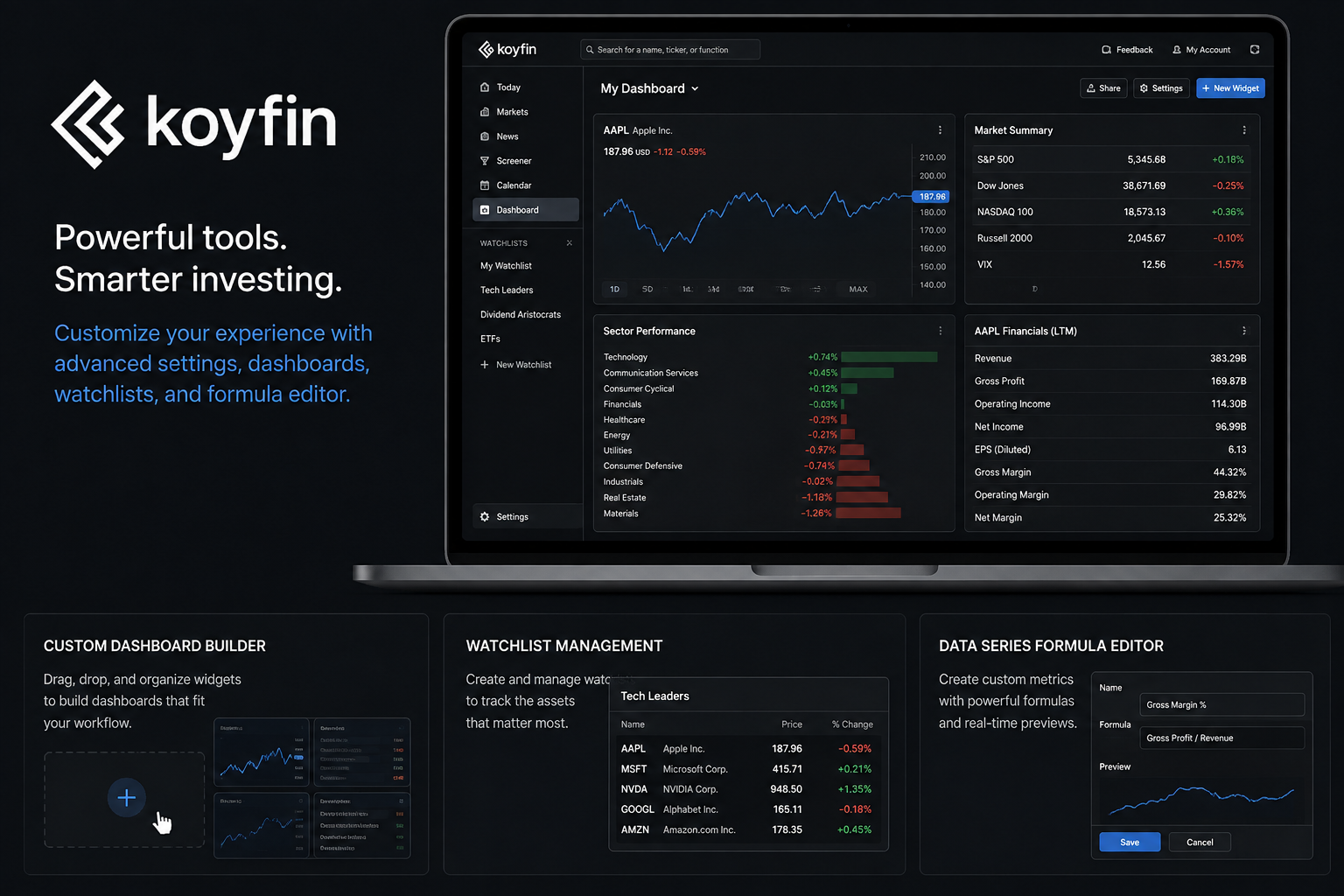
- Custom formulas and equations on data series let you build metrics other platforms won't give you
- Annual billing cuts up to 30% off the monthly rate across every paid tier
- Essential at $39/month delivers ten years of financials for a fraction of what institutional data costs
❌ What Could Be Better
- Community Verdict scored 13/20, public discussion is thin, making independent validation harder
- Free tier stops at two years of historical financials, too shallow for cycle-aware valuation
- Free users capped at two watchlists, two dashboards, and two saved charts
- Filings and earnings transcripts withheld entirely from the free plan
- Not built for intraday trading, active traders will need a charting platform alongside it
Final Verdict
The free tier is real. That's the first thing to say, because a lot of "free" research tools are demos with a paywall after the second click. Koyfin's free plan is a functional research environment that delivers macro dashboard depth, a global fundamental screener, portfolio tracking, and advanced charting at no cost. For the investor who monitors a focused watchlist, wants macro context, and screens globally for ideas, the free tier is enough, and it outperforms several paid subscriptions on the dimensions that matter most to that workflow.
The upgrade to Essential at $39/month is the right call the moment you need more than two years of financial history or more than two of anything. Anyone valuing a business seriously, tracking multiple portfolios, or building a structured research process will hit the free tier's limits quickly. Ten years of financials and unlimited everything for $39/month is priced well below what comparable data costs elsewhere. That's the Price-to-Value score of 19/20 in practice.
The honest caveat: the thin public community means you're taking this platform somewhat on faith. The data is good, the interface works, and the value proposition is clear, but the independent validation that comes from a large, active user community isn't there yet. That's a real gap, not a minor footnote.
Free tier: right for a focused, macro-aware investor who doesn't need deep historical data or primary source documents.
Essential: right for anyone doing serious fundamental valuation, tracking more than two portfolios, or building a repeatable research process.
Premium and above: right for professionals who need filings, transcripts, and advanced portfolio analytics as part of a daily workflow.
If the free tier isn't enough and Koyfin isn't the right fit, there are 200+ AI stock and research tools catalogued in the FullStack Alpha directory, filterable by category, price, and what they actually do.
Browse the full directory at aistockpickerapps.com
Affiliate disclosure: This review may contain affiliate links. FullStack Alpha may earn a commission if you purchase through a link on this page, at no additional cost to you. Scores and editorial opinions are independent of commercial relationships.
We test the tools. You get the verdict.
One email a week. What we tested, what scored, and what we'd skip. Written for traders, not for clicks.
Frequently asked
Topics in this teardown
Our verdict on Koyfin
Koyfin scores 85 on genuine capability.