

Short on time? The TradeZero Alpha Score scorecard breaks the 85/100 down by pillar, with pricing and the verdict, in about 90 seconds.
See the score
Quick Answer

The pain this solves is specific. You spot a clean setup on a low float runner, you fumble through a mouse-driven order ticket, and by the time your limit order hits the book the move already happened. Or worse, you try to short the obvious fade and get the dreaded "no shares available." This broker answers both with programmable hotkeys and an in-platform short locate desk.
Key Takeaways
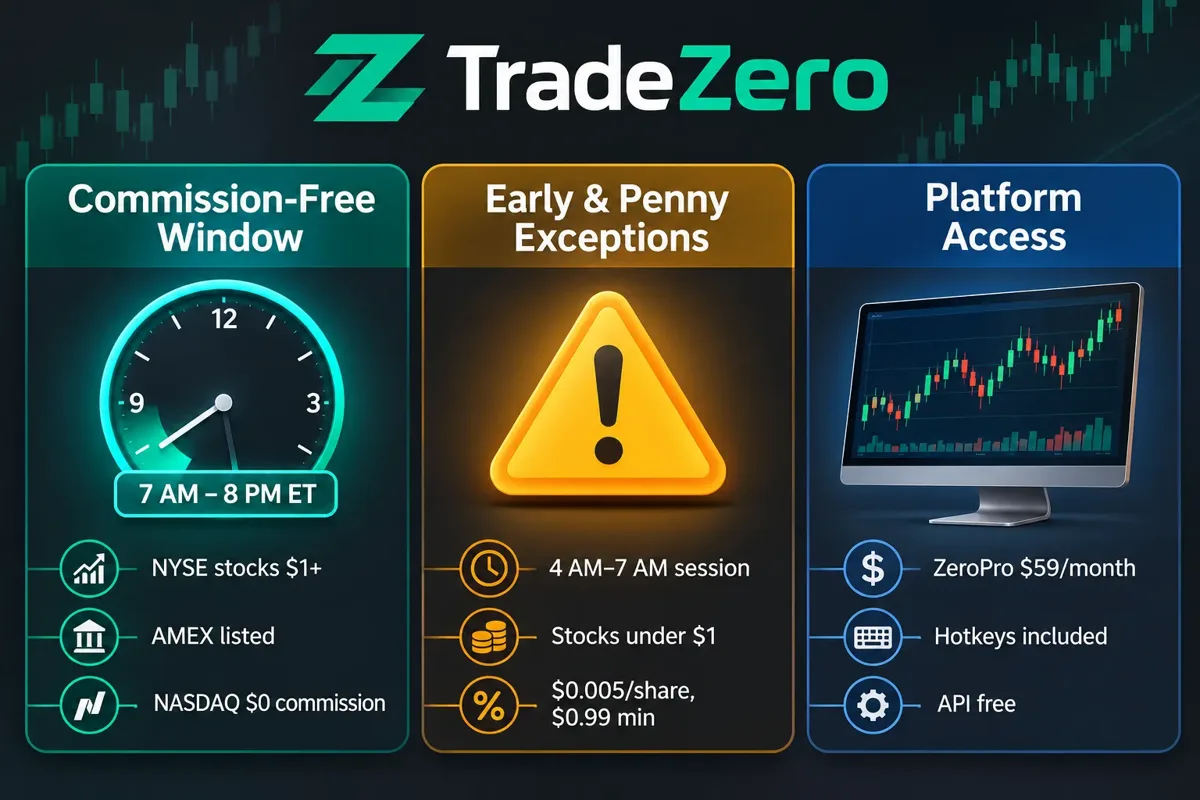
- Commissions: Stocks at $1 or more on NYSE, AMEX and NASDAQ are $0 commission from 7 AM to 8 PM ET.
- The exception: The 4 AM to 7 AM ET session, stocks under $1 and OTC names cost $0.005 per share, with a $0.99 minimum and a $7.95 maximum per order.
- Platform fees: ZeroPro is $59 a month. ZeroWeb and ZeroMobile cost nothing.
- Options: $0 commission plus $0.42 per contract, capped at $20 per order.
- Minimum: The US broker says you can start with as little as $500. The old $25,000 pattern day trader floor ended June 4, 2026.
- API and AI: The developer API is free, includes a paper environment and allows 200 requests per minute. The official MCP exposes 21 tools, and anything that commits capital or accepts a locate needs your approval.
- Regulation: The US entity is FINRA registered, BrokerCheck CRD 282940, founded 2015.
- Withdrawals: Outgoing ACH $5, outgoing wire $50, incoming transfers free.
What is TradeZero and who is it built for?
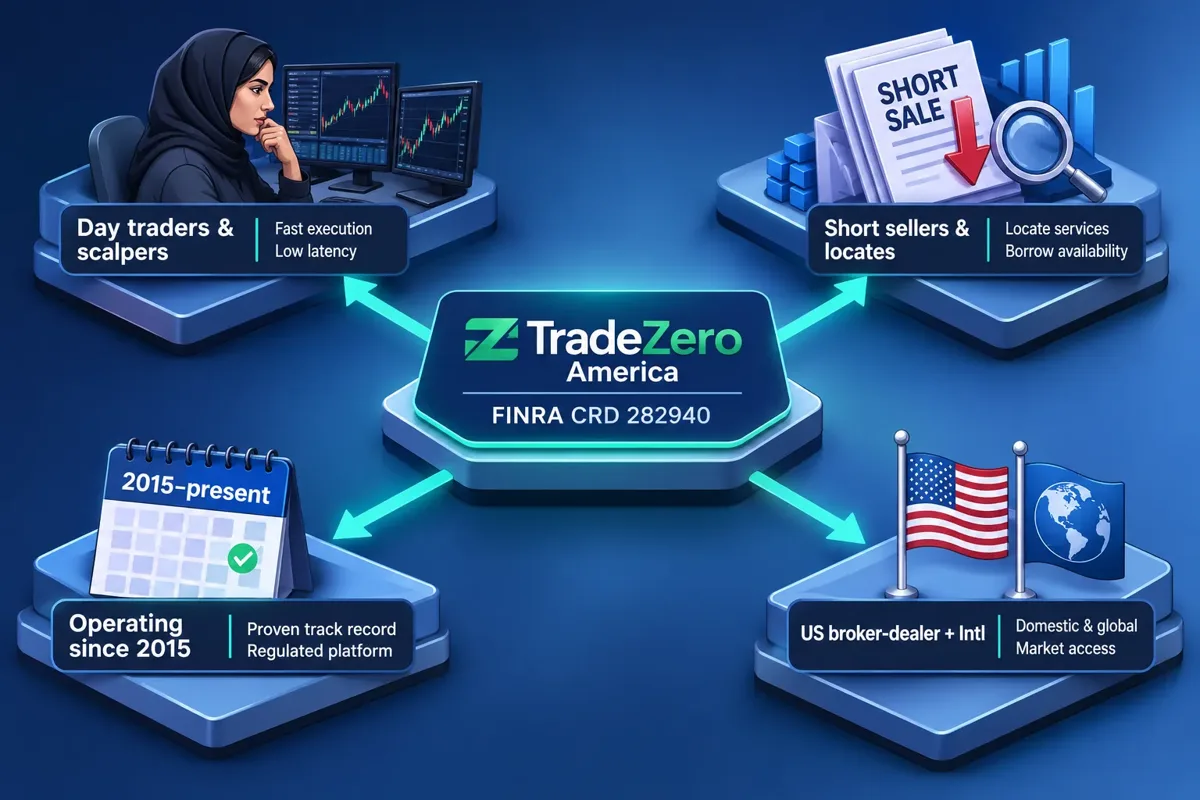
It's a brokerage designed around one customer: the trader who takes a lot of positions, holds them for minutes rather than months, and sometimes needs to sell short. TradeZero America, the US broker-dealer, is FINRA registered under CRD 282940 and has been operating since 2015. A separate international arm serves non-US clients, with different account rules and a different product set.
Most brokers are built for someone buying an index fund every payday. The product decisions follow: simple app, delayed quotes, no short locate desk, no hotkeys. Fine for that person. Useless at 9:31 AM when a stock is printing 400,000 shares a minute and you need to be on the bid right now.
The fit by trader type:
- Momentum scalper and small-cap day trader: Strong fit. Hotkeys, Level 2, locates and fast fills are the whole point.
- Short seller: Strong fit. The locate desk and the lowered $0.25 minimum short price threshold are hard to find elsewhere at retail.
- Options trader: Decent fit. $0.42 per contract capped at $20 is competitive, though the options tooling isn't as deep as a dedicated derivatives platform.
- Developer or AI-curious trader: Strong fit. A free API, a paper sandbox and an official MCP connector put it ahead of most retail brokers.
- Buy-and-hold investor: Poor fit. You'd be paying $59 a month for speed you'll never use. A discount broker suits you better.
- Total beginner with no process: Mixed. More on that below, because this deserves honesty rather than a sales pitch.
One more piece of context before you open an account: eToro agreed to buy the company on August 11, 2026 in a deal valued at up to $231 million. The deal still needs regulatory clearance and is expected to close in the first half of 2027. Nothing has changed for account holders yet, but ownership changes can move pricing and product roadmaps. Keep it on your radar.
What does this broker do for stock day traders?
Stocks come first here, and the structure reflects it. Equities priced $1 or more on NYSE, AMEX and NASDAQ carry zero commission across a long session, 7 AM to 8 PM ET, which covers most of pre-market and all of after-hours. Full trading hours stretch from 4 AM to 8 PM ET.
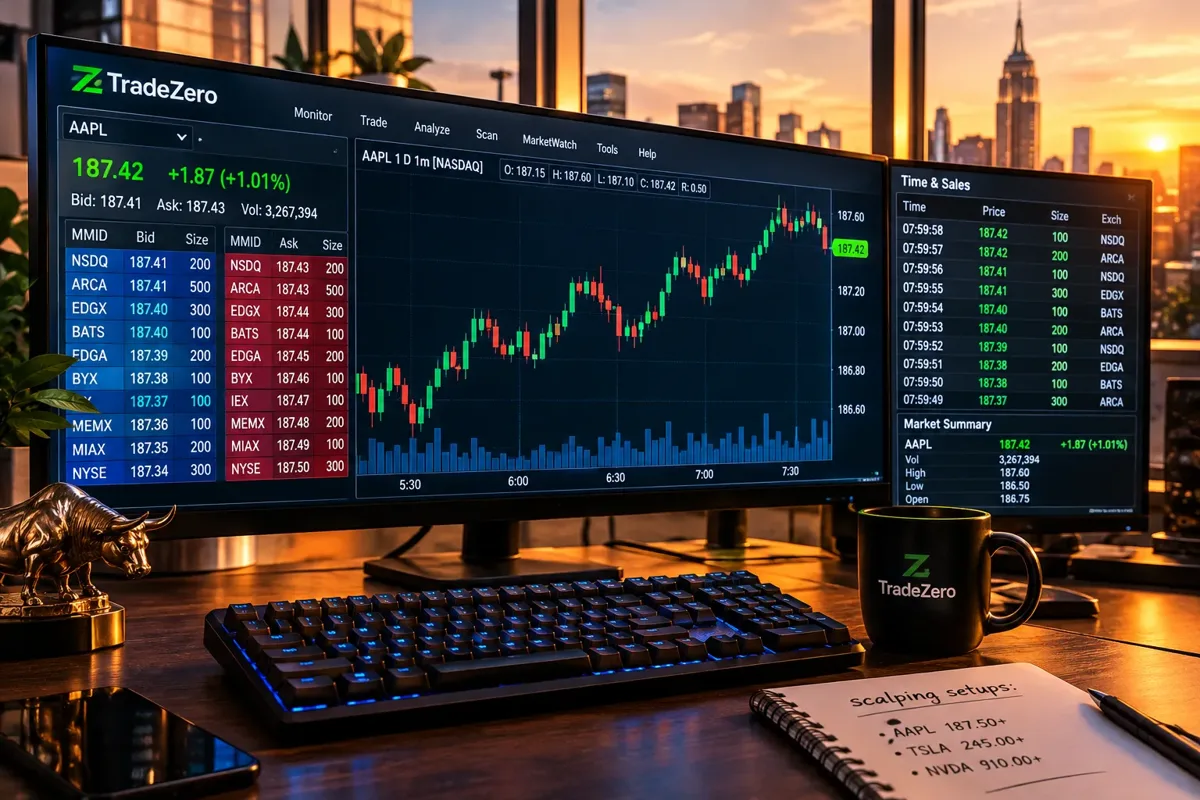
That long window matters more than it sounds. Gap setups form between 7 AM and 9:30 AM. If your broker makes you wait for the opening bell, you're watching the move, not trading it.
Three platforms, three jobs:
| Platform | Cost | Best for |
|---|---|---|
| ZeroPro (desktop) | $59/month | Hotkeys, Level 2, time and sales, montage order entry |
| ZeroWeb (browser) | No platform fee | Charting and order entry from any machine |
| ZeroMobile (app) | No platform fee | Position monitoring and quick exits away from the desk |
Hunting for a lower price? Check our AI stock tool deals page.
ZeroPro is the serious one. ZeroWeb handles the days you're on a borrowed laptop. The mobile app is for managing risk, not hunting entries, and its store rating shows it's the weakest leg of the stool.
Options are available too: $0 commission plus $0.42 per contract, capped at $20 per order. That cap is quietly useful if you trade size. Forty contracts and a hundred contracts cost the same $20.
Decision rule: if you place fewer than 10 trades a month, skip the ZeroPro subscription and run ZeroWeb. The $59 only pays for itself when hotkeys are saving you real slippage.
What are TradeZero's top 5 features?
The five things active traders keep this account open for: hotkeys, Level 2 with time and sales, short locates, paper trading, and the free developer API with its MCP connector.
1. Hotkeys in ZeroPro
Hotkeys map a keyboard combination to a complete order. One key sends a limit buy for 500 shares at the ask. Another flattens your position instantly. Another cancels everything open.
Why this matters more than any indicator: in a fast tape, the gap between deciding and executing is where your edge leaks out. Mouse-driven order entry costs you two or three seconds. On a stock moving 15 cents a second, that's the trade.
Common mistake: new users configure 20 hotkeys on day one and then freeze because they can't recall which key does what. Start with four. Buy, sell, flatten, cancel all. Add more after a month.
2. Level 2 and real-time data with time and sales
Level 2 shows the full order book: every bid and ask stacked by price and size, not just the single best quote. Time and sales is the running tape of actual executions, with price, size and timestamp.
Together they tell you whether a move is real. A stock climbing into a thin, pulling offer stack is a different animal from one grinding through a wall of size on heavy prints. That's what traders mean by reading the tape, and it's one of the few genuine edges available to a retail account.
A trader on r/Daytrading put it plainly: "Level 2: quite fast. I use level 2 all the time."
3. Short locates on hard-to-borrow stocks
This is the feature that keeps short sellers here. To short a stock, your broker must borrow shares for you. Most retail brokers either have the shares on an easy-to-borrow list or shrug and say no. This one runs a locate desk inside the platform, where you request shares on hard-to-borrow names, see the fee, and accept or decline.
The broker also lowered its minimum short price threshold from $0.50 to $0.25 in 2026, which opens up names that were off-limits before. Borrow availability still depends on inventory, your margin eligibility and the firm's risk controls, so a locate is never a sure thing.
Edge case worth planning for: on a hot morning when one small cap is the only story in town, locates on that name get expensive or disappear. Budget for it. Check the borrow before you build the thesis, not after.
4. Paper trading
TradeZero paper trading gives you a simulated account running on live market data, with the same hotkeys and the same layout as the live platform. Muscle memory transfers.
Use it for two things: learning your hotkey map without burning real money on a fat-fingered 5,000-share order, and testing a setup for 30 sessions before you size up. Paper trading isn't a beginner's consolation prize. It's how you prove a setup survives contact with a live tape.
5. Free developer API plus the official MCP for Claude and ChatGPT
The developer API launched on May 22, 2026 at no extra fee, with a paper environment and a rate limit of 200 requests per minute. That's a real API on a retail day trading account, which is rarer than it should be.
The official MCP connector exposes 21 tools and works with Claude, ChatGPT (Business, Enterprise or Edu plans only), Perplexity, Cursor and VS Code. Anything that commits capital or accepts a locate requires your explicit approval. There's a full section on this below, because it's the most misunderstood feature in the lineup.
What do we like about this broker?
The short answer: it does the three things day traders complain about most at other brokers, and it charges honestly for them.
Execution that traders vouch for unprompted. Reddit skews negative by nature, which makes positive broker threads worth more. From r/Daytrading: "Execution : great. Atleast 3x better than thinkorswim" and "still using it havent had a single issue about execution. and i scalp very fast."
Pricing you can calculate in advance. Zero commission on $1-plus listed stocks during the 7 AM to 8 PM window, a stated per-share rate outside it, a flat platform fee, a hard cap on options commissions. Nothing is buried. That earned an 18 out of 20 on cost transparency.
Short selling treated as a first-class product. Most brokers tolerate shorts. This one builds around them.
A free API with a sandbox. Alpaca built a whole business on developer access, and it's worth comparing the two approaches in the full Alpaca review. Bolting a free API onto a hotkey-driven day trading platform is a different animal, and a useful one.
The $500 entry point. With the pattern day trader rule gone and the US broker stating you can start with as little as $500, the barrier that kept small accounts out of active trading for 25 years is down.
Speed is a feature you only notice when it's missing. By then you've already paid for it in slippage.
What should you know before opening an account?
A handful of things, and they're all knowable in advance. None of them are dealbreakers if you plan around them.
Per-share fees before 7 AM. From 4 AM to 7 AM ET, and on any stock under $1 or trading OTC, you pay $0.005 per share with a $0.99 minimum and a $7.95 maximum per order. On a 2,000-share order, that's $7.95 each way. If you live in the 4 AM gap window, model that cost honestly.
Withdrawal fees. Outgoing ACH is $5 and an outgoing wire is $50. Incoming is free. Not unusual, but if you sweep profits weekly, $5 a pop adds up to $260 a year for no reason. Batch your withdrawals monthly.
Locate availability on hot mornings. Covered above. On the days you most want to short, borrow is tightest. That's not a bug in the broker. It's how the securities lending market works.
The mobile app is the weak point. The iPhone app sits at 2.7 stars from 96 ratings on the App Store. One reviewer there noted: "Once you get used ti the flow, the speed to placing an order is really nice." Read that for what it is. Speed is good, the learning curve is real, and the user count is small. Treat the app as a position-management tool, not your primary platform.
The regulatory record. In September 2026, the Massachusetts Securities Division fined the US broker-dealer $750,000 over a 2024 customer-data breach tied to a third-party chat service and over gaps in automated account approvals. The consent order required reimbursement for affected Massachusetts investors, an independent compliance consultant and upgraded security and approval controls. It's a real mark, it's public, and you can read the record yourself on FINRA BrokerCheck under CRD 282940.
US vs international accounts. The US entity is the FINRA-registered broker-dealer. The international arm serves non-US clients under a different regulatory structure, with different margin rules and account minimums. Confirm which entity you're opening with before funding.
How much does TradeZero cost?
Here's the full fee picture in one table. The headline: listed stocks over $1 cost nothing in commissions during the main session, and everything else is a stated rate.
| Item | Cost |
|---|---|
| Stocks $1+ on NYSE, AMEX, NASDAQ (7 AM to 8 PM ET) | $0 commission |
| Stocks 4 AM to 7 AM ET, under $1, or OTC | $0.005/share, $0.99 min, $7.95 max |
| ZeroPro desktop platform | $59/month |
| ZeroWeb and ZeroMobile | No platform fee |
| Options | $0 commission + $0.42/contract, $20 cap per order |
| Futures (micro) | $0.39 per side |
| Futures (standard) | $1.29 per side |
| Outgoing ACH withdrawal | $5 |
| Outgoing wire withdrawal | $50 |
| Incoming transfers | Free |
| Developer API | No extra fee |
| Stated starting balance (US accounts) | As little as $500 |
Decision rule on ZeroPro: if hotkeys and Level 2 save you even two cents of slippage on 500 shares, twenty times a month, that's $200 of value against a $59 cost. If you can't honestly say your fills are costing you money on ZeroWeb, don't buy the upgrade yet.
A worked example. Say you take 6 round trips a day at 500 shares, 21 trading days a month, and 20% of those trades land in the 4 AM to 7 AM window. That's about 50 early orders a month at $2.50 each ($0.005 x 500 shares), or roughly $126, plus $59 for ZeroPro. Call it $185 a month all-in, and the other 200 or so orders cost nothing in commissions. Move those early trades to after 7 AM and the bill drops to $59.
Current promos and account offers are tracked on the FullStack Alpha deals page. Prices change fast, like AI technology.
Is the broker really commission free?
Mostly yes, with one clearly stated exception that's easy to avoid. Stocks priced $1 or more on NYSE, AMEX and NASDAQ carry no commission from 7 AM to 8 PM ET. That covers the vast majority of what a typical day trader does.
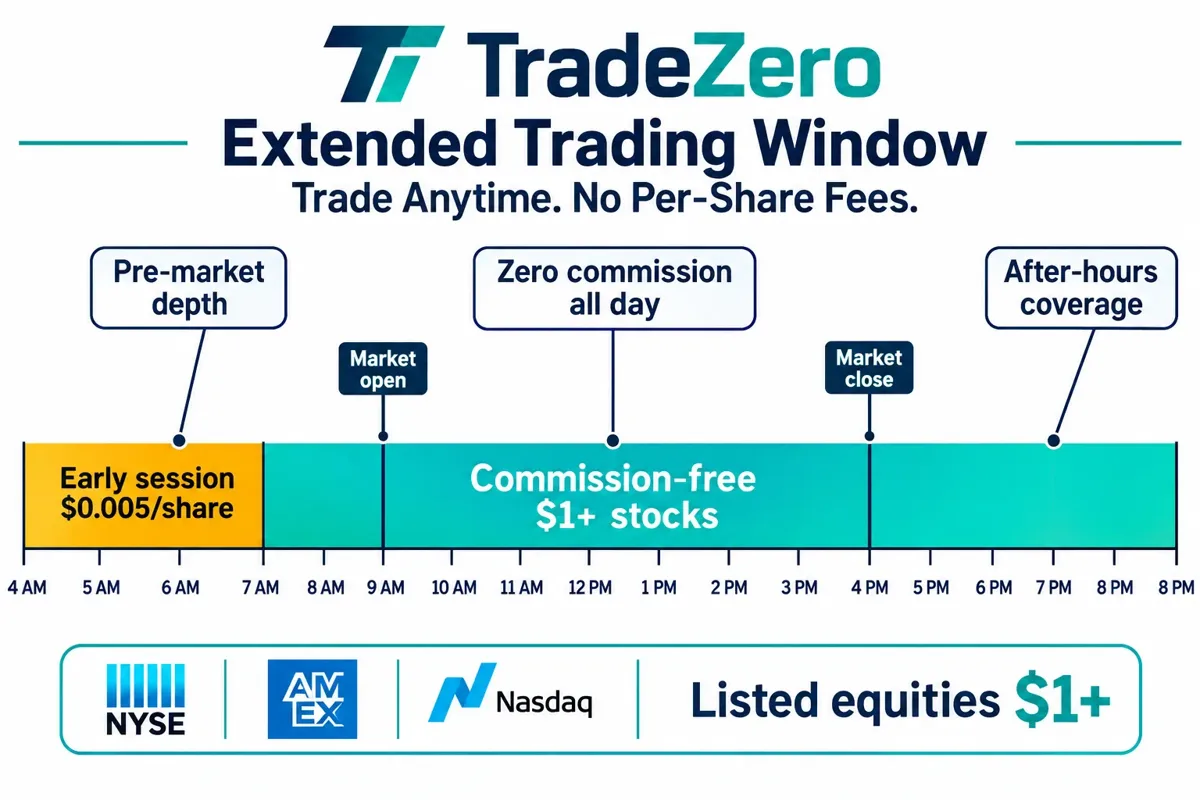
The exceptions: the 4 AM to 7 AM ET early session, stocks under $1, and OTC names. Those cost $0.005 per share with a $0.99 floor and a $7.95 ceiling per order. ZeroPro's $59 monthly fee is a platform cost, not a commission, but it's still money leaving your account.
Honest framing: zero commission is real for the main session on listed names. If you trade sub-dollar tickers at 5 AM, you're paying per share, and the broker tells you so up front. That transparency is why cost transparency scored 18 out of 20.
How does the TradeZero API and MCP work for AI trading?
The developer API went live on May 22, 2026, costs nothing extra, includes a paper environment and allows 200 requests per minute. The official MCP connector sits on top of it and exposes 21 tools to Claude, ChatGPT (Business, Enterprise or Edu plans only), Perplexity, Cursor and VS Code. You switch on API Trading in the client portal first.
MCP stands for Model Context Protocol. It's the standard that lets an AI assistant call outside tools instead of just talking about them. With the connector enabled, you can ask Claude to pull your open positions, check a borrow, or stage an order.
The safety design is the headline: anything that commits capital or accepts a locate needs your explicit approval. The model proposes. You confirm. A connected AI can't trade on its own, which puts it in a different category from brokers experimenting with agents that can trade without your sign-off.
How to start without breaking anything:
- Connect the API to the paper environment first. Not live. Paper.
- Build and test read-only calls: positions, quotes, account balance.
- Add order staging in paper. Watch what the model proposes for a full week.
- Write explicit limits before you go live, the same way you'd give any AI trading helper hard limits and then test them.
- Go live with the smallest size you can trade, and keep the approval step on.
Common mistake: treating the MCP as a strategy. It isn't. It's plumbing. If your process is undefined, automating it just produces bad decisions faster. Systems over hacks.
Rate limit reality check: 200 requests per minute is plenty for position monitoring, order staging and a scanner polling a watchlist. It's not enough for tick-by-tick streaming of hundreds of symbols. Design accordingly.
Are futures available too?
Yes, and they're new for the US broker. Micro contracts cost $0.39 per side and standard contracts cost $1.29 per side.
That pricing is competitive for retail futures, and micro contracts give small accounts index exposure without the capital a standard contract demands. Still, futures are an add-on to a stock-first platform, not the reason to open the account. If futures are your main business, a dedicated futures broker gives you deeper tooling. If you trade equities and want index futures to hedge or catch an overnight move, the pricing works.
What do real traders say?
The sentiment splits cleanly: execution and Level 2 get praised, the mobile app and customer service get criticized. Community Verdict scored 14 out of 20 because of that gap.
From Reddit (r/Daytrading), where nobody is paid to be nice:
- "Execution : great. Atleast 3x better than thinkorswim"
- "Level 2: quite fast. I use level 2 all the time."
- "still using it havent had a single issue about execution. and i scalp very fast"
From Trustpilot (3.9 from 3,095 reviews):
- "The Pro Chart is surprisingly fast."
- "Excellent service, great platforms and a reasonable cost"
From the App Store (2.7 from 96 ratings):
- "Once you get used ti the flow, the speed to placing an order is really nice."
Read the spread, not the average. A 3.9 on Trustpilot across 3,095 reviews next to a 2.7 on the App Store across 96 ratings tells you the desktop and mobile experiences are two different products. The Reddit threads, which are unsolicited and skew negative by default, consistently back the execution claim. That's the strongest signal in the set.
The criticisms that recur: the mobile app lags the desktop, support response times vary, and locate costs on hot names frustrate people who didn't check the borrow first. That last one is partly a user problem.
How does TradeZero compare to Webull, Interactive Brokers and DAS Trader?
Each of these wins at something different. The honest comparison is about what you trade, not which brand is "best."
| TradeZero | Webull | Interactive Brokers | DAS Trader | |
|---|---|---|---|---|
| Stock commissions | $0 on listed $1+, 7 AM-8 PM ET | $0 | Tiered or fixed per share | Depends on clearing broker |
| Platform fee | ZeroPro $59/mo; web and mobile free | Free | Free (data fees apply) | ~$150/mo typical |
| Hotkeys | Yes, ZeroPro | Limited | Yes, TWS | Yes, best in class |
| Short locates | In-platform locate desk | Limited inventory | Deep borrow book | Depends on broker |
| Options | $0 + $0.42/contract, $20 cap | $0 + small fees | Low per contract | Via broker |
| API | Free, paper env, 200 req/min | Available | Extensive | Limited |
| AI / MCP connector | Official, 21 tools, approval required | No | No | No |
| Best for | Scalpers, short sellers, API builders | Casual day traders, mobile-first | Global multi-asset, pros | Pure execution specialists |
Versus Webull: Webull wins on mobile polish and charges nothing for a platform. This broker wins on short locates, hotkey depth and the developer API. If you short small caps, it isn't close. If you swing trade from your phone, Webull is the easier ride.
Versus Interactive Brokers: IBKR has a deeper borrow book and global market access. It also has a learning curve that defeats a lot of people, and its pricing is harder to model.
Versus DAS Trader: DAS has the deepest hotkey engine in retail trading, and it costs roughly three times as much per month plus a clearing relationship. ZeroPro at $59 covers most of what traders use DAS for.
Related reading: if you're building the scanner layer on top of whatever broker you pick, start with 7 swing trade scanners that find setups before they break out.
Can you day trade with a small account now that the PDT rule is gone?
Yes, and the rules got simpler. The US pattern day trader designation and its $25,000 minimum equity requirement ended June 4, 2026 after SEC and FINRA rule changes. The floor is now the standard $2,000 margin minimum that always existed, and the US broker says you can open with as little as $500.
What didn't go away: margin requirements, buying power limits and the broker's own risk controls. Intraday buying power and overnight buying power are different numbers, and exceeding either triggers a call. Leverage amplifies losses exactly as fast as it amplifies gains.
Decision rule for small accounts: the gate opening doesn't mean you should sprint through it. Define your position sizing and your stop loss rules before you place a single live trade. A $500 account using 4-to-1 intraday leverage can be gone in two bad sessions. If you want the framework first, read how to day trade without $25k.
Play stupid games, win stupid prizes.
Is your money safe here, and how do withdrawals work?
The US broker-dealer is FINRA registered, BrokerCheck CRD 282940, founded in 2015. You can verify that record yourself on FINRA's BrokerCheck. SIPC coverage protects your assets if the broker fails. It does not cover trading losses.
The Massachusetts consent order from September 2026 is covered above. Weigh it. A $750,000 fine with required fixes is meaningful, and it's also a long way from an unregulated offshore operation.
Withdrawals run through the client portal. Outgoing ACH costs $5 and typically takes a few business days. An outgoing wire costs $50 and lands same day or next. Incoming transfers are free.
Practical tip: set a monthly withdrawal cadence rather than a weekly one. Twelve ACH withdrawals a year cost $60. Fifty-two cost $260 for the same money.
How do you log in to TradeZero, download ZeroPro and reach support?
Everything account-related lives in the client portal: funding, withdrawals, platform subscriptions, document uploads and the switch that turns on API Trading. Log in there first after your application is approved.
From there, you pick your platform:
- ZeroWeb: runs in the browser, so you sign in with the same credentials and trade from any machine. Nothing to install.
- ZeroPro: a Windows desktop download. Install it on your main trading machine, set your four core hotkeys, and save your layout before the next open.
- ZeroMobile: the iOS and Android app, best kept for monitoring positions and closing trades away from the desk.
Customer service runs through the Help center on the website, which lists current contact options and hours. Two habits save time: search the Help center before opening a ticket, and contact support during regular market hours rather than at 9:25 AM, when every active trader has the same urgent question.
Is TradeZero good for beginners?
Mixed, and the honest answer depends on what kind of beginner you are. Beginner to markets? Probably not the right first stop. Beginner to active day trading but already comfortable with charts and risk? It's a strong place to learn properly.
Reasons it works for a motivated newcomer:
- Paper trading runs on live data with the real platform layout, so practice transfers.
- The $500 starting point makes a small, survivable account realistic.
- The fee structure is simple enough to model in advance.
Reasons it doesn't work for everyone:
- Level 2 and time and sales are information-dense. Without context, they create analysis paralysis.
- Hotkeys are fast in both directions. A misconfigured key sends a wrong order instantly.
- Short selling on margin is dangerous without rules.
The path that works: 30 sessions in paper, same setup every day, written rules for entry, exit and position size. Then go live at the smallest size you can tolerate. A good filter is running a yes-or-no checklist before the open so you're not trading a choppy tape out of boredom.
Alpha Score: 85 out of 100
It scores 85 out of 100 across five pillars, 20 points each.
| Pillar | Score | Why |
|---|---|---|
| Execution Quality | 17/20 | Consistent unsolicited praise from scalpers on fill speed. Not perfect, but strong. |
| Cost Transparency | 18/20 | Every fee is published and calculable in advance. Few surprises. |
| Price-to-Value | 19/20 | $59 for hotkeys, Level 2, locates and a free API is the best value in this category. |
| Usability | 17/20 | ZeroPro is excellent once learned. The mobile app drags the score down. |
| Community Verdict | 14/20 | Strong Reddit sentiment on execution, a weak App Store rating and a state enforcement action. |
Community Verdict is the honest soft spot. Desktop users praise it, mobile users don't, and the Massachusetts consent order is a legitimate mark on the record. The full scorecard with testing notes lives on our broker scorecard, and the tool profile sits in the FullStack Alpha directory.
Alternatives worth checking
If this one isn't the fit, here are genuine substitutes depending on what you weight:
- Webull if mobile experience and zero platform fees matter more than locates.
- Interactive Brokers if you need global markets and deep borrow inventory and don't mind complexity.
- DAS Trader if hotkey precision is everything and you'll pay roughly triple for it.
- Alpaca if you mainly build automated systems and don't need a manual trading platform.
- Lightspeed or Cobra Trading if short locates are your single highest priority.
For AI trading tools ranked side by side, the Best AI Trading Tools hub keeps a running list.
Final verdict
TradeZero is one of the few retail brokers clearly designed by people who've sat in the chair during a fast open. Hotkeys that fire instantly, a Level 2 book that keeps up, a locate desk that finds shares, and a $59 platform fee that undercuts the usual $150 competitors by a wide margin. Add a free API with a paper sandbox and an MCP connector that keeps a human in the approval loop, and the value case is strong.
It isn't flawless. The mobile app sits at 2.7 stars. The Massachusetts enforcement action is real and belongs in your thinking. Pre-market before 7 AM and sub-dollar names cost per share. The pending eToro deal could change things in 2027.
Who should open an account: momentum day traders, scalpers, short sellers, and developers who want a real API on a real day trading account.
Who should pass: long-term investors, phone-only traders, and anyone who hasn't written down their risk rules yet.
Your next three steps:
- Open the paper account and spend one week doing nothing but learning four hotkeys.
- Run the worked example above with your own trade count before you commit to ZeroPro.
- Write your position sizing and stop loss rules on paper before the first live order.
The platform gives you speed. Speed without a system just gets you to the wrong place faster.
Prices are subject to change as fast as AI technology.
We test the tools. You get the verdict.
One email a week. What we tested, what scored, and what we'd skip. Written for traders, not for clicks.
Frequently asked
Topics in this teardown
Our verdict on TradeZero
TradeZero scores 85: a day trading broker that gets the hard parts right.
This is an affiliate link. It never affects our score. Why →