Motley Fool vs Seeking Alpha: Stock Picks or Research Depth?
Motley Fool vs Seeking Alpha is a fork in the road: Stock Advisor hands you two finished picks a month for $199 a year, while Seeking Alpha hands you a research library and expects you to form your own opinion.
Quick answer
Buy Motley Fool Stock Advisor if you want someone else to do the picking and you'll actually hold a position for five years. Buy Seeking Alpha Premium if you want the bull case and the bear case on the same ticker, plus Quant Ratings and Factor Grades to sanity-check your own thesis. Stock Advisor is $199 a year at standard price, often $99 for a first year when the intro offer is running, with a 30-day money-back guarantee. Seeking Alpha runs a free Basic tier, Premium at $299 a year list, Alpha Picks at $499 a year for two model picks a month, and Pro at $2,149 a year. Pay for one. Not both.
Motley Fool vs Seeking Alpha: key takeaways
- Stock Advisor delivers 2 new stock recommendations per month plus a Top 10 Recommendations list and a Starter Stocks list for beginners.
- Seeking Alpha Premium delivers zero picks by default. Model picks live in Alpha Picks, a separate $499-a-year product that adds 2 picks a month.
- Price gap at list: $199 vs $299 a year. Stock Advisor's first-year intro price of $99 makes the gap wider for year one, then renewal snaps back to $199.
- Only Seeking Alpha has a usable free tier. Limited article access, limited data, still enough to test the contributor quality before you spend a dollar.
- Only Stock Advisor has a stated 30-day money-back guarantee. After 30 days, your options narrow considerably.
- Factor Grades score five things: valuation, growth, profitability, momentum, and EPS revisions. Stock Advisor has no letter-grade system at all, just recommendations and a published archive of past picks.
- Motley Fool Stock Advisor scores 69/100 on our Alpha Score, dragged down by a 13/20 on transparency and an 11/20 on community verdict.
Motley Fool vs Seeking Alpha at a glance
| Product | Core output | Who it's for | Price |
|---|---|---|---|
| Motley Fool Stock Advisor | 2 new picks a month, Top 10 list, Starter Stocks | Buy-and-hold investors who want a decision, not a reading list | $199/yr standard; $99 first year when the intro offer runs |
| Seeking Alpha | Contributor articles, Quant Ratings, Factor Grades, transcripts, screener | Investors who want to read the argument and decide themselves | Free Basic; Premium $299/yr list; Alpha Picks $499/yr; Pro $2,149/yr |
How did we compare Motley Fool vs Seeking Alpha?
We compared them on five things that change the outcome for a paying subscriber: what the service actually outputs, how transparent the method is, what it costs across the full renewal cycle, how long it takes to get something useful, and what real users say in places where nobody was asked to review.
Here's what that looks like in practice.
Output first. A research service is only worth the money if it produces something you can act on. Stock Advisor produces a decision. Seeking Alpha produces material for a decision. Those are not the same product, and pricing them against each other by dollars alone misses the point.
Then the method. Can you see why a stock was chosen? Seeking Alpha publishes the five factors behind its Quant Ratings. Motley Fool publishes the recommendation and the reasoning article, and keeps the actual selection process closer to the vest. That's a real difference and it shows up in the scoring.
Then the full cost. Introductory pricing is marketing. Renewal pricing is the product. Both services renew at list, so we compare year two, not year one.
Then time to first useful output. Stock Advisor gets you there in about ten minutes. Open the Top 10, read two write-ups, place an order. Seeking Alpha can take a week before you know which contributors to trust and which to skip.
Then unsolicited sentiment. Reddit threads, complaint-heavy review sites, and app store reviews all carry different biases. The gap between them is the finding. Our full methodology lives at how we test.
One rule we hold to: we never present a published track record as a forecast. Past results are history, not a promise. The SEC's own investor education arm is blunt about this, and you should be too before subscribing to anything. (Investor.gov)
Motley Fool vs Seeking Alpha: picks or research depth?
Picks if you have 20 minutes a month. Research depth if you have three hours a week. That's the honest split, and it has almost nothing to do with intelligence or experience.
Think of it like food. Stock Advisor is a meal kit: portioned, labeled, ready in fifteen minutes, and someone else decided what's for dinner. Seeking Alpha is a well-stocked grocery store with an opinionated staff. Better ceiling, more work, and you can absolutely walk out with a cart of nothing.
The failure modes are different too, and they matter more than the feature lists.
Stock Advisor's failure mode is passivity. You get a pick, you buy it, you never learn why. Three years later the thesis breaks and you have no framework to evaluate whether to hold or sell, because you outsourced the thinking along with the picking.
Seeking Alpha's failure mode is analysis paralysis. Analysis paralysis means gathering so much information that you stop making decisions. Twelve contributors, six bullish, six bearish, all articulate. You read all twelve, feel informed, and buy nothing. A subscription you use as entertainment is a subscription you should cancel.
Decision rule: if you've owned a brokerage account for more than a year and still can't name three stocks you researched and bought on your own conviction, you're not a research person yet. Start with picks, and read the write-ups like homework.
Motley Fool Stock Advisor: best for investors who want finished picks
Stock Advisor is the finished-product side of Motley Fool vs Seeking Alpha: $99 for the first year when the intro offer runs, then $199.
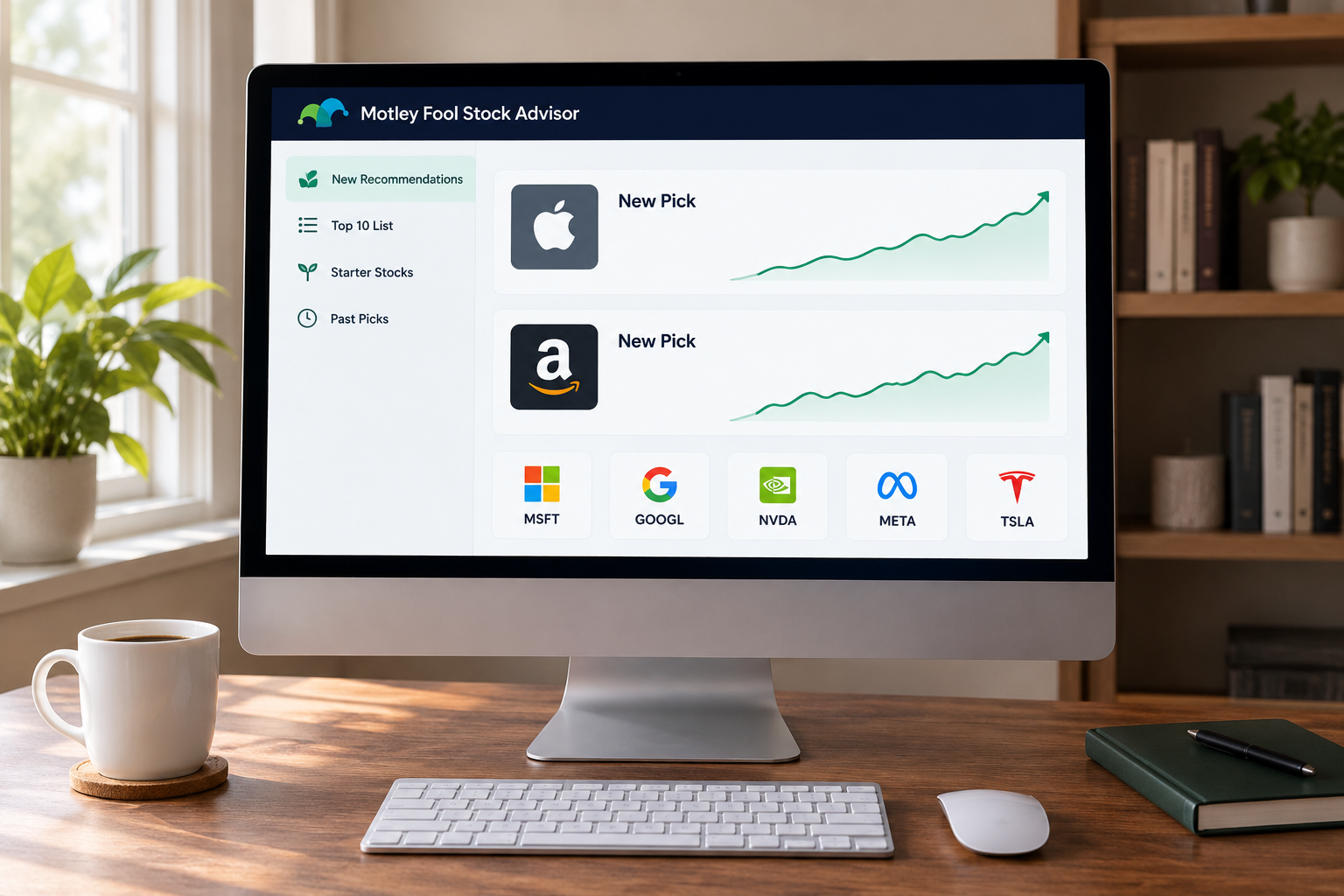
Motley Fool Stock Advisor is a stock-picking subscription built for long-horizon buy-and-hold investors who want a short list of ideas rather than a research terminal. You get two new recommendations a month, a Top 10 Recommendations list that tells you where to put money today, a Starter Stocks list for new accounts, and the full archive of past picks with their published returns.
The two-decade published record is the reason this service has the brand recognition it does. It's also the reason the marketing leans on it so hard.
Pros
- Two new stock picks every month, plus the Top 10 Recommendations list so you're never staring at a blank screen
- $99 first-year price when the intro offer is running, with a 30-day money-back guarantee attached
- Full archive of past recommendations and their published returns, which is more disclosure than most newsletter-style services offer
- Starter Stocks gives a beginner a defensible first five positions instead of a lottery ticket
- The buy-and-hold framing actively discourages overtrading, which is the single most expensive habit in retail investing
Cons
- Renewal jumps to $199 a year and refund options after the 30-day window are limited
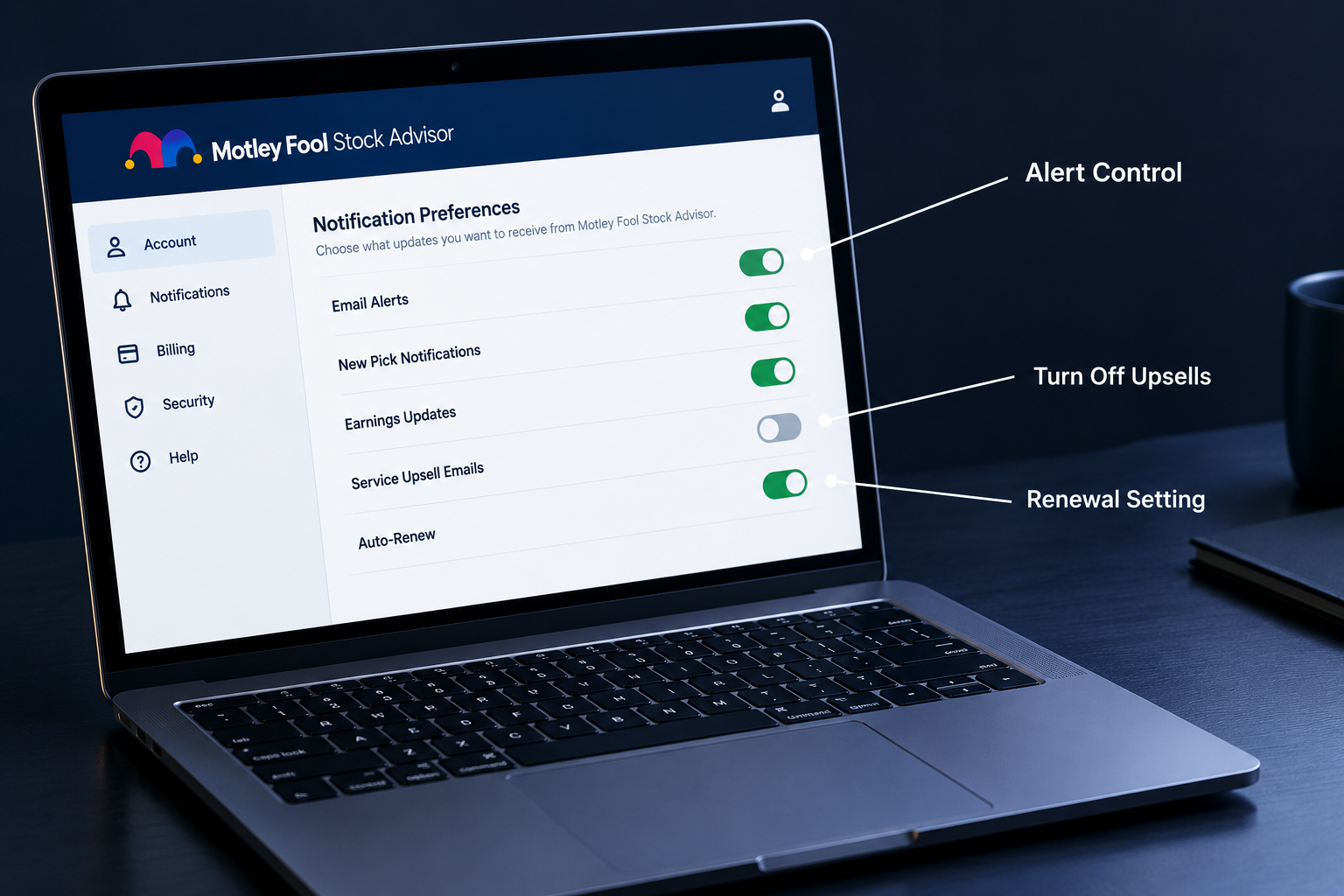
- The upsell pressure is relentless. Reddit threads about Motley Fool are dominated less by pick quality and more by frustration with email volume and the constant pitch for higher-priced services
- No ratings system, no screener, no letter grades. If you want to check a stock that wasn't recommended, this service has nothing for you
- The published method is thin. You see the conclusion and the argument, not the selection framework
Key features that matter
Two picks a month. Dated, written up, and archived. Predictable cadence is underrated for people who need a reason to actually contribute to their account every month.
Top 10 Recommendations. The most practical asset in the service. It answers the question "what do I buy with $500 today" without requiring you to read 40 write-ups.
Starter Stocks. Built for accounts under roughly $5,000 that need a foundation before chasing anything interesting.
Full pick archive with published returns. Useful for pattern recognition. Read ten old write-ups and you'll start to see the house style: growth-leaning, long duration, comfortable with volatility.
Who it's best for
Self-directed long-term investors who want curated ideas and a nudge toward patience, not a screener and 100 filters. If your realistic research budget is 20 minutes a month and your holding period is measured in years, this is the right tool, and the $99 first year makes testing it cheap. Full breakdown in our Motley Fool Stock Advisor review.
Who it's not for: active traders, dividend-income investors who need yield and payout grades, and anyone who wants to check a ticker the service never covered.
Seeking Alpha: best for investors who want to do the research
Seeking Alpha is the raw-materials side, with a free Basic tier and Premium at $299 a year list.
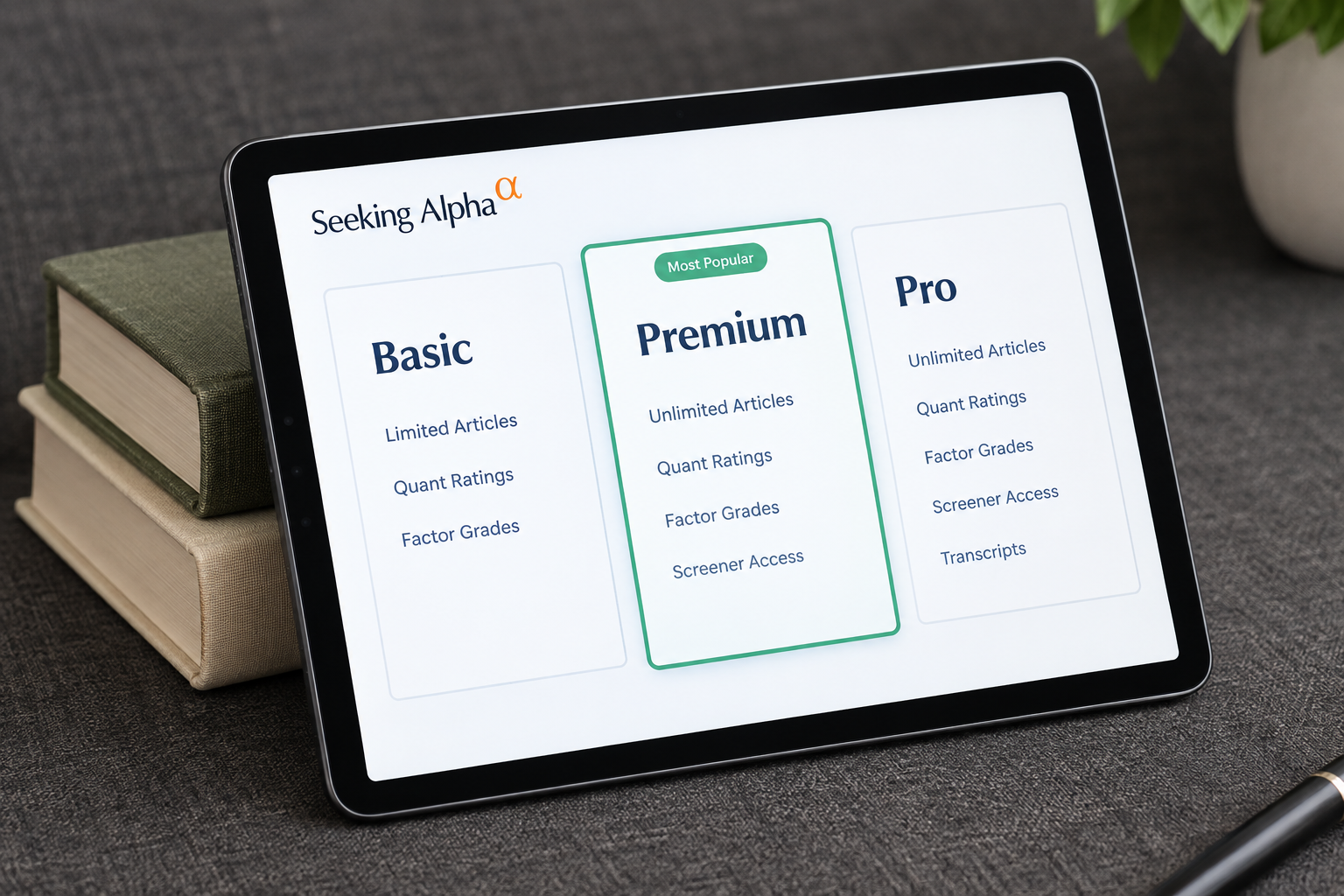
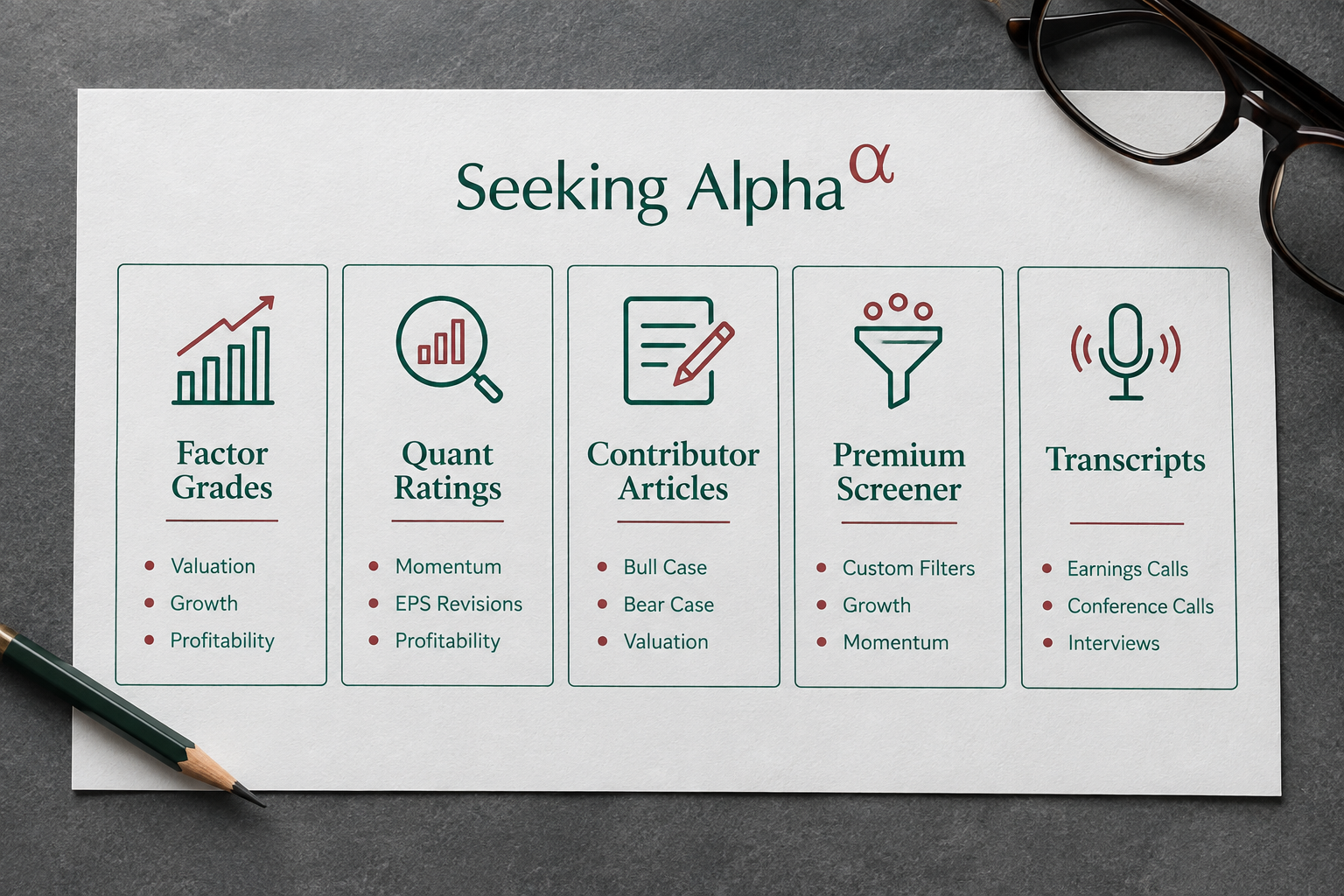
Seeking Alpha is a crowd-sourced research platform where thousands of contributors publish long-form bull and bear cases on individual stocks, and Premium layers quantitative scoring on top. You get Quant Ratings, Factor Grades across valuation, growth, profitability, momentum, and EPS revisions, Dividend Grades, earnings call transcripts, and a screener with 100+ filters.
The thing nobody else replicates: two credible writers arguing opposite sides of the same ticker, on the same page, with the comment section visible. That's closer to how an actual investment committee works than any single-analyst newsletter.
Pros
- Deep bench of contributor articles, often with a bull case and a bear case on the same stock published within days of each other
- Quant Ratings and Factor Grades put a letter grade on five separate dimensions, so you can see whether a stock is cheap, growing, profitable, trending, or getting upgraded by analysts
- Premium screener with 100+ filters, which turns the platform from a reading list into a discovery tool
- Earnings call transcripts included, so you can read management's exact language instead of a summary of a summary
- Dividend Grades make it genuinely useful for income investors, a group Stock Advisor barely serves
- A real free Basic tier, so you can judge the contributor quality before paying
- First-year promos frequently land Premium below the $299 list price
Cons
- Contributor quality is uneven. Some writers are former sell-side analysts, some are hobbyists with a template, and the platform doesn't sort them for you
- Model stock picks cost extra. Alpha Picks is $499 a year on top of Premium, which means the "picks plus research" bundle runs well past $700 at list
- Promotional pricing renews at full list, and that renewal surprise is the most common complaint pattern for any annual research subscription
- Pro at $2,149 a year is priced for professionals and is almost never the right call for an individual investor
- Volume can overwhelm. Following 40 tickers here produces more reading than most people will ever finish
Key features that matter
Factor Grades. Five letter grades per stock covering valuation, growth, profitability, momentum, and EPS revisions. EPS revisions track whether Wall Street analysts are raising or cutting their earnings estimates, which is one of the more useful short-term signals in fundamental data.
Quant Ratings. A single systematic rating built from those factors. Treat it as a filter, not a verdict.
Earnings call transcripts. Free elsewhere in fragments, consolidated and searchable here.
The screener. 100+ filters means you can build a repeatable process instead of reacting to headlines. Compare it against dedicated screeners in our Koyfin vs Stock Rover comparison if screening is your main use case.
Who it's best for
Research-oriented investors who want to understand a business before owning it, plus dividend investors who need payout and yield grading. Our deeper look is in the Seeking Alpha review.
Who it's not for: anyone who wants a decision handed to them. Premium without the willingness to read is $299 for a paywall you'll resent.
Motley Fool vs Seeking Alpha full comparison: the columns that decide it
This Motley Fool vs Seeking Alpha table covers the six factors that decide the purchase, refunds and top-end plans included.
| Decision factor | Motley Fool Stock Advisor | Seeking Alpha | Price |
|---|---|---|---|
| Stock picks per month | 2 new picks, plus Top 10 list and Starter Stocks | 0 on Premium; 2 a month via Alpha Picks add-on | MF: $199/yr ($99 intro first year) · SA: Premium $299/yr list |
| Research depth | Write-up per pick, full archive of past recommendations | Thousands of contributor articles, bull and bear cases, earnings transcripts, 100+ filter screener | Included in each plan above |
| Ratings system | None. Recommendations only, no grades or scores | Quant Ratings, Factor Grades (valuation, growth, profitability, momentum, EPS revisions), Dividend Grades | Premium tier required |
| Free tier | No | Yes, Basic with limited article and data access | Free |
| Refund policy | 30-day money-back guarantee | No stated money-back window. Test with the free Basic tier first and confirm terms at checkout | n/a |
| Top-end plan | Other Motley Fool services sold separately | Alpha Picks $499/yr; Pro $2,149/yr | SA Pro $2,149/yr |
Prices reflect list pricing at the time of writing. Both companies discount first years and renew at list, so confirm the renewal figure on the checkout page before you enter a card. That's where most of the anger in the review sections comes from, on both platforms.
Which one fits your time budget and investing personality?
Time, not intelligence, settles Motley Fool vs Seeking Alpha for most investors.
Match the service to the hours you'll genuinely spend, not the hours you plan to spend in an imaginary version of your life where you read annual reports on Saturday mornings.
Under 30 minutes a month: Stock Advisor. Two picks, a Top 10 list, done. You'll buy something, and buying something beats an unused subscription and a cash balance.
One to three hours a week: Seeking Alpha Premium. That's enough time to read two contributor pieces, check the Factor Grades, skim the latest transcript, and reach an actual opinion.
Three-plus hours a week and you run your own screens: Seeking Alpha Premium, and skip Alpha Picks. You're paying $499 extra for someone else's conviction when you already have your own process.
You want both and you're short on cash: Stock Advisor for year one at $99, then switch. Use the picks as training wheels and the write-ups as a reading curriculum. When you find yourself disagreeing with a recommendation and being able to explain why, you've graduated. Move to Premium.
Common mistake: subscribing to both at list price. That's $498 a year, and the overlap in usable output for a single investor with one portfolio is substantial. Two subscriptions rarely produce twice the clarity. They usually produce conflicting opinions and slower decisions.
Edge case worth naming: if you're primarily a dividend and income investor, Stock Advisor is a poor fit regardless of your time budget. Its growth-leaning recommendations and lack of dividend grading leave you doing the yield work manually. Seeking Alpha's Dividend Grades exist precisely for you.
Top 5 features that decide Motley Fool vs Seeking Alpha
Only one of these five favors Stock Advisor outright, and it happens to be the one most of its subscribers are paying for.
Five features separate these two services in ways that show up in your actual behavior, not just the feature grid.
1. Whether a decision is included. Stock Advisor's two-picks-a-month cadence is the entire product. Seeking Alpha Premium deliberately doesn't do this, and Alpha Picks charges $499 a year to add it. If you need the decision made for you, the cheaper path is obvious.
2. Factor Grades and Quant Ratings. Seeking Alpha grades valuation, growth, profitability, momentum, and EPS revisions on every covered stock. This is the single most useful feature on either platform for building your own process, because it gives you a consistent frame to compare two unrelated companies. Stock Advisor has nothing comparable.
3. The opposing-view structure. Reading a bear case on a stock you already own is the closest thing retail investors have to risk management on the research side. Seeking Alpha is the only one of the two that routinely puts both arguments in front of you.
4. Refund and trial mechanics. Stock Advisor's 30-day money-back guarantee lets you see the Top 10 list and the archive before committing. Seeking Alpha's free Basic tier lets you judge the writing before paying. Different mechanisms, same job: don't buy either one blind.
5. The upsell environment. This is a feature in the negative. The Motley Fool ecosystem pushes higher-priced services persistently, and that friction is the loudest complaint in unsolicited user discussion. Seeking Alpha's version of the same problem is promotional pricing that renews at list. Budget for the annoyance in both cases.
How do they compare to their competitors?
Four competitors fill gaps that Motley Fool vs Seeking Alpha leaves open: TipRanks, Zacks, Morningstar Investor, and Simply Wall St.
Neither one is the only answer, and four alternatives serve people these two serve badly. Here's who each competitor actually suits.
TipRanks aggregates analyst ratings and tracks the accuracy of individual Wall Street analysts and financial bloggers over time. Best for investors who want a fast consensus read and a sanity check on whose opinion has historically been worth anything. Thinner on original long-form reasoning than Seeking Alpha, stronger on quantifying who's been right.
Zacks is built around earnings estimate revisions, the same signal that shows up as one of Seeking Alpha's five Factor Grades. Its rank system is the most systematic of the group. Best for investors who want a rules-based, quantitative screen and don't care about narrative at all. Weakest for anyone who wants to understand the business behind the number.
Morningstar Investor is the quality-and-valuation shop, with analyst fair value estimates, economic moat ratings, and the deepest fund and ETF research of the five. Best for long-term investors who hold funds alongside stocks and care about valuation discipline more than momentum. Worst fit for anyone hunting fast-growing small caps.
Simply Wall St turns fundamental data into visual snowflake charts and plain-English summaries. Best for beginners and visual thinkers who bounce off dense tables, and it has a free tier worth using. It won't satisfy anyone who wants to read a genuine bear case. Our take is in the Simply Wall St review.
How to choose between all six: if you want a decision, it's Stock Advisor. If you want to read the argument, Seeking Alpha. If you want analyst consensus, TipRanks. If you want a pure quantitative rank, Zacks. If you want valuation and fund coverage, Morningstar Investor. If you want the data drawn for you, Simply Wall St.
Pricing on all four competitors moves with promotions and tier structures, so check current list and renewal prices on their own pages rather than trusting a number in an article. For a wider field of tools that overlap with these, browse the AI stock pickers guide.
The Alpha Score Breakdown: Motley Fool vs Seeking Alpha
On the Alpha Score, Motley Fool vs Seeking Alpha finishes Seeking Alpha 75, Stock Advisor 69, and the whole six-point gap comes from Transparency and Community Verdict.
Every tool on the site is scored out of 100 across five pillars worth 20 points each. No stars. Stars hide why a tool is good.
Motley Fool Stock Advisor: 69/100
| Pillar | Score | Read |
|---|---|---|
| Signal Quality | 15 / 20 | The picks have a real, long-published record and an open archive. Solid, with the caveat that a published record describes the past and forecasts nothing |
| Transparency | 13 / 20 | Critical. You get the recommendation and the argument, not the selection framework. For a $199-a-year decision service, the method should be more visible than this |
| Price-to-Value | 14 / 20 | The $99 first year is fair value for two picks a month and a Top 10 list. The $199 renewal is where the math gets less friendly, especially with no ratings system or screener attached |
| Usability | 16 / 20 | Easy to read, easy to follow, fast time to first useful action. The Top 10 list does real work in the first ten minutes |
| Community Verdict | 11 / 20 | Critical. Unsolicited discussion skews mixed to negative, and the dominant theme is upsell pressure and email volume rather than pick quality. That complaint pattern is consistent enough to take seriously |
Seeking Alpha: 75/100
| Pillar | Score |
|---|---|
| Signal Quality | 15 / 20 |
| Transparency | 16 / 20 |
| Price-to-Value | 15 / 20 |
| Usability | 15 / 20 |
| Community Verdict | 14 / 20 |
| Total | 75 / 100 |
Both scores come from FullStack Alpha desk research plus public user sentiment, and the pillar split is provisional. The fuller Seeking Alpha breakdown lives on the Seeking Alpha review page.
Motley Fool vs Seeking Alpha FAQ
Is Motley Fool Stock Advisor worth $199 a year?
It's worth it if you'd otherwise hold cash while you "do research" you never get around to. Two picks a month, a Top 10 list, and a 30-day money-back guarantee for a $99 first year is a low-cost test. At the $199 renewal with no screener and no ratings system included, the value question gets harder, and that's reflected in its 14/20 on price-to-value.
Does Seeking Alpha give you stock picks?
Not on Premium. Premium gives you contributor articles, Quant Ratings, Factor Grades, transcripts, and the screener. Model picks are sold separately as Alpha Picks at $499 a year for two picks a month. If picks are what you want, Stock Advisor delivers them for less than half that.
Which is cheaper, Motley Fool or Seeking Alpha?
Motley Fool Stock Advisor at $199 a year list is cheaper than Seeking Alpha Premium at $299 a year list, and the $99 introductory first year widens that gap. Seeking Alpha is the only one with a free tier, so its entry cost is technically zero.
Can I use Seeking Alpha for free?
Yes. The free Basic membership gives limited access to articles, data, and tools. It's enough to judge contributor quality and decide whether the paid depth is worth $299 a year. Use it for two weeks before paying for anything.
Do I need both Motley Fool and Seeking Alpha?
No. At list price that's $498 a year for one portfolio, and the overlap is real. Pick one based on your weekly reading time, run it for a full year, then reassess. Two subscriptions tend to slow decisions rather than sharpen them.
Does Motley Fool Stock Advisor offer refunds?
It carries a 30-day money-back guarantee on new memberships. After that 30-day window, refund options are limited, so treat the first month as your actual evaluation period and read the current terms at checkout.
Which is better for dividend investors?
Seeking Alpha, clearly. Dividend Grades and Factor Grades on profitability and valuation are built for income screening. Stock Advisor's recommendations lean toward growth and it has no dividend grading, so income investors end up doing that work by hand.
What happens to the price when my promotional year ends?
Both renew at list. Stock Advisor's $99 intro becomes $199 a year. Seeking Alpha's discounted Premium becomes $299 a year. Set a calendar reminder 45 days before renewal so the decision is yours, not the billing system's.
Motley Fool vs Seeking Alpha: which is better for beginners?
Most beginners do better starting with Stock Advisor, because two picks a month and a Starter Stocks list force a first decision. Test Seeking Alpha's free Basic tier alongside it, and move to Premium once you can explain why you disagree with a pick.
Which scores higher on the Alpha Score, Motley Fool vs Seeking Alpha?
Seeking Alpha scores 75 and Motley Fool Stock Advisor 69 on the FullStack Alpha scale, based on desk research plus public user sentiment. The pillar split is provisional, and Stock Advisor's gap sits in Transparency and Community Verdict.
Is Motley Fool vs Seeking Alpha really a picks-versus-research decision?
Mostly, yes. Stock Advisor sells finished picks, while Seeking Alpha Premium sells research and grades and charges $499 a year extra for Alpha Picks.
Is there anything better than Seeking Alpha?
For some investors, yes. Stock Advisor is better if you want finished picks, TipRanks for analyst consensus, Zacks for a pure quantitative rank, and Morningstar Investor for valuation and fund coverage. For reading both sides of a stock, Seeking Alpha is the pick here.
Does Motley Fool actually beat the market?
Nobody can promise that it will from here. Stock Advisor publishes the returns of past picks in an open archive, but a published record describes the past and forecasts nothing. Check it yourself by comparing archived picks against an index over the same dates.
Who is better than The Motley Fool?
It depends on what you want. Seeking Alpha scores 75 to Stock Advisor's 69 and is better for research and dividend investors, TipRanks for analyst consensus, Morningstar Investor for funds, and Simply Wall St for visual beginners. For finished picks on 20 minutes a month, Stock Advisor still fits.
Motley Fool vs Seeking Alpha: final verdict
There is no universal winner in Motley Fool vs Seeking Alpha, only a right answer for each type of investor below.
For the buy-and-hold investor with a full-time job and 20 minutes a month: Motley Fool Stock Advisor. Start at $99, use the Top 10 Recommendations list to deploy capital, and read the write-ups as an education rather than an instruction. Accept the upsell emails as the cost of admission, and know going in that our 69/100 reflects thin method disclosure and mixed user sentiment, not bad picks.
For the investor who wants to understand what they own: Seeking Alpha Premium at $299 a year. The bull-and-bear structure, Factor Grades across five dimensions, transcripts, and the 100+ filter screener give you a repeatable process instead of a monthly recommendation. Skip Alpha Picks unless you genuinely want the picks and the research, and skip Pro entirely unless you manage money professionally.
For the income investor: Seeking Alpha, no contest. Dividend Grades alone settle it.
For the beginner with under $2,000 invested: Seeking Alpha's free Basic tier for 30 days, then Stock Advisor's $99 first year if you still can't form your own opinions. Paying $299 for research you won't read is worse than paying $99 for picks you'll actually buy.
Your next step: open Seeking Alpha's free tier tonight and read two opposing articles on a stock you already own. If you finish both and feel sharper, you're a research investor and Premium is your subscription. If you stall halfway through and want someone to just tell you, take the $99 Stock Advisor trial and spend the year learning from the write-ups. Either way you've made the decision with evidence instead of marketing copy. Cut the noise, keep the alpha.
Two tools compared here. 200+ catalogued in the FullStack Alpha directory, sorted by category, price and use case.
Compare the full field → aistockpickerapps.com
Some links in this article are affiliate links, and we may earn a commission at no extra cost to you.
We test the tools. You get the verdict.
One email a week. What we tested, what scored, and what we'd skip. Written for traders, not for clicks.
More from FullStack Alpha