Tradervue Pricing 2026: What Free, Silver and Gold Get You
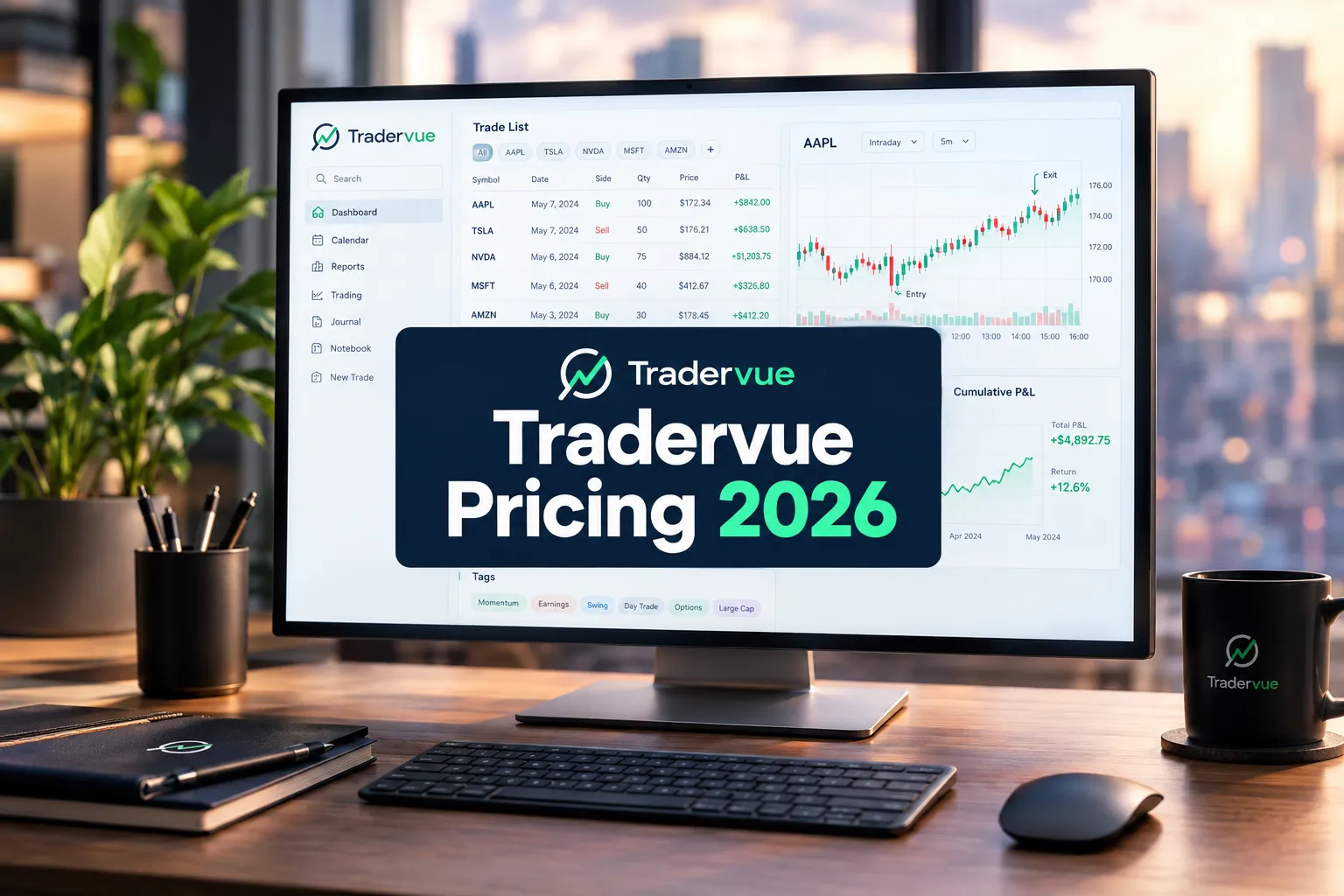
Quick answer
Tradervue pricing in 2026 runs three tiers: a free plan capped at 100 trades per month, Silver at $29.95 a month, and Gold at $49.95 a month. Both paid plans come with a 7-day free trial, and Tradervue does not advertise an annual discount, so the monthly number is the number. The free tier is a real product, not a demo with a countdown clock, which makes Tradervue one of the few journals you can run for a full quarter before you pay a dollar.
Key Takeaways
- Free plan: up to 100 trades per month, no credit card. If you take more than about 5 round-trip trades a trading day, you'll hit the ceiling.
- Silver: $29.95 per month, which is $359.40 a year at list. Gold: $49.95 per month, or $599.40 a year. The $20 monthly gap is the whole decision.
- 7-day free trial on both Silver and Gold, so the honest test sequence is free plan first, then trial the paid tier during a week you actually trade.
- Track record since 2011. Founded by Greg Reinacker, acquired by SureSwift Capital in March 2021. SureSwift cites 100,000+ traders; the Tradervue homepage counter now shows more than 207,000.
- Imports are fast. One user reported loading 499 trades in under 10 minutes, which is the part most journal buyers underestimate and the part that decides whether you keep using it.
- Trustpilot sits at 2.4 from 10 reviews, with complaints clustered on customer service. Ten reviews is a thin sample, and thin is exactly the problem.
- FullStack Alpha Alpha Score: 69 out of 100 (Signal Quality 15, Transparency 16, Price-to-Value 15, Usability 14, Community Verdict 9).
- Tradervue pricing starts at $0, so you can test the journal before paying anything.
Tradervue pricing in 2026: what does each plan cost?
Three prices, published openly on the site, no "contact sales" nonsense: Free at $0 with a 100 trade per month cap, Silver at $29.95 a month, Gold at $49.95 a month. Paid plans include a 7-day free trial.
Here's what those numbers mean once you annualize them, because monthly pricing is how software companies make $600 feel like pocket change:
- Silver: $359.40 per year
- Gold: $599.40 per year
- The upgrade from Silver to Gold: $240 per year
No annual billing discount is advertised, which cuts both ways. You don't get a 20% break for prepaying, and you also don't get locked into twelve months of a tool you stopped opening in March. Month-to-month is the default, and for a journal you're still auditioning, that's the better deal.
The real comparison isn't Tradervue against other software. It's Tradervue against the cost of repeating the same mistake. Thirty bucks a month is roughly what a 100-share position moving 30 cents against you costs, once. If a journal stops one recurring leak a quarter, the math is settled and you can stop reading pricing articles.
One decision rule before we go deeper: if you don't know how many trades you took last month, start on the free plan. Not because you're broke, but because you have no idea yet whether your volume justifies the cap removal. Traders routinely overestimate their own activity by a wide margin.
What do you get on the Tradervue free plan?
The free Tradervue plan gives you up to 100 trades per month with broker imports, trade notes and tagging, and the core reporting view. It's a functioning journal, not a 14-day tease, and that's unusual in this category. The free tier is the most important line in Tradervue pricing, because it decides whether you ever need to upgrade.
What the 100 trade cap actually means in practice:
- A US market month averages about 21 trading days. 100 trades divided by 21 is 4.76 trades per day.
- Swing traders almost never hit it. If you take 3 to 8 positions a week and hold them for days, 100 round trips a month is a wall you'll never touch.
- Scalpers blow through it in the first week of the month. If your style is 20 to 40 executions on a single ticker before lunch, the free plan is a sampler, nothing more.
A trading journal is a food log for your P&L. You don't need to photograph every almond to learn you're eating 1,400 calories after 9pm. You need enough entries, tagged honestly, to see the pattern. For a swing trader, the free tier delivers that. For a high-frequency day trader, the pattern lives in the trades you can't log.
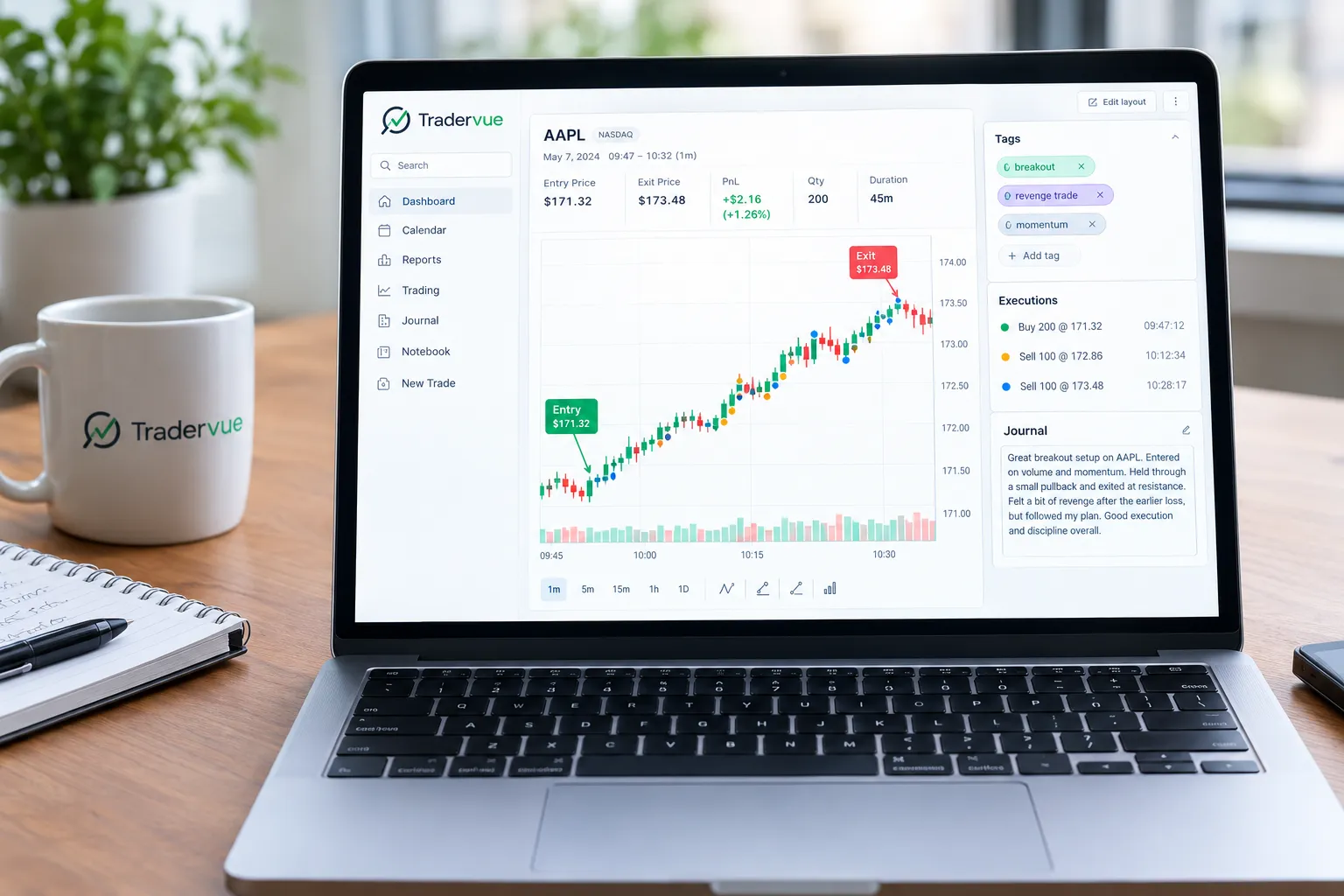
Common mistake on the free plan: importing trades and never tagging them. Imported data with no tags gives you a transaction history, which your broker already has. The tags are the product. "Breakout," "news gap," "revenge trade," "sized too big," "no stop." Thirty days of honest tags on a free account will tell you more than $600 of reports you never filter.
Edge case worth naming: if you run a cash account and settle T+1, your trade count is naturally throttled, so the free tier can genuinely carry you for a year. Small accounts got fuller intraday access in 2026 after the pattern day trader minimum came off, and a lot of newly active traders are journaling for the first time. Start free. Earn the upgrade. You can read FINRA's day trading rules for the regulatory side.
Tradervue Silver vs Gold: which paid plan is worth it?
Silver at $29.95 removes the trade cap and opens the standard reporting suite. Gold at $49.95 adds the advanced analytics layer, the deeper historical and intraday detail, and the heavier filtering that firms and coaches ask for. Silver is the right default for a solo trader. Gold earns its $20 only if you'll actually run the advanced reports. The $20 monthly jump from Silver to Gold is the biggest decision in Tradervue pricing.
Since vendors reshuffle feature matrices without announcing it, confirm the current line items on Tradervue's pricing page before you commit. The shape of the tiers, though, has been consistent: Silver is "unlimited journaling with real reports," Gold is "journaling plus forensics."
Choose Silver if:
- You trade more than 100 times a month and mostly want the cap gone.
- Your review process is: import, tag, read the weekly P&L breakdown, repeat.
- You're one person reviewing your own trades with no team, no students, no outside accountability.
- You want the cheapest version of a permanent habit. $359 a year for a habit that lasts is fine.
Choose Gold if:
- You want excursion-style analysis, meaning how far a trade ran in your favor before you exited and how far underwater it went before it worked. That single report is the most honest feedback a discretionary trader can get, because it separates bad entries from bad exits. Most traders blame the entry. The data usually blames the exit.
- You slice performance by time of day, hold duration, position size, and tag combination rather than just looking at a total.
- You run a trading firm, a prop desk, or a mentoring group and need to review other people's trades alongside your own.
- You're a futures or options trader whose P&L hinges on execution detail that a simple report flattens out.
The honest decision rule: pay for Silver for 60 days. If you catch yourself wanting to ask a question the reports can't answer, upgrade. If you haven't opened the reports tab in two weeks, downgrade to free and fix the habit before you fix the subscription. Paying $49.95 to feel like a serious trader is the software equivalent of buying a Peloton to own a Peloton.
Edge case: if you're a part-time trader with a day job and you review trades on Sunday mornings, Gold is probably overkill. The advanced reports reward volume. With 40 trades a quarter, there isn't enough data for the granular cuts to mean anything, and you'll be reading noise as signal.
Who is Tradervue built for?
Tradervue is built for active retail and professional traders in stocks, options and futures who want structured performance analytics rather than a prettier spreadsheet. It fits trading firms, prop desks and mentoring groups particularly well, because trade sharing and multi-account review were baked in early. Tradervue pricing makes the most sense for active day traders who log enough trades to use the reports.
Buy it if you are:
- A day trader taking 10 to 100+ trades a week who needs imports to be automatic, because manual entry at that volume never survives contact with a bad morning.
- A swing trader who wants the free tier indefinitely and might upgrade during an active stretch.
- A futures or options trader needing a journal that handles contracts and multi-leg fills without translation errors.
- A coach, firm or group leader reviewing other people's trades. The sharing and annotation layer is the reason Tradervue still shows up in prop desk workflows fifteen years in.
- Someone who has already admitted their problem is behavioral. Overtrading, revenge trading, cutting winners early. A journal is diagnostic equipment for exactly these.
Skip it if you are:
- A buy-and-hold investor. Four purchases a year doesn't need performance analytics. It needs patience and a brokerage statement.
- Allergic to data entry of any kind. Imports are fast, but the tags and notes are manual, and the notes are where the value sits. Nobody automates self-awareness.
- Primarily a crypto trader. Tradervue's center of gravity is equities, options and futures.
- Shopping on looks. Covered below, the interface is functional and dated. If a dated UI will stop you from opening the app, that's a real cost, not a shallow one.
- Looking for signals or picks. It's a mirror, not a scanner. If you want setup discovery, that's a different category of tool, and we cover it in our breakdown of AI trading platforms.
Tradervue pricing table: Free vs Silver vs Gold
| Free | Silver | Gold | |
|---|---|---|---|
| Monthly price | $0 | $29.95 | $49.95 |
| Annualized at list | $0 | $359.40 | $599.40 |
| Annual discount advertised | n/a | None | None |
| Free trial | Not needed | 7 days | 7 days |
| Trade limit | 100 per month | No monthly cap | No monthly cap |
| Broker and platform imports | Yes | Yes | Yes |
| Tags, notes, journal entries | Yes | Yes | Yes |
| Core performance reports | Core set | Full standard suite | Full standard suite |
| Advanced analytics and deeper detail | No | Limited | Yes |
| Best fit | Swing traders, new journalers | Solo active day traders | High-volume traders, firms, coaches |
Prices verified from Tradervue's public pricing page. Feature allocation between tiers is directional, not a contract. Check the live matrix before you subscribe, because a feature you're buying for specifically could sit one tier above where you expect. Use this Tradervue pricing table to match a tier to how many trades you log each month.
Top 5 favorite features in Tradervue
1. Imports that don't ruin your evening
Tradervue connects to a long list of brokers and platforms, and the import is the feature that decides whether a journal becomes a habit or a graveyard. One user reported loading 499 trades in under 10 minutes. That's roughly 50 trades a minute, versus the 90 seconds per trade a human spends typing fills into Excel and then mistyping one. Each feature below maps to a tier in Tradervue pricing, so check which plan includes it before you buy.
Practical takeaway: import your last three months before you decide anything. A journal with no history can't show you a pattern, and patterns are the only reason to pay.
2. Tagging that turns feelings into data
Tags are where "I think I trade worse on Fridays" becomes "my Friday afternoon trades are down on 34 occurrences." Tradervue lets you tag by setup, mistake, emotion, market condition, whatever you'll stay consistent about.
The rule that makes tags work: keep it under 12 tags and never invent a new one mid-month. Forty tags produce forty buckets of three trades each, which is astrology with a database behind it.
3. Reports that find the leak instead of the excuse
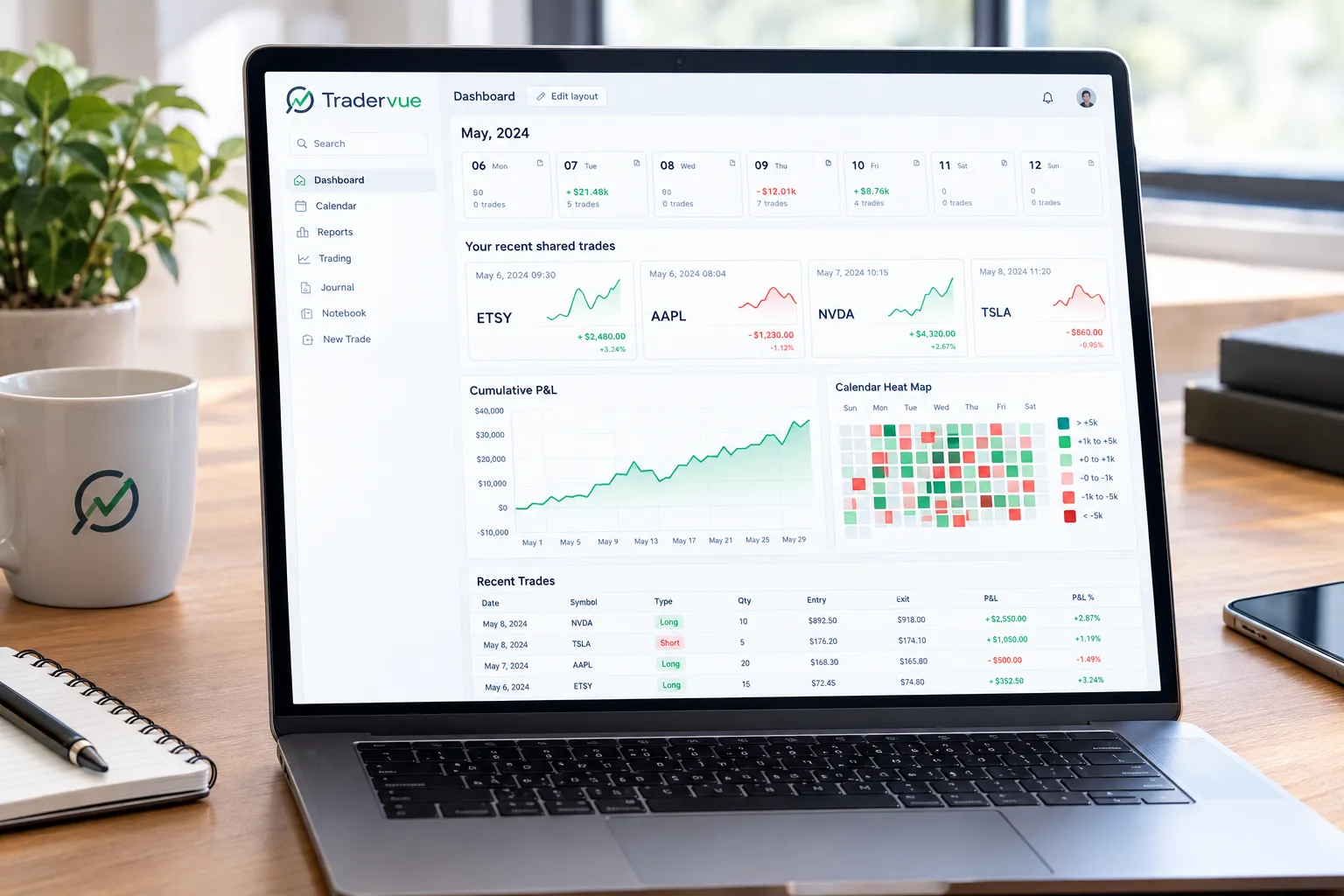
The report suite breaks P&L down by symbol, tag, day of week, time of day, hold duration and size. This is the part that stings. Most traders discover their edge is real and their position sizing is random, or that 80% of their damage comes from one hour of the session.
Example of how that plays out: a trader convinced they need a better entry signal runs the time-of-day report and finds every losing day traces back to trades taken after 2:30pm. The fix wasn't a new indicator. The fix was closing the platform at 2:30.
4. Annotated charts attached to the trade
Each trade can carry its chart with your execution marks and your notes on what you saw. Six weeks later, when you're wondering why you bought a vertical 11% extension, the evidence is sitting right there with your own handwriting on it.
This is the single most underrated function in any journal. Memory edits your trades into better decisions than you made. Charts don't.
5. Trade sharing and group review
Tradervue has supported sharing trades publicly or inside a group since the early days, which is why firms and mentoring programs adopted it. For a coach, reviewing ten students' tagged trades in one place beats ten screenshot threads in Discord, by a distance.
If you trade alone and never want anyone seeing your fills, ignore this feature entirely. It costs you nothing and it's off by default.
What we like about Tradervue
It survived. Launched in 2011, still operating under SureSwift Capital after the March 2021 acquisition, with a homepage counter above 207,000 traders and SureSwift citing 100,000+. In a category where journals appear and vanish inside eighteen months, fifteen years of continuous operation is the most underrated feature on the list.
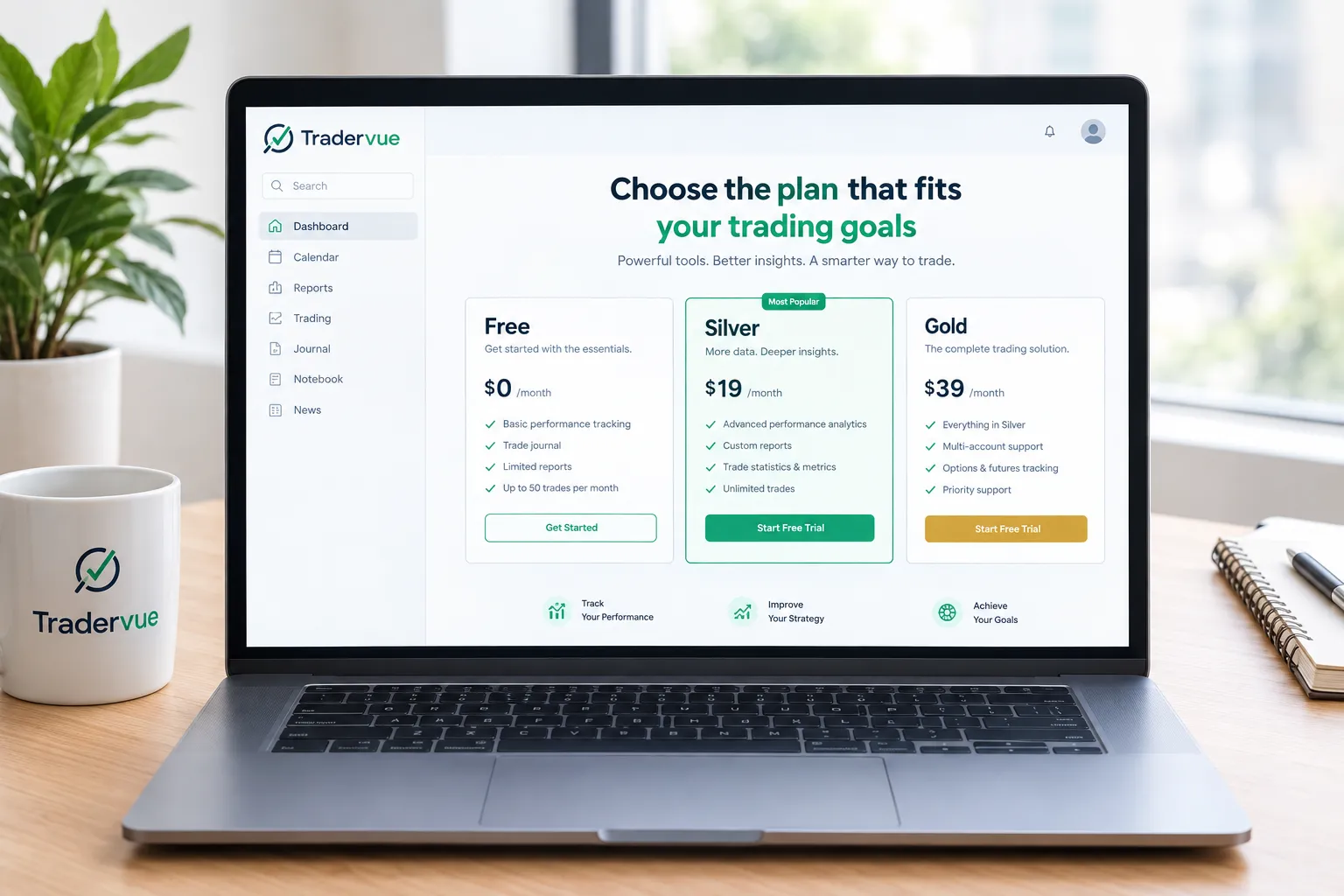
The pricing is public and plain. $29.95 and $49.95, printed on the page, no sales call, no "starting from," no annual lock-in dressed up as a discount. The transparency pillar scored 16 out of 20 for exactly this reason: you can see what you're buying and what it costs before you give anyone an email address.
The free plan is genuinely usable. 100 trades a month covers most swing traders permanently. Plenty of vendors call a trial a free plan. Tradervue doesn't.
Imports are quick and broad. The 499-trades-in-10-minutes data point matters more than any feature list, because the friction of getting data in is what kills journaling habits in week two.
The reports answer real questions. Not "here's your equity curve, good luck." Which setups pay, which hours bleed, which tags correlate with your worst drawdowns. That's diagnostic work, and it's the entire reason to pay for a journal rather than keeping a notebook.
What we don't like about Tradervue
The interface looks its age. Functional, dense, and clearly built by engineers who cared more about the data model than the drop shadows. Next to newer journals, it reads like a 2015 web app, because in structural terms it is one. Usability scored 14 out of 20: solid, with that caveat named out loud. You will get useful output in your first session. You may also wince at how it looks while you do. None of these drawbacks change Tradervue pricing, but they change whether a paid tier is worth it.
Customer service complaints are on the record. Trustpilot sits at 2.4 from 10 reviews, and the recurring theme is support responsiveness and billing friction. Ten reviews is not a verdict on a platform with six figures of users, and we're not going to pretend it is. But a 2.4 average with service complaints inside it is a flag, and you should test the 7-day trial as much for support response as for features. Send one question during the trial and time the reply.
Public discussion is thin. Few Reddit mentions in the last 30 days, almost no recent organic buzz. Community Verdict scored 9 out of 20, the lowest pillar on the board, specifically because there's so little to corroborate. A quiet tool isn't automatically a bad tool. It does mean you can't crowdsource your due diligence, and you're buying on your own read.
No annual discount. At $599.40 a year for Gold with zero prepay break, you're paying full retail for loyalty. Vendors that want multi-year users usually price for it.
Manual effort is still required. Imports are automated. Insight isn't. The traders who get nothing from Tradervue are the ones who connect a broker, admire the equity curve, and never write a note. That's a user problem, and it's the most common one in this category.
What do real users say in this Tradervue review?
Public sentiment on Tradervue is thin and mixed, which is the single weakest part of its profile. Trustpilot: 2.4 out of 5 from 10 reviews, with customer service and billing the dominant complaints. Recent Reddit discussion is sparse, with few mentions in the last 30 days. Users rarely complain about Tradervue pricing itself; the complaints center on support.
Reading the sources against each other is the only sane way to handle a sample this small:
- Trustpilot skews toward complaints by design. People rarely write a review because their trade import worked. A 2.4 built from 10 entries tells you support friction exists. It cannot tell you how often.
- Reddit skews negative too, because frustrated traders post. The notable thing here is the silence, not the tone. For a platform claiming 207,000+ traders, near-zero recent organic chatter is odd. Either the user base is steady and quiet, or it's aging and quiet.
- One concrete positive data point exists in the usage reports: the user who imported 499 trades in under 10 minutes. That's a specific, checkable claim about the feature that matters most.
We don't invent quotes and we don't average six review sites into a soothing sentence. The honest read: you're buying a tool with a long operating history and a small, quiet public footprint. Use the 7-day trial as actual diligence, not as a formality, and open a support ticket while the clock is running.
Tradervue vs TradeZella: how does the pricing compare?
The pricing comparison comes down to one structural difference: Tradervue has a permanent free tier at 100 trades a month. TradeZella's model has been paid-only with a trial, not a free plan. If "I want to journal without paying" is your requirement, the comparison ends there. Against TradeZella's $35 to $99 a month, Tradervue pricing at $29.95 and $49.95 is the cheaper paid entry.
On the paid side, Tradervue publishes $29.95 for Silver and $49.95 for Gold, month to month, with no advertised annual discount. TradeZella publishes monthly and annual options on its own pricing page, and those numbers move, so check them live rather than trusting any article's snapshot, including this one.
What you're trading off, in plain terms:
- TradeZella's advantage is the interface and the newer feature set. It's the better-looking product, with a more modern backtesting and replay experience. For traders in their first year, a tool you enjoy opening is not a vanity concern. The journal you actually use beats the journal that scores better on paper.
- Tradervue's advantage is the free tier, the operating history since 2011, and the multi-account and group review workflow that firms and coaches have leaned on for years.
- Neither one generates an edge. Both are mirrors. The trader who tags 200 trades honestly in the uglier app will learn more than the one who imports 200 trades into the prettier app and never writes a word.
Decision rule: if your budget is zero right now, Tradervue free, no debate. If you're paying either way and you know you'll quit a tool that feels dated, look hard at TradeZella. If you run a group or need years of history and fast bulk imports, Tradervue.
Best Tradervue alternative picks, including a trading journal free option
Four routes worth considering, including the free one most traders skip because it isn't exciting.
1. The Tradervue free plan itself. The best free trading journal for most swing traders is the free tier of a paid product, because it's maintained by a company with revenue. 100 trades a month, real imports, real reports. If you take fewer than five round trips a day, this is your answer and you can stop shopping.
2. Your broker's built-in analytics. Most major US brokers now ship some form of performance reporting and trade history export. It's free, it's already connected, and it's weaker than a dedicated journal because it shows you what you did without any mechanism for recording what you were thinking. Use it as a stopgap, not a system.
3. A spreadsheet you actually maintain. Unglamorous and surprisingly effective at low volume. Columns for date, ticker, setup, size, stop, exit reason, and one sentence on your state of mind. The failure rate is high because nobody keeps it past 60 trades, which is precisely why paid journals exist. If you've never kept a journal at all, prove you'll do it for 30 days in Google Sheets before you pay anyone $600 a year.
4. A modern dedicated journal like TradeZella. Better interface, newer feature set, paid-only. The right call if a dated UI genuinely stops you from using the tool. Verify current pricing directly.
And one thing a journal cannot replace: setup discovery. A journal tells you what happened. It won't find you a clean consolidation tomorrow morning. If that's the actual gap in your process, start with our swing trade scanners that find setups before they break out, and read what you pay for versus what you get in AI trading software before you add another subscription to the pile.
How the Alpha Score rates Tradervue
The Alpha Score breakdown
Tradervue scores 69 out of 100 across five pillars, 20 points each. Public, simple Tradervue pricing is a big reason Transparency scores 16. The score comes from FullStack Alpha desk research plus public user sentiment, and the pillar split is provisional.
| Pillar | Score | Read |
|---|---|---|
| Signal Quality | 15 / 20 | Solid with caveats. The reports answer real questions and imports are fast. The output quality depends heavily on your own tagging discipline, which no vendor controls. |
| Transparency | 16 / 20 | Strong. Public pricing, clear trade limits, named ownership history (Greg Reinacker in 2011, SureSwift Capital since March 2021). Tier feature allocation could be clearer. |
| Price-to-Value | 15 / 20 | Solid with caveats. The free tier counts heavily in its favor. $599.40 a year for Gold with no annual discount counts against it. |
| Usability | 14 / 20 | Works fast, looks dated. You'll get useful output in session one, and you'll notice the interface belongs to an earlier era of the web. |
| Community Verdict | 9 / 20 | Weak and the biggest problem here. Trustpilot 2.4 from 10 reviews with customer service complaints, and almost no recent Reddit discussion to corroborate anything. |
| Total | 69 / 100 |
The number is held down by one pillar, and it isn't the product. Tradervue's core function works. What's missing is corroboration: a 2.4 Trustpilot average from a sample of 10, plus near-silence in the places traders actually talk, leaves you buying on your own judgment rather than on the crowd's. For a $30 to $50 monthly commitment with a 7-day trial, that's a manageable risk. For a tool you'd prepay a year on, it wouldn't be, which is one small mercy in the no-annual-plan structure.
FullStack Alpha sells no journal, no screener and no scanner. There's no house product sitting above Tradervue in any ranking, because there's no house product at all.
FullStack Alpha scorecards
Every tool in this article has a full scorecard: pricing, pros and cons, verified user quotes and the Alpha Score breakdown.
FAQ
How much does Tradervue cost?
Tradervue costs $0 for the free plan (capped at 100 trades per month), $29.95 a month for Silver, and $49.95 a month for Gold. Annualized at list price that's $359.40 for Silver and $599.40 for Gold. No annual billing discount is advertised.
Is Tradervue free?
Yes, Tradervue has a permanent free plan limited to 100 trades per month, with broker imports, tagging, notes and core reports included. It isn't a trial. Most swing traders can run it indefinitely without paying; high-volume day traders will hit the cap in the first week or two of each month.
Is Tradervue worth it?
Tradervue is worth paying for if you exceed 100 trades a month and you'll actually read the reports, in which case Silver at $29.95 is the sensible tier. It scored 69 out of 100 on the FullStack Alpha Alpha Score, held back mainly by a weak Community Verdict of 9 out of 20 (Trustpilot 2.4 from 10 reviews and thin recent discussion). The value depends on your tagging discipline more than on the subscription level.
Is Tradervue better than TradeZella?
Tradervue is better if you want a free tier, a long operating history since 2011, or group and multi-account review for a firm or mentoring program. TradeZella is better if you want a more modern interface and newer backtesting and replay tools, and you're paying either way since it has no permanent free plan. Check TradeZella's live pricing page, as its rates change.
What is the best free trading journal?
For most US swing traders, the Tradervue free plan is the best free trading journal, because 100 trades per month with real broker imports and reports covers typical swing volume at no cost. A disciplined spreadsheet is the alternative if you want zero vendor dependency, though most traders abandon spreadsheets within a few months.
Does Tradervue have a free trial?
Yes. Tradervue offers a 7-day free trial on both the Silver and Gold plans. You don't need the trial to test the platform, since the free plan is permanent, so use the trial specifically to test the paid-only features and the support response time.
Who owns Tradervue?
Tradervue was founded in 2011 by Greg Reinacker and was acquired by SureSwift Capital in March 2021. SureSwift, which buys and operates established SaaS businesses, cites 100,000+ traders on the platform, while the Tradervue homepage counter shows more than 207,000.
Can I cancel Tradervue anytime?
Tradervue bills monthly with no advertised annual contract, so there's no multi-year lock-in. Since customer service and billing are the recurring themes in its Trustpilot reviews, cancel through your account settings and keep the confirmation.
Final verdict: is Tradervue worth paying for as your day trading journal?
Tradervue is worth paying for if you take more than 100 trades a month and you'll genuinely run the reports. Otherwise the free plan is the correct purchase, and "correct purchase" here means zero dollars. Silver at $29.95 is the right paid tier for the overwhelming majority of solo traders. Gold at $49.95 is for high-volume traders, firms and coaches who need the advanced analytics layer and will use it weekly. Bottom line on Tradervue pricing: start free, and pay for Silver only when the reports change how you trade.
What you're getting: a journal with fifteen years of operating history, fast imports, tagging that converts hunches into counts, and reports that will find the hour of the day or the setup that's quietly costing you money. What you're not getting: a modern interface, a vocal user community, or any evidence of outstanding customer support.
The uncomfortable part nobody markets: a journal only works on traders willing to write down the trade they're embarrassed about. The analytics are the easy half. Discipline beats prediction, and a journal is just the ledger that proves whether you had any.
So here's the test. Run the free plan for 30 days with 8 tags and one honest sentence per trade. At day 30, pull the report. If it shows you something you didn't know about your own trading, the $29.95 is a bargain and you should pay it. If it shows you nothing, the problem was never the software, and spending $600 a year won't solve it.
Start on the free plan, then upgrade when the reports pay off
The sequence that actually works, in order:
- Open the free account. No card, no trial clock. Import your last 90 days of trades.
- Build 8 to 12 tags and freeze the list. Setups and mistakes only. No new tags mid-month.
- Write one sentence per trade on why you entered and why you exited. Thirty seconds each. This is the whole product.
- At day 30, run the breakdowns: by tag, by day of week, by time of day, by hold duration.
- Pick one leak and change one rule. One. Not five.
- Then decide on paid. Start the 7-day Silver trial during a week you're actively trading, and send support a question on day one to see how fast they answer. If you hit the 100 trade cap in week three of a normal month, Silver pays for itself. If you want excursion-level detail on entries versus exits, trial Gold.
Fewer tabs, fewer subscriptions, one process you repeat. Cut the noise, keep the alpha.
Related reading
- Best stock apps for day trading
- 7 AI tools swing traders are using to catch moves before everyone else
- How we test and score tools at FullStack Alpha
Worth it depends on what you're replacing. The FullStack Alpha directory has 200+ AI stock tools filterable by price, so you can see what the same money buys elsewhere.
Check the alternatives → aistockpickerapps.com
This is education, not financial advice.
Your market edge starts with the right tool. Stay alpha.
This article contains affiliate links. Prices verified from Tradervue's public pricing page and subject to change.
We test the tools. You get the verdict.
One email a week. What we tested, what scored, and what we'd skip. Written for traders, not for clicks.
More from FullStack Alpha