TraderSync Pricing 2026: Which Plan Pays for Itself
Reviewed by Jay Rocco, Chief Editor
TraderSync Pricing: The Plan That Actually Pays for Itself
Read the transcript
A trading journal costs less than one bad trade. That's the argument for TraderSync... and it's also the argument traders use to buy the most expensive tier they'll never use. This is FullStack Alpha. In about two and a half minutes, you'll know which TraderSync plan earns its keep at your trade count.
Quick answer. TraderSync has three paid plans, Pro, Premium and Elite, plus a seven-day free trial with no credit card required. Most traders should buy Premium, at $49.95 a month billed monthly, or about $43.42 a month billed annually. Elite runs $79.95 a month, or $69.50 on annual billing. The gap from cheapest to priciest is fifty dollars a month on monthly billing. On a five-thousand-dollar account, that matters.
The most important things you need to know.
One. Match the plan to your trade count. Under ten trades a month? Start with Pro, or honestly, the free trial and a spreadsheet. Twenty to a hundred trades a month across stocks and options? Premium is the sweet spot. Three hundred-plus trades across multiple accounts? That's Elite territory.
Two. Annual billing knocks about thirteen percent off the monthly rate. But buy annual only after monthly proves itself.
Three. Cypher, TraderSync's AI, looks for patterns in your trades, checks whether you stuck to your plan, and gives a second opinion on any trade you ask about.
Four. Elite carries the full feature list, including automatic spread detection and market replay.
Five. The trial is genuinely low friction. No card up front, which is rare in this category.
What to watch out for. Cypher analyzes your own trades. It does not generate buy or sell signals. It's a mirror, not a crystal ball. With only forty recorded trades, the AI is reasoning over forty observations... garbage in, garbage out. There are no refunds, per the pricing page FAQ. Check the account limits on your tier if you run multiple portfolios. And verify your profit and loss numbers in week one, because an inaccurate P and L defeats the entire point of a journal.
The verdict. Premium is the plan that pays for itself for most active retail traders. Elite is for high-volume day traders who'll actually use replay and daily AI review. Pro is fine while you're getting started.
Your next step. Use the trial properly. Connect your actual broker on day one, not day six. Import at least thirty historical trades. Tag every trade with a setup name and a mistake flag. On day five, run the reports and write down one thing you'd change. If you can't name that one thing, the subscription is a gym membership you'll pay for and never visit.
The full plan breakdown, with a break-even calculator, is right below this player. Prices change, so check the table for current numbers. Your market edge starts with the right tool. Stay alpha.
Last updated: October 28, 2026
A trading journal costs less than one bad trade. That's the whole argument for 
Quick answer: the TraderSync plan most traders should buy and its price
Most traders should buy Premium, and only move to annual billing after it has proven itself. Premium runs $49.95 a month billed monthly or $43.42 a month billed annually. It's the middle of the TraderSync pricing ladder, and it's where most active retail traders get enough reporting depth without paying for the full Elite feature list a part-time swing trader will touch twice a year.
Here's the short version by trader type:
- Under 10 trades a month, swing trading one account? Start with Pro, or honestly, start with the free trial and a spreadsheet. You don't have enough data for the analytics to say anything.
- 20 to 100 trades a month across stocks and options? Premium. This is the sweet spot for TraderSync pricing, and annual billing knocks about 13% off the monthly rate.
- Active day trader, 300+ trades a month, multiple accounts, wants AI reviewing the journal daily? Elite, at $79.95 a month or $69.50 a month billed annually. It carries the full feature list. Check which tier gates market replay and the AI insights on the comparison table before you pay for them.
One more thing before anyone reaches for a card. TraderSync's own pricing FAQ says it plainly: no refunds. Use the free trial properly. Import a full month of real trades, tag them, run the reports. If the journal doesn't change a single decision you make in that week, no plan pays for itself.
How much does TraderSync cost in 2026?
TraderSync runs three paid tiers in 2026, Pro, Premium, and Elite, priced at $29.95, $49.95, and $79.95 per month billed monthly, or $26.00, $43.42, and $69.50 per month billed annually (per tradersync.com/pricing). Always check the pricing page before you buy, because feature gates have shifted before, and regional currency conversion has been a sore spot in recent user reviews.
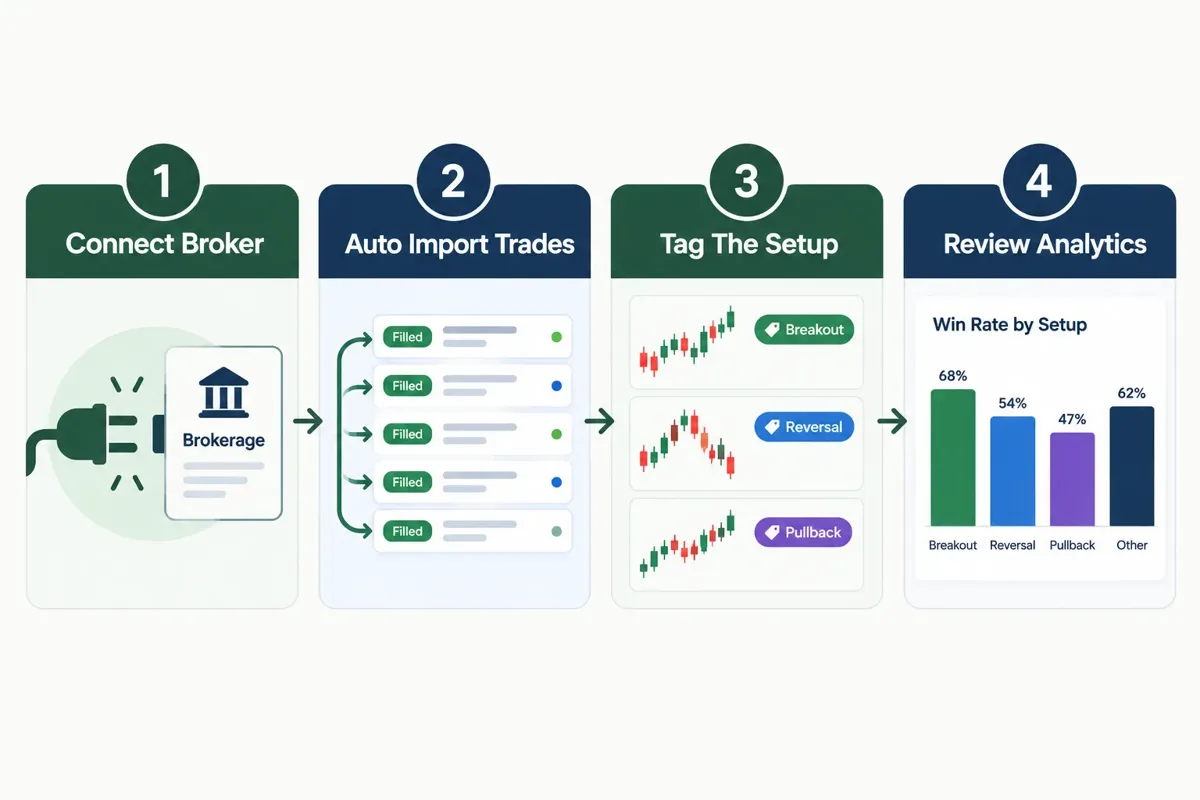
The pricing logic is straightforward once you see it. You're not paying for a notebook. You're paying for three things stacked on top of each other:
- Automation, trade import and broker sync that pulls your fills in without you typing anything
- Analysis depth, slicing performance by setup, time of day, symbol, mistake tag, and market
- Simulation and AI, market replay and the Cypher AI reading your own history back to you
Each tier adds a layer. The question of whether the TraderSync price is fair comes down to whether you'll use the layer you're paying for.
The free trial is the only honest way to judge TraderSync pricing
TraderSync offers a 7-day free trial, and its pricing page says no credit card is required. That's unusually low-friction. Plenty of subscription tools want your card up front and count on you forgetting to cancel.
Use the week properly:
- Connect your actual broker on day one, not day six
- Import at least 30 historical trades if your broker allows backfill
- Tag every trade with a setup name and a mistake flag
- Run the reports on day five and write down one thing you'd change
If you can't name that one thing by the end of the trial, the subscription is a gym membership you'll pay for and never visit.
What drives the real cost beyond the sticker
Three things inflate the true annual cost for some traders:
- No refunds. The pricing page FAQ says it in two words. Buy annual only if the monthly version already earned your trust.
- Multi-account needs. "Multiple Portfolio" is on the feature list, but check the account limits on your tier before assuming your prop account and your personal account both fit.
- Currency conversion. Trustpilot reviews from April and May 2026 flag currency conversion errors on imported trades for non-US traders. If you trade in GBP or EUR, verify your P&L math inside the journal during the trial. A journal with wrong P&L is worse than no journal.
TraderSync pricing table: every plan, monthly and annual
All three plans share the same core journaling engine. What changes is reporting depth, automation, market replay, and how much AI you get. The dollar figures below come straight from tradersync.com/pricing. The savings column is TraderSync's own number.
| Plan | Monthly billing | Annual billing (per month) | Yearly savings vs monthly | Best fit |
|---|---|---|---|---|
| Pro | $29.95 | $26.00 | $46.72 | Swing traders, one broker, under 15 trades a month |
| Premium | $49.95 | $43.42 | $77.92 | Active traders, 20 to 100 trades a month, several strategies |
| Elite | $79.95 | $69.50 | $124.72 | High-volume day traders who want the full feature list |
Hunting for a lower price? Check our AI stock tool deals page.
The ratios are what matter: annual billing saves about $47 to $125 a year depending on tier, roughly 13% off, and Elite costs about 2.7x Pro on monthly billing.
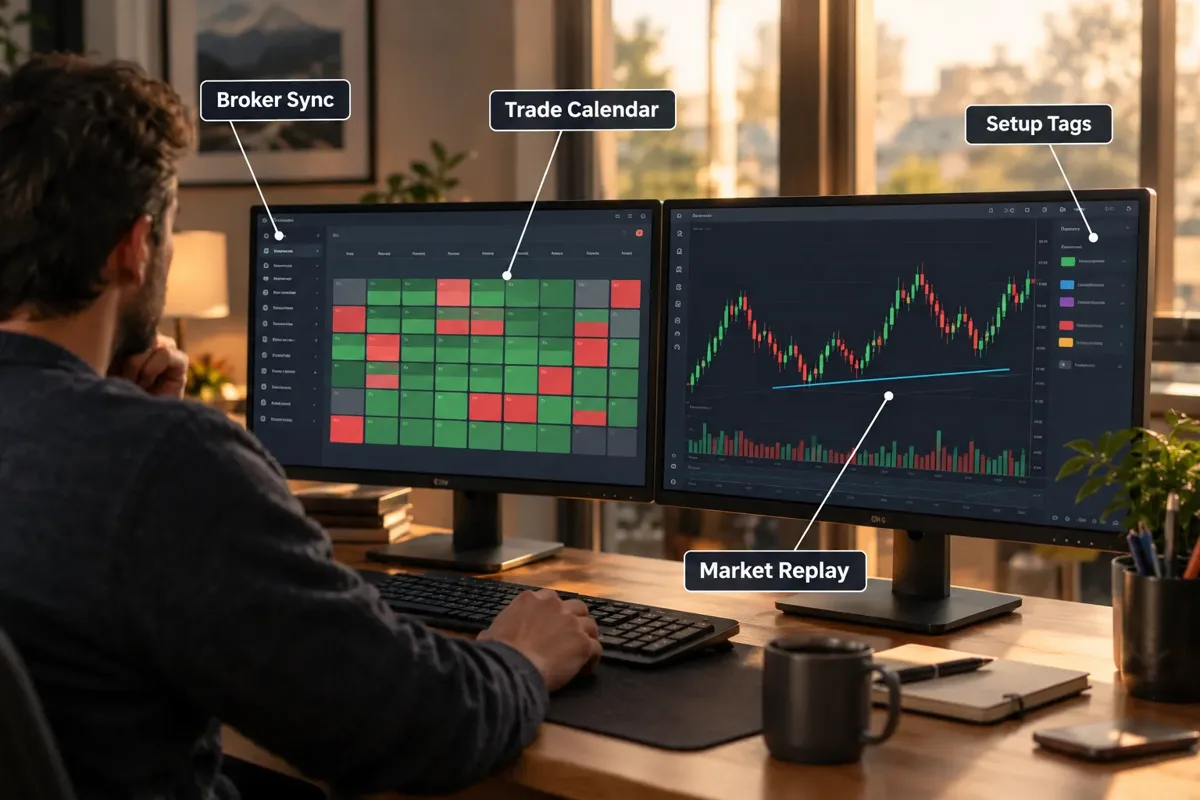
The savings math, plainly
Under current TraderSync pricing, the gap between paying monthly and paying annually on Premium is $77.92 a year, per TraderSync's own pricing page. That's real money on a small account. It's also less than one undersized stop loss on a position you held too long.
A decision rule that works:
Pay monthly for the first 90 days. Switch to annual only after you've logged 60+ trades and can point to one habit the journal killed.
The no-refund policy makes this the only sane sequence. Annual billing is a bet on your own consistency, and most traders lose that bet in month two.
A common mistake with the tier comparison
Traders see "A.I. Q&A" on the feature list and assume the AI is the same product on every tier. Don't. The pricing page doesn't publish per-tier AI allowances, and independent reviews disagree on the caps. Two October 2026 reviews (
What does each TraderSync plan include?
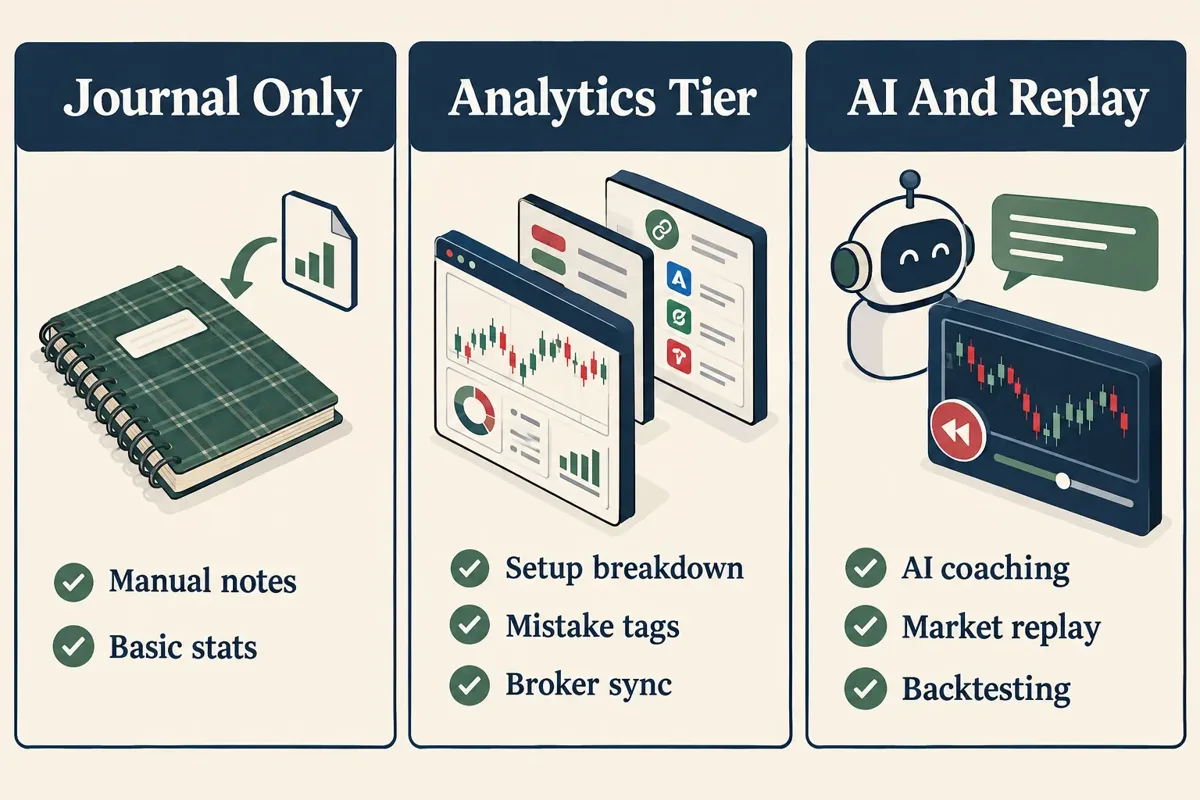
Pro gives you a clean journal. Premium adds the deeper reporting that actually changes behavior. Elite carries the full feature list, including the advanced automation and AI rows at the bottom of the comparison table. Here's what that means in practice. Confirm the checkmarks on the pricing page, since gates move.
Pro: the honest starter tier
Pro is a structured logbook with core stats. The base rows on the comparison table cover the trade journal, manual entry, trade import, setup and mistake tracking, calendar view, and the core reports.
Who it fits:
- Swing traders holding days to weeks, under 15 trades a month
- Someone migrating off a spreadsheet who wants structure before sophistication
- Traders in one market, one broker, one strategy
Who it doesn't fit: anyone trading intraday at volume. Manual tagging becomes a chore, and a small AI allowance runs out before your coffee's cold.
Premium: where TraderSync earns its price
Premium is the tier most active retail traders should sit on. Automatic import means your fills land without data entry, which is the single biggest reason journals get abandoned. Journals don't fail because the analytics are weak. They fail because typing 40 trades by hand on a Friday night is miserable.
The analytics layer is where the money comes back:
- Performance by setup, your breakout trades versus your mean-reversion trades, separated
- Performance by time of day, most day traders discover they're giving back their morning gains in the midday chop
- Mistake tagging, tag "moved my stop," "no plan," "revenge trade," then total the dollar cost of each
- Exit and risk stats, MAE/MFE, best exit, and R multiple reporting show whether your exits or your entries are the leak
TraderSync's software update log also says AI answers now come back up to 50% faster on a new model, and Market Replay now covers forex trades. For options traders with multi-leg spreads, the import accuracy matters more than the speed.
Elite: for volume and for Cypher
Elite is the top of the TraderSync pricing ladder at $79.95 a month. It carries the full feature list, including automatic spread detection, market replay, and the AI insights rows.
TraderSync's Cypher page pitches the AI as pattern detection, plan-adherence monitoring, risk decisions tied to your metrics, and a "second opinion" on any trade you ask about.
Two honest caveats, because the brochure won't give them to you:
- Cypher analyzes your own trades. It does not generate buy or sell signals. Kagels Trading's October 2026 review says so directly. It's a mirror, not a crystal ball.
- Garbage in, garbage out. With 40 recorded trades, you're asking the AI to reason over 40 observations. That's not a sample size, that's an anecdote. Cypher can't manufacture statistical evidence from a thin, selectively recorded journal.
Treat any AI commentary as retrospective analysis of your behavior, not a validated edge. Your journal's AI is a review partner, not an advisor.
Is the annual plan worth it?
Annual billing is worth it if you've already journaled consistently for 90 days. It is a trap if you haven't. The annual discount is the best deal in TraderSync pricing, about 13% off the monthly rate, but TraderSync's pricing page says no refunds. Quit in month three and you've donated nine months.
The math is simple and the psychology isn't.
The case for annual
- You save $46.72 to $124.72 a year depending on tier, by TraderSync's own figures
- Prepaying creates a small commitment device, the same reason people pay for a year of the gym
- You avoid the monthly decision fatigue of "is this worth it this month"
The case against annual
- The no-refund policy means zero exit
- Feature gates have shifted before, so you're locking into a snapshot
- If broker sync breaks for your specific broker, you're stuck. Trustpilot reviews from 2026 cite sync problems and slow fixes
The rule that keeps you out of trouble
Earn the annual plan. Three months of monthly billing, 60+ logged trades, and one documented behavior change. Then prepay.
That sequence costs about $20 extra on Premium and about $31 on Elite. It saves you a full year of regret in the realistic case.
Edge case: prop firm traders and funded accounts
If you're trading a funded account with a hard drawdown rule, the journal's value goes up sharply, because mistake tagging and daily loss review are directly tied to keeping the account. But prop firm relationships end abruptly. Monthly billing fits a situation where your trading setup might change next week. Annual doesn't.
TraderSync vs TradeZella vs Tradervue on price
On TraderSync pricing alone, the tool undercuts 

| Tool | Monthly billing | Annual billing (per month) | Positioning | Best for |
|---|---|---|---|---|
| TraderSync |
$29.95 / $49.95 / $79.95 (Pro, Premium, Elite) | $26.00 / $43.42 / $69.50 | Broad asset coverage, replay, AI | Multi-market traders who want replay and AI in one place |
| TradeZella |
$35 / $59 / $99 (Essential, Pro, Ultra) | $26 / $44 / $74 (25% off) | Polished UI, backtesting, Zella AI credits | Traders who value interface and backtesting workflow |
| Tradervue |
Free plan, Silver $29.95, Gold $49.95 | Not listed on the pricing page | Long-running, analytics-first, lean | Traders who want clean stats and nothing else |
For the tradersync vs tradezella question: TradeZella's backtesting and replay are its pitch, and its 25% annual discount means the gap almost closes on annual billing ($26 vs $26 at entry, $43.42 vs $44 in the middle, $69.50 vs $74 at the top). TraderSync's pitch is a lower monthly price, coverage across stocks, options, futures, and forex, plus market replay. Read our TradeZella scorecard before deciding, and see the head-to-head on our TradeZella vs TraderSync comparison page.
For the tradersync vs tradervue comparison: Tradervue is the budget-conscious choice. It does analytics well, skips the extras, and keeps a free plan. If you don't need replay or AI, you're paying TraderSync for layers you won't touch. Our Tradervue scorecard and the TradeZella vs Tradervue comparison cover the rest.
The uncomfortable truth about this whole category
Basic journaling and analytics are cheap, and in Tradervue's case, free. That's not a knock on TraderSync, it's just the market. The premium you pay buys replay, AI, and multi-asset breadth. If you trade one market with one strategy, you're subsidizing features for someone else's workflow.
A decision rule:
- Need replay and AI coaching? TraderSync or TradeZella.
- Need clean analytics and nothing else? Tradervue or a cheaper alternative.
- Need backtesting as a primary workflow? Compare TradeZella and dedicated tools. Our
QuantConnect versus
Trade Ideas comparison covers the heavier end.
What about thinkorswim or NinjaTrader?
Different animals. Those are execution platforms with charting and some analytics bolted on. TraderSync is a review layer that sits on top of whatever you trade through. You don't choose between them. You use 
Does it work with your broker?
TraderSync's homepage lists support for stocks, options, futures, and forex across 100+ brokers. Broad coverage does not mean identical sync quality per broker. Trustpilot reviews from 2026 flag a thinkorswim sync that dropped closing legs on a multi-leg trade, and note that 
Who should stay on the cheapest plan?
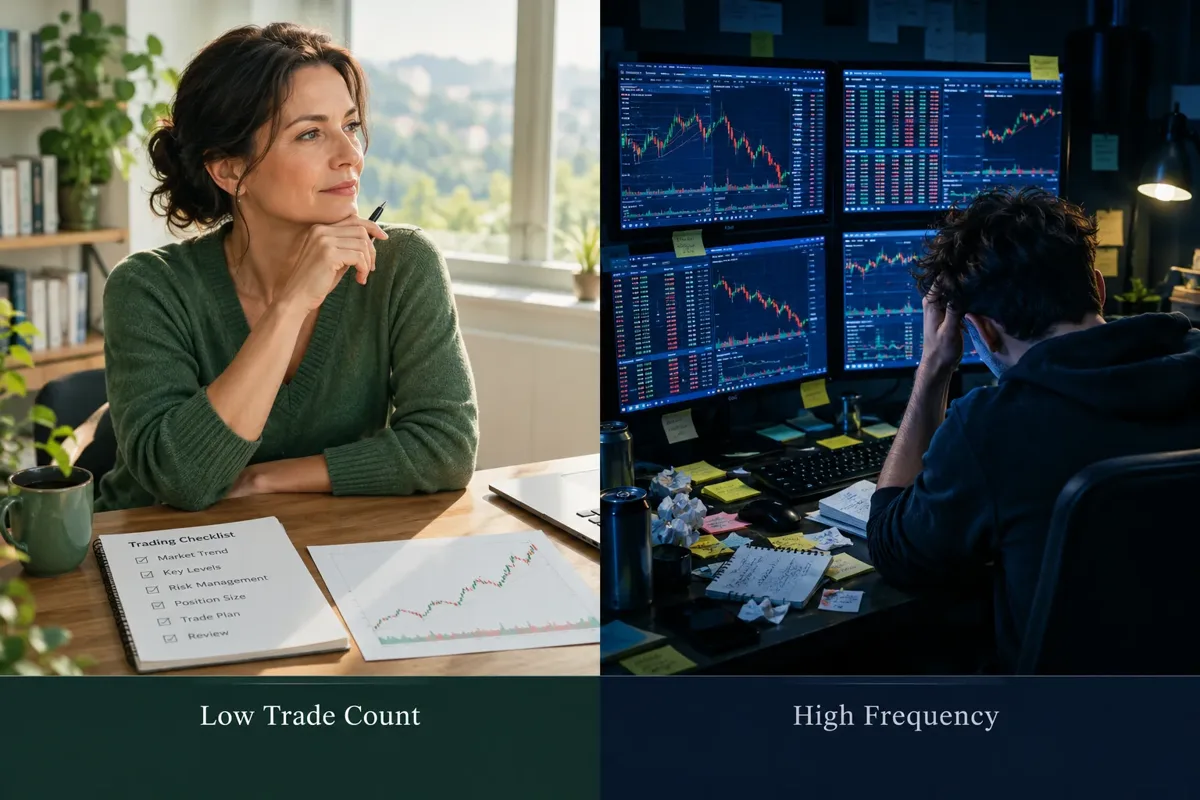
Stay on the cheapest tier if you trade fewer than 15 times a month, run one strategy, and have never finished a 30-day journaling streak. Paying for Elite when you log four trades a week is like buying a commercial espresso machine to make one cup on Sundays.
The four profiles that belong on Pro
- The new swing trader. Position held for days, 6 to 12 trades a month. You need the discipline of recording, not the analytics. Analytics on 12 trades is noise.
- The long-horizon investor who occasionally trades. You're tracking a handful of tactical positions around a core portfolio. A journal helps. An $834-a-year journal doesn't.
- The returning trader rebuilding a process. You're coming back after a break and re-learning your own rules. Start cheap, prove consistency, upgrade when volume justifies it.
- The small-account trader post-PDT. The SEC approved scrapping the $25,000 pattern day trader minimum, and a lot of $2,000 to $5,000 accounts are getting intraday access. Elite on annual billing, about $834 a year, is a 28% drag on a $3,000 account before you place a trade. Start on Pro. Survive first.
When to upgrade, specifically
Upgrade from Pro to Premium when any two of these are true:
- You're logging more than 20 trades a month and manual entry is costing you an hour a week
- You trade more than one strategy and can't tell which one is actually profitable
- You trade more than one broker or asset class
- You keep hitting the Pro tier's AI limit more than three days in a row
Upgrade from Premium to Elite when:
- You're a full-time or near-full-time day trader with 200+ monthly trades
- You want to test a setup before risking capital on it
- You'd use market replay weekly, not aspirationally
- You want Cypher doing a real daily review, not an occasional one
The mistake almost everyone makes
Buying the top tier as a motivation hack. Paying more does not make you journal more. Discipline beats prediction, and it beats a bigger subscription too. The trader who logs 200 trades on Pro beats the trader who logs 12 on Elite, every single time.
One more honest caution
Public sentiment on TraderSync is good but not spotless. Trustpilot showed 4.2 out of 5 from 325 reviews in late October 2026, with 88% five-star. Alongside that sit recent complaints about currency conversion errors, sync problems, chart markings that vanished after the September 2026 redesign, and slow bug fixes. A high rating with specific, recurring accuracy complaints is a different signal than a uniformly clean record. Inaccurate P&L defeats the entire purpose of a journal, so verify yours in week one.
For the full scoring breakdown, see our TraderSync review scorecard and the longer TraderSync deep dive. If you want a side-by-side against the rest of the field, our TraderSync tool page and the 
Conclusion: buy the plan your trade count justifies
TraderSync pricing isn't complicated once you stop shopping on features and start shopping on volume. Pro for under 15 trades a month. Premium for 20 to 100 and multiple strategies. Elite for high-volume traders who'll actually use replay, automation, and daily AI review. Everything else is paying for someone else's workflow.
Three things to do this week:
- Start the free trial today, not next month. No card required. Connect your real broker on day one and verify your P&L math, especially if you trade in a non-USD currency.
- Tag 30 trades with a setup name and a mistake flag. Then run the report by time of day. Most traders find one window that's quietly bleeding them.
- Stay monthly for 90 days before you prepay. No refunds means no refunds. Earn the annual discount with three months of proof.
A journal doesn't make you a better trader. Reading it does. Systems over hacks.
References
- TraderSync pricing and FAQ. tradersync.com/pricing.
- TraderSync homepage FAQ (asset classes, broker count). tradersync.com.
- Cypher AI. tradersync.com/cypher.
- Software updates. tradersync.com/software-updates.
- TraderSync reviews. trustpilot.com.
- TraderSync review, October 2026. kagels-trading.com.
- TraderSync pricing explained. daytradingtoolkit.com.
- TradeZella pricing. tradezella.com/pricing.
- Tradervue pricing. tradervue.com/site/pricing.
Not sure TraderSync pricing beats what else is out there? The FullStack Alpha directory tracks 200+ AI stock tools, with side-by-side pages for every major journal. See every TraderSync alternative → aistockpickerapps.com/alternatives/tradersync
This is education, not financial advice.
Your market edge starts with the right tool. Stay alpha.
Some links on this page may be affiliate links. Scores and verdicts are never influenced by them.
Prices are subject to change as fast as AI technology.
We test the tools. You get the verdict.
One email a week. What we tested, what scored, and what we'd skip. Written for traders, not for clicks.
Frequently asked
More from FullStack Alpha