Is StocksToTrade Legit? 5 Checks to Run Before You Pay
Is StocksToTrade legit? Yes, it is a real trading software company with published pricing, a working platform and a $7 14-day trial, so the real question is whether $179.95 a month fits the way you trade.
Quick answer
Is StocksToTrade legit? Yes, it's a real trading software platform with published pricing, a working product, and a paid 14-day trial at $7, not a ghost company that takes your card and disappears. The harder question is whether $179.95 a month ($1,899.50 a year) is worth it for a scanner tuned to low-float small caps, and the honest answer is that it depends entirely on whether you actually trade that niche before 11 a.m. Level 2 data costs $29 a month extra, which pushes the realistic monthly cost to roughly $209. Run the five checks below before you enter a card.
Is StocksToTrade legit? Key takeaways
If your question is simply is StocksToTrade legit, these seven points answer it in under a minute: real company, real product, premium price.
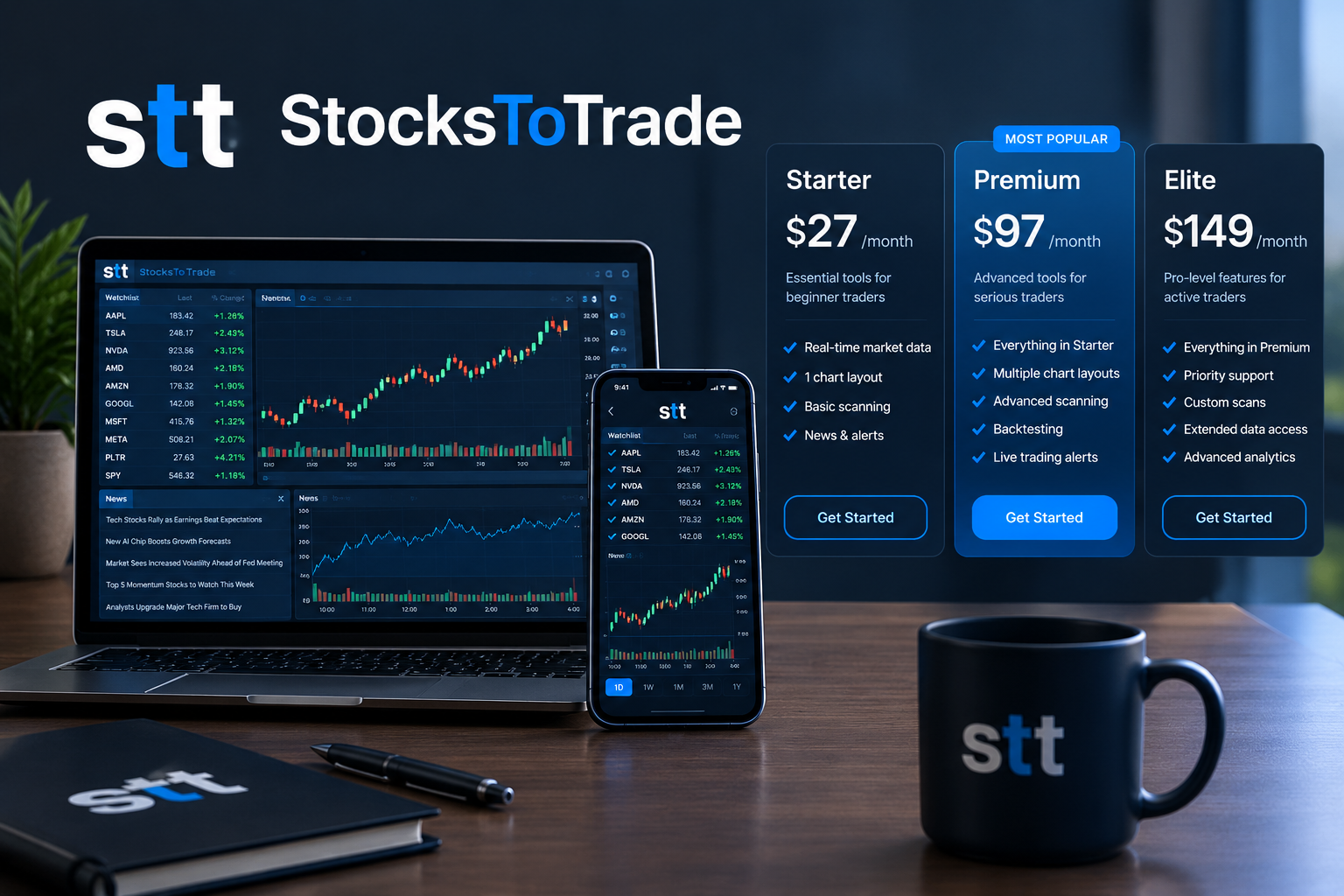
- Legit, not cheap. StocksToTrade charges $179.95 per month, $539.85 per quarter, or $1,899.50 per year for the core platform. The annual plan saves $259.90 against 12 monthly payments.
- The quarterly plan is a rounding error. $539.85 is exactly $179.95 times three. Zero discount for prepaying three months.
- Level 2 is a separate line item. $29 per month or $345 per year. For momentum traders reading order flow on thin floats, that's not optional, which makes the real entry price about $208.95 a month.
- The $7 trial is the whole point. Fourteen days for $7 works out to 50 cents a day. There's also a $17 trial bundled with Breaking News Chat and an $18 trial bundled with Small-Cap Rockets.
- Add-ons stack fast. Platform plus Level 2, Breaking News Chat ($49/mo), Small-Cap Rockets ($50/mo), and TipRanks ($8.95/mo) runs $316.90 a month, or $3,802.80 a year paid monthly.
- No audited track record is published. Oracle's trade ideas and the alert services carry no third-party verified performance report. Treat every win-rate number you see in marketing as vendor-claimed.
- Separate, much pricier upsells exist. Daily Market Profits is listed at $1,995 a year. That's a different product from the platform subscription, and it's the one that catches people off guard.
Is StocksToTrade legit? The short answer
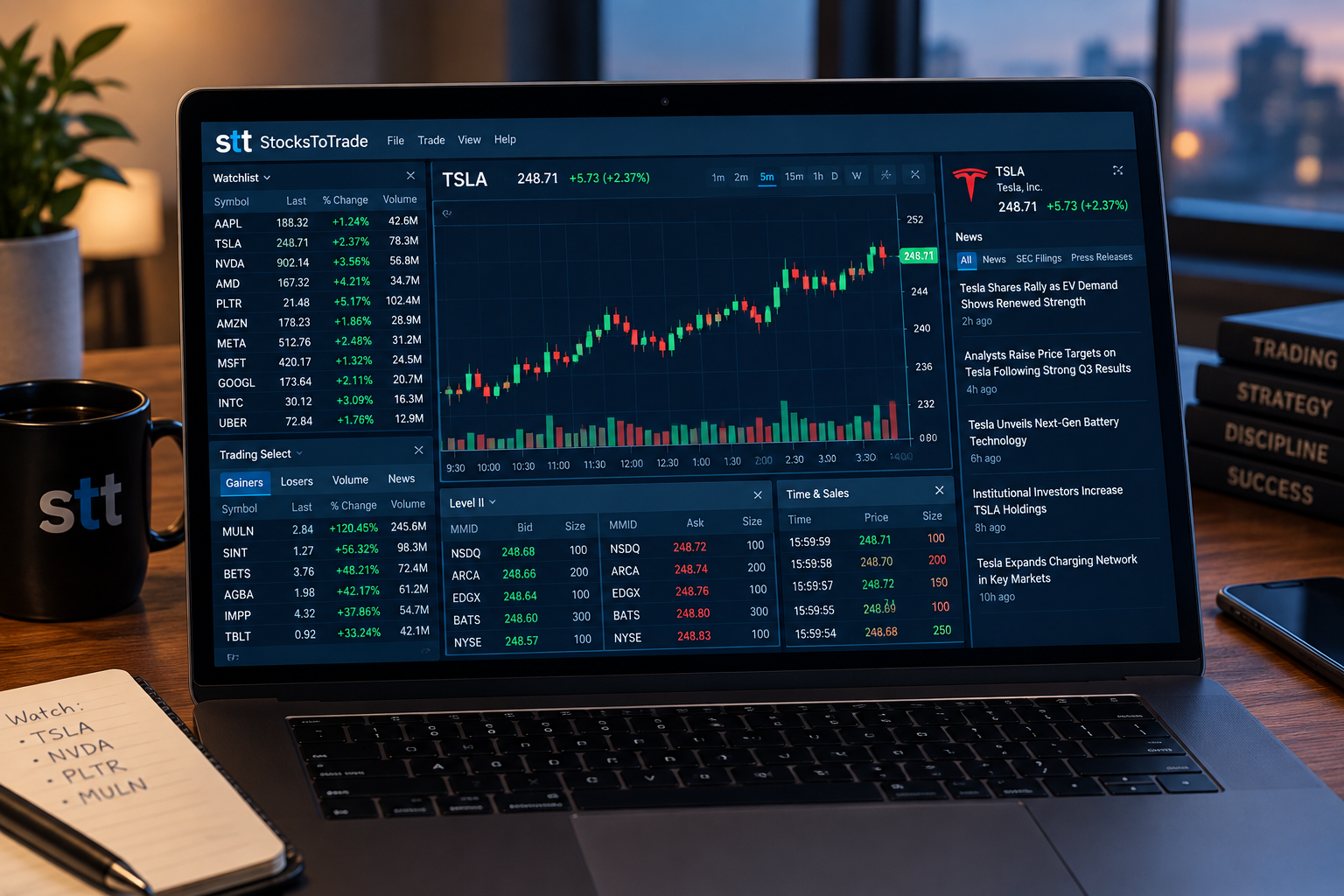
StocksToTrade is a legitimate software business selling a real desktop and web trading platform. It publishes prices, it has a live product you can log into within minutes of paying $7, and it's been operating in the day trading space for years. Nobody is running off with your card number.
"Legit" and "worth it" are two different questions, and the ads blur them on purpose. Plenty of legitimate products are terrible value. A $19 protein shake is legally protein. It's also $19.
Here's the distinction that matters for your money: StocksToTrade is a scanner and news terminal for a narrow style of trading, priced like a professional tool. If you trade low-float small caps in the first 90 minutes of the session, the price can make sense. If you're a swing trader holding positions for two weeks, you're paying a premium for speed you'll never use.
The five checks below are how I answer is StocksToTrade legit, and they're the same ones I'd run on any tool at this price point: pricing transparency, what the core feature actually does, whether performance claims are audited, how hard it is to stop paying, and what users say when nobody's soliciting the review.
What is StocksToTrade and who is it for?
Half the people asking is StocksToTrade legit are really asking whether it fits their trading style, and that comes down to who the platform was built for.
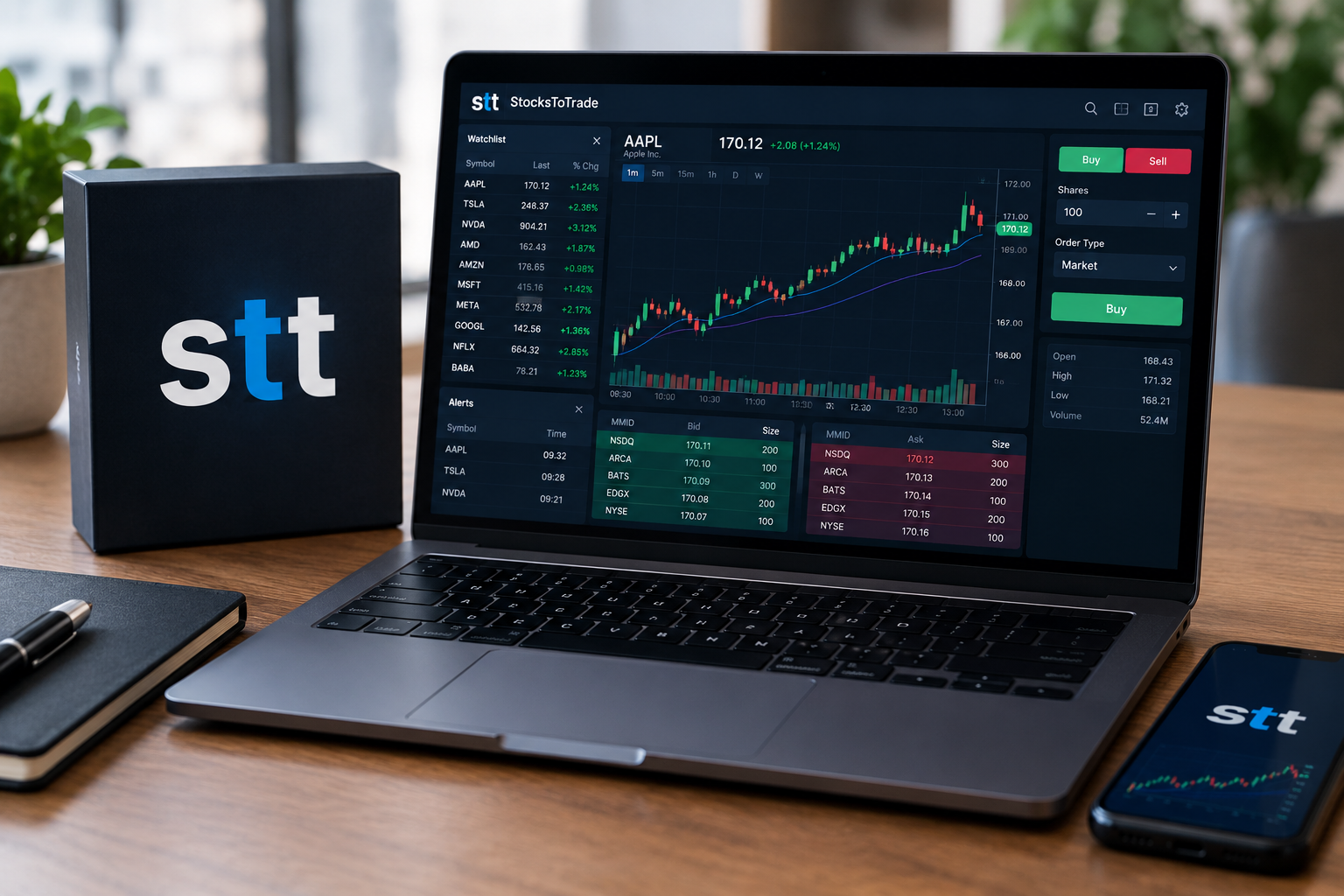
StocksToTrade is a day trading platform built around real-time scanners, charting, a news feed, and a trade-idea tool called Oracle, with an editorial focus on small-cap and penny stock momentum. It puts charts, scans, and headlines in one window so you're not flipping between six tabs while a stock is halting.
The product grew out of the penny stock education world and is publicly associated with trader Timothy Sykes, which explains both the strengths and the marketing. The scanners are genuinely tuned for the stuff most platforms treat as noise: sub-$10 names, tiny share counts, volume spikes on no institutional coverage. Most general-purpose screeners either filter that universe out or surface it too late.
Who it's built for, specifically:
- Active day traders working the open, looking for low-float runners (a low float means very few shares available to trade, so price moves violently on modest volume)
- Traders who want pre-built scans instead of spending a weekend configuring filters
- People who trade catalyst-driven moves and need the headline and the chart on the same screen
- Short-term swing traders who still care about intraday volume and Level 2 depth
Who it isn't for: long-term investors, dividend people, options-focused traders, and anyone who checks their positions twice a day. You'll pay $2,159 a year for features you'll open once.
One common mistake worth naming: beginners buy the platform hoping it will tell them what to buy. A scanner narrows a universe of 8,000 tickers down to a watchlist of eight. Deciding which of those eight has a clean setup, and where your stop loss goes, is still your job. If you don't have that process, no subscription fixes it. If you're still building one, start with our guide to AI stock scanners before you spend anything.
Check 1: Is the StocksToTrade pricing transparent?
Pricing is the first place to look when you ask is StocksToTrade legit, because shady products hide the bill and legitimate ones publish it.
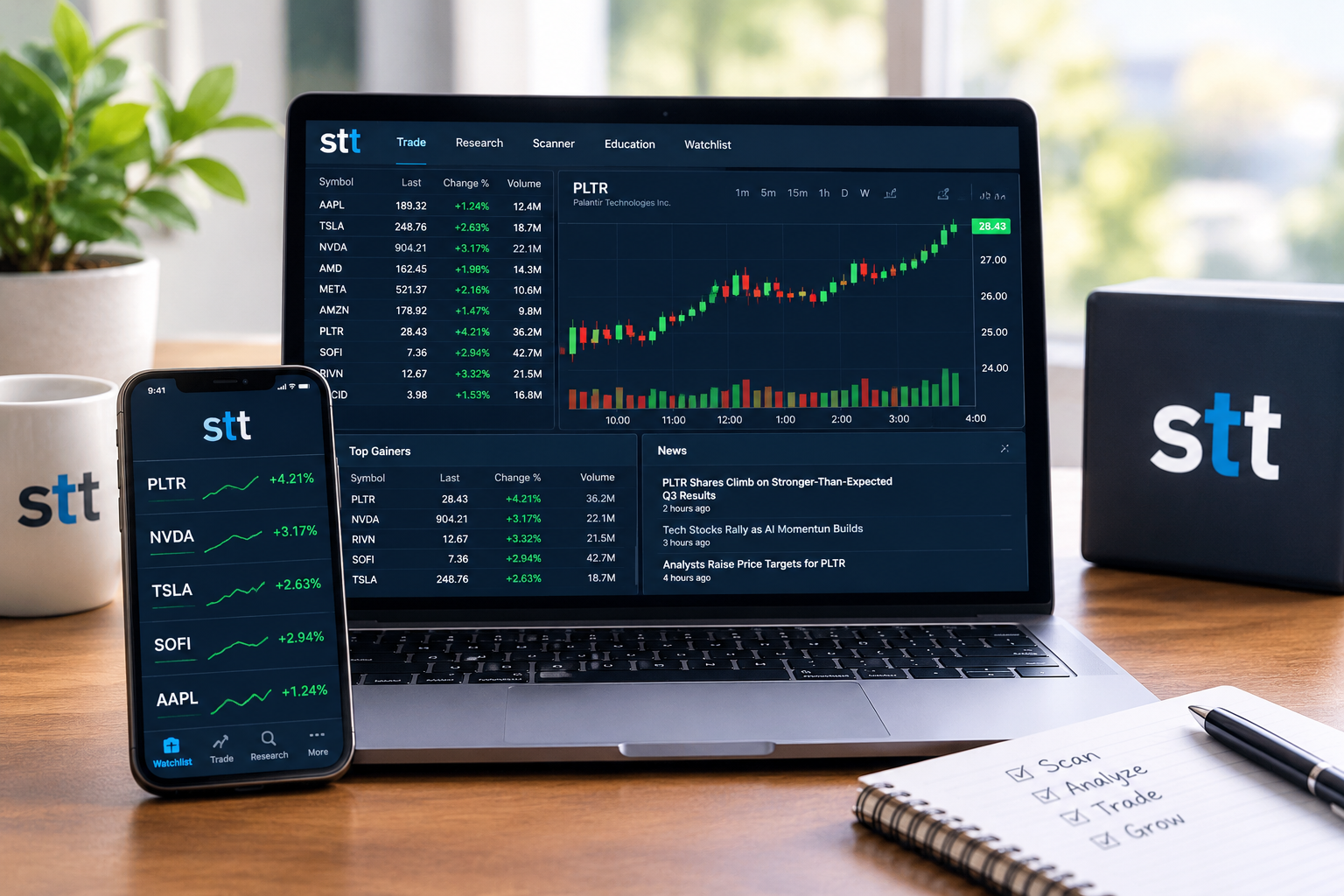
Mostly yes on the platform, and murkier on everything around it. The core subscription prices are published and easy to find: $179.95 monthly, $539.85 quarterly, $1,899.50 annually. The trial tiers are published too, at $7, $17, and $18 for 14 days. That's more transparency than a lot of this category offers.
Now the parts the ads don't lead with.
The math you should run yourself:
- 12 months at $179.95 = $2,159.40. The annual plan at $1,899.50 saves you $259.90, about 12%.
- The quarterly plan at $539.85 is exactly three monthly payments. Prepaying a quarter saves you nothing. If you want the discount, you commit to a year.
- Level 2 data at $29 a month is $348 a year. The annual Level 2 price is $345. Prepaying 12 months of Level 2 saves $3. That's not a discount, that's a typo with confidence.
- Breaking News Chat: $49 a month, $490 a year, saving $98.
- Small-Cap Rockets: $50 a month, $500 a year, saving $100.
- TipRanks: $8.95 a month, $89.50 a year, saving $17.90.
Stack the whole thing monthly and you're at $316.90 a month, or $3,802.80 a year. Buy every piece annually and it's $3,324. That's real money, and it's before commissions, before data fees at your broker, and before the separate Daily Market Profits service at $1,995 a year.
The decision rule: if your trading account is under $10,000, a $2,159-a-year software bill is 21% of your capital. You would need a very good year just to cover the tool. Beginners with small accounts should treat the $7 trial as the entire relationship until the account can absorb the subscription without flinching.
How to get the best deal
- Start with the $7 basic trial, not the $17 or $18 bundles. Fourteen days is enough to learn whether you like the scanners. Adding a chat room or an alert service in week one guarantees you can't tell which thing you're actually paying for.
- Trial during a busy tape. A quiet, choppy week with no small-cap volume makes any momentum scanner look useless. Earnings season or a period with active low-float movers gives you a fair read.
- Don't buy annual on day 14. Pay one month at $179.95 first. If you're still logging in daily after 60 days, then the $259.90 annual saving is real. If you're not, you just saved yourself $1,700.
- Skip Level 2 during the trial only if you're testing scan quality. If you're testing execution decisions, add it, because trading thin floats without depth-of-book is guessing.
- Watch the upsell path. The platform subscription and the advisory or alert products are separate purchases. Know which cart you're in.
Check 2: What do the scanners and Oracle actually do?
This is the check where StocksToTrade looks strongest, since the scanners are the product and the pre-built small-cap scans work out of the box.
The scanners filter the market in real time against criteria like price, volume, float, percent change, and news, and StocksToTrade ships pre-built scans so you're not building from scratch. Oracle is a trade-idea tool that surfaces candidate tickers with suggested entry and exit levels. Both are the reason people pay, and both need to be tested rather than trusted.
What the scanners do well: the pre-built small-cap scans save real setup time. Instead of fumbling with float filters at 9:15 a.m., you open a scan called something like "top percent gainers with volume" and you have a watchlist. For a beginner, that shortcut alone removes the analysis paralysis that keeps people from trading at all.
What you have to verify in your 14 days: latency. A scanner that surfaces a mover three minutes after it moved is a history lesson, not a trade. Sit with the scan open, watch a stock spike, and note how fast the ticker appears versus your broker's Time and Sales. That single test tells you more than any review, including this one.
On Oracle, be careful about what "suggested entry and exit levels" means. It's an algorithmic read on price action, not a forecast, and there is no published audit showing how those levels perform over a large sample. Used as a second opinion on a setup you already like, it's useful. Used as a signal to click buy because software said so, it's the most expensive way to learn about position sizing.
A quick example of the right workflow: the scan flags a $3 stock up 40% on 15 million shares against a 6 million share float. You pull the chart, see a tight consolidation under the morning high, check the news feed for the catalyst in the same window, and set a stop below the consolidation low. The tool did the finding. You did the deciding. That division of labor is the only version of this that works.
Check 3: Are the performance claims audited?
No audit is not the same as no value; it just means you judge the tool by your own trial results instead of its marketing.
No. StocksToTrade does not publish a third-party audited track record for Oracle, for the pre-built scans, or for the alert services. That's not unique to this company, it's standard across the entire retail trading tool market, but it should change what you're willing to pay.
Here's the standard I'd hold any tool to:
- A live, timestamped record of every idea, not selected screenshots
- Losses included, at the same font size as the wins
- A third party with no revenue share verifying the numbers
Marketing that shows a chart with an arrow on it meets none of those. Neither does a testimonial. Neither does a screenshot of a P&L from an account you can't verify, from a person you can't identify, over a period you didn't choose.
Treat every win rate, every "average gain," and every alert performance number as vendor-claimed until audited. That's not an accusation, it's just what unverified means. The Securities and Exchange Commission has published guidance on exactly this pattern of trading-education and alert marketing, and it's worth ten minutes of your time at investor.gov before you buy any product in this category.
The edge case worth flagging: alert services and chat rooms in thinly traded small caps have a structural problem that has nothing to do with honesty. When a few thousand people get the same alert on a stock with a 5 million share float, the alert itself moves the price. The first fills and the last fills are different trades. If you subscribe to Small-Cap Rockets at $50 a month or Breaking News Chat at $49 a month, assume you are not the first fill and size accordingly.
Check 4: How easy is it to cancel or get a refund?
A clean exit is part of the answer to is StocksToTrade legit, so spend five minutes on the terms before you spend $7.
This is the check people skip, and it's the one that generates the angriest reviews in any subscription category. Do not take anyone's word for the policy, including mine. Read the terms on the checkout page you're actually on, screenshot them, and note the exact renewal date in your calendar.
What to confirm before you pay, in writing:
- Does the $7, $17, or $18 trial auto-convert to a paid subscription at $179.95 when the 14 days end, and on which day exactly?
- Can you cancel inside the account dashboard, or does it require an email or a phone call?
- Are annual subscriptions refundable pro-rata, refundable within a window, or not refundable at all?
- Do add-ons like Level 2, Breaking News Chat, and Small-Cap Rockets cancel separately from the platform?
- Are the advisory and Daily Market Profits products governed by different terms than the software?
The practical move: if the trial auto-converts, cancel on day 12 regardless of how much you like it, then resubscribe deliberately. You lose nothing and you remove the possibility of a $179.95 charge you didn't plan for. Also pay with a card that lets you see and manage recurring merchants, and never with a debit card tied to your trading capital.
One more thing. Multi-product companies with a paid trial, a monthly plan, an annual plan, five add-ons, and separate premium services will always generate billing confusion. That's a structural consequence of the pricing architecture, not proof of bad intent. Your defense is a calendar reminder, not a complaint later.
Check 5: Is StocksToTrade legit according to real users?
Unsolicited reviews give the most honest read on this platform, and they keep crediting the scanner and the one-window layout while pushing back on price.
Public sentiment on StocksToTrade is mixed and, more importantly, hard to read cleanly, because the loudest voices on both sides have an incentive. The scanner and the all-in-one layout get consistent credit. The price and the volume of upsells draw consistent criticism. That's the pattern, and I'm not going to dress it up with invented quotes or numbers.
How to read the reviews yourself, source by source:
- Reddit (r/Daytrading, r/RealDayTrading, r/pennystocks): negative skew, because people post when they're annoyed. Best place to find unsolicited, specific complaints about scanner latency and billing. Search the brand name and sort by top of all time.
- Trustpilot: complaint-heavy by design. Read only the one-star and two-star reviews and count how many are about the product versus the cancellation process. The ratio tells you which risk you're taking.
- G2 and Capterra: positive skew, because vendors solicit these. Useful for workflow and support detail, not for verdicts.
- YouTube: the most compromised source in this niche, because most "reviews" of trading platforms are affiliate content. If a video has a discount link in the description and no criticism in the script, it's an ad.
The gap between solicited and unsolicited sources is the actual finding. A tool that reads well on vendor-collected reviews and rough on Reddit is telling you something about the sales process rather than the software. Read both and weigh the unsolicited one heavier.
And a filter for the noise: complaints that boil down to "I subscribed and didn't make money" say nothing about the tool. A scanner is a flashlight. It doesn't pick the room you walk into.
StocksToTrade plans and add-ons: what you actually pay
Every price below is published by StocksToTrade, which is one more point in the legit column: you can see the full bill before you commit.
| What you get | Monthly price | Annual price |
|---|---|---|
| Basic platform trial, 14 days (charts, scanners, news, Oracle) | $7 one-time | Not applicable |
| Platform + Breaking News Chat trial, 14 days | $17 one-time | Not applicable |
| Platform + Small-Cap Rockets trial, 14 days | $18 one-time | Not applicable |
| Core platform (charting, real-time scanners, pre-built scans, news feed, Oracle) | $179.95 | $1,899.50 |
| Core platform, quarterly billing | $539.85 per 3 months (no discount) | Not applicable |
| Level 2 data (depth of book, bids and offers behind the quote) | $29 | $345 |
| Breaking News Chat (live headline and commentary room) | $49 | $490 |
| Small-Cap Rockets (small-cap alert service) | $50 | $500 |
| TipRanks (analyst ratings and sentiment overlay) | $8.95 | $89.50 |
| StocksToTrade Advisory | Not applicable | $49 per year ($79 for 2 years) |
| Daily Market Profits (separate premium service) | Not applicable | $1,995 per year |
| Everything above except Advisory and Daily Market Profits | $316.90 | $3,324 |
Two lines in that table deserve a second look. The quarterly plan at $539.85 gives you no price benefit over paying monthly, so it exists purely as a commitment nudge. And Daily Market Profits at $1,995 a year costs more than the platform itself, which is a useful reminder that the software subscription is the front door, not the whole house.
Top 5 StocksToTrade features
These five features are why the answer to is StocksToTrade legit comes back yes for active small-cap traders.
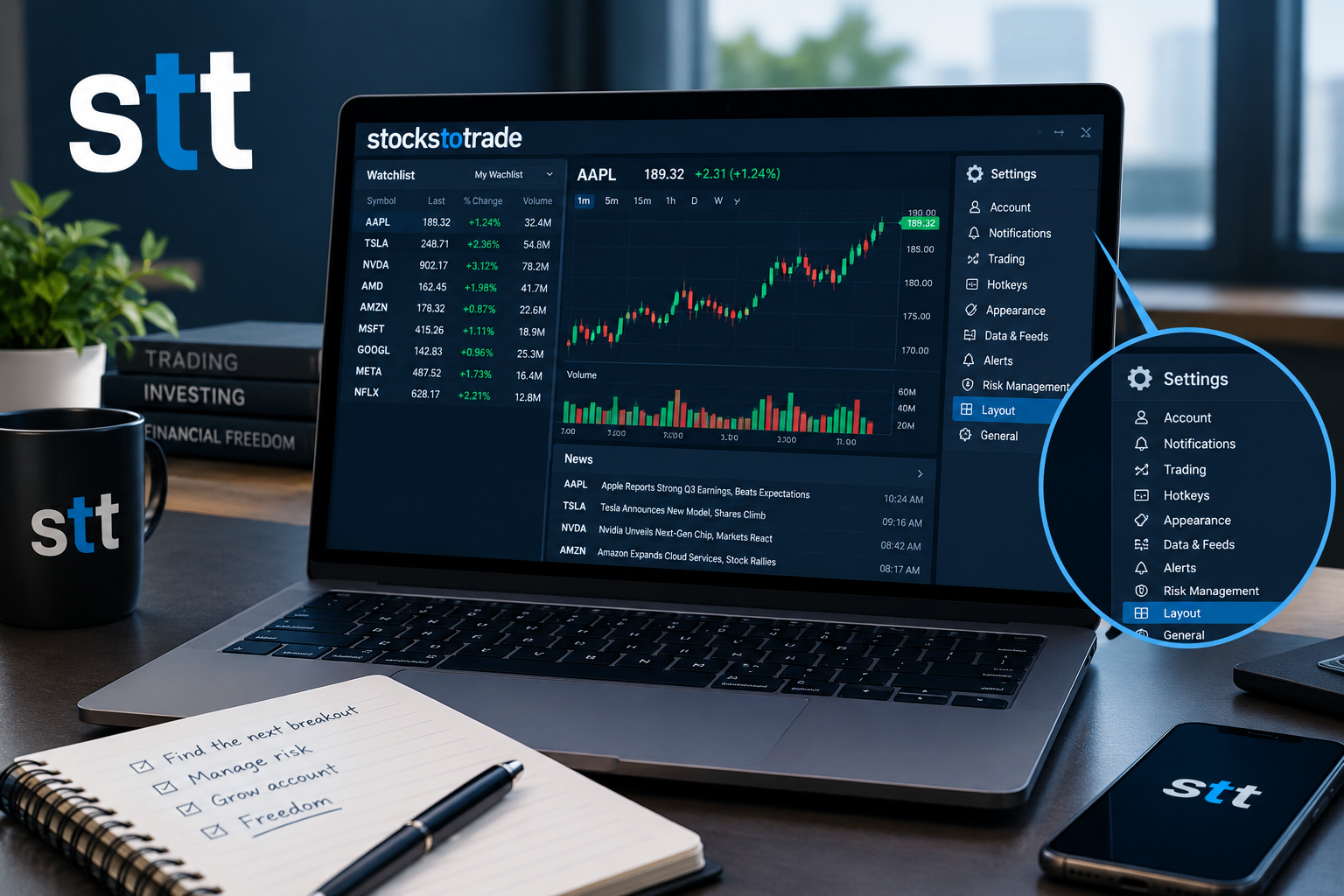
1. Pre-built small-cap momentum scans
The highest-value feature for a beginner. Ready-made scans for top gainers, volume spikes, and low-float runners mean you get a watchlist in 30 seconds instead of learning filter syntax for a month. Time-to-first-useful-output is the metric that decides whether people keep paying, and this is where StocksToTrade earns its keep.
2. Oracle trade ideas with entry and exit levels
Oracle surfaces candidate setups with suggested levels attached. Treat it as a prompt to go look at a chart, not an instruction. With no published audit behind it, its honest job is to shorten your search, not to replace your judgment.
3. Charts, news, and scanners in one window
Fewer tabs means fewer mistakes. When a small cap gaps 60% and halts, you need the headline, the chart, and the volume in the same glance. Tab-switching during a fast move costs you the entry, and the single-window layout is a real ergonomic advantage over a stitched-together free stack.
4. Level 2 depth of book (add-on, $29 a month)
Level 2 shows the resting bids and offers behind the best quote, which on a thin float is the difference between reading the tape and guessing at it. It's an add-on, which is annoying, and it's also the add-on I'd argue is mandatory if you trade this style with real size.
5. Daily watchlists and training content
The education library and daily watchlists give beginners a framework and vocabulary, which has genuine value. It also means the content is doing double duty as marketing for other products in the ecosystem. Use the lessons on support and resistance, risk-reward, and position sizing. Be skeptical of anything that ends in a checkout page.
✅ What we love
- Pre-built low-float, high-volume scans that work out of the box
- A $7 entry point for 14 days, which is one of the cheapest real tests in this category
- One window for news, charts, and scans, which cuts down on tab-switching during fast moves
- Genuine specialization in a niche most general platforms ignore
- Published, findable pricing for the core platform and trials
❌ What could be better
- $179.95 a month is a professional price for a retail tool, and effectively $208.95 once you add Level 2
- No third-party audited performance record for Oracle or the alert services
- The upsell architecture (five add-ons plus two separate premium services) creates billing confusion and decision fatigue
- The quarterly plan and the annual Level 2 pricing offer essentially no savings, which reads as pricing theater
- Narrow by design, so swing traders and investors get little they couldn't find cheaper elsewhere
What are the best StocksToTrade alternatives?
Settling is StocksToTrade legit does not settle whether it is right for you, so here is where the same money goes further for other styles.
If the $179.95 price or the small-cap-only focus doesn't fit, four platforms cover the same ground from different angles. Match the tool to how often you trade and what you trade, not to which one has the best ad.
Trade Ideas. The closest competitor on real-time scanning horsepower, with AI-driven scan generation and backtesting built in. Choose it if you want to build and test custom intraday scans across the whole market rather than work from someone else's small-cap presets. It's a similar order of price and has a similar learning curve. Our TrendSpider vs Trade Ideas comparison covers where the scan engines diverge.
Benzinga Pro. A news and squawk terminal first, a scanner second. Choose it if your edge is catalyst speed and you already have charting you like. If the only StocksToTrade feature you used during the trial was the news feed, you're overpaying by a wide margin. See the Benzinga Pro review for the cost breakdown.
TC2000. Charting and scanning at a fraction of the cost, with a deep custom-formula language. Choose it if you're a swing trader who wants excellent charts, solid scans, and no chat room. The tradeoff is that its culture and defaults aren't built around low-float momentum.
Finviz Elite. The value option. Real-time quotes, intraday screening, and backtesting for a small fraction of a StocksToTrade subscription, with a free tier that does a surprising amount. Choose it if you're a beginner with a small account who needs to find movers and doesn't need Level 2 or an alert service. Start with the Finviz Elite review and the Finviz vs Trade Ideas breakdown.
The decision rule: if you place fewer than 10 trades a week, buy Finviz Elite or TC2000 and keep the difference in your trading account. If you're in and out of five low-float names before 11 a.m. every session, the specialized scanner is defensible.
The Alpha Score Breakdown: is StocksToTrade legit and good value?
A 61 says the product is real and useful for its niche, while Price-to-Value and Transparency pull the total down.
StocksToTrade scores 61 out of 100 across five pillars, 20 points each.
| Pillar | Score |
|---|---|
| Signal Quality | 14 |
| Transparency | 11 |
| Price-to-Value | 10 |
| Usability | 15 |
| Community Verdict | 11 |
The 61 comes from FullStack Alpha desk research plus public user sentiment, and the pillar split is provisional. What each pillar weighs: scanner latency against Time and Sales on live small-cap movers (Signal Quality), whether Oracle's methodology and any performance data are disclosed (Transparency), the $179.95 monthly price against category alternatives (Price-to-Value), time from signup to first usable watchlist (Usability), and the gap between solicited review sites and unsolicited Reddit threads (Community Verdict).
Want to see StocksToTrade next to every other scanner and research tool we track? Browse the FullStack Alpha AI stock tool directory and filter by price, category and trading style.
FAQ: is StocksToTrade legit, safe, and worth it?
Is StocksToTrade a scam?
No. It's a real software company with a working platform, published pricing, and a paid trial you can use immediately. The legitimate criticisms are about price ($179.95 a month), the number of upsells, and the absence of audited performance data, not about whether the product exists.
How much does StocksToTrade cost per month?
$179.95 a month for the core platform. Add Level 2 data at $29 and you're at $208.95. The annual plan is $1,899.50, which saves $259.90 versus 12 monthly payments.
Is the $7 StocksToTrade trial really only $7?
The 14-day basic platform trial is listed at $7 as a one-time charge. Confirm on the checkout page whether it auto-converts to the $179.95 monthly subscription at day 14, and set a calendar reminder to cancel on day 12 if you don't want to continue.
Do I need to pay extra for Level 2 data on StocksToTrade?
Yes. Level 2 is an add-on at $29 a month or $345 a year. If you trade low-float small caps with real size, treat it as required rather than optional, because depth of book is how you judge whether a bid will hold.
Does StocksToTrade work for swing trading?
It can, but you're paying for intraday speed you won't use. A swing trader holding for days or weeks gets most of what they need from TC2000 or Finviz Elite at a fraction of the cost.
Can beginners use StocksToTrade?
The pre-built scans and training content make it usable on day one, which is a genuine strength. The problem is economics: at $2,159 a year paid monthly, the subscription is a heavy drag on an account under $10,000. Paper trade the setups first and buy the tool when your account can carry it.
Is Oracle's performance verified?
No third-party audit of Oracle's suggested entry and exit levels has been published. Any win-rate or average-gain figure you see in marketing should be read as vendor-claimed.
What's the difference between StocksToTrade and Daily Market Profits?
StocksToTrade is the software subscription at $179.95 a month or $1,899.50 a year. Daily Market Profits is a separate premium service listed at $1,995 a year. Buying one does not include the other, and confusing the two is the most expensive mistake in this product line.
Is StocksToTrade legit for beginners?
Yes. It's a real platform, and the pre-built scans make it usable on day one. The catch is cost, so start with the $7 trial and paper trade the setups before paying $179.95 a month.
Is StocksToTrade legit according to Reddit?
Reddit threads on r/Daytrading, r/RealDayTrading and r/pennystocks skew negative because people post when they're annoyed. The complaints center on scanner latency, billing, price and upsells, not on the product being fake.
Is StocksToTrade legit for trading penny stocks?
That is the exact niche it is built for. The scanners are tuned for sub-$10, low-float names with volume spikes, which most general screeners filter out or surface too late.
Is StocksToTrade legit enough to pay for a full year?
Make it prove itself first. Pay one month at $179.95, and move to the $1,899.50 annual plan only if you're still logging in daily after 60 days, when the $259.90 saving becomes real.
What Alpha Score does StocksToTrade get?
61 out of 100, built from FullStack Alpha desk research and public user sentiment. The provisional split is Signal Quality 14, Transparency 11, Price-to-Value 10, Usability 15 and Community Verdict 11.
Can I make $1000 per day from trading?
A very small number of traders do, but most day traders lose money, and no scanner changes that math. What protects you is a written process for entries, stop losses and position sizing. On a small account, chasing $1,000 a day means taking risk that can wipe the account out just as fast.
What is the most trusted stock trading app?
There is no single winner, because trust depends on the job the app does. StocksToTrade is scanning, charting and news software rather than a broker, so your money sits with your broker. Trust tools that publish pricing and let you test cheaply, like the $7 trial here, and check any broker's registration at investor.gov before you fund an account.
Who is the owner of StocksToTrade?
StocksToTrade is publicly associated with trader Timothy Sykes, and the product grew out of the penny stock education world. If the legal entity matters to you, check the company details in the terms on the checkout page before you pay.
Final verdict: is StocksToTrade legit and worth your money?
So, is StocksToTrade legit? Yes, and for the right trader it is a sharp, focused tool worth a $7 test.
StocksToTrade is legitimate software with a defensible niche and an indefensible price for most of the people who see its ads. The scanners do the job they claim, the single-window layout is a real advantage during fast moves, and the $7 trial makes testing it nearly free. The problems are the absence of audited performance data, the add-on architecture that turns $179.95 into $316.90 quickly, and pricing tiers like the $539.85 quarterly plan that offer no benefit at all.
Buy it if: you day trade low-float small caps in the first two hours, you place at least 10 trades a week, your account is large enough that $2,159 a year is under 5% of capital, and you already have written rules for entry, stop loss, and position sizing.
Skip it if: you're a swing trader, an options trader, a long-term investor, or a beginner with a few thousand dollars and no system. Finviz Elite or TC2000 gives you 80% of what you'll actually use for a fraction of the money, and the difference belongs in your trading account.
Your next step, today: buy the $7 basic trial, not the $17 or $18 bundle. Set a calendar reminder for day 12. For 14 days, run one test and one test only: how fast does the scanner surface a mover compared to your broker's Time and Sales, and did you take a single trade you wouldn't have found otherwise? If the answer is no, cancel and keep the $2,152 you didn't spend. Fewer tools, one clean process. Cut the noise, keep the alpha.
Related reading: AI day trading tools guide · AI news and catalyst tools · All tool reviews
One tool, scored five ways. There are 200+ more in the FullStack Alpha directory, filterable by category, price and what they actually do.
Browse the directory → aistockpickerapps.com
Some links in this article are affiliate links, which may earn FullStack Alpha a commission at no extra cost to you.
We test the tools. You get the verdict.
One email a week. What we tested, what scored, and what we'd skip. Written for traders, not for clicks.
More from FullStack Alpha