

tastytrade Fees: The Full Cost Map for Options Traders
Short on time? The tastytrade Alpha Score scorecard breaks the 74/100 down by pillar, with pricing and the verdict, in about 90 seconds.
See the score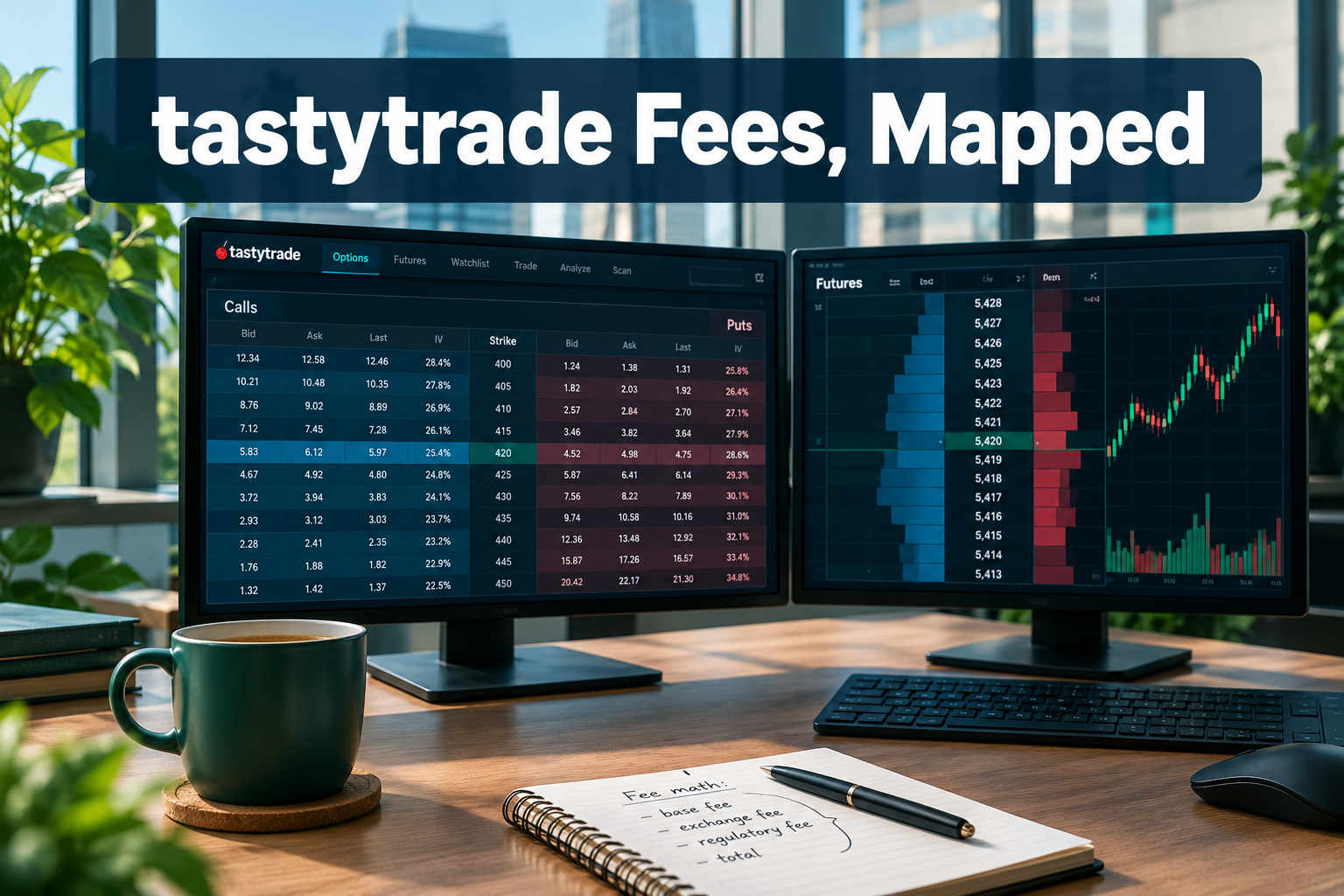
tastytrade fees boil down to one honest number for options: $1 per contract to open, capped at $10 per leg, and $0 to close. Stocks and ETFs trade for $0 in commission but still carry small pass-through charges, and futures run $1 per contract each way before clearing and exchange costs.
Quick Answer: tastytrade fees are among the lowest in the options business. You pay $1 per contract to open an equity or index option, that charge stops climbing once it hits $10 on a single leg, and closing the trade costs nothing. Stocks and ETFs are commission-free but not fee-free, and futures traders pay $1 per contract each way plus small clearing and exchange charges. The catch isn't the pricing. It's the platform, which assumes you already know what a leg is.
Key Takeaways
- $1 per contract, capped at $10 per leg. That's the core equity and ETF options commission to open a trade, with $0 to close it.
- A 25-lot vertical spread costs $20 to open, not $50, because each of the two legs hits its own $10 cap.
- Stocks and ETFs trade at $0 commission, but a $0.0008 per share clearing fee still applies on both sides of the trade.
- Futures cost $1 per contract each way, plus roughly $0.30 in clearing fees and small exchange charges like the $0.01 NFA fee.
- Broad based index options (like SPX or XSP) open at $1 per contract and close for $0, the same structure as equity options.
- tastytrade's Alpha Score lands at 74 out of 100: strong on price to value (17/20), weaker on usability (13/20) for anyone new to options.
- No stated account minimum or monthly platform fee shows up in tastytrade's published pricing, but margin, wires, and inactivity in certain account types still carry their own charges.
What are the tastytrade fees for options?
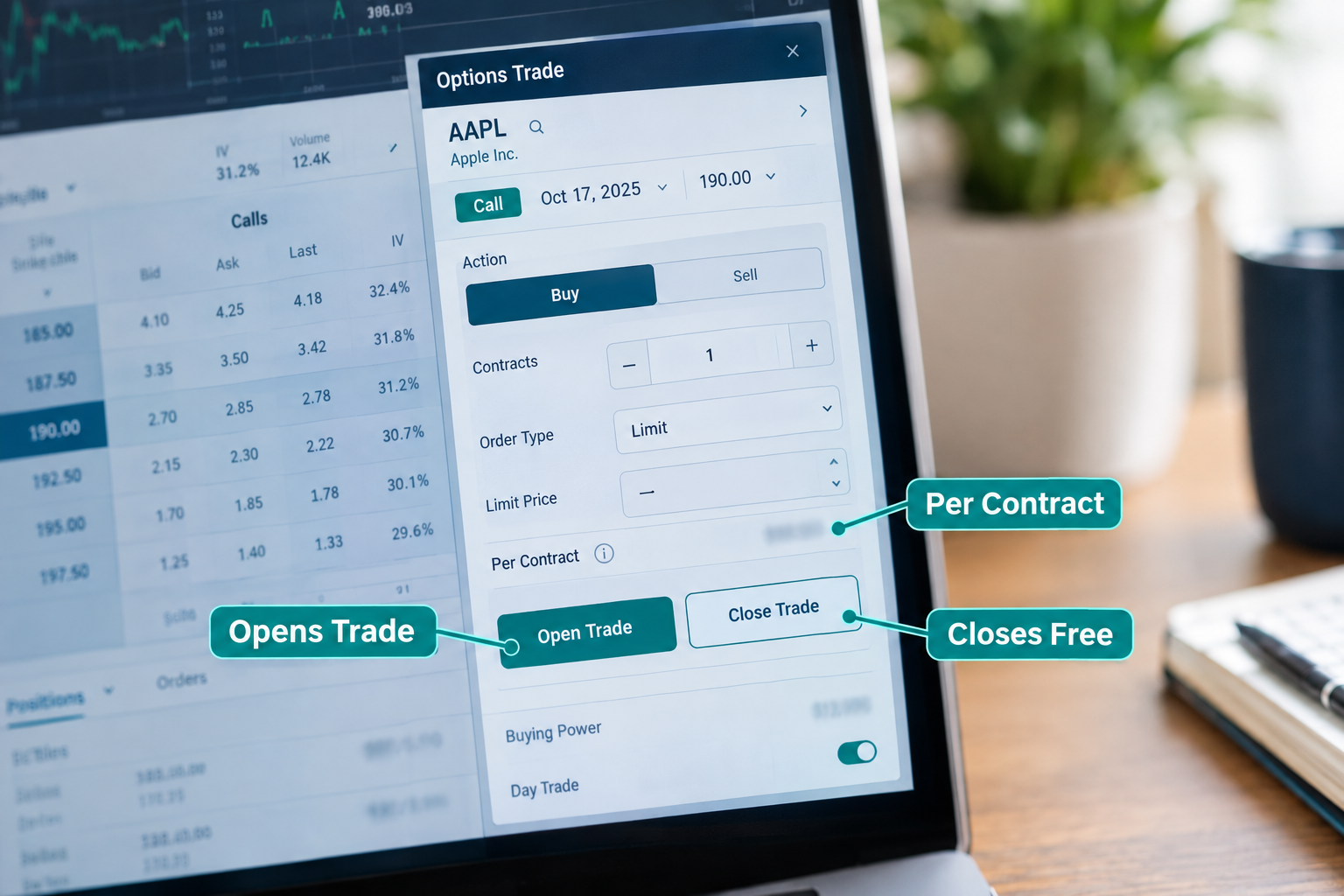
tastytrade fees for equity and ETF options are $1 per contract to open a trade, with a hard $10 cap on any single leg, and $0 to close. That's the entire commission structure for the product tastytrade was built around, and it's the reason the platform gets called one of the cheaper serious options brokers around.
Here's what that actually looks like in practice. Buy a single call for $1. Buy 10 contracts of that same call for $10, hitting the cap. Buy 50 contracts, and you still pay $10, because the per-leg cap stops the meter once it hits ten bucks. That's the whole idea behind an options commission cap: it rewards size instead of punishing it.
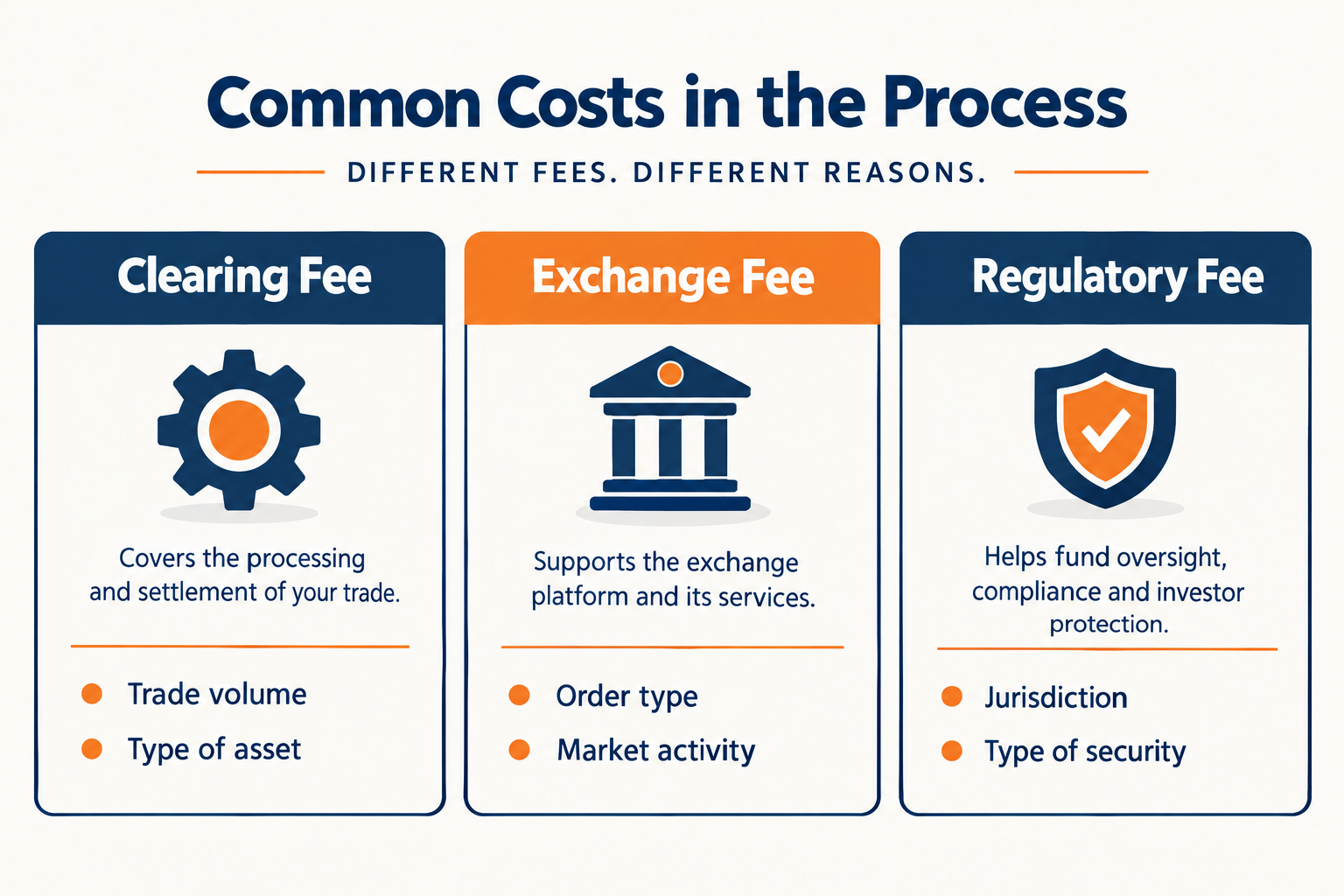
Index options work the same way, with one tweak. Broad based index products like SPX, VIX, RUT, and XSP also run $1 per contract to open and $0 to close, matching the equity options structure. Where it gets more textured is the pass-through costs layered on top of every tastytrade options fee:
- Clearing fee: $0.10 per contract
- Options Regulatory Fee (ORF): $0.02 per contract
- FINRA Trading Activity Fee: $0.00329 per contract, charged only on sales
- SEC fee: may apply on option sales, small and variable
None of these are tastytrade's commission. They're regulatory and exchange charges every broker passes through in some form. tastytrade just publishes them clearly instead of burying them in a footnote, which is more than most brokers do.
Decision rule: if you trade small size (1 to 5 contracts per leg) and open and close often, tastytrade's $0 closing commission is the single biggest reason its total tastytrade options fees run lower than brokers that charge on both ends of a trade.
What do stocks, futures and crypto cost at tastytrade?
Stocks and ETFs cost $0 in commission at tastytrade, futures run $1 per contract each way, and crypto trades carry a spread built into the 0.75% to 1% range through tastytrade's Zero Hash partnership. Three very different products, three very different fee shapes.
Stocks and ETFs. Zero commission to open and close, which matches the industry standard set by Robinhood, Schwab, and Fidelity years ago. The wrinkle is a $0.0008 per share clearing fee that applies regardless. On a 100 share trade that's roughly 8 cents. Not nothing, but not a reason to avoid the trade either.
Futures. Standard futures contracts cost $1 per contract to open and $1 to close, a genuinely symmetrical structure unlike the options side. Add in a roughly $0.30 clearing fee and small exchange charges, including a $0.01 NFA fee per contract, and a single round-trip futures contract lands in the neighborhood of $2.60 to $2.70 all in. Micro futures (like /MES or /MNQ) typically run cheaper per contract than their full-size counterparts, which is exactly why retail futures traders gravitated toward micros in the first place.
Options on futures. These sit at roughly $1.25 per contract, reflecting the extra clearing complexity of an option on a futures contract rather than a straight equity option.
Crypto. tastytrade routes crypto trades through Zero Hash, and the cost shows up as a spread rather than a stated commission, generally landing in the 0.75% to 1% range depending on the pair. One thing worth knowing before you fund a crypto position here: crypto held through Zero Hash is not SIPC covered, unlike your stock and options positions. SIPC protects against a brokerage failure, not against a coin's price falling, and it simply doesn't extend to this asset class the same way.
Common mistake: treating futures pricing like options pricing. They're structured differently. Futures charge you twice (open and close); options only charge you once. Mixing up the math is how a trader underestimates their real cost basis on a futures campaign.
How does the $10 per-leg cap change the math for spreads?
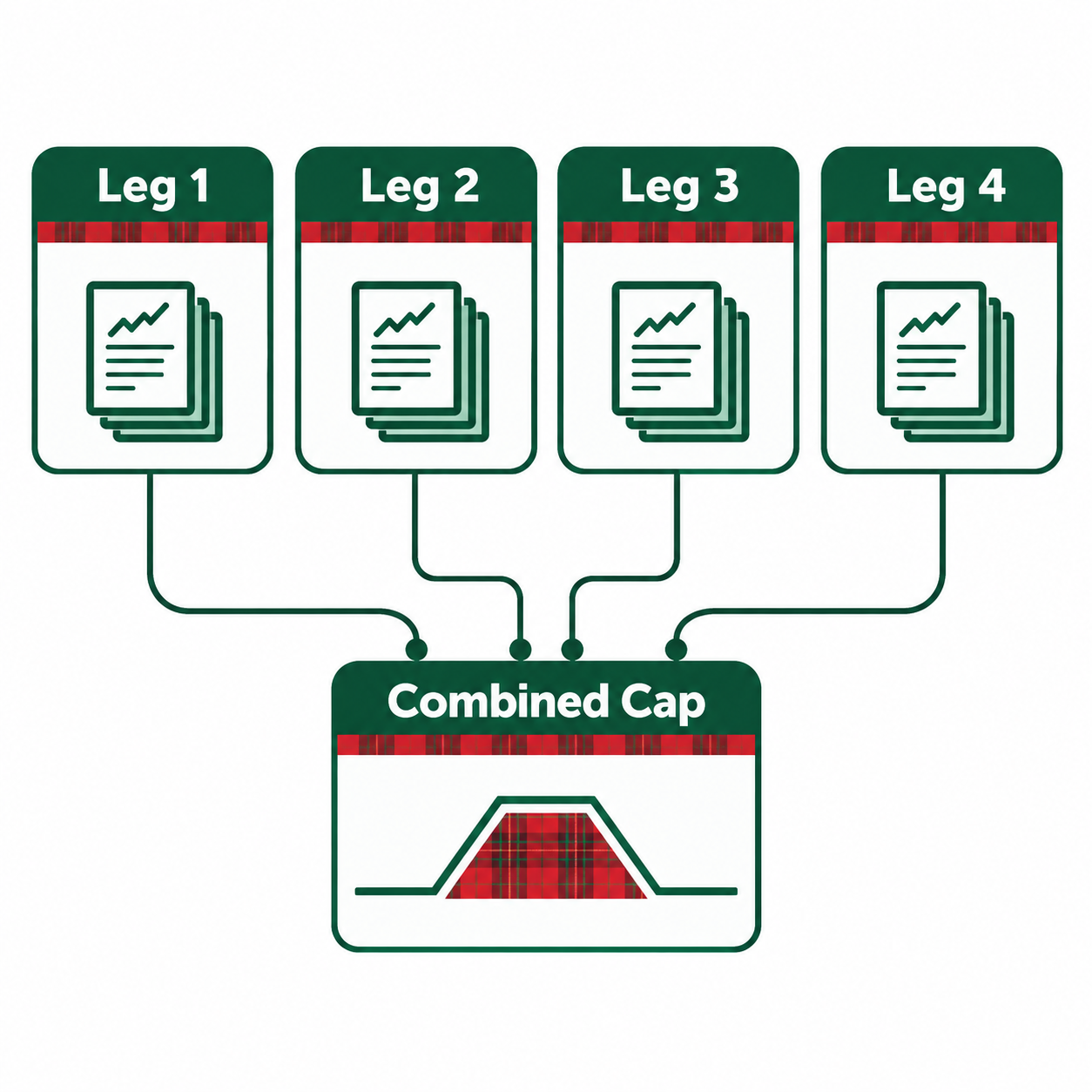
The $10 per-leg cap means a multi-lot spread doesn't scale in cost the way most traders assume. Each leg caps out independently, so size stops adding commission well before the trade gets large. This is the single most misunderstood part of tastytrade's pricing, and it's exactly what generic broker comparison articles tend to gloss over.
Here's a real worked example, straight from tastytrade's own fee documentation. A one-lot vertical spread (two legs) costs $2 to open. Scale that same spread up to 25, 50, or even 100 contracts, and the opening commission stays flat at $20, because each leg independently hits its $10 cap once contract count crosses ten.
Now stretch that logic to a bigger structure: a 20-contract iron condor. An iron condor has four legs (a bear call spread stacked on a bull put spread). Each leg is 20 contracts. Here's how the cap plays out:
| Leg | Contracts | Per-contract rate | Leg cost |
|---|---|---|---|
| Short call | 20 | $1, capped at $10 | $10 |
| Long call | 20 | $1, capped at $10 | $10 |
| Short put | 20 | $1, capped at $10 | $10 |
| Long put | 20 | $1, capped at $10 | $10 |
| Total opening commission | $40 |
Without the cap, that same 80-contract-leg trade (20 contracts times 4 legs) would run $80 in commission at a flat $1 per contract. The cap cuts it in half. Closing all four legs costs $0, so the entire round trip on a 20-lot iron condor runs $40 total, before the small clearing and regulatory pass-throughs from the section above.
This is where tastytrade's pricing actually beats a lot of "cheap" competitors once you're trading size. A broker charging $0.65 per contract with no cap would run $52 to open that same 80-contract-leg trade, and that's before they charge you again to close it.
If you're sizing spreads like this regularly, running the math ahead of time through a free position size and risk calculator is a cleaner habit than doing it in your head after the fill comes back. Systems over hacks: know your cost basis before you place the order, not after.
tastytrade vs Interactive Brokers vs Schwab thinkorswim vs Robinhood: how do the fees compare?
tastytrade's options pricing beats most full-service competitors on multi-contract trades because of the per-leg cap, while Robinhood wins on pure per-contract simplicity and Interactive Brokers wins on the lowest all-in cost for high-volume professionals. None of these brokers are priced identically once you look past the headline number, so the comparison depends on how you trade, not just what you pay per contract.
| Broker | Options commission (open) | Options commission (close) | Per-leg or contract cap | Notable trade-off |
|---|---|---|---|---|
| tastytrade | $1 per contract | $0 | $10 per leg | Platform has a learning curve for beginners |
| Interactive Brokers | Around $0.65 per contract (tiered pricing can run lower) | Around $0.65 per contract | No stated cap | Fee structure is layered and tiered by volume |
| Schwab thinkorswim | Around $0.65 per contract | Around $0.65 per contract | No stated cap | Charges on both legs, no cap benefit for size |
| Robinhood | $0 per contract | $0 per contract | No cap needed | No cap needed since it's already free |
The pattern here is straightforward. Robinhood is the cheapest options broker for small, simple trades. But it also offers far less in the way of order types, backtesting, and futures access. tastytrade is the cheapest serious options broker once you're running multi-lot spreads, because the per-leg cap does the work Robinhood's flat zero already does at smaller size. Interactive Brokers and Schwab thinkorswim charge on both the open and close, which adds up fast on active accounts that don't hit tastytrade's cap.
If you're weighing tastytrade against a simpler, more beginner-leaning platform, our Webull review breaks down fees and tools side by side with what a newer trader actually needs on day one.
Does tastytrade charge monthly fees, an inactivity fee, or require an account minimum?
tastytrade does not publish a monthly platform fee, an account minimum to open, or a standing inactivity fee in its core pricing schedule. That puts it in line with the rest of the modern retail brokerage field, where subscription-style account fees mostly disappeared over the last decade.
A few specifics worth knowing:
- Account minimum: tastytrade's published pricing doesn't list a minimum deposit to open a cash account. Margin approval and options trading levels carry their own eligibility requirements, separate from a dollar minimum.
- Is tastytrade free to use? The platform itself, including its desktop, web, and mobile apps, carries no subscription charge. You pay per trade, not per month for access.
- Inactivity fee: No standing inactivity fee shows up in tastytrade's core commission schedule. This is different from brokers that still charge a maintenance fee on accounts that go quiet.
- Data and add-ons: Real-time data and certain research feeds may carry their own cost depending on what you subscribe to, separate from trading commissions.
Decision rule: if a broker comparison site claims tastytrade has a monthly fee, check the date on that article. Broker fee schedules change, and this is one area where tastytrade's current published pricing is genuinely simple: no minimum, no subscription, no charge for sitting still.
What hidden costs should tastytrade traders watch for?
tastytrade fees are transparent on paper, but the real cost of trading here includes exchange and regulatory pass-throughs on every options trade, plus a margin rate and wire fee schedule that live outside the headline commission page. None of this is deceptive. It's just easy to miss if you only read the "$1 per contract" headline.
Margin interest. tastytrade publishes tiered margin rates that scale down as your borrowed balance grows, following the same structure most brokers use: smaller balances pay a higher rate, larger balances pay less. If you're running a margin account for leveraged futures or stock positions, that ongoing interest rate matters more to your annual cost than any per-trade commission does.
Wire transfer fees. Outgoing domestic wires typically carry a flat charge, and international wires generally cost more, consistent with standard brokerage practice across the industry. ACH transfers, by contrast, are free at most brokers including tastytrade, so the fee only bites if you specifically need same-day wire speed.
Exchange and regulatory fees, again. We covered these in the options section above, but they're worth repeating here because they're the most common source of "wait, why did I get charged that?" moments: clearing fees, ORF, and the FINRA Trading Activity Fee all still apply on top of the stated commission.
A newer wrinkle for 2026: tastytrade expanded into overnight index options trading and CFTC-regulated prediction markets this year, covering catalysts like Fed decisions and inflation prints. Regulators have already started scrutinizing certain prediction market structures, with a CFTC staff advisory in September flagging elevated manipulation risk around contracts tied to what a named person says or does. That's not a tastytrade fee change today, but it's the kind of regulatory attention that can eventually reshape what's available and what it costs to trade it. Worth a bookmark, not a panic.
Fill quality. This isn't a line-item fee, but traders on r/options and r/thetagang have flagged occasional mid-price slippage on wider bid-ask spreads during choppy tape, particularly in lower liquidity names. It's not universal, and it's not unique to tastytrade among retail brokers, but it's a real cost that never shows up on a commission schedule.
Do you pay tastytrade fees if you just hold stocks?
Simply holding a stock or ETF position at tastytrade costs nothing ongoing. You only pay when you actually trade, and even then it's the small per-share clearing fee, not a holding charge. There's no annual account fee, no custody fee, and no charge for letting a position sit untouched.
The only moment money leaves your account tied to a stock or ETF is at the transaction itself: buying or selling triggers the $0.0008 per share clearing fee mentioned earlier. A buy-and-hold investor who trades rarely will pay close to nothing at tastytrade in a given year, which is worth knowing if most of your activity is options while a smaller slice sits in long-term stock positions.
What do tastytrade fees look like for day traders and active options sellers?
Active traders get the best version of tastytrade's fee structure, because the $10 per-leg cap and $0 closing commission both reward frequency and size instead of punishing them. This is a broker built around premium sellers who open and close positions constantly, not one that tolerates that behavior as an afterthought.
Run the numbers on a realistic week for a premium seller: five short strangles opened Monday, each two legs, one contract per leg. That's $2 per trade to open ($1 per leg), $10 total across five trades, and $0 to close all of them when they expire or get bought back. Compare that to a broker charging $0.65 per contract on both legs, both sides, and the gap widens fast across dozens of trades a month.
How much does tastytrade cost for options trading if you're truly active? For someone running 20 to 30 options trades a month at typical retail size (1 to 5 contracts per leg), total monthly commission frequently lands in the $30 to $80 range before regulatory pass-throughs, a number that's hard to match at a full-commission broker.
The risk for day traders isn't the commission. It's the temptation the low cost creates. Cheap fees don't fix overtrading, and cheap fees don't fix revenge trading either. A $1 commission is easy to justify five extra times a day. That's a discipline problem, not a fee problem, and it's the exact reason "process over prediction" matters more once your per-trade friction drops this low. If you're building out a repeatable day trading process, our breakdown of AI tools tested for day trading is a reasonable next stop.
Our Top 5 Favorite tastytrade Features
Beyond the commission schedule, tastytrade earns its reputation from a handful of platform features built specifically for options and futures traders, not bolted on as an afterthought. Here's what stands out in actual use.
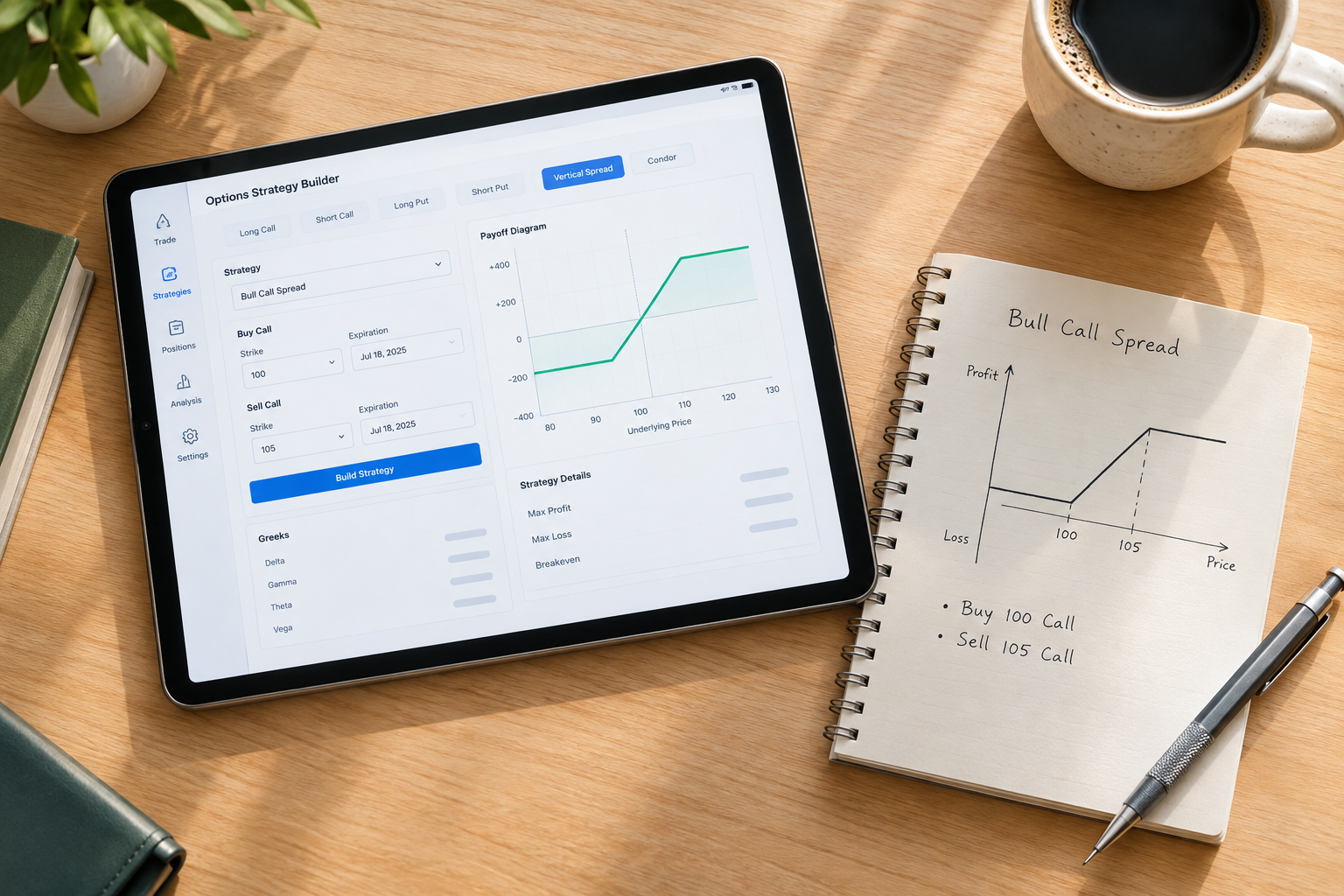
- The order builder. Building multi-leg spreads visually, with live risk graphs updating as you adjust strikes, is faster than typing out legs one at a time on most competing platforms.
- A genuine mid-price fill culture. tastytrade's platform is built around working orders toward the mid of the bid-ask spread rather than accepting the first price shown, which matters more to your real cost than the commission line ever will.
- Platform stability on volatile days. Traders on trading forums have generally reported fewer outages during high volume sessions compared to some competing apps that struggled during past volatility spikes.
- Free education and live onboarding calls. tastytrade built an entire media arm around teaching options mechanics, and new account holders can access onboarding calls at no charge, which matters for anyone asking "is tastytrade good for beginners" before funding an account.
- Backtesting through the desktop platform. Testing a strategy's historical behavior before risking real capital fits directly into the "systems over hacks" approach this brand keeps coming back to.
For traders who lean on options flow data alongside their own strategy building, it's worth comparing what tastytrade's own tools show against a dedicated flow scanner. Our Unusual Whales options flow review and our roundup of the best options flow scanners tested both cover that ground directly.
tastytrade Alpha Score breakdown: 74/100
tastytrade earns a 74 out of 100 Alpha Score, carried by genuinely low tastytrade fees and strong price-to-value, and held back by a real learning curve for anyone new to options. Here's the pillar-by-pillar breakdown, tested rather than assumed.
Execution Quality (14/20): Mid-price fill culture is real and it's a genuine edge, but slippage complaints during choppy tape on lower liquidity names keep this from a top score.
Cost Transparency (16/20): tastytrade publishes its full fee schedule, including the per-leg cap math and pass-through charges, in more detail than most brokers bother to. That's rare, and it's earned.
Price-to-Value (17/20): This is where tastytrade fees genuinely shine. The per-leg cap turns size into a discount instead of a penalty, making it one of the cheapest serious options brokers for anyone trading multi-lot spreads regularly.
Usability (13/20): The platform assumes fluency. Options terminology, order types, and the risk graph interface aren't built for a first-week user, and there's no trailing stop feature, a gap active traders notice quickly.
Community Verdict (14/20): The mobile app rating sits around 4.8 from roughly 13,000 reviews on the Google Play listing. That's a strong number, but it skews the way app store ratings typically do, toward people who already like the product enough to rate it. Broader review platforms like Trustpilot tell a rougher story, with sentiment clustering noticeably lower and complaints concentrated on account service response times rather than pricing. That gap between the app store and the open web is the actual finding here, not either number alone.
Where do tastytrade fees fall short, and who should skip tastytrade?
tastytrade's fee structure is close to best-in-class for active options and futures traders, but the platform itself asks more of a beginner than the pricing page suggests. Low fees don't fix a steep learning curve, and they don't replace features some traders genuinely need.
No trailing stop orders. This is a real gap. Traders who manage risk with a trailing stop on a runner position have to build that logic manually or watch the position actively, which defeats part of the point.
The platform assumes options fluency. New traders asking "is tastytrade good for beginners" should know the honest answer: the pricing is beginner-friendly, the interface is not. Someone who has never built a vertical spread will need to lean on tastytrade's own free education before the order builder stops feeling like a foreign language.
Fill slippage reports, though inconsistent. Traders on options-focused forums have described occasional wider-than-expected fills during fast markets, though this isn't unique to tastytrade and isn't the norm on liquid names.
Who saves the most: active options sellers running multi-lot spreads, futures traders comfortable with a self-directed platform, and anyone who values low cost over hand-holding.
Who should look elsewhere: a true first-time trader who wants training wheels and simple mobile-first design might be better served starting somewhere gentler, then moving to tastytrade once the mechanics click. That's not a knock. It's a trade-off, and naming it clearly beats pretending every broker fits every trader.
Verdict: who actually saves the most with tastytrade fees
tastytrade fees favor one kind of trader clearly: someone running multi-lot options spreads or an active futures book who wants the commission to shrink as size grows, not climb with it. The per-leg cap isn't a marketing line. It's a real structural advantage that a 20-lot iron condor trader will feel every single week, and it's the reason tastytrade keeps showing up near the top of any honest "cheapest options broker" conversation.
The trade-off is just as real. A trader who's never opened a spread, doesn't know what a leg is, and wants a simple mobile app with training wheels will find the fee schedule generous and the interface unforgiving. That's not a flaw to hide. It's a fit question, and naming it clearly is more useful than pretending one broker works for everyone.
Next step: if your account already runs multi-contract spreads, run your last month of trades through the per-leg cap math above and see what you'd have paid elsewhere. If you're still building that process, start smaller, paper trade it first, and only fund tastytrade once the mechanics feel automatic rather than intimidating. Cut the noise, keep the alpha.
One tool, examined in depth here. There are 200+ more AI-driven trading and research tools catalogued in the FullStack Alpha directory, filterable by category, price, and what they actually do.
Browse the directory → aistockpickerapps.com
This article may contain affiliate links. FullStack Alpha may earn a commission if you open an account through a link on this page, at no added cost to you.
References
support.tastytrade - https://support.tastytrade.com/support/s/solutions/articles/43000435233
Pricing - https://tastytrade.com/pricing/
tastytrade - https://tastytrade.com/
Options - https://tastytrade.com/options/
Newsroom - https://tastytrade.com/newsroom/
Press Releases - https://tastytrade.com/newsroom/press-releases/
Futures Options - https://tastytrade.com/futures-options/
Futures - https://tastytrade.com/futures/
Details - https://play.google.com/store/apps/details?id=com.ig.tastyworks.app&hl=en_IN
We test the tools. You get the verdict.
One email a week. What we tested, what scored, and what we'd skip. Written for traders, not for clicks.
Frequently asked
Topics in this teardown
Our verdict on tastytrade
tastytrade was built by options traders for options traders, and it shows.