

Short on time? The Streetbeat Alpha Score scorecard breaks the 59/100 down by pillar, with pricing and the verdict, in about 90 seconds.
See the score
Quick Answer


Key Takeaways
- Streetbeat turns a plain-English theme ("AI and clean energy") into a diversified portfolio with exact tickers and percentage weights shown before you commit a dollar.
- Warren, the AI advisor, answers market questions without an account, so you can test the brain before you hand it your bank login.
- Streetbeat AI is free to download and free to use: the App Store lists no in-app purchases, and the version 2.9.2 release notes say "Streetbeat is now officially free to use." The last publicly reported subscription figure was $14.99/month or $119/year with a 7-day free trial (Wallet Hacks, July 2024). Streetbeat does not publish tiers on its site.
- Fee schedule items that matter: deposits held 9 days, $25 ACAT transfer out, $25 ACH return, $9 international SWIFT withdrawal, 0.50% currency conversion.
- Streetbeat LLC is an SEC-registered investment adviser; brokerage and custody sit with Alpaca Securities. Registration is a legal status, not a quality rating.
- The loudest user complaints are operational, not philosophical: slow withdrawals and slow support.
- There is no published, audited track record. Portfolios are labeled illustrative.
- Streetbeat raised a $15 million Series A in October 2025 and its homepage now leads with enterprise AI for banks and wealth managers. The consumer app lives at streetbeat.com/en/individuals.
- Best fit: a beginner, hands-off, long-term investor who thinks in themes. Worst fit: anyone who trades actively, needs options or charting, or wants fast access to cash.
What Is Streetbeat AI and Who Is It For?
Streetbeat AI is an AI-assisted investing app for people who know what they believe in but not which tickers express that belief. You type a theme. It builds a portfolio. It keeps the weights in line over time.
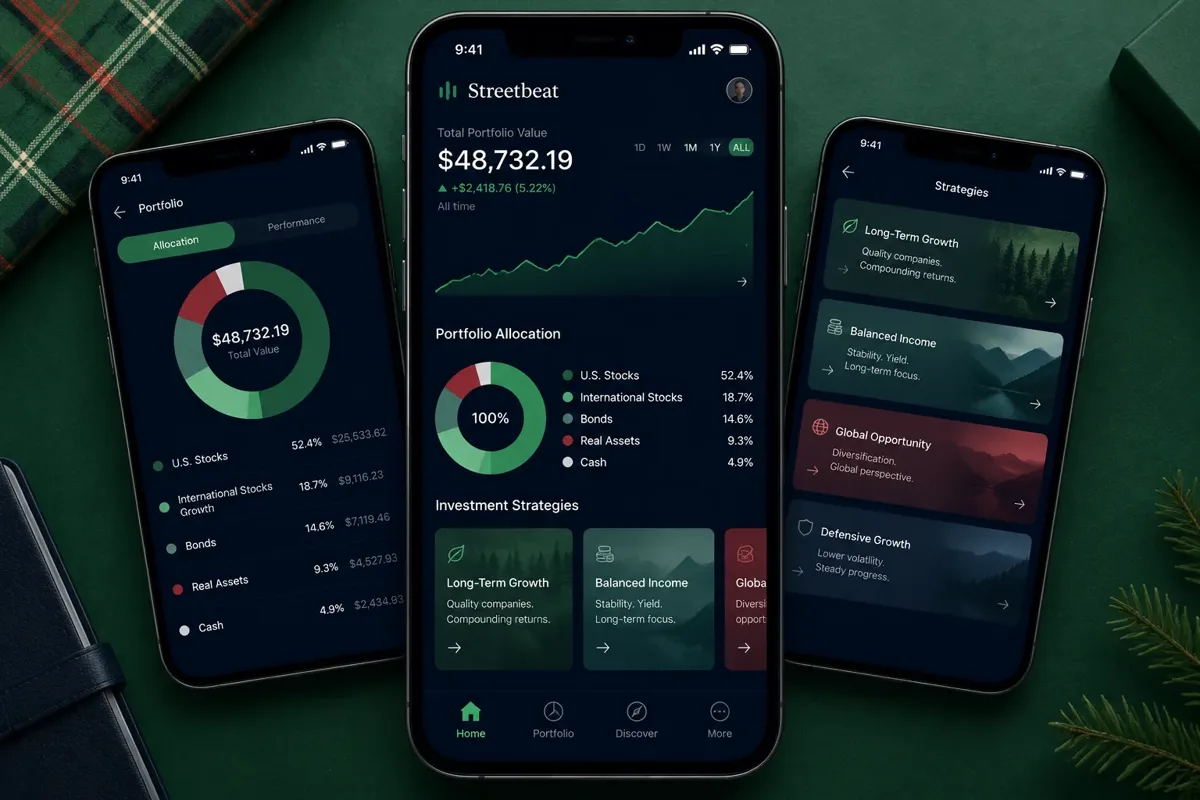
The company behind it is Streetbeat LLC, registered with the SEC as an investment adviser under CRD #315893. Your brokerage account and your securities don't live at Streetbeat; they live at Alpaca Securities, which handles clearing and custody. (Alpaca also runs a popular trading API; our sister site explains it in Alpaca API for beginners.) That split matters. The app is the interface and the adviser. The broker is the vault.
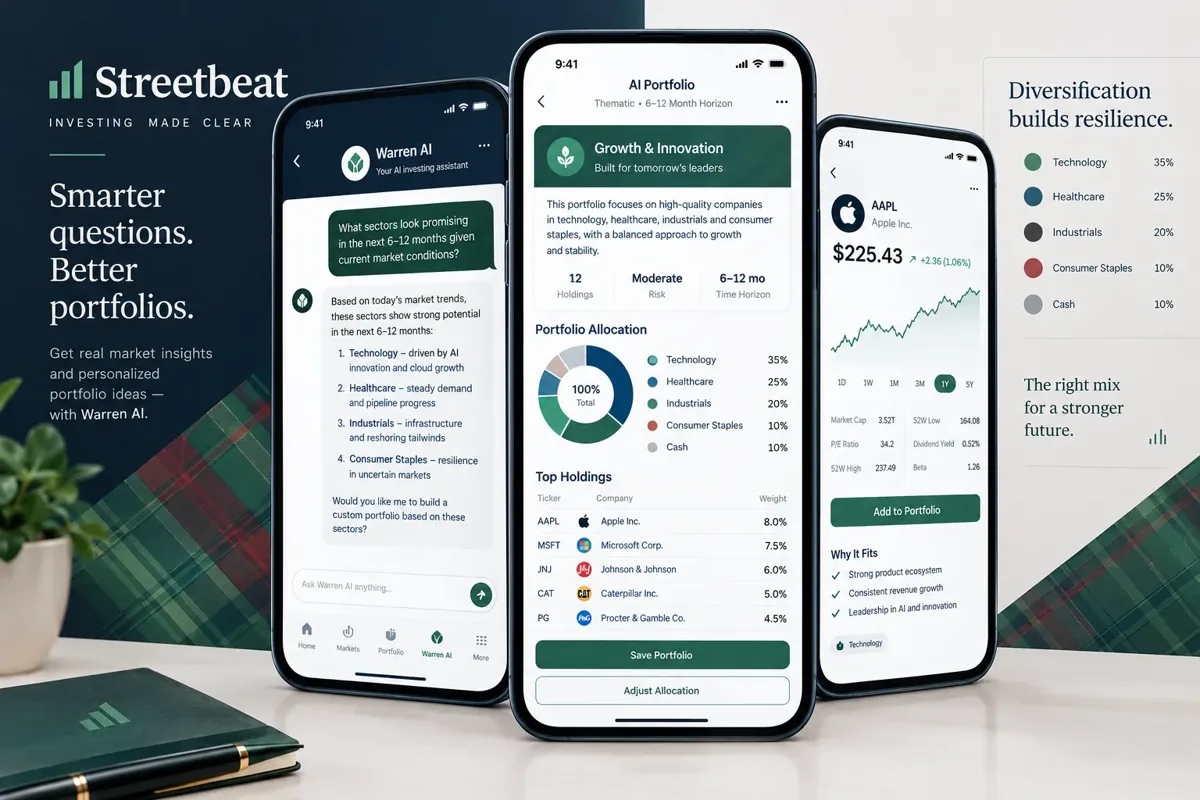
The feature doing the marketing work is Warren, the AI investment advisor. Ask it why semiconductor stocks moved last week and it answers in plain English, no jargon tax, no account required. That last part is unusual and it's the single most reader-friendly decision Streetbeat made. Most fintech apps make you hand over a Social Security number before you can see whether the product is any good.
Streetbeat AI investing is built for one specific person: the thematic beginner.
That's the investor who can tell you with confidence that artificial intelligence, defense, or clean energy will matter over the next decade, and who has no interest in spending four Saturdays learning how to read a 10-K to figure out which five companies to own. Streetbeat compresses that gap into a sentence.
Who it isn't for: active traders. There's no options chain, no charting package, no scanner, no hotkeys. If you want price action tools and a watchlist you babysit during power hour, you're in the wrong store. Look at AI trading platforms or AI options tools instead.
Decision rule: if your investing horizon is measured in years and your research appetite is measured in minutes, Streetbeat is aimed squarely at you. If either of those is reversed, keep walking.
What Problem Does Streetbeat Solve?
Streetbeat AI solves the blank-page problem: the gap between having an investing idea and owning anything that expresses it. For a beginner, that gap is where most good intentions die.
One Reddit commenter described the beginner's version of this perfectly: "staring at investment terms that might as well have been written in another language" ( r/investingforbeginners).
Think about how this normally goes. You decide clean energy is worth owning. Then you open a brokerage app and face 8,000 tickers, a dozen overlapping ETFs with names that all sound identical, and no idea whether a 40% position in one solar name is bold or stupid. So you buy nothing. Or worse, you buy the one stock your cousin mentioned at Thanksgiving and call it a portfolio.
That's analysis paralysis, and it's not an information problem. It's a translation problem.
Streetbeat's answer is to do the translation out loud. You write one line. Warren returns a basket with names and weights you can read before any money moves. You can see that it put 12% here and 7% there, and you can disagree with it. Visibility is the point. Plenty of robo-advisors hand you a risk score and a pie chart and never show you what you actually own until the statement arrives.
The second problem it addresses is drift. Portfolios rot. If one holding runs 60% and another falls 20%, your careful 10% positions quietly become a 19% bet and a 6% afterthought. Streetbeat rebalances automatically, which is the least glamorous and most useful thing an automated adviser does for a hands-off investor.
The honest framing: Streetbeat AI removes the excuse for not starting, not the risk of being wrong. A diversified basket of AI stocks is still a concentrated bet on one theme. Diversified within a theme is not the same as diversified, period. Nobody at Streetbeat is promising otherwise, but the marketing leans on the word "diversified" hard enough that a beginner could misread it.
Common mistake to avoid: treating a thematic Streetbeat portfolio as your core holding. It's a satellite. Themes rotate, and a basket built around one narrative can underperform a plain broad-market fund for years. Size it like the concentrated position it is.
What Do Real Users Say About Streetbeat?
The public conversation around Streetbeat AI is thin, and where it exists, it splits along a clear line: people mostly like the product and repeatedly complain about the plumbing.
Coverage check: Apple App Store 4.6 from 630 ratings, Google Play 3.7 from 2,030 reviews, Trustpilot 3.4 from 65 reviews (the profile is titled "Old Streetbeat Beta App"), and no G2 listing. Reddit chatter is mostly referral links, which we exclude.
Here is what users actually wrote, quoted exactly:
"This app has saved me a lot of time on market analysis." Apple App Store
"I created my own portfolio using the AI creator." Trustpilot
"The registration only takes a few minutes, but once inside, the app proves to be intuitive and easy to use." Trustpilot
"This app appears to have promise, but falls dramatically short." Apple App Store
If you are hunting for Streetbeat reviews and complaints, the recurring themes are slow withdrawals and slow customer support response times. Any honest Streetbeat app review has to start there. Those two tend to travel together, because the moment a withdrawal stalls is exactly the moment a user emails support, and a slow reply turns an annoyance into a trust event.
That gap is the finding. A tool whose investing features draw praise while its money-movement features draw complaints is telling you something specific about where the company spent its engineering budget. The AI is the storefront. The back office is where the friction lives.
How to read app store ratings on a product like this. App Store and Google Play prompts tend to fire after a good moment, like a successful login or a nice portfolio day, which inflates scores. Reddit and complaint boards skew the other way because satisfied users rarely post. Read them against each other. When positive reviews praise the AI and negative reviews describe operations, both can be accurate at once.
Also, public discussion volume is genuinely low. Search Streetbeat Reddit threads and you mostly find referral links; Streetbeat doesn't have the Reddit thread density that a 

Where users and our Alpha Score agree: usability is the high point and money movement is the low point. Where they split: the App Store reads far happier than Trustpilot, which matches the rating-prompt bias above.
Practical takeaway: before you move real size with Streetbeat AI, run a full round trip. Deposit a small amount, let it settle, buy something, sell it, and withdraw. Time every step. That single test tells you more about Streetbeat than every review you'll read, including this one.
How Much Does Streetbeat Cost?
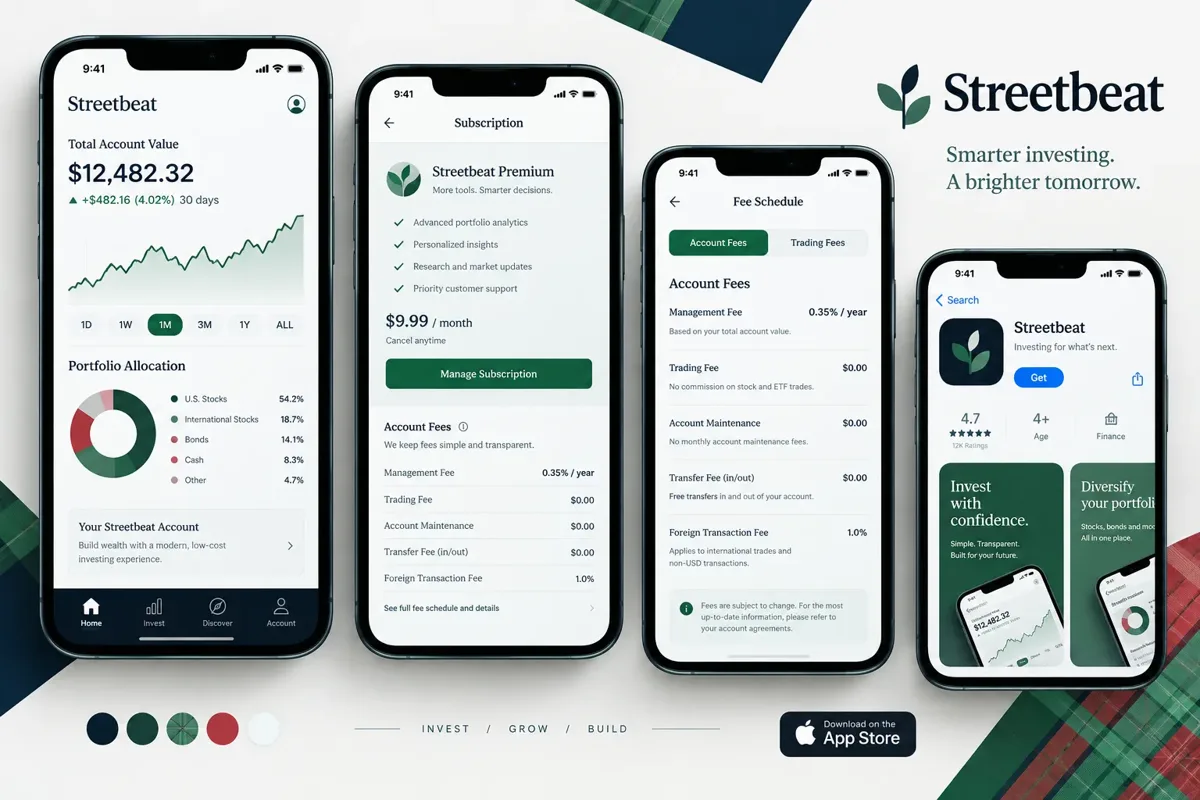
Streetbeat AI is free to download and free to use: the Apple App Store lists it as Free with no in-app purchases, and the version 2.9.2 release notes say "Streetbeat is now officially free to use." Streetbeat's own website does not publish subscription tiers or monthly and annual prices. It points you to a fee schedule or to support for account-specific fees.
That is an unusual choice for a consumer fintech product, and it's worth saying plainly: a company that won't publish its price on its own site is asking you to trust it before it trusts you.
The last publicly reported figure came from Wallet Hacks in July 2024: $14.99 a month or $119 a year, with a 7-day free trial. Treat that as historical, not current. Prices change, and a 2024 number quoted in 2026 is a data point, not a quote.
What Streetbeat does publish is a fee schedule, and these are the line items that actually affect you:
| Item | What it costs | Why it matters |
|---|---|---|
| Deposit hold | 9 days | Your cash is parked and not invested for over a week |
| ACAT transfer out | $25 | Moving your account to another broker isn't free |
| ACH return | $25 | A bounced transfer is a real charge, not a warning |
| International SWIFT withdrawal | $9 | Relevant for non-US users |
| Currency conversion | 0.50% | On a $10,000 conversion, that's $50 |
Hunting for a lower price? Check our AI stock tool deals page.
Other fees may apply, per Streetbeat's disclosure library. Read the full fee schedule before funding.
The 9-day deposit hold deserves its own paragraph. Holds exist to protect the broker against ACH reversals, and they're common across the industry, but nine days is on the long end. For a long-term investor, nine days of idle cash is a rounding error. For anyone who wants to put money to work on a specific week, it's a dealbreaker. Know which one you are.
Decision rule on cost: if the subscription is genuinely free right now, the math is easy and the real cost is the fee schedule plus whatever the price becomes later. If a subscription returns at roughly $15 a month, that's $180 a year, and on a $3,000 account that's a 6% annual drag before the market does anything. Small accounts get eaten alive by flat fees. Below roughly $10,000, a flat monthly subscription needs to earn its keep hard.
What Should You Watch Out For With Streetbeat?
Four things, in order of how much they should affect your decision.
1. No published performance track record. Streetbeat AI labels its portfolios illustrative. There's no audited live record showing how a Warren-generated AI-and-clean-energy basket actually performed over a full cycle. That's not fraud, it's just absence, and absence is a legitimate reason to size your position smaller. Judge the tool on its process and its disclosures, not on a number it hasn't published.
2. Streetbeat withdrawal and support friction. Covered above, and it's the complaint that shows up most. If your money is going to be hard to get back quickly, you need to know that before you need it quickly.
3. The strategic pivot. Streetbeat raised a $15 million Series A in October 2025, and its homepage now leads with enterprise AI for banks and wealth managers. The consumer app has been moved to streetbeat.com/en/individuals. Read that the way you'd read any product-line demotion. It doesn't mean the app is being shut down. It does mean the consumer product may no longer be where the roadmap, the headcount, and the support budget go first. That wasn't on my bingo card for a consumer-first AI investing app, but B2B is where fintech margins live.
4. AI output risk. Warren is a language-model-driven advisor. Language models produce confident, fluent answers regardless of whether they're right. A portfolio that reads coherent isn't the same as a portfolio that's been stress-tested. Check the holdings yourself. If Warren hands you a "clean energy" basket with 30% in a single thinly traded name, that's a concentration problem no amount of plain-English explanation fixes.
Edge case worth naming: themed portfolios built from a sentence can quietly overlap. Ask for "AI" and "semiconductors" as two separate portfolios and you may end up owning Nvidia twice at a combined weight you never intended. Nothing in a one-sentence prompt prevents that. You have to look.

What Should You Know Before You Fund Streetbeat?
Before any money moves, work through this checklist. It takes twenty minutes and it's the difference between an informed decision and a vibe.
- Verify the registrations yourself. Look up Streetbeat LLC, CRD #315893, on the SEC's adviser search at adviserinfo.sec.gov, and check Alpaca Securities on FINRA BrokerCheck. Read the Form ADV Part 2A. It's dry, it's free, and it tells you how the adviser gets paid and what conflicts it discloses.
- Confirm the current price in-app. Don't rely on a 2024 third-party figure, including the one in this review. Open the app, find the subscription screen, screenshot it.
- Read the fee schedule end to end. Specifically the deposit hold, the transfer-out charge and the currency conversion fee.
- Understand what SIPC does and doesn't cover. SIPC protection at the custodian covers failure of the brokerage to return your securities and cash, up to limits. It does not cover market losses. If your AI basket drops 25%, that's the market, and no insurance applies.
- Run the small-deposit round trip. Fund $100. Wait out the hold. Buy. Sell. Withdraw. Time it.
- Decide your allocation before you look at a portfolio. Thematic baskets are persuasive. Write the number down first so the story doesn't talk you into a bigger position than you meant.
- Check your tax situation. Automatic rebalancing in a taxable account creates taxable events. In an IRA it doesn't. That difference compounds over a decade.
The one mistake I'd most want to prevent: funding the account with money you need inside six months. Between a 9-day deposit hold and reported withdrawal delays, Streetbeat is not a place for short-horizon cash. Long-term money only.
Streetbeat Pros and Cons
What we love
- Warren works before you open an account. You can interrogate the AI on market questions with no signup. That's a rare, user-respecting decision and it lets you judge the quality of the explanations before handing over personal data.
- One sentence to a real portfolio. Describe a theme, get a diversified basket. For a beginner staring at a blank screen, this is the single highest-value feature in the product.
- Exact tickers and weights shown up front. You see what you'd own before you own it. Transparency at the holdings level is more than several competing robo products offer.
- Automatic rebalancing. Boring, unglamorous, and the thing that actually keeps a hands-off portfolio behaving like the portfolio you designed.
- Proper regulatory structure. SEC-registered adviser, separate broker-dealer custodian in Alpaca Securities. The architecture is the one you want.
- Themed strategy portfolios. Pre-built concepts like Congress Buys give you something to study even if you never fund them.
What could be better
- Slow withdrawals and slow support. The most repeated complaint, and the one that does the most damage to trust.
- Nine-day deposit holds and a $25 transfer-out fee. Easy money in, expensive and slow money out. That asymmetry always deserves scrutiny.
- No published subscription pricing on the company's own site. Pointing users to "contact support for account-specific fees" is a consumer-unfriendly choice for a consumer app.
- No published performance record. Portfolios labeled illustrative means you're buying a process, not a proven result.
- Consumer app appears deprioritized after the October 2025 Series A and the enterprise pivot on the homepage.
- Thin public review volume, which limits how much outside corroboration exists in either direction.
How Does Streetbeat Compare to Magnifi, Prospero AI and Public?
Streetbeat's differentiator is portfolio construction from natural language. 

| Core job | Who it suits | Key trade-off | |
|---|---|---|---|
| Streetbeat | Turns a one-sentence theme into a diversified portfolio with visible weights, then rebalances it | Hands-off thematic beginners | Operational friction on withdrawals and support; no published track record |
| Magnifi | Conversational search and discovery across funds and stocks, plus portfolio insights | People who want to find and compare investments by asking questions | Discovery-first, less about hands-off automated management |
| Prospero AI | AI-generated signals and scores on individual stocks | Self-directed investors who still pick their own names | Gives you signals, not a managed portfolio. You do the work |
| Public | A full-featured brokerage with investing across asset classes and social and AI-assisted research layers | Investors who want one brokerage account and broad access | Not a one-sentence portfolio builder; you still assemble the portfolio |
The decision rule, written plainly:
- Choose Streetbeat if you want someone else to construct and maintain a themed portfolio and you want to see the holdings before you buy.
- Choose Magnifi if your problem is finding and comparing investments, not building and maintaining a basket.
- Choose Prospero AI if you already pick individual stocks and want AI scoring layered onto your own process.
- Choose Public if your problem is actually "I need a decent brokerage account" and the AI features are a bonus.
If you want the full field rather than four options, the alternatives directory catalogs the category by price and use case.
One structural note: Streetbeat's custody sits at Alpaca, which also powers plenty of other apps. The investing engine you're buying is the Streetbeat adviser layer, not the broker underneath it. Don't confuse the two when you're comparing.

What Are Our 5 Favorite Streetbeat Features?
1. Warren, the no-account AI advisor
Ask it why energy stocks sold off, what a sector ETF actually holds, or what rebalancing means, and you get a plain-English answer without a signup wall. For a beginner, the educational value here is genuine, and the fact that it's gated behind nothing is the most consumer-friendly thing Streetbeat does. Use it as a free tutor even if you never fund an account.
2. One-sentence portfolio generation
Type "AI and clean energy with moderate risk" and get back a structured basket. The craft here isn't the language model, it's the constraint layer: diversification rules, weight caps, instrument selection. You're trusting that layer. Test it by asking for the same theme twice and seeing whether the output is stable. Wildly different baskets from the same prompt means the constraints are loose.
3. Visible tickers and weights pre-investment
This is the feature that separates Streetbeat from a black box. You see a full holdings list with percentage allocations before any trade executes. It also gives you a free exercise: take the ticker list, paste it into any free portfolio tracker, and you've got a benchmark to watch for 30 days without spending a dollar. Paper trade it first.
4. Automatic rebalancing
Hands-off investors don't rebalance. They mean to, then life happens, and three years later one winner is half the account. Automation solves a behavioral problem, not a math problem. If you want rules that also place trades for you, our sister site covers the fully automated AI trading app route. Keep the tax consequence in mind in a taxable account.
5. Themed strategy portfolios like Congress Buys
Pre-built concept portfolios are useful as reading material even if you don't buy them. Congress Buys, which tracks a disclosed-trading theme, is the kind of idea that's hard to assemble yourself and easy to understand. Treat these as idea generators with a hard allocation cap, not as a core strategy.
Streetbeat Alpha Score
Full Stack Alpha scores tools out of 100 across five pillars worth 20 points each: Signal Quality, Transparency, Price-to-Value, Usability, and Community Verdict. No stars, because one number hides why a tool is good or bad.
Streetbeat Alpha Score: 59 / 100
| Pillar | Score |
|---|---|
| Signal Quality | 11 / 20 |
| Transparency | 13 / 20 |
| Price-to-Value | 11 / 20 |
| Usability | 15 / 20 |
| Community Verdict | 9 / 20 |
The score comes from FullStack Alpha desk research plus public user sentiment, and the pillar split is provisional. See the full Streetbeat Alpha Score breakdown. Here is what drives each pillar.
Signal Quality. Mixed and unverifiable. The portfolio construction visibly works and produces reasonable baskets, but there's no published, audited live performance record and the portfolios are labeled illustrative. You can evaluate the output's structure. You cannot evaluate its results.
Transparency. Split. Strong on holdings: exact tickers and weights before you invest is better disclosure than most automated advisers offer. Weak on commercials: a consumer app that doesn't publish its subscription price on its own website, and instead directs users to support for account-specific fees, is withholding the single most basic piece of information a buyer needs.
Price-to-Value. Currently favorable if the app is genuinely free to use, which the latest App Store release notes indicate. The uncertainty is the problem. A price you can't confirm is a price you can't budget for, and the fee schedule items (9-day hold, $25 to leave) carry real cost.
Usability. The strongest pillar. Time to first useful output is close to instant, Warren works pre-account, and the mobile-first design fits the target user exactly. This is a well-built app.
Community Verdict. Weak. Public discussion volume is thin, and the recurring themes that do exist center on slow withdrawals and slow support. Thin plus operationally critical is a low combination, and no amount of good UI design offsets a user who can't get their money out on schedule.
Full methodology lives on our how we test page.
Is Streetbeat Worth It? Our Final Verdict
Streetbeat AI is worth a small, deliberate test if you're a beginner, hands-off, long-term investor who thinks in themes. It is not worth a large allocation until you've personally verified the withdrawal timeline and the current subscription price.
The product idea is the best part of it. Turning "AI and clean energy" into a diversified basket with visible weights solves a real problem that keeps beginners out of the market entirely. Warren being free and account-free is a genuine act of good faith. The regulatory structure, SEC-registered adviser with brokerage custody at Alpaca Securities, is the right architecture rather than a workaround.
The catches are not philosophical. They're operational, and operational problems are the ones that cost you at the worst possible moment. Nine-day deposit holds. $25 to transfer your account out. Repeated complaints about slow withdrawals and slow support. A subscription price the company won't publish. No live track record. And a homepage that now sells enterprise AI to banks while the consumer app sits at a subdirectory.
Here's the position I'll defend: Streetbeat AI is a good first portfolio builder and a questionable place to park serious money until it fixes the back office.
The fix is specific and it's on them: publish the subscription price on the website, shorten the deposit hold, and get withdrawals to the two-to-three-day range the rest of the industry runs. Do those three things and this becomes an easy recommendation.
What you should do today, in order:
- Download the app and spend 30 minutes with Warren. Free, no account, zero risk.
- Generate two or three themed portfolios and screenshot the tickers and weights.
- Track those tickers in a free tracker for 30 days without funding anything.
- If the output holds up, fund $100 and run a complete deposit-buy-sell-withdraw cycle. Time every step.
- Only then decide on a real allocation, and cap any single theme at a slice you'd be fine seeing fall 30%.
That's five steps, four of which cost nothing. A tool with no published track record earns your money in increments, not in one deposit. Discipline beats prediction.
Related reading
- All AI stock tools, catalogued
- AI trading platforms compared
- Alpaca, the broker behind Streetbeat's custody
Not sure a one-sentence portfolio is enough for you? We sorted 200+ AI stock tools by strategy, price and what they actually do, including the robo-advisors Streetbeat competes with. See the robo-advisor shortlist: aistockpickerapps.com/robo-advisors
Sources
- Streetbeat official site and fee schedule, streetbeat.com (accessed 2026)
- Wallet Hacks, Streetbeat subscription pricing, July 2024
- SEC Investment Adviser Public Disclosure, Streetbeat LLC, CRD #315893, adviserinfo.sec.gov
- FINRA BrokerCheck, Alpaca Securities, brokercheck.finra.org
- Apple App Store listing and release notes, Streetbeat
- Trustpilot, Streetbeat profile
This is education, not financial advice.
Your market edge starts with the right tool. Stay alpha.
Some links on this page may be affiliate links. Scores and verdicts are never influenced by them.
Prices are subject to change as fast as AI technology.
We test the tools. You get the verdict.
One email a week. What we tested, what scored, and what we'd skip. Written for traders, not for clicks.
Frequently asked
Topics in this teardown
Our verdict on Streetbeat
Streetbeat scores 59, and usability leads at 15.