

Short on time? The OVTLYR Alpha Score scorecard breaks the 65/100 down by pillar, with pricing and the verdict, in about 90 seconds.
See the scoreQuick Answer

Key Takeaways
- OVTLYR is a signal and research platform, not a broker and not an auto-trading bot. You still click the button. Brokerage access is available through Tradier.
- The core idea: three filters must agree before you buy. Stock in an uptrend, sector showing strength, and greed rising with an active buy signal.
- The published plans include an aggressive options plan (Plan M), a defensive ETF plan, and an explicit rule to park in a Treasury ETF when nothing qualifies.
- Pricing is $69/month with a 14-day free trial, or $299/year billed up front against a listed $828 value. Plans auto-renew.
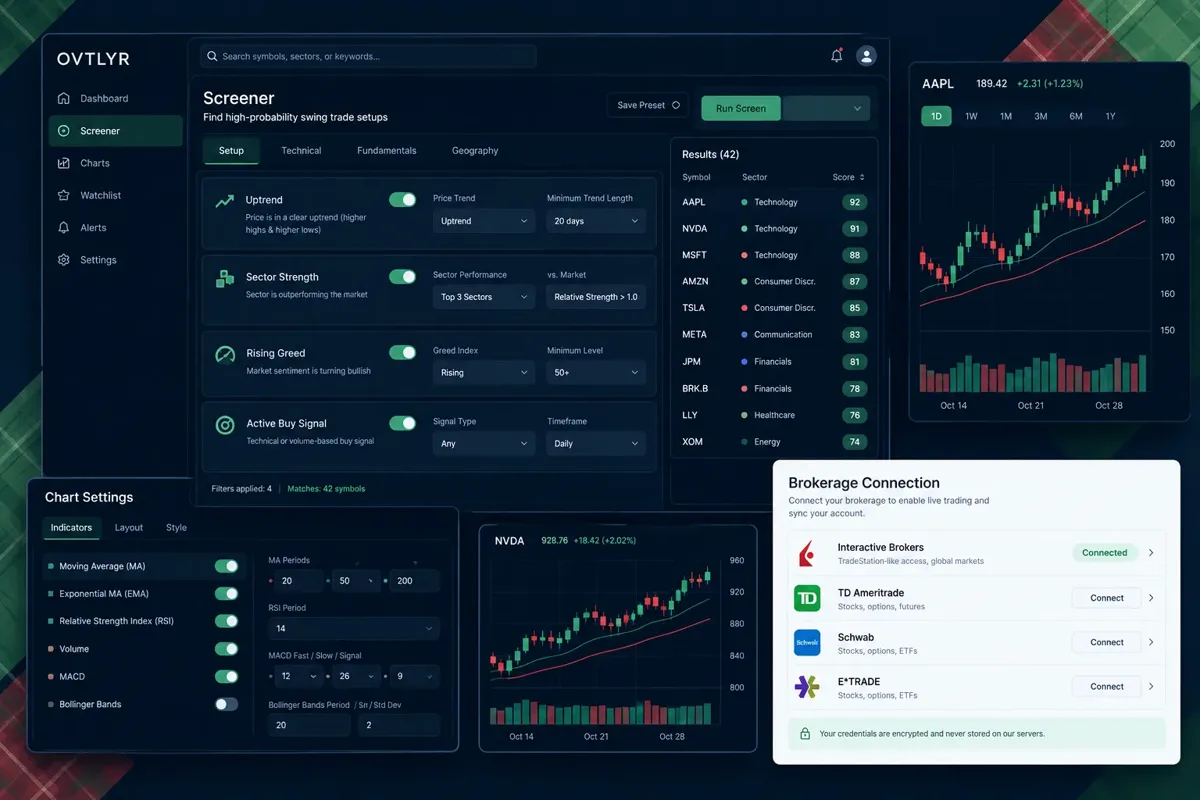
- The screener is the time saver. It pre-filters for uptrend, sector strength, rising greed and an active signal, which turns a daily chart grind into a 15-minute review.
- Real weakness: no mobile app, no coverage for stocks lacking years of price history, and backtests are the vendor's own.
- Social proof is thin. There's Reddit chatter and YouTube content, but no Trustpilot or G2 footprint to cross-check against.
- Wrong fit for day traders, scalpers, futures traders and fundamental investors.
What is OVTLYR trading and who is it for?
OVTLYR trading runs on a subscription web platform that turns behavioral data, specifically crowd fear and greed, into buy and sell signals for swing traders holding positions days to weeks. It's built for someone with a job, a brokerage account, and about 20 minutes a night.
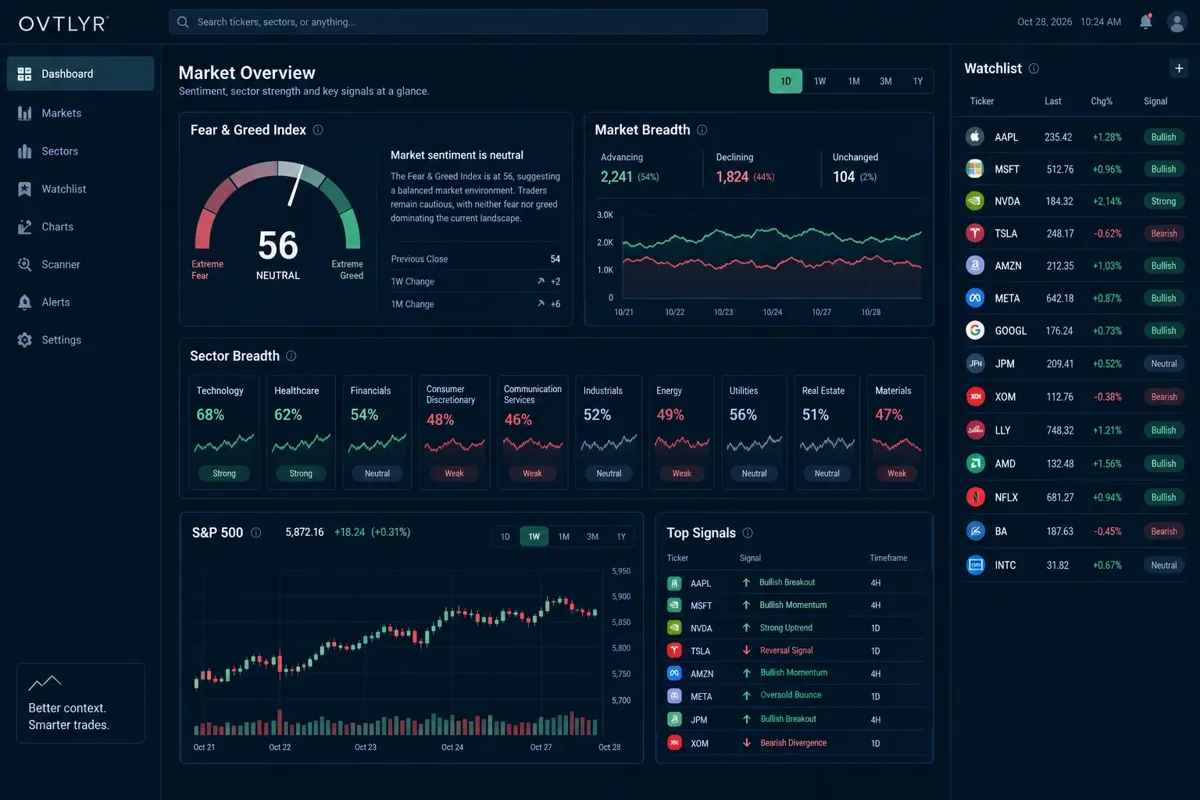
Most trading software is built on the assumption that you want more. More indicators, more alerts, more tickers, more screens. OVTLYR is built on the opposite assumption: that you already have too much, and what you're missing is a filter strict enough to say no.
The OVTLYR strategy works in three layers:
- Market level. Is the broad market in a state where buying tends to work? The breadth dashboard counts how many stocks are in uptrends, broken out by sector. Breadth is just participation. A rally where 70% of stocks are rising is structurally different from one where eight megacaps are carrying the index.
- Sector level. Within a healthy market, which sectors are actually leading? Buying a decent stock in a sinking sector is like being the best swimmer tied to an anchor.
- Stock level. Is this specific name in an uptrend, with sentiment turning from fear toward greed, and an active buy signal on the chart?
All three have to agree. That's the whole thesis. Most of the time, they don't, and the honest answer is cash.
Who it fits: a swing trader or options buyer, beginner to intermediate, account anywhere from $2,000 to six figures, who wants rules instead of vibes and doesn't have the schedule to day trade.
Decision rule: if your main problem is "I don't know what to buy," OVTLYR helps. If your main problem is "I buy too much," OVTLYR helps more. If your problem is execution speed on one-minute charts, OVTLYR trading is the wrong tool entirely.
What problem does OVTLYR solve?
It solves overtrading, which is the most expensive and least discussed problem in retail trading. The fix isn't a better entry. It's fewer entries.
Here's the pattern almost every self-directed trader runs: you watch the market all week, you feel like you should be doing something, and by Thursday you're in three positions you can't defend. None of them came from a plan. They came from boredom and a green candle. That's FOMO wearing a trade ticket.
One options trader on Reddit summed up the old way in a single line:
"I just guessed a number (mostly long calls) and guessed an expiry date."
r/options
That is how a lot of options accounts die: no setup, no exit, just a strike and a hope. OVTLYR attacks that in two specific ways.
It replaces opinion with a count. The breadth dashboard doesn't care how you feel about the Fed. It counts stocks in uptrends by sector. When that number is collapsing across the board, the platform isn't going to hand you a long list of ideas to make you feel busy.
It publishes the sit-out rule in writing. This is the part that matters. Plenty of educators say "don't force trades." Fewer encode it as a rule with a destination: when nothing qualifies, you hold a Treasury ETF and collect yield while the tape chops. That's a position, not a failure. Treasury ETFs are funds holding short-term government debt, used here as a parking spot, not an investment thesis.
The practical takeaway: most traders don't need a better edge, they need fewer at-bats. The value of OVTLYR trading isn't the signals it gives you. It's the 200 signals it doesn't.
There's a cost to this, and I'll name it plainly in the warnings section: a system that keeps you out will keep you out during stretches you'll later wish you'd traded. Both sides of that are real.
How does the OVTLYR system actually work day to day?
The daily OVTLYR trading workflow is short by design: check the market gauge, check sector strength, run the pre-filtered screener, size the position, place the order. Twenty minutes, usually after the close or before the open.
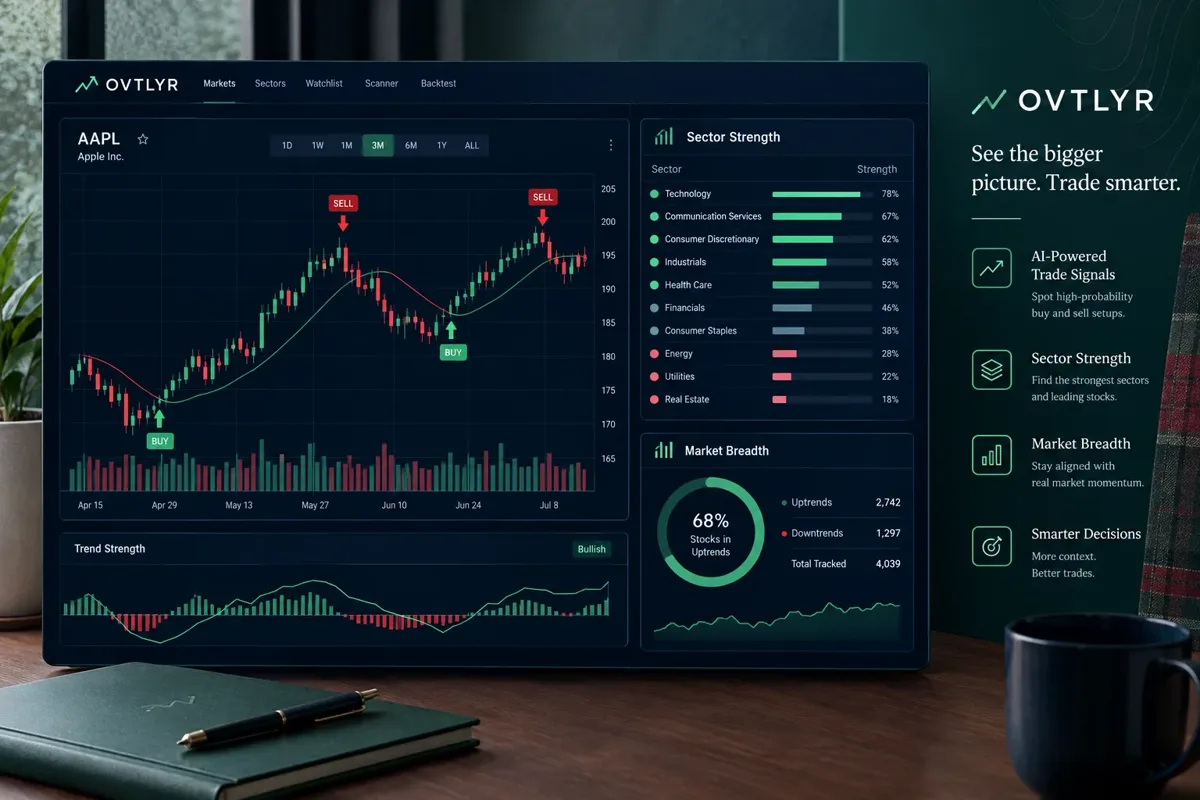
Walk through a realistic evening:
Step 1. Market check. Open the OVTLYR dashboard. Is broad breadth expanding or contracting? If the market-level read is deep in fear and breadth is falling, you're probably done in four minutes. That's a feature.
Step 2. Sector check. Assume breadth is fine. Now you look at which sectors have the highest share of stocks in uptrends. You're hunting inside the two or three strongest, ignoring the rest. The trend is your friend applies at the sector level before it applies at the ticker level.
Step 3. Screener. The screener is pre-filtered. It's looking for names that are in an uptrend, sitting in a strong sector, with greed rising and an active buy signal. You're not building a 14-criteria scan from scratch. You're reviewing a short list that already passed the gate.
Step 4. The setup check. Look at the chart yourself. Is it basing (consolidating quietly before a move) or already overextended, meaning it's run so far from its moving average that the risk-reward is ugly? Signals don't excuse you from reading price action.
Step 5. Size and exit. Decide your position size and your stop loss, the price where you admit you're wrong and get out, before you enter. Not after.
Common mistake: taking the signal and skipping steps 4 and 5. A buy signal with no stop isn't a trade, it's a hope. The platform gives you entries and exit signals. Risk management is still your job, and no software can hand that to you.
Edge case worth knowing: names without years of price history don't get covered. Recent IPOs and newly listed names fall outside the dataset because the behavioral model needs history to calibrate. If your strategy leans on fresh listings, OVTLYR will simply be blind there.
What do real users say about OVTLYR?
Public sentiment on OVTLYR is thin and mixed, and that's the honest finding. Search for OVTLYR reviews and complaints and you mostly land on Reddit threads and YouTube. Coverage check: Trustpilot 0 reviews, G2 0 reviews, and no App Store or Google Play app to rate.
That matters more than it sounds. Our scoring framework reads six review sources against each other precisely because each has a different bias. Reddit skews negative because people post when they're annoyed. G2 and Capterra skew positive because vendors solicit. Trustpilot is complaint-heavy and great for billing and cancellation issues. When several of those sources are empty, you can't triangulate. You're left with the vendor's own material and a self-selected community.
Here is what members actually say, quoted exactly:
"It is not a get rich quick scheme." 14-month subscriber,
"It makes trading easy for people like me who have a full time job and have no time to go through charts everyday." Second-year member,
"Its really good for new traders, my main issue is that its alot of work for the return you get" Former member,
"For only $300 a year, it is well worth it." Viewer comment on an independent OVTLYR review on YouTube
Where users and our Alpha Score agree: the price is fair and the method suits busy traders. Where they split: some members credit it with teaching them to trade a plan, others call the returns too small for the effort.
What else you can observe:
- The free content is substantial. OVTLYR University runs free on YouTube, and daily live trading sessions mean the methodology is on display in public rather than locked behind a paywall. That's a transparency point in its favor. Educators who hide the method usually hide it for a reason.
- The OVTLYR Discord is active, which helps with the loneliest part of swing trading: sitting on your hands.
- Member results are mixed. Some traders describe the system clicking. Others describe frustration with flat stretches. Both are consistent with how trend-following behaves.
- Backtests are vendor-produced. Treat any win-rate or return figure from OVTLYR as vendor-claimed until a third party audits it. That's not an accusation. It's the standard that should apply to every tool in this category, including the ones with glossier marketing.
The practical takeaway: don't buy on community sentiment here, because there isn't enough of it to buy on. Buy on whether the method makes sense to you after watching the free material, then verify with the trial.
How much does OVTLYR cost?
The OVTLYR price is $69 per month plus tax, or $299 per year plus tax on the annual pass, which works out to about $24.92 a month. A 14-day free trial with full access to the Elite feature set is available on the monthly path. Annual plans are billed immediately and skip the trial. All plans auto-renew.
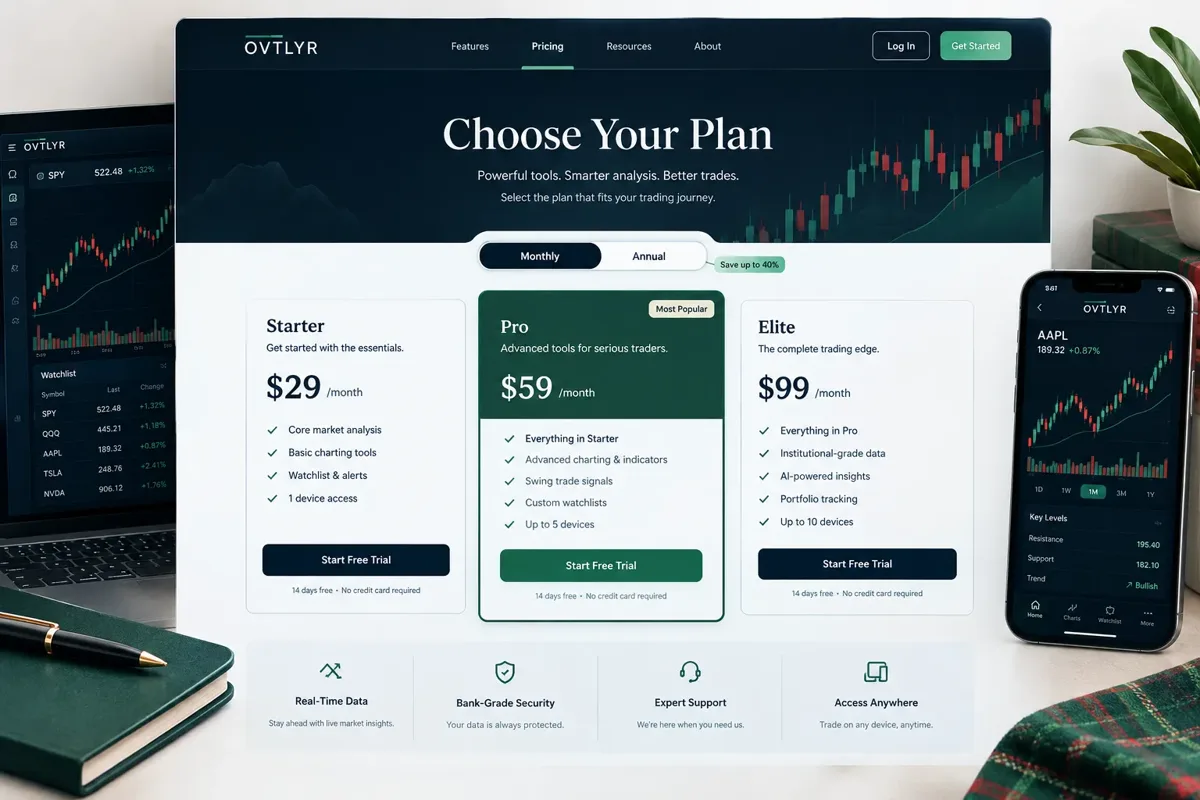
| Plan | Price | Trial | Billing | Effective monthly |
|---|---|---|---|---|
| OVTLYR Monthly | $69/mo + tax | 14-day free trial, full Elite access | Charged after the trial, auto-renews | $69 |
| OVTLYR Annual Pass | $299/yr + tax | No trial | Billed immediately, auto-renews | ~$24.92 |
Hunting for a lower price? Check our AI stock tool deals page.
The annual pass is marketed against a listed value of $828 (12 months at $69) and described as a limited-time offer. Do the math yourself: $828 minus $299 is a $529 difference, which is real money if you're going to use it for a year.
The trade-off is simple and worth being deliberate about. Monthly gets you a trial but costs 2.8 times more per month. Annual is cheaper but you're paying up front with no trial period, which means you're committing before you've clicked a single signal.
Choose monthly if you've never used behavioral or sentiment-based signals and you want to see whether the sit-out discipline matches your temperament.
Choose annual if you've already watched a meaningful chunk of OVTLYR University, understand the three-filter logic, and know you'll still be swing trading next summer.
Mistake to avoid: buying the annual pass during a strong bull run because every signal is working. Trend systems, OVTLYR trading included, look brilliant in trends. The year you need to judge them on is the sideways one.
A note on auto-renewal: both plans renew automatically. If you're the type who forgets, put a calendar reminder two days before the renewal date the moment you subscribe. That's a 30-second habit that prevents the most common complaint in all of SaaS.
What should you watch out for with OVTLYR?
Four things, and the first one is the one that makes people quit.
1. Long stretches with no trades. When markets chop sideways, the three filters rarely agree, and the system tells you to sit. For a trader who signed up for OVTLYR trading specifically to trade more, paying $69 a month to be told "not today" feels absurd. It's also the point. But feelings don't care about logic, and this is where most cancellations happen. If you can't sit still, this tool will annoy you into leaving right before it would have helped you most.
2. The backtests are the vendor's own. No independent audit. Self-reported historical performance in this industry has a well-documented habit of being optimistic, which is why the SEC's marketing rule for investment advisers tightened requirements around hypothetical performance presentations. Read any OVTLYR performance figure as vendor-claimed and verify behavior yourself in the trial.
3. Coverage gaps. Stocks without enough price history aren't covered. Small, newly listed and low-float names (low float means few shares actually available to trade, which makes price moves violent) may fall outside the model. If your watchlist lives there, half your universe will be dark.
4. No mobile app. It's web-based. You can open it in a phone browser, but there's no native app and no push alert tapping you on the shoulder at 2:15 pm. For an end-of-day swing system this is a modest problem. For anyone wanting intraday reactivity, it's disqualifying.
One more thing that isn't a flaw but gets misread as one: OVTLYR doesn't execute trades for you. Brokerage access runs through Tradier, but you're the one placing orders. That's a design choice, and the right one for a tool teaching discipline. Automation that fires while you're in a meeting also teaches you nothing. If you do want rules that execute themselves, our sister site breaks down the swing trading bot route.
What should you know before you buy OVTLYR?
Three things, all behavioral rather than technical.
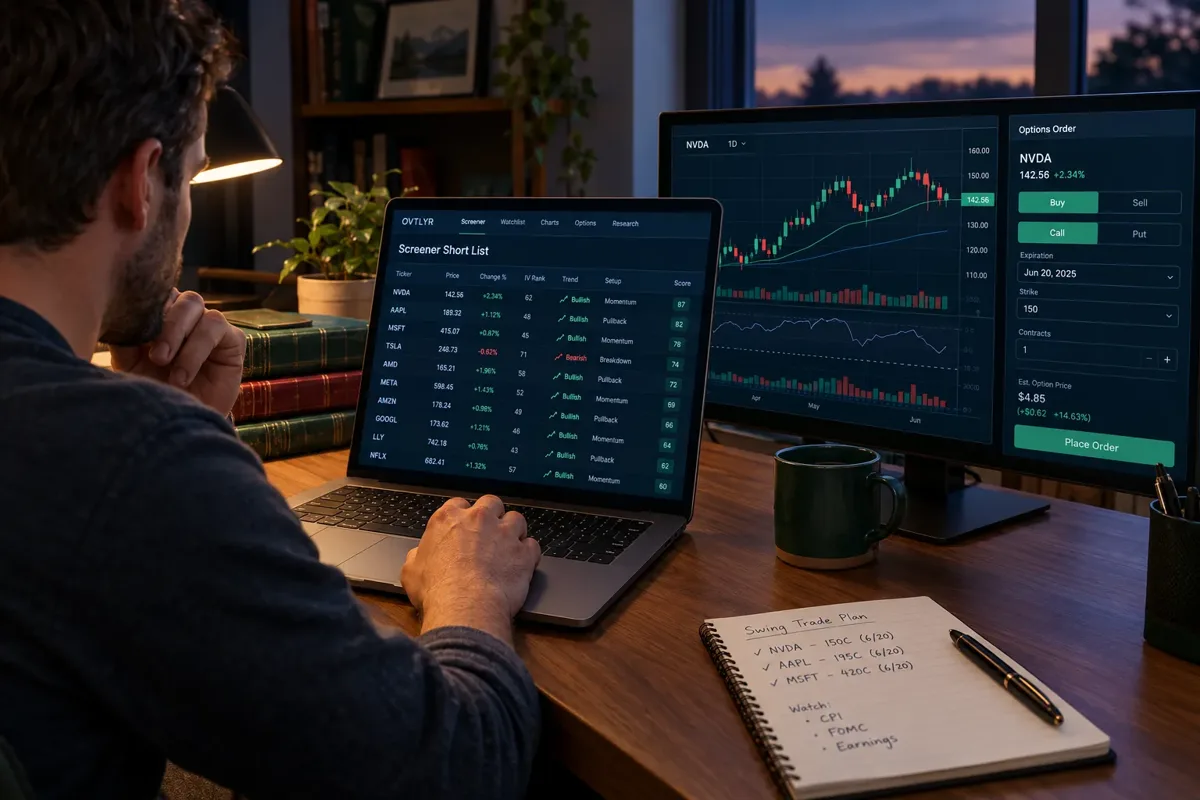
You need a defined position size before your first signal. OVTLYR tells you what and when. It does not tell you how much, and how much is where accounts die. Decide what percentage of your account a single position gets and what you'll lose if the stop hits. Write it down. A system without position sizing is a system that works until the one trade that doesn't.
Options buying amplifies everything, including being wrong. Plan M is described as the aggressive options plan. Buying options means you're also fighting time decay, which is the daily erosion of an option's value as expiration approaches. A correct directional call with bad timing still loses. If you're new to options, trade the signals in shares first, or paper trade it first. The signal logic is identical. The damage profile isn't. If you're assessing the options side specifically, our breakdown of AI options tools is a useful second read.
Set your evaluation window before you start. Fourteen days is not enough time to judge OVTLYR trading as a swing system. It's enough time to judge the interface, the screener speed and whether the daily routine fits your life. Judge the method over a quarter, ideally one that includes a drawdown. Use the trial to answer "can I run this?" not "does this work?"
Quick pre-purchase checklist:
- Watch at least four hours of OVTLYR University before paying anything. It's free.
- Sit in on a live trading session to see the signals called in real time, not in a replay.
- Confirm your actual watchlist tickers are covered.
- Decide now whether you can hold a Treasury ETF for three weeks without getting restless.
- Set the renewal reminder.
OVTLYR pros and cons
What we love
- Three-filter confirmation in one screen. Market, sector and stock sentiment live together. You're not stitching together a breadth site, a sector tracker and a charting package.
- The screener is a genuine time saver. Pre-filtered for uptrend, sector strength, rising greed and an active signal. That's the difference between a two-hour nightly grind and a 15-minute review, which for a trader with a day job is the difference between running the system and abandoning it.
- The sit-in-cash rule is published, not implied. Naming the destination (a Treasury ETF) makes doing nothing feel like a decision.
- $299 a year is modest for a platform in this category, and the 14-day trial on monthly lowers the cost of finding out.
- Free education that isn't a tripwire. OVTLYR University on YouTube plus daily live sessions means you can evaluate the thinking before paying. That's rarer than it should be.
- You keep execution control. Signals in, orders yours. For beginner and intermediate traders, that's the correct amount of automation.
What could be better
- Flat periods will test you. Weeks with no qualifying setups are a feature of the design and a problem for retention.
- No independent verification of performance. Vendor backtests only, and member outcomes vary widely.
- Coverage excludes stocks without a long price history, which rules out recent IPOs and some small caps.
- No mobile app. Web only.
- Social proof is too thin to audit. Zero Trustpilot, zero G2. Reddit plus the vendor's own community is not a cross-check.
- Narrow by design. No day trading, no scalping, no futures, no fundamental screening. If your interests widen, you'll outgrow one side of it.
How does OVTLYR compare to TrendSpider, Trade Ideas and MarketSurge?
OVTLYR trading competes on a different axis than the big three: it optimizes for fewer decisions, while they optimize for more capability.
| Platform | Core job | Built for | What OVTLYR does differently |
|---|---|---|---|
| OVTLYR | Fear and greed signals across market, sector and stock; tells you when to sit out | Swing traders, options buyers with a day job | Publishes an explicit no-trade rule and a cash destination |
 TrendSpider |
Automated technical analysis, backtesting, alert building | Traders who want to build and test their own rules | OVTLYR hands you the rules; TrendSpider hands you the workbench |
 Trade Ideas |
Real-time AI scanning and intraday idea generation | Active and day traders watching the tape live | OVTLYR is end-of-day and deliberately not intraday |
 MarketSurge |
Chart and fundamental research built on the CAN SLIM tradition | Growth-stock investors doing deeper individual research | OVTLYR ignores fundamentals entirely and runs on behavior |
The honest framing: if you want to build your own system, TrendSpider gives you more raw material. If you want live intraday ideas, Trade Ideas is in a different business. If you want earnings growth and institutional sponsorship data, MarketSurge owns that lane.
OVTLYR's bet is that most retail traders don't fail from a lack of capability. They fail from a lack of restraint. Whether that's worth $299 a year depends entirely on which of those two problems you actually have. Be honest with yourself about which one it is. If you want to see the full field before choosing, the AI trading platforms directory lays out the category.
What are our 5 favorite OVTLYR features?
1. The market breadth dashboard. Counting stocks in uptrends by sector is unglamorous and more useful than almost any oscillator. It answers one question that drives everything downstream: is the tide coming in or going out? When breadth narrows and only a handful of names hold up the index, that's where bull traps (false breakouts that reverse hard) multiply.
2. Fear and greed at three levels in one view. Market sentiment alone is a blunt instrument. Sector sentiment alone is incomplete. Having all three stacked lets you see when a single stock is getting greedy inside a sector the rest of the market is abandoning, which is usually a warning rather than an invitation.
3. The pre-filtered screener. No scan building. The filters are the thesis, already applied. You open it and get a short list. This is the feature that makes OVTLYR trading survivable for someone who gets home at 6:30 with kids to feed.
4. The published trading plans. Plan M for aggressive options, a defensive ETF plan, and the cash rule. Having named plans with written conditions means you're not improvising at the exact moment improvisation costs the most. Analysis paralysis dies when the plan is already written.
5. OVTLYR University, free on YouTube. A full course, outside the paywall, plus daily live sessions. The ability to evaluate the method before paying is worth something on its own. It also means that if you cancel, the education doesn't evaporate with the subscription.
OVTLYR Alpha Score
Every tool reviewed by Full Stack Alpha on aistockpickerapp.com gets an Alpha Score out of 100, built from five pillars worth 20 points each: Signal Quality, Transparency, Price-to-Value, Usability and Community Verdict. No star ratings, because one star rating collapses five separate questions into a number that hides the answer.
OVTLYR Alpha Score: 65 / 100
| Pillar | Score | What drives it |
|---|---|---|
| Signal Quality | 12 / 20 | Three-filter confirmation is logically sound, but performance claims are vendor-produced with no independent audit |
| Transparency | 14 / 20 | Strong on method disclosure (free course, daily live sessions, published plans); weak on verified results |
| Price-to-Value | 16 / 20 | $299/year is modest for the category; the annual pass removes the trial, which shifts risk to the buyer |
| Usability | 13 / 20 | Fast time to first useful output via the pre-filtered screener; no mobile app and coverage gaps on short-history names |
| Community Verdict | 10 / 20 | Thin and mixed. Reddit chatter and an active Discord, but no Trustpilot or G2 footprint to corroborate |
The score comes from FullStack Alpha desk research plus public user sentiment, and the pillar split is provisional. See the full OVTLYR Alpha Score breakdown.
What the breakdown tells you: price-to-value (16) and transparency (14) carry the score, while signal quality (12) and community verdict (10) hold it back. That matches everything above about OVTLYR trading: an open method at a fair price, with performance nobody outside the company has audited yet.
Who should buy OVTLYR, and who should skip it?
Buy it if you're:
- A swing trader with a full-time job who needs the daily research load to fit in 20 minutes
- An options buyer who's been burned by entering good directional ideas at bad moments
- Someone who overtrades and knows it, and wants an external rule to stop you
- A beginner who wants a defined framework and free education before committing cash
- A dollar-cost-averaging investor curious about timing contributions around breadth and sentiment
Skip it if you're:
- A day trader or scalper. It's end-of-day, web-only, and not built for intraday reaction.
- A futures or forex trader. Wrong asset classes.
- A fundamental investor. The platform doesn't care about earnings quality or valuation.
- Someone who wants a bot to trade the account for you. You place every order.
- Someone trading recent IPOs and low-float names. Coverage requires price history you won't have.
- Someone who will cancel after three quiet weeks. The quiet weeks are the product.
That last one deserves emphasis. The most common failure mode in OVTLYR trading isn't that the system breaks. It's that the user does, during the stretch when the system is correctly doing nothing. If you know you'll revenge trade the moment you get bored, no screener fixes that. Start with position sizing and a written plan, then add a tool. Our AI stock picker directory covers the broader field if you want to see what else sits in the same lane.
How to get the best deal on OVTLYR
The cheapest way into OVTLYR trading: run the free stuff first, then start monthly, then switch to annual if you're still using it at week six.
Looking for an OVTLYR promo code? We found no working public code when we checked, only coupon-spam pages. The real discount is the annual pass itself. We track live offers on our deals page.
Step by step:
- Watch OVTLYR University on YouTube. Free, no card. If the three-filter logic doesn't make sense to you here, it won't make sense inside the platform either.
- Attend a live trading session. Seeing signals called in real time, including the ones that don't work, tells you more than any marketing page.
- Start on monthly to use the 14-day trial. Full Elite access. Use those two weeks on workflow and coverage, not on judging returns.
- During the trial, run your actual watchlist through the screener. Confirm your names are covered and that the short list is actually short.
- Place at least one trade in shares, small size. You want to know how the signal feels in a live account, not a spreadsheet.
- Set a renewal reminder immediately. Both plans auto-renew.
- Upgrade to annual at week six, not week one. If you've run the routine for six weeks including at least one flat stretch and you're still opening it daily, $299 is the better math.
Mistake to avoid: buying annual for the discount before you know if the discipline suits you. A $529 saving on a tool you abandon in March is a $299 loss, not a saving. Play stupid games with prepaid subscriptions, win stupid prizes.
Is OVTLYR worth it? Our final verdict
OVTLYR trading is worth it for one specific trader: the swing trader or options buyer with a day job who already knows they trade too often and wants a rules-based system to stop them. For that person, $299 a year is a reasonable price for a daily short list and a written permission slip to sit in cash.
The strengths are real and specific. Fear and greed at three levels in one view. A pre-filtered screener that cuts nightly chart work to minutes. A free full course so you can evaluate the method before paying. An explicit no-trade rule with a named destination.
The weaknesses are equally specific and you should take them seriously. The backtests are the company's own with no third-party audit. There's no meaningful Trustpilot or G2 presence to check the marketing against. Coverage excludes stocks without a long price history. There's no mobile app. And the system's defining behavior, sitting out, is the thing most subscribers will eventually resent paying for.
My position: run the free material first, use the monthly trial, and only commit to annual after you've survived a quiet stretch without canceling. The tool is a reasonable buy. It's a bad buy for anyone expecting it to make trading feel exciting, because its entire design is pointed the other way.
The thing worth taking from OVTLYR even if you never subscribe: write down, today, the conditions under which you will not trade. Market breadth falling, sector weak, no signal. Then honor it for 30 days and see what your results do.
Related reading
- AI trading platforms compared
- AI options tools
- Browse all AI stock tools
- Tool alternatives directory
- About FullStack Alpha and how we test
One tool, scored five ways. There are 200+ more in the FullStack Alpha directory, filterable by category, price and what they actually do. Browse the directory → aistockpickerapps.com
This is education, not financial advice.
Your market edge starts with the right tool. Stay alpha.
Some links on this page may be affiliate links. Scores and verdicts are never influenced by them.
Prices are subject to change as fast as AI technology.
We test the tools. You get the verdict.
One email a week. What we tested, what scored, and what we'd skip. Written for traders, not for clicks.
Frequently asked
Topics in this teardown
Our verdict on OVTLYR
OVTLYR scores 65, and price-to-value leads at 16.