Trading Checklist | 7 AI Prompts That Poke Holes in Your Thesis
Reviewed by Jay Rocco, Chief Editor
A trading checklist only earns its keep when it argues back, and most of the ones traders print out never do.
Quick Answer
A trading checklist is a written set of conditions a trade must meet before you risk money on it, covering entry, stop placement, position size, and the news sitting inside your holding window. The upgrade in 2026 is pairing that checklist with AI prompts built to challenge your thesis instead of cheering for it, because a model that just agrees with you is worse than no checklist at all. The seven prompts below, pulled from how actual traders are using AI chat tools right now, force you to argue the other side of your own trade before you click buy.
Quick pick: trading checklist tools
- Claude Pro: Best for pressure-testing a thesis with follow-up questions. Starts at $20/month.
- Edgewonk: Best for tagging rule breaks across a trading journal. Priced on its official annual plan page.
- TraderSync: Best for auto-scoring checklist adherence per trade. Priced on its official plans page.
Skip it if: you want a tool to pick trades for you instead of checking your own thinking.
Key Takeaways
- A trading checklist is a pre-trade filter, not a prediction engine: it checks entry, stop, size, and news before every trade, the same way a pilot checks a plane before every flight.
- A Reddit thread titled "I don't want AI to pick my trades. I want it to catch the dumb stuff I miss" pulled 35 upvotes and 26 comments, and the top reply nails the actual use case for AI in a trading checklist.
- Bullynx's 2026 ChatGPT prompt set runs 25 prompts deep, and the strongest ones force you to name your entry, stop, target, and size before the AI will even discuss the idea.
- A Vanguard survey covered by Business Insider on October 1, 2026 found 57% of investors are uncomfortable with AI acting on their portfolios directly, which lines up with the FullStack Alpha position: AI should check your thinking, not place your trades. Our breakdown of that survey covers why brokers are shipping AI anyway.
- FXNX's prompt engineering framework breaks a good trading prompt into five hard elements: role, context, task, constraints, output format.
- Obside's trading prompt library reduces every pre-trade checklist to five building blocks: setup, condition, action, size, invalidation.
- FullStack Alpha's free Bear Case Generator runs the first prompt on this list for you: it builds the case against your trade before you take it.
What is a trading checklist?
A trading checklist is a short written list of conditions a trade has to satisfy before you put real money on it, covering your entry trigger, your stop, your position size, and the catalyst that's supposed to make the trade work. It exists for one reason: your brain under pressure is a worse risk manager than your brain on a quiet Sunday writing rules down.
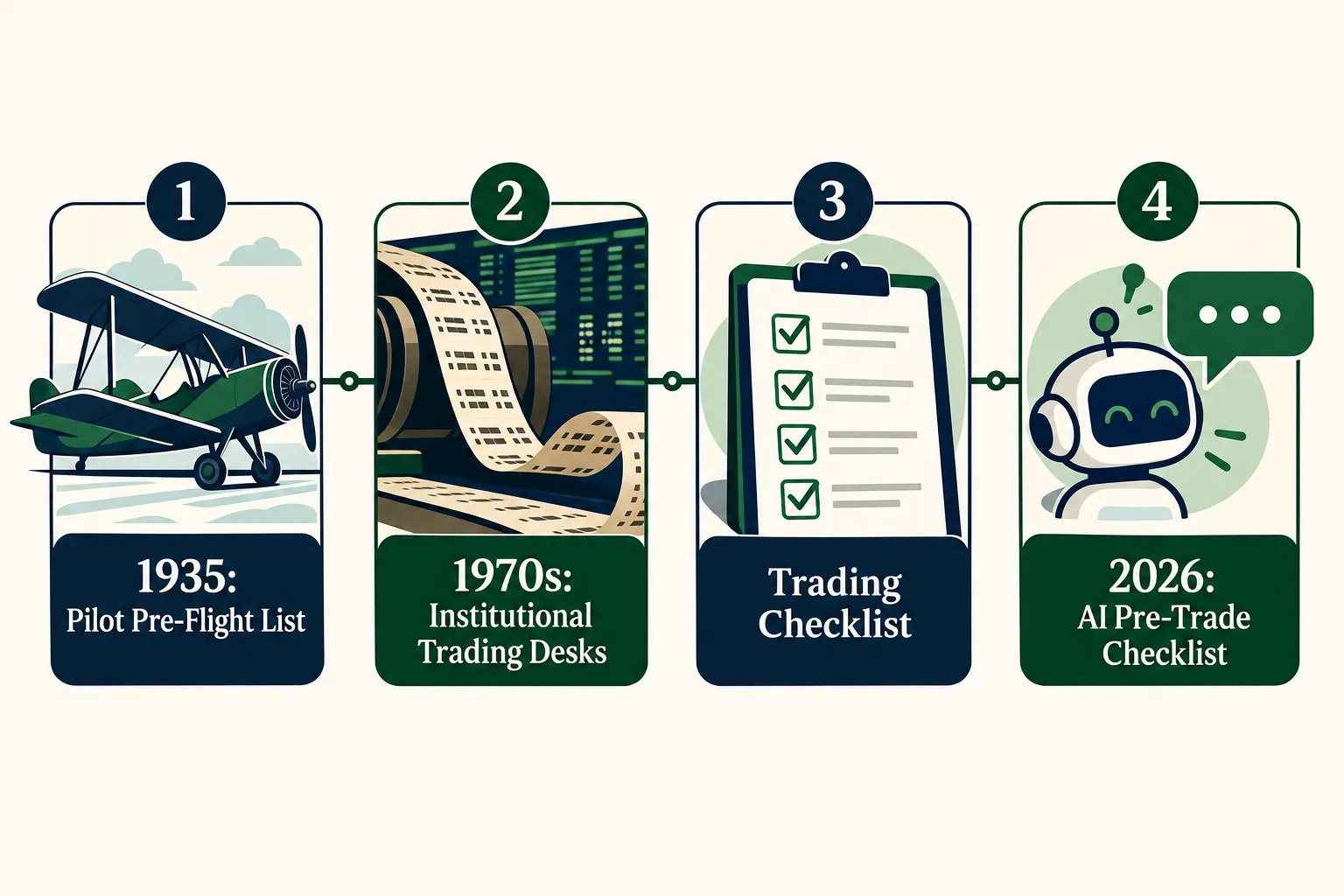
Pilots didn't invent the checklist because they're forgetful. They invented it because the cockpit of a B-17 bomber in 1935 had too many switches for any human memory to track reliably under stress, so Boeing built a written list that every crew had to run before takeoff, no exceptions. A trading desk during earnings season, three positions open, a Fed headline flashing across the tape, is the exact same cockpit. Your working memory isn't built for that load, and a trading checklist is the fix, not a crutch.
Origins of the checklist: the aviation pre-flight list is the direct ancestor of every modern trading checklist. Retail traders got their own version once trading journals and apps made it easy to log every entry and review every mistake after the close.
Who is this checklist for? Discretionary traders who already know their setup, stocks, options, futures, or forex, but who break their own rules under pressure. It's for the trader who writes "wait for confirmation" in their plan Monday morning and buys the breakout candle Tuesday anyway because the chart looked exciting. It is not for someone who has never placed a trade; you need a plan before you need a checklist to enforce it.
Trading checklist vs trading plan, what's the difference? A trading plan is the strategy: your edge, your market, your timeframe, your risk-reward target. A trading checklist is the gate that checks whether a specific trade in front of you actually matches that plan right now. The plan is the constitution. The checklist is the border guard checking your papers before you cross.
Trading checklist: what should it cover before every trade?
A working trading checklist covers four phases: pre-market prep, trade entry, during-trade management, and post-trade review, and it has to be short enough that you'll actually run it under pressure. If your checklist takes fifteen minutes to complete, you'll skip it the one time you need it most.
Pre-market preparation, start your day right. Before the open, check the economic calendar for Fed decisions, CPI prints, or earnings inside your holding window, scan your watchlist for names near support and resistance, and confirm your daily loss limit for the session. This is also where you decide if the tape is tradeable at all; a choppy tape before the open is a reason to size down, not a reason to force a trade.
Trade entry, execute with discipline. Before you click buy, your checklist needs:
- A defined entry trigger tied to price action, not a feeling
- A stop loss placed at the level that proves you're wrong, set before entry, never after
- A position size calculated from your stop distance and your daily loss limit, not from how confident you feel
- A risk-reward ratio you can state in one sentence
During-trade management, stay in control. Once you're in, the checklist shifts from entry rules to exit rules: where does this trade get stopped out, what does a gap fill or a dead cat bounce mean for your thesis, and what's your rule for getting out if the setup breaks down before your stop is hit. This is also where revenge trading and overtrading do the most damage, because a trader down on the day starts improvising instead of checking the list.
Post-trade review, continuous improvement. After the close, log the trade in your trading journal: did price action match your thesis, did you follow your own exit rule, and what would you change. This is where tools like Edgewonk and TraderSync earn their subscription, tagging every trade against your written rules so the pattern of your mistakes shows up in a chart instead of your memory.
Best trading checklist template for day traders vs swing traders: a day trading checklist needs tighter time windows, power hour behavior, and same-day news risk built in. A swing trading checklist needs more room for basing and tight consolidation over days, and less obsession with the open. Look for a trading checklist template built for your actual holding period, not a generic one someone posted as a trading checklist PDF without saying which style of trading it was built for.
Common mistake: copying someone else's trading checklist Excel sheet line for line without changing the numbers for your own account size. A daily loss limit that works for a $50,000 account will blow up a $5,000 one in three bad trades.
Trading checklist templates: day trading, swing, options, and forex
Copy the version that matches how you trade, then change the numbers to your account. Each one fits on an index card, which is the point.
| Checklist | Before entry | During the trade | Exit rule |
|---|---|---|---|
| Day trading checklist | Daily loss limit set; catalyst or level identified; no CPI, Fed, or earnings in the next 30 minutes; size from stop distance | No adding to a loser; stop never moved wider | Stop hit, target hit, or flat by your time cutoff |
| Swing trading checklist | Trend on the daily chart agrees; earnings date outside the hold; stop below the base or swing low | Review at the close only, not intraday | Close below the stop level, or the thesis changes |
| Options trading checklist | Max loss known in dollars; implied volatility checked against its range; expiration after the catalyst | Track the underlying, not the option's price swings | Planned profit target or a time stop before expiry |
| Forex trading checklist | Session and spread checked; no high-impact news inside the hold; correlated pairs counted as one position | Watch swap costs on overnight holds | Stop, target, or news window approaching |
Trading checklist PDF, Excel, or app? Format matters less than friction. A printed card next to your keyboard gets used more than a perfect spreadsheet you have to open. If you journal in a spreadsheet, put the checklist as the first columns so every logged trade shows which boxes you checked. Our trading journal template shows how to build that in Google Sheets with Claude.
The 7 AI prompts that test a trade idea (copy and paste)
Seven AI prompts can pressure-test a trade thesis before you risk money: they force you to argue against yourself, define what has to be true, locate your stop, size your risk in dollars, check scheduled news, confirm the setup matches your written plan, and explain the trade out loud. Run them in order, every time, before entry.
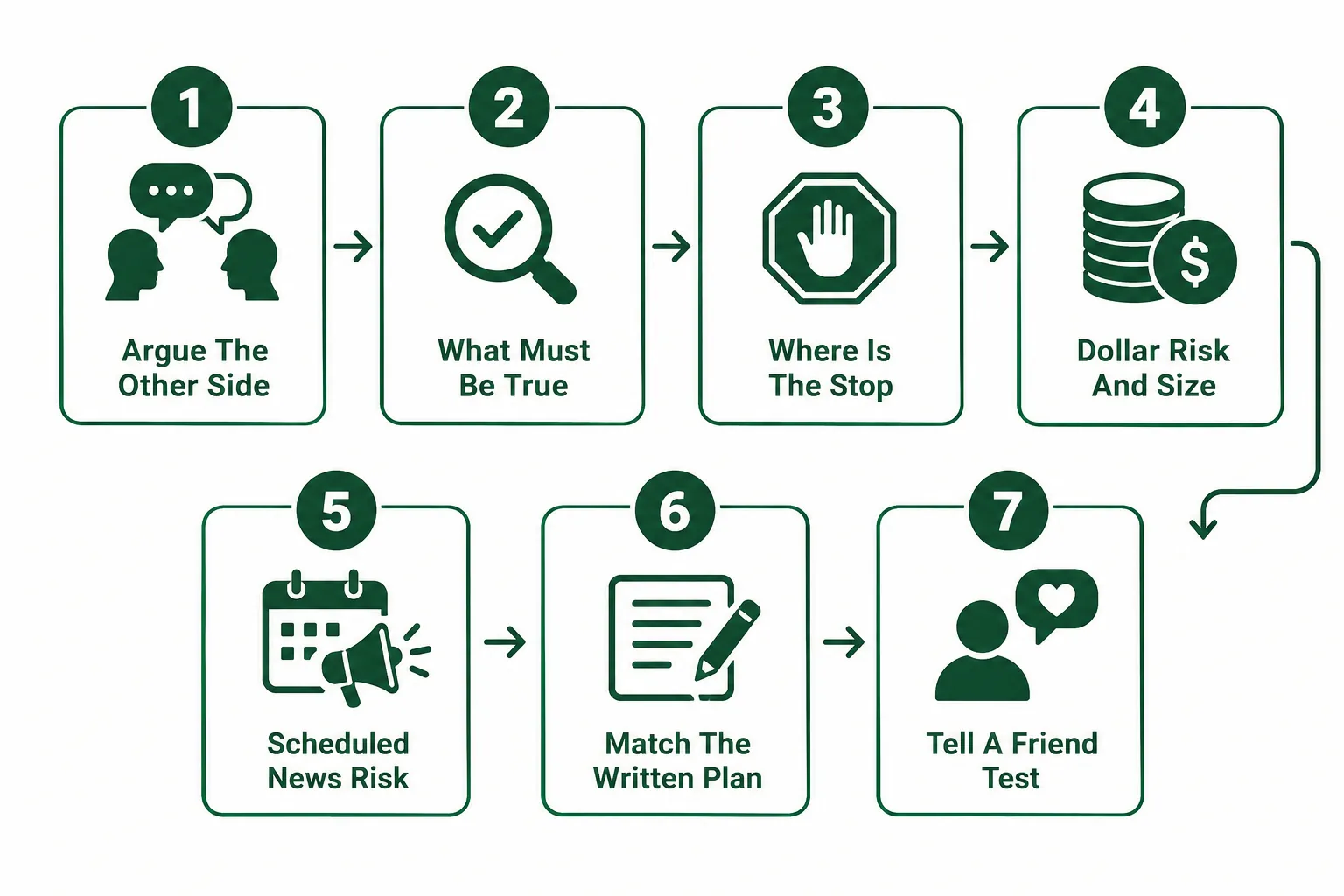
As one Reddit trader, u/klipsetrades, put it, the point is "not picking trades, but acting like a pre-trade checklist and trying to poke holes in your thesis before you put risk on." That's the whole job description for this section.
How to use these: copy a prompt, paste it into Claude, ChatGPT, or Gemini, and replace every [BRACKET] with your real numbers. Run them in order in the same chat, so each answer builds on the last. Nothing here asks the AI to pick a trade. Every prompt asks it to find what's wrong with yours.
Want more like these? The free FullStack Alpha AI trading prompt library has premarket, midday, trade management, and journal prompts you can copy the same way.
Prompt 1: The bear case cross-examination
Use this first, every time. It's built to break the confirmation bias trap: the AI argues against you, and it isn't allowed to soften the answer.
Act as a skeptical risk manager whose only job is to find reasons NOT to take my trade. Do not encourage me. Do not summarize my idea back to me.

My trade idea:
- Ticker: [TICKER]
- Direction: [LONG or SHORT]
- Timeframe and expected hold: [e.g. day trade, 30 to 90 minutes / swing trade, 3 to 10 days]
- Entry plan: [price or trigger]
- Why I want it: [your thesis in 2 to 4 sentences]
- What I see on the chart: [levels, trend, volume, pattern]
- Recent news or catalyst: [anything you know]

Do this:
1. Build the strongest possible case for the opposite direction using the same information I gave you.
2. List the 3 most likely ways this trade loses money, ranked by how likely they are.
3. Point out any part of my reasoning that is a feeling, a hope, or a prediction rather than evidence.
4. Tell me what information I'm missing that a professional would check first.
5. Finish with one line: "The weakest part of this thesis is ___."

Keep it under 300 words. Be blunt.
Prompt 2: What has to be true for this to work?
A real thesis has conditions. This prompt turns a vague hunch into a short list of things you can check, plus the signals that would kill the idea.
I want to test whether my trade idea is a thesis or just a hunch.

Trade: [LONG or SHORT] [TICKER], timeframe [TIMEFRAME], entry near [PRICE].
My reason: [YOUR THESIS]

Do this:
1. List exactly 3 to 5 conditions that must be true for this trade to work. Make each one specific and checkable (a price level that must hold, volume that must show up, a sector or index that must agree, a time window).
2. For each condition, tell me how I can check it in under 60 seconds before entry.
3. List 3 "kill signals": things that, if they happen after I enter, mean the thesis is dead and I should exit even if my stop hasn't been hit.
4. If my reason is too vague to produce specific conditions, say so plainly and ask me 3 questions to sharpen it.

Format the answer as a checklist I can copy into my trading journal.
Prompt 3: Where is my stop, and what invalidates the idea?
Most traders pick a stop based on how much they're willing to lose. This prompt puts the stop where the trade idea is proven wrong, which is where it belongs.
Help me place my stop where my trade idea is proven wrong, not where it feels comfortable.

Trade: [LONG or SHORT] [TICKER] on the [TIMEFRAME] chart.
Planned entry: [ENTRY PRICE]
Key levels I see: [support, resistance, recent swing high/low, VWAP, moving averages, with prices]
Average true range (ATR) if I know it: [ATR or "unknown"]

Do this:
1. Identify the price that would prove my thesis wrong, and explain why in one or two sentences.
2. Suggest a stop just beyond that level, with a small buffer for normal noise. Explain the buffer.
3. Calculate the distance from my entry to that stop in dollars per share and as a percent.
4. Tell me if the stop is unusually wide or tight for this timeframe, and what that means for position size.
5. Warn me if my stop sits at an obvious round number or a level where many other traders' stops probably sit.

Do not move the stop to make the trade look better. If the logical stop is too far away, tell me the trade may not be worth taking.
Prompt 4: What is my dollar risk and position size at that stop?
This turns a chart pattern into a number you can live with losing. Always recheck the math yourself, because AI models still make arithmetic mistakes.
Calculate my position size from my risk rules. Show every step of the math so I can check it.

- Account size: $[ACCOUNT SIZE]
- Max risk per trade: [e.g. 1]% of the account
- Entry price: $[ENTRY]
- Stop price: $[STOP]
- Target price: $[TARGET]
- Estimated commissions and slippage per share: $[e.g. 0.02]
- Daily loss limit: $[DAILY LIMIT] and how much I've already lost today: $[LOSS SO FAR]

Do this:
1. Calculate my dollar risk per share, including costs.
2. Calculate the maximum shares (or contracts) I can buy without exceeding my max risk per trade. Round down.
3. Calculate the total position value and what percent of my account that is.
4. Calculate the reward-to-risk ratio using my target.
5. Check my daily loss limit: if this trade hits the stop, how much daily room do I have left? If it would break my daily limit, say STOP in capital letters and tell me the largest size that fits.
6. If the reward-to-risk ratio is below 1.5 to 1, flag it.

Present the final answer as: Shares, Dollar risk, Position value, Reward-to-risk, Daily room left.
Prompt 5: What scheduled news sits inside my holding window?
CPI prints, Fed decisions, and earnings don't care about your setup. This prompt makes you check the calendar before you hold through one by accident.
Check my trade for scheduled event risk inside my holding window. If you can browse the web, look up current dates. If you cannot, say so and tell me exactly what to check myself.

Trade: [LONG or SHORT] [TICKER], entering [DATE and TIME], planning to exit by [DATE and TIME].
Sector: [SECTOR, if known]
Economic calendar I found (paste it if you can't browse): [PASTE EVENTS]

Do this:
1. List any earnings report for this company inside my holding window, with date and before or after the open.
2. List major US economic releases inside the window (CPI, PPI, jobs report, FOMC decision and press conference, retail sales, GDP) with dates and times in Eastern Time.
3. Flag any earnings from the biggest companies in the same sector that could move my ticker.
4. For each event, tell me what usually happens to spreads and volatility around it.
5. Give me a clear recommendation: hold through it, exit before it, or reduce size before it, and why.

Do not guess dates. If you are not certain a date is correct, mark it "verify."
Prompt 6: Does this match my written plan, or am I improvising?
This is the prompt that catches FOMO dressed up as analysis. Paste your actual trading plan, then let the AI act as a strict compliance officer.
Act as a strict compliance officer for my trading plan. Your only job is to check whether this trade follows my written rules. You are not allowed to judge whether the trade will win.

My written trading plan:
[PASTE YOUR PLAN: the setups you trade, entry rules, stop rules, size rules, times you trade, times you don't, max trades per day]

The trade I'm about to take:
[TICKER, DIRECTION, ENTRY, STOP, SIZE, TIME OF DAY, WHICH SETUP YOU THINK IT IS]

Today's context:
- Trades already taken today: [NUMBER] with results [WINS/LOSSES]
- How I'm feeling right now, honestly: [e.g. calm / frustrated after a loss / excited]

Do this:
1. Go through my plan rule by rule and mark each one PASS, FAIL, or NOT APPLICABLE for this trade.
2. Name which of my setups this trade matches. If it doesn't clearly match one, say "No matching setup."
3. Flag any sign of revenge trading, overtrading, or chasing (late entry after a big move, trading after a loss, trading outside my hours, sizing up).
4. Give a final verdict: "FOLLOWS PLAN" or "BREAKS PLAN," with the specific rule numbers that failed.
Prompt 7: The pre-mortem: what would I tell a friend?
Run this last. It asks you to imagine the trade already failed, then explain why. If you can't defend the trade out loud, don't put money on it.
Run a pre-mortem on my trade. Imagine it is [DATE OF YOUR PLANNED EXIT] and this trade lost the full amount at my stop.

Trade summary: [LONG or SHORT] [TICKER], entry [ENTRY], stop [STOP], target [TARGET], size [SHARES], thesis: [ONE SENTENCE].

Do this:
1. Write the 3 most likely stories of how this trade failed, each in 2 sentences.
2. For each story, tell me the earliest warning sign I could have seen and what I should have done.
3. Now pretend a friend is about to take this exact trade. Write the honest advice you would give them in 4 sentences or less.
4. Ask me one question I should be able to answer before I enter. If I can't answer it, I don't take the trade.
5. End with a one-line pre-trade checklist summary: Thesis / Invalidation / Stop / Size / Event risk / Plan match, each marked READY or NOT READY based on everything in this chat.
After you run all seven: paste the final READY / NOT READY line into your journal with the trade. If any item says NOT READY, skip the trade. There will be another one tomorrow.
Bullynx's 2026 ChatGPT prompt set runs 25 prompts deep, and the strongest ones force you to name your entry, stop, target, and size before the AI will even discuss the idea. - A Vanguard survey covered by Business Insider on October 1, 2026 found 57% of investors are uncomfortable with AI acting on their portfolios directly, which lines up with the FullStack Alpha position: AI should check your thinking, not place your trades. Our breakdown of that survey covers why brokers are shipping AI anyway. - FXNX's prompt engineering framework breaks a good trading prompt into five hard elements: role, context, task, constraints, output format. - Obside's trading prompt library reduces every pre-trade checklist to five building blocks: setup, condition, action, size, invalidation. - FullStack Alpha's free Bear Case Generator runs the first prompt on this list for you: it builds the case against your trade before you take it.
What is a trading checklist?
A trading checklist is a short written list of conditions a trade has to satisfy before you put real money on it, covering your entry trigger, your stop, your position size, and the catalyst that's supposed to make the trade work. It exists for one reason: your brain under pressure is a worse risk manager than your brain on a quiet Sunday writing rules down.
Pilots didn't invent the checklist because they're forgetful. They invented it because the cockpit of a B-17 bomber in 1935 had too many switches for any human memory to track reliably under stress, so Boeing built a written list that every crew had to run before takeoff, no exceptions. A trading desk during earnings season, three positions open, a Fed headline flashing across the tape, is the exact same cockpit. Your working memory isn't built for that load, and a trading checklist is the fix, not a crutch.
Origins of the checklist: the aviation pre-flight list is the direct ancestor of every modern trading checklist. Retail traders got their own version once trading journals and apps made it easy to log every entry and review every mistake after the close.
Who is this checklist for? Discretionary traders who already know their setup, stocks, options, futures, or forex, but who break their own rules under pressure. It's for the trader who writes "wait for confirmation" in their plan Monday morning and buys the breakout candle Tuesday anyway because the chart looked exciting. It is not for someone who has never placed a trade; you need a plan before you need a checklist to enforce it.
Trading checklist vs trading plan, what's the difference? A trading plan is the strategy: your edge, your market, your timeframe, your risk-reward target. A trading checklist is the gate that checks whether a specific trade in front of you actually matches that plan right now. The plan is the constitution. The checklist is the border guard checking your papers before you cross.
Trading checklist: what should it cover before every trade?
A working trading checklist covers four phases: pre-market prep, trade entry, during-trade management, and post-trade review, and it has to be short enough that you'll actually run it under pressure. If your checklist takes fifteen minutes to complete, you'll skip it the one time you need it most.
Pre-market preparation, start your day right. Before the open, check the economic calendar for Fed decisions, CPI prints, or earnings inside your holding window, scan your watchlist for names near support and resistance, and confirm your daily loss limit for the session. This is also where you decide if the tape is tradeable at all; a choppy tape before the open is a reason to size down, not a reason to force a trade.
Trade entry, execute with discipline. Before you click buy, your checklist needs:
- A defined entry trigger tied to price action, not a feeling
- A stop loss placed at the level that proves you're wrong, set before entry, never after
- A position size calculated from your stop distance and your daily loss limit, not from how confident you feel
- A risk-reward ratio you can state in one sentence
During-trade management, stay in control. Once you're in, the checklist shifts from entry rules to exit rules: where does this trade get stopped out, what does a gap fill or a dead cat bounce mean for your thesis, and what's your rule for getting out if the setup breaks down before your stop is hit. This is also where revenge trading and overtrading do the most damage, because a trader down on the day starts improvising instead of checking the list.
Post-trade review, continuous improvement. After the close, log the trade in your trading journal: did price action match your thesis, did you follow your own exit rule, and what would you change. This is where tools like Edgewonk and TraderSync earn their subscription, tagging every trade against your written rules so the pattern of your mistakes shows up in a chart instead of your memory.
Best trading checklist template for day traders vs swing traders: a day trading checklist needs tighter time windows, power hour behavior, and same-day news risk built in. A swing trading checklist needs more room for basing and tight consolidation over days, and less obsession with the open. Look for a trading checklist template built for your actual holding period, not a generic one someone posted as a trading checklist PDF without saying which style of trading it was built for.
Common mistake: copying someone else's trading checklist Excel sheet line for line without changing the numbers for your own account size. A daily loss limit that works for a $50,000 account will blow up a $5,000 one in three bad trades.
Trading checklist templates: day trading, swing, options, and forex
Copy the version that matches how you trade, then change the numbers to your account. Each one fits on an index card, which is the point.
| Checklist | Before entry | During the trade | Exit rule |
|---|---|---|---|
| Day trading checklist | Daily loss limit set; catalyst or level identified; no CPI, Fed, or earnings in the next 30 minutes; size from stop distance | No adding to a loser; stop never moved wider | Stop hit, target hit, or flat by your time cutoff |
| Swing trading checklist | Trend on the daily chart agrees; earnings date outside the hold; stop below the base or swing low | Review at the close only, not intraday | Close below the stop level, or the thesis changes |
| Options trading checklist | Max loss known in dollars; implied volatility checked against its range; expiration after the catalyst | Track the underlying, not the option's price swings | Planned profit target or a time stop before expiry |
| Forex trading checklist | Session and spread checked; no high-impact news inside the hold; correlated pairs counted as one position | Watch swap costs on overnight holds | Stop, target, or news window approaching |
Trading checklist PDF, Excel, or app? Format matters less than friction. A printed card next to your keyboard gets used more than a perfect spreadsheet you have to open. If you journal in a spreadsheet, put the checklist as the first columns so every logged trade shows which boxes you checked. Our trading journal template shows how to build that in Google Sheets with Claude.
Which 7 AI prompts test a trade idea?
Seven AI prompts can pressure-test a trade thesis before you risk money: they force you to argue against yourself, define what has to be true, locate your stop, size your risk in dollars, check scheduled news, confirm the setup matches your written plan, and explain the trade out loud. Run them in order, every time, before entry.
As one Reddit trader, u/klipsetrades, put it, the point is "not picking trades, but acting like a pre-trade checklist and trying to poke holes in your thesis before you put risk on." That's the whole job description for this section.
- Argue the other side of this trade. Ask the AI to build the strongest bear case against a long, or bull case against a short, using the same chart and the same news you're looking at. Our free Bear Case Generator does this in one step.
- What has to be true for this to work? Force a specific answer: a level has to hold, volume has to confirm, a sector has to participate. Vague answers mean you don't have a thesis yet.
- Where is my stop, and what invalidates the idea? Your stop isn't a number you pick after you're already down money. It's the price where your reason for being in the trade stops being true.
- What is my dollar risk and position size at that stop? This turns a chart pattern into an actual number you can live with losing. Check the AI's math with the free trade plan builder.
- What scheduled news or earnings sits inside my holding window? CPI, Fed decisions, and earnings reports don't care about your setup. Check the economic calendar before you hold through one by accident.
- Does this match a setup in my written plan, or am I improvising? This is the prompt that catches FOMO disguised as analysis.
- What would I tell a friend taking this trade? If you wouldn't say it out loud to someone you respect, don't say it to your own account.
Bullynx's 2026 ChatGPT prompt collection runs 25 prompts built around this exact idea, forcing entry, stop, target, and size before the AI engages further. GodOfPrompt's trader library and aiunpacker's prompt list both ship roughly 10 prompts aimed at the same pre-market and pre-trade briefing. Scheplick's trading prompt set recommends answering 5 to 7 such prompts before you click buy or sell, specifically to filter out trades that are really just a prediction wearing a process costume.
How do you stop AI from just agreeing with you?
AI stops agreeing with you the moment you stop prompting it like a lawyer building a case and start prompting it like a hostile witness cross-examining one. Ask a model to confirm your thesis and it will, happily, because that's what you asked for.
As Reddit user u/Xiara08 put it bluntly: "AI is VERY good at confirmation bias if you prompt it like a lawyer." That's not a flaw in the model. That's a flaw in the question.
Fix it with structure, not hope:
- Give the AI the opposing case to build, not just your thesis to validate. Prompt one asks it to be your bear case lawyer, not your cheerleader.
- Set hard constraints before the conversation starts, the same way FXNX's prompt engineering framework does: maximum risk per trade, maximum drawdown for the day, a news blackout window, a stop-loss rule the AI isn't allowed to talk you out of.
- Ask for disconfirming evidence by name. ForexTradeLab's AI prompt playbook has you state your bias out loud, then instructs the AI to list the evidence against it, alternative explanations for the same chart pattern, and macro risk sitting inside your holding window.
- Strip adjectives from your prompt. "This looks like a clean breakout, am I right?" is a leading question. "What does this chart look like to someone who has never seen my position?" is a real one.
This is where "poke holes in your trading thesis" stops being a slogan and becomes an actual workflow. Traderank's 2026 prompt templates include a dedicated bear-case stress test specifically positioned as a guardrail against overconfidence, sitting alongside separate prompts for chart analysis, position sizing, and portfolio review. Run the bear case prompt first, every time. If it can't survive its own cross-examination, it wasn't ready for your money.
What should a checklist never do?
A trading checklist should never place a trade for you, remove your stop loss, or get so long that you stop running it before every trade. The moment a checklist becomes a chore, it stops being a safety system and becomes a formality you click through without reading.
Three failure modes show up constantly:
- The checklist that's really a permission slip. A trader fills it out after they've already decided to enter, so every box gets checked to match the decision instead of testing it. That's not a checklist, that's paperwork.
- The checklist with no exit rule. Entry gets ten bullet points. Exit gets nothing. A plan without an exit checklist is a plan to hold a losing position until it hurts enough to force you out, which is the opposite of risk management.
- The checklist that ignores emotional state. Revenge trading and overtrading don't show up on a price chart. They show up in how fast you're clicking and how many trades you've placed in the last hour. Obside's trading prompt framework builds every prompt around a clear invalidation condition specifically because an AI agent without one will keep trading a broken thesis indefinitely, same as a human on tilt.
Can a trading checklist help avoid emotional trading decisions? Yes, but only the kind written and locked in before the market opens. A checklist written in the heat of a trade is just your emotions wearing a clipboard.
How often should you update a trading checklist? Review it monthly against your trading journal, not daily. Change it after a pattern of losses repeats three or more times in your log, not after one bad trade. A checklist that changes every day isn't a system, it's noise pretending to be discipline.
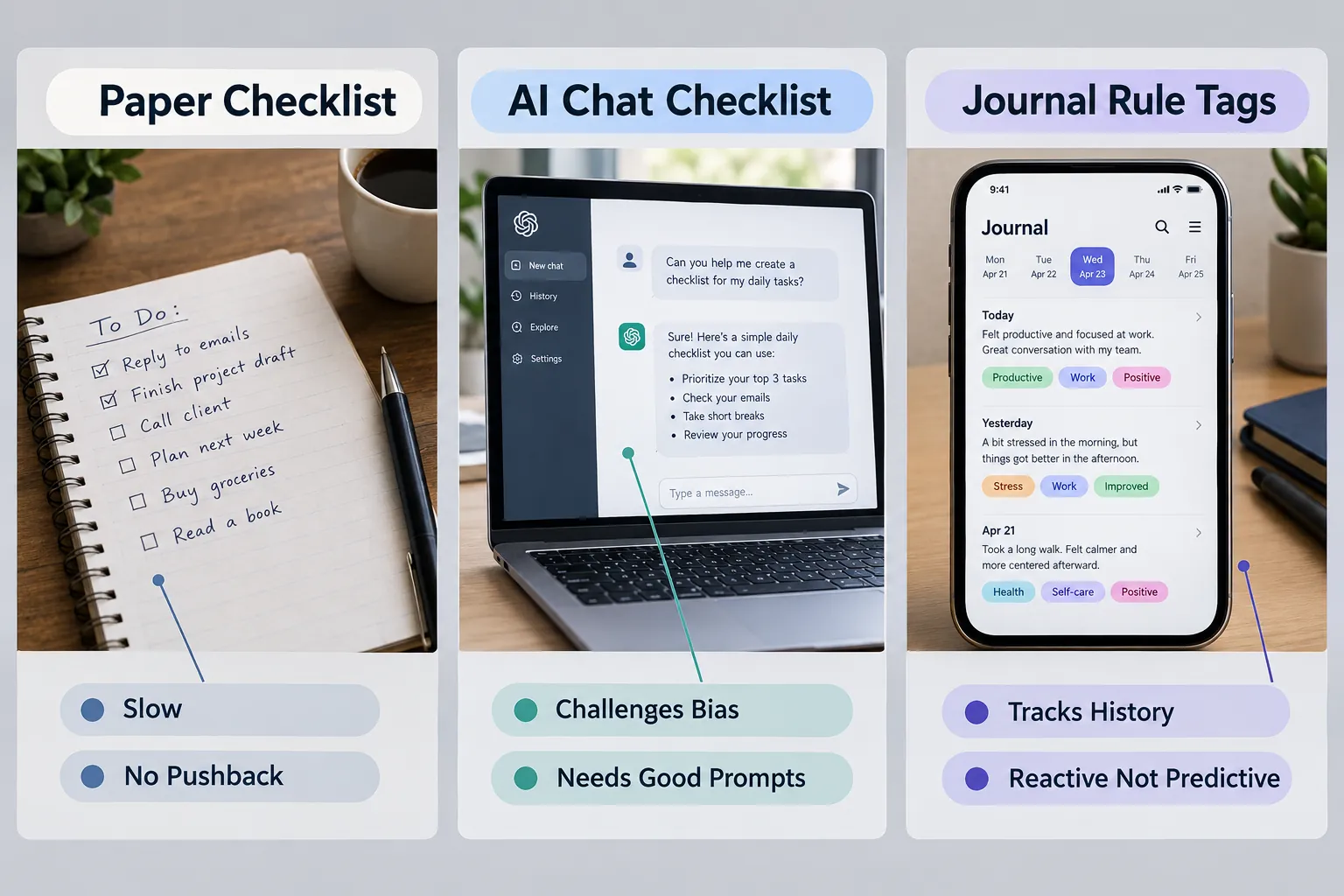
Paper checklist vs AI chat checklist vs journal rule tags
| Method | What it catches | Main weakness | Price |
|---|---|---|---|
| Paper checklist | Missing entry, stop, or size before a trade | Never argues back, easy to skip or fudge under pressure | Free |
| AI chat checklist (Claude, ChatGPT) | Confirmation bias, missing bear case, scheduled news risk | Only as good as the prompt, will agree with you if you let it | Claude Pro from $20/month, check official pricing |
| Journal rule tags (Edgewonk, TraderSync) | Patterns of rule breaks across weeks of trades | Reactive, it tells you after the loss, not before the entry | Edgewonk billed annually, see official pricing page; TraderSync tiered, see official plans page |
Prices are confirmed on each tool's official pricing page and are subject to change, because software companies love a quiet price bump.
📌 What You Should Know
- A trading checklist is a gate, not a forecast. It tells you whether this trade matches your plan, not whether it will win.
- AI agrees by default. Models are trained to be helpful, which means they lean toward your framing. You have to ask for the opposing case on purpose.
- Shorter beats complete. A checklist you run in under two minutes beats a perfect one you skip.
- The journal closes the loop. The checklist stops a bad trade; the journal shows which boxes you keep skipping. FullStack Alpha's journal and review prompts grade the trade, not the outcome.
- Pick the right model for the job. Our comparison of Claude, GPT, Grok, and Gemini for trading work covers which one pushes back hardest.
⚠️ What to Look Out For
- Checklists filled in after the decision. If you open the checklist after you've already sized the order, it's paperwork, not a filter.
- Leading prompts. "This is a clean breakout, right?" gets a yes. Ask what someone without your position would see.
- AI math you didn't check. Models still make arithmetic mistakes on position size. Recompute dollar risk yourself.
- Pasting account details into chat tools. Share the setup, not your account number or login.
- Copied templates. Someone else's daily loss limit can be ten times too big for your account.
- Letting AI place the trade. Once the tool executes, the checklist is gone. Keep the click human.
What do real users say?
Real traders on Reddit are already using AI the same way this article recommends: as a pressure test, not a trade picker, and they're saying so in plain language. A thread titled "I don't want AI to pick my trades. I want it to catch the dumb stuff I miss" pulled 35 upvotes and 26 comments, which is a decent engagement number for a niche trading subreddit.
"AI is VERY good at confirmation bias if you prompt it like a lawyer.", u/Xiara08
"Not picking trades, but acting like a pre-trade checklist and trying to poke holes in your thesis before you put risk on.", u/klipsetrades
Search "trading checklist app" and you'll mostly find generic to-do apps with a trading name and zero reviews. That's the gap this article is built to close: a trading checklist built specifically to argue with your entry before you take it.
What are the alternatives?
If AI prompts and a written checklist aren't enough structure for you, the next step up is a broker-level pre-trade check or a funded account with rules enforced by someone other than you. These options trade flexibility for discipline you can't skip.
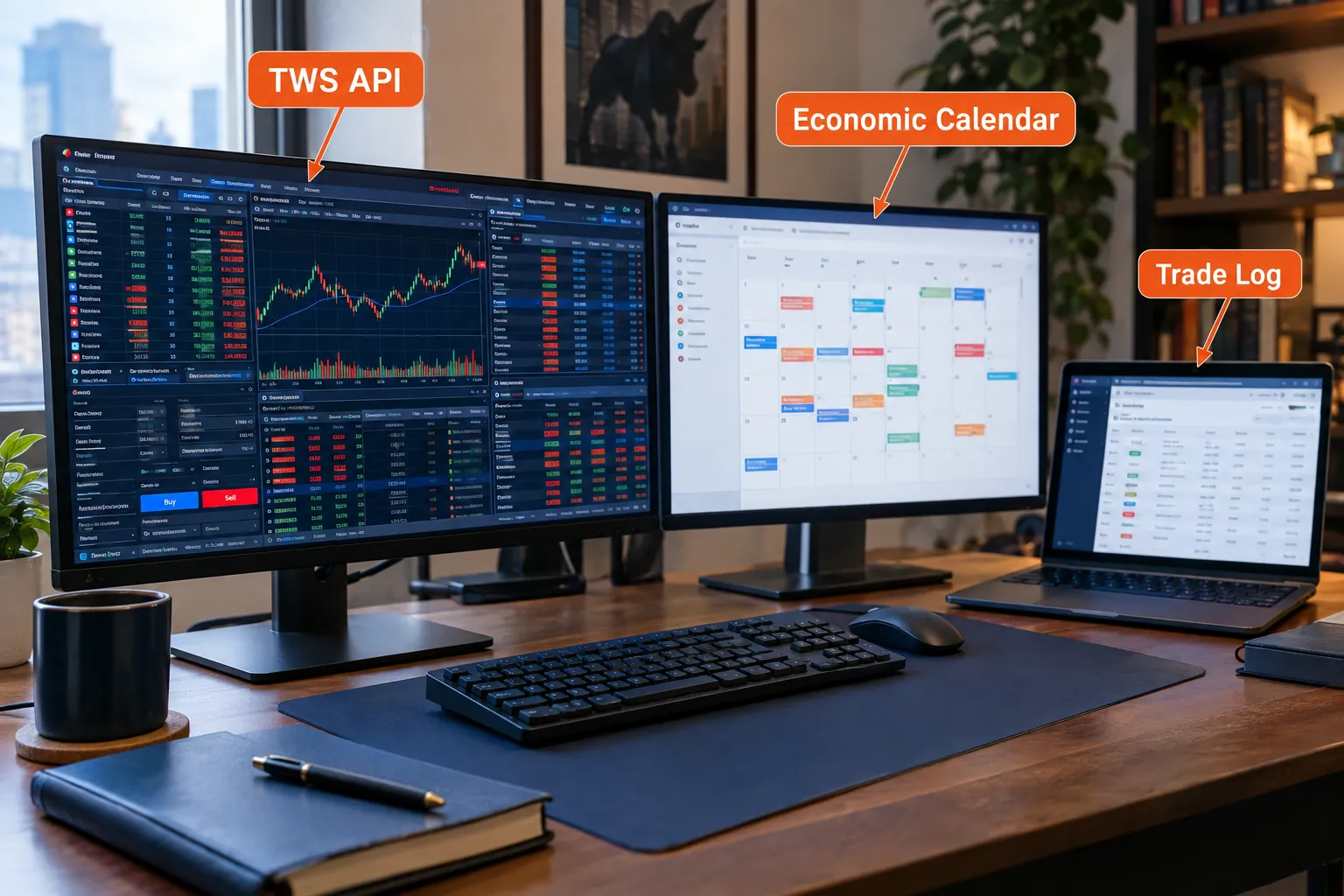
Broker-level checks. Interactive Brokers offers pre-trade risk checks and margin alerts inside Trader Workstation, plus a free education hub, IBKR Campus. Developers can build their own pre-trade logic, like a custom daily loss limit alert, on the TWS API.
Prop firms are the other structural option. A funded capital arrangement means someone else's rules, usually a hard daily loss limit and a maximum drawdown, get enforced automatically at the account level instead of relying on your own willpower. Pick one whose rules you can verify in writing, not just a marketing page. Our ranking of the top prop firm picks for 2026 compares the drawdown rules that decide most failures, and how prop firms make money explains why those rules exist.
Trading checklist templates and apps fill the middle ground: a trading checklist PDF free download, a trading checklist Excel sheet with your own formulas, or a dedicated trading checklist app on your phone. Individual traders share their personal versions online, which are worth reading for ideas but never worth copying line for line without adjusting the position sizing math to your account.
For more on avoiding the single most expensive beginner error, read the position sizing mistake that wipes out 90% of new traders, and for building the edge a checklist is supposed to protect, see how to find a trading edge before you risk a single dollar. A trading journal template is the natural companion to any checklist, since the checklist stops a bad trade and the journal explains why you almost made it anyway.
Final Verdict: does a trading checklist with AI prompts work?
A trading checklist works when it's short, specific to your holding period, and paired with at least one prompt built to argue against you, not for you. Paper alone is too slow to update and too easy to skip. AI alone, prompted badly, just hands you confirmation bias with better grammar. The combination, a written checklist plus a hostile-witness AI prompt run before every entry, is the setup that actually holds up when the tape gets choppy.
The seven prompts in this piece cost nothing beyond a free AI chat tier, and the discipline to run all seven before every trade, no skipping the uncomfortable ones. That's the whole system. Systems over hacks, every single time.
Stuck choosing between a dozen AI trading tools that all claim to "optimize" your edge?
FullStack Alpha has tested 200 AI stock tools and sorted them by category, price, and what they actually do, so you don't have to download six apps to find one worth keeping.
We test the tools. You get the verdict.
One email a week. What we tested, what scored, and what we'd skip. Written for traders, not for clicks.
Frequently asked
More from FullStack Alpha