

Short on time? The Firstrade Alpha Score scorecard breaks the 65/100 down by pillar, with pricing and the verdict, in about 90 seconds.
See the score
Firstrade fees on U.S. stocks, ETFs and options add up to almost nothing, and the handful of charges that survive are small, specific, and easy to see coming.
Quick Answer
Firstrade fees on online U.S. stocks, ETFs and options trades are $0, including $0 per options contract, per the broker's pricing schedule updated September 22, 2026. The costs left standing are narrow: a $0.02 per contract options regulatory fee, the standard SEC fee on stock sales, a $19.95 short-term mutual fund redemption charge, and margin rates that run from 8.25% to 12.25% depending on balance size. There's no published account minimum or maintenance fee, but wire transfers and phone-assisted orders still cost real money. For a cost-conscious options trader, Firstrade fees rank among the lowest of any full-service U.S. broker. The trade-off shows up in the platform, not the price tag.
Key Takeaways
- Firstrade charges $0 commission on online U.S. stocks, ETFs and options, plus $0 per options contract, per its September 22, 2026 pricing update.
- The only real options charge is a $0.02 per contract Options Regulatory Fee (ORF), passed through from Apex Clearing since July 1, 2026, and labeled "TRAN FEE" on your confirmation.
- Selling stock still triggers the SEC's transaction fee: $0.00002060 per dollar sold, or $20.60 per $1 million in proceeds, effective April 6, 2026.
- Margin balances run from 8.25% (above $1 million) to 12.25% (below $25,000), built off an 11% base rate set September 16, 2026.
- Redeeming a mutual fund within 90 days, or below $500 without closing the position, triggers a flat $19.95 fee.
- Broker-assisted phone orders run $19.95 for stocks and $19.95 plus $0.50 per contract for options, a solid reason to never call it in.
- Firstrade's Alpha Score lands at 65 out of 100: a 16/20 on Price-to-Value, dragged down by a 9/20 Community Verdict.
What Are Firstrade Fees for Stocks, ETFs and Options?
Firstrade fees on online U.S. stock, ETF and options trades are $0. No commission, no per-contract charge, no exercise or assignment fee. That's the whole pitch, and it's true as written on the current schedule.
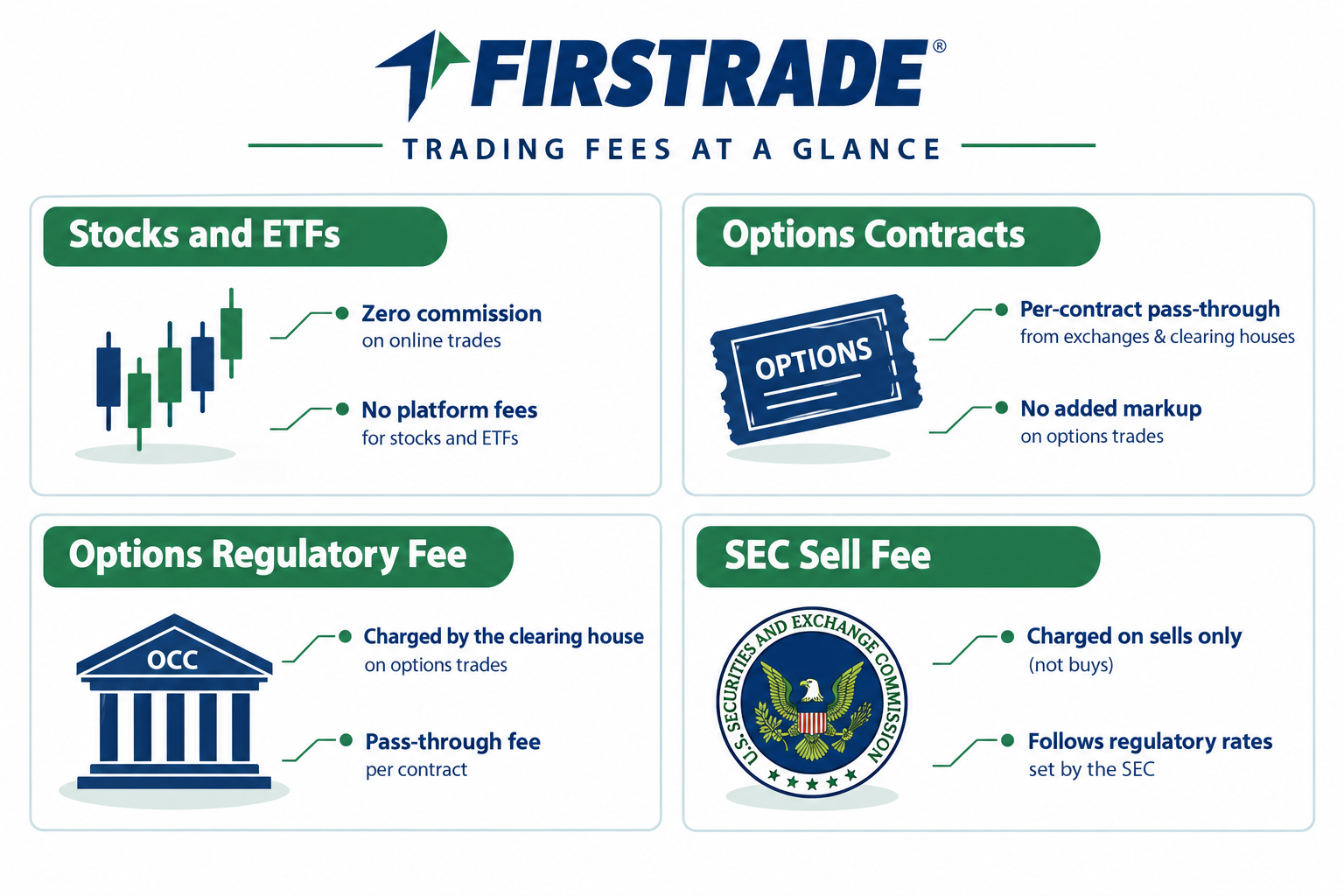
This isn't a promotional rate that reverts after 90 days. It's the standing price. Firstrade has run commission-free stock and ETF trading for years, and it extended that to options with zero base commission and zero per-contract cost. If you've been paying $0.65 a contract somewhere else, that adds up fast once you're trading more than a handful of contracts a month.
Is Firstrade Really Commission Free?
Yes, on the trades that matter most to a self-directed trader: online stocks, ETFs, options, and even no-transaction-fee mutual funds. "Commission free" doesn't mean "fee free," and Firstrade is upfront about the difference once you read past the headline number.
Two pass-through charges still apply, and neither one is a Firstrade markup:
- Options Regulatory Fee (ORF): $0.02 per contract, charged by Apex Clearing (Firstrade's clearing firm) as of July 1, 2026, and shown as "TRAN FEE" on your trade confirmation.
- SEC transaction fee: $0.00002060 per dollar of proceeds on sell orders, or $20.60 per $1 million sold, set April 6, 2026.
Both are regulatory pass-throughs every U.S. broker collects in some form. They're not proof Firstrade fees are secretly higher than advertised. They're proof the SEC and the options exchanges still need to get paid, and Firstrade isn't hiding that fact in fine print.
Firstrade Options Fees, Contract by Contract
For a trader running a real options book, this is the section that matters. Firstrade fees for options trading are $0 commission and $0 per contract on the base rate. The only line item you'll see is that $0.02 ORF pass-through, which on a 10-contract spread costs you 20 cents.
Compare that to a broker charging $0.65 per contract. Trade 50 contracts a month and you're paying $32.50 a month there versus roughly a dollar at Firstrade. That's the entire argument for zero commission options and no contract fee options as a category, and Firstrade is one of the cleanest examples of it. Pair that pricing with a real options flow scanner or a strategy builder like OptionStrat and you've got a genuinely cheap options broker setup without giving up analytical firepower.
How Does Firstrade Afford Zero Options Contract Fees?
Firstrade, like almost every $0-commission broker, earns money on payment for order flow (PFOF): market makers pay the broker to route your orders to them, in exchange for handling the execution. That's the honest answer, and it's worth naming instead of pretending the fee structure is a charity project.
Here's the mechanism in plain terms. When you place a market or marketable limit order, Firstrade routes it to a market maker instead of directly to an exchange. The market maker profits on the bid-ask spread, and shares part of that with the broker. You get $0 commission. The market maker gets order flow. Firstrade gets paid without billing you directly.
The trade-off is real, and it's not free in the way it looks free. PFOF can mean slightly worse fill prices than you'd get on a direct-to-exchange order, especially on wider-spread options contracts. For a trader doing a handful of trades a month, the fill-quality gap rarely outweighs the commission you're saving. For a high-frequency trader running hundreds of contracts, it's worth watching your execution quality, not just your Firstrade fees.
This is a discipline beats prediction situation. You can't predict your exact fill on every order. You can control whether you're checking your fill price against the quoted spread before you assume $0 commission means $0 cost. That's process over prediction, applied to a broker statement instead of a chart.
What Account Fees Should You Watch With Firstrade?
Beyond trading, Firstrade fees show up in a short list of account-level charges: mutual fund redemptions, margin interest, wire transfers, and broker-assisted orders. None of them are hidden, but none of them are $0 either.
Firstrade Account Minimum Requirements
There's no published account minimum on Firstrade's current schedule to open a standard cash account. That's a real advantage if you're funding a small account, especially with the old $25,000 pattern-day-trading gate gone as of mid-2026 and small accounts now walking through the same door as everyone else.
A margin account is a different story. Margin trading always carries risk beyond your deposit, and Firstrade's margin rates apply regardless of account size once you're borrowing. If you're new to margin, treat position sizing the same way you would in any leveraged account: know your stop loss before you know your upside.
Firstrade Wire Transfer Fees and Transfer-Out Charges
Wire transfers and account transfers are two of the more commonly searched Firstrade fees, and for good reason: this is where a "free" broker can still cost you money on the way out. Firstrade's published schedule lists broker-assisted and specialty service charges separately from trading commissions, so check the current fee page before you initiate a wire or a full account transfer (ACAT) to another firm.
The practical rule: online electronic funding (ACH) is typically the cheapest way to move money in and out. Wires and paper processes cost more everywhere in the brokerage industry, not just at Firstrade. If you're transferring out entirely, confirm the current transfer-out charge before you request it, since these numbers change and Firstrade's own site is the source of record.
Firstrade Mutual Fund Fees and Expenses
Firstrade lists load funds, no-load funds and no-transaction-fee (NTF) funds as free to trade online. That's a genuinely strong number for a buy-and-hold investor who wants index or sector fund exposure without a per-trade charge.
The catch sits in the redemption window, and it's a real one:
- Redeem within 90 days of purchase: $19.95 flat fee.
- Redeem below $500 without closing the entire position: $19.95 flat fee.
- Redeem the whole position, even if it's under $500: no fee.
Translation: mutual funds are not a short-term trading vehicle at Firstrade, or almost anywhere else. Buy them, hold them, and if you're getting out, get out in full rather than nibbling at a small balance.
Firstrade Margin Rates
Firstrade's margin rates run on an 11% base rate as of September 16, 2026, with effective rates that scale down as your balance grows: 12.25% on debit balances under $25,000, down to 8.25% above $1 million. That's a normal tiered structure, similar to how most full-service brokers price margin.
The takeaway for an options or swing trader: margin interest compounds daily and adds up fast if you're carrying a balance for weeks, not days. If your strategy depends on margin to size a position, run the math on carrying cost before you assume the trade's risk-reward still works once financing is included. A free position size and risk calculator will do that math faster than a napkin.
How to Avoid Firstrade Fees Altogether
Most Firstrade fees are avoidable with a few habits:
- Trade online, not by phone. Broker-assisted orders cost $19.95 for stocks and $19.95 plus $0.50 per contract for options. The online platform is free. Use it.
- Hold mutual funds past 90 days, or exit the full position instead of a partial redemption under $500.
- Fund and withdraw by ACH, not wire, whenever the timeline allows it.
- Avoid unnecessary margin balances. Interest accrues daily, and it's the one Firstrade fee that scales with time, not with trades.
- Read your trade confirmation once. The $0.02 ORF and the SEC sell fee will show up there. They're small, but "small and understood" beats "small and mysterious."
Firstrade Hidden Fees: What to Know Before You Fund the Account
"Hidden" is the wrong word here, but "easy to miss" is fair. The ORF, the SEC fee, the mutual fund redemption charge, and margin interest are all published on Firstrade's pricing page. They're just not the headline number, and a trader who only reads the marketing copy can be surprised by a line item they never noticed.
Fixed income is the other spot worth flagging. Treasury securities, municipal bonds, agency bonds, zeros and strips, and secondary-market CDs are priced on a net-yield basis, meaning Firstrade acts as principal and the price you see can include a markup or markdown. That's standard practice across the bond market, not a Firstrade-specific surcharge, but it means the "fee" isn't a line item. It's baked into the yield you're quoted.
Firstrade Fees vs Robinhood, Webull, Schwab and Fidelity
Firstrade fees compare well against nearly every major U.S. discount broker on options pricing, and hold up on stocks and ETFs across the board. The differences show up in account fees, platform depth, and how much research comes bundled in.
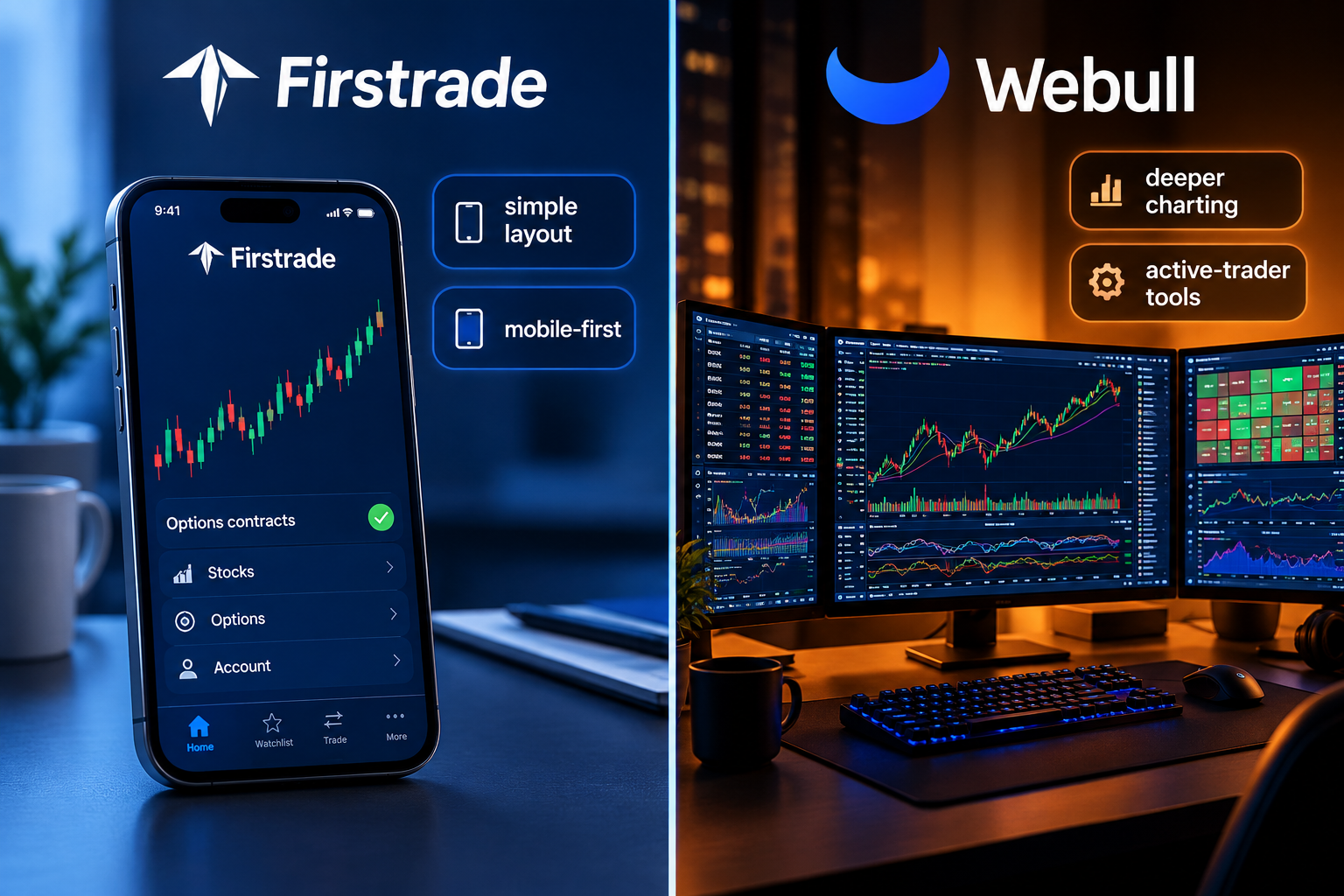
| Broker | Options Contract Fee | Notable Account Fees | Platform Depth |
|---|---|---|---|
| Firstrade | $0, plus $0.02 ORF pass-through | $19.95 short-term mutual fund redemption | Basic web and mobile, thin charting |
| Robinhood | $0 typical | No standard maintenance fee | Simple mobile-first app, limited depth |
| Webull | $0 typical | Outbound ACAT transfer fee applies | Deeper charting, active-trader layout |
| Schwab | $0.65 per contract, published rate | No account minimum; broad fee schedule | Full-service, thinkorswim tools post-merger |
Fidelity lands close to Schwab on structure: $0 commission on stocks and ETFs, a small per-contract options charge, and a research library that dwarfs Firstrade's. If research depth and account tools matter more to you than shaving pennies off contracts, Fidelity or Schwab earn their higher options cost. If your strategy is contract volume, Firstrade fees win the math every time.
Confirm current numbers on each broker's own pricing page before funding an account. Broker pricing pages update more often than review articles do.
Curious what a real fee gap looks like at your own trading volume? Run it below.
Is Firstrade Legit and Safe?
Yes. Firstrade is a FINRA-registered broker-dealer and SIPC member, which means client securities are protected up to standard SIPC limits against the firm's failure, not against market losses. Firstrade has operated as a discount brokerage since the mid-1980s, well before "zero commission" was an industry norm.
Firstrade has also earned third-party recognition for its low-cost positioning, including mentions among the best online brokers in Kiplinger's broker rankings. That kind of outside validation matters more than a broker's own marketing copy, because Kiplinger has no reason to flatter a broker that doesn't earn it.
SIPC coverage is worth restating plainly since it's commonly misunderstood: it protects your cash and securities if the brokerage itself collapses. It does not protect you from a bad trade, a stock going to zero, or a losing options position. That's on your own risk management, not your broker's insurance.
Our Top 5 Favorite Firstrade Features
Firstrade fees get the headlines, but the feature set underneath them is worth naming on its own. Here's what stands out after putting the platform through real use:
- True $0 options pricing, contract fee included. Not a promo, not a tiered plan. It's the standing rate.
- No account minimum to open. A trader funding $500 gets the same commission schedule as a trader funding $50,000.
- No-transaction-fee mutual funds. Buy-and-hold investors get a real lineup of NTF funds without a per-trade charge.
- Straightforward margin tiers. The rate table is public, scaled, and easy to find, which is more than some competitors offer.
- Decades of operating history. A broker that's survived multiple market cycles since the mid-1980s has been tested in ways a five-year-old app hasn't.
Firstrade Alpha Score Breakdown: 65/100
Firstrade earns a 65 out of 100 on the Alpha Score, our five-pillar system that scores execution quality, cost transparency, price-to-value, usability and community verdict on a 20-point scale each. The number tells the real story: elite pricing, dated everything else.
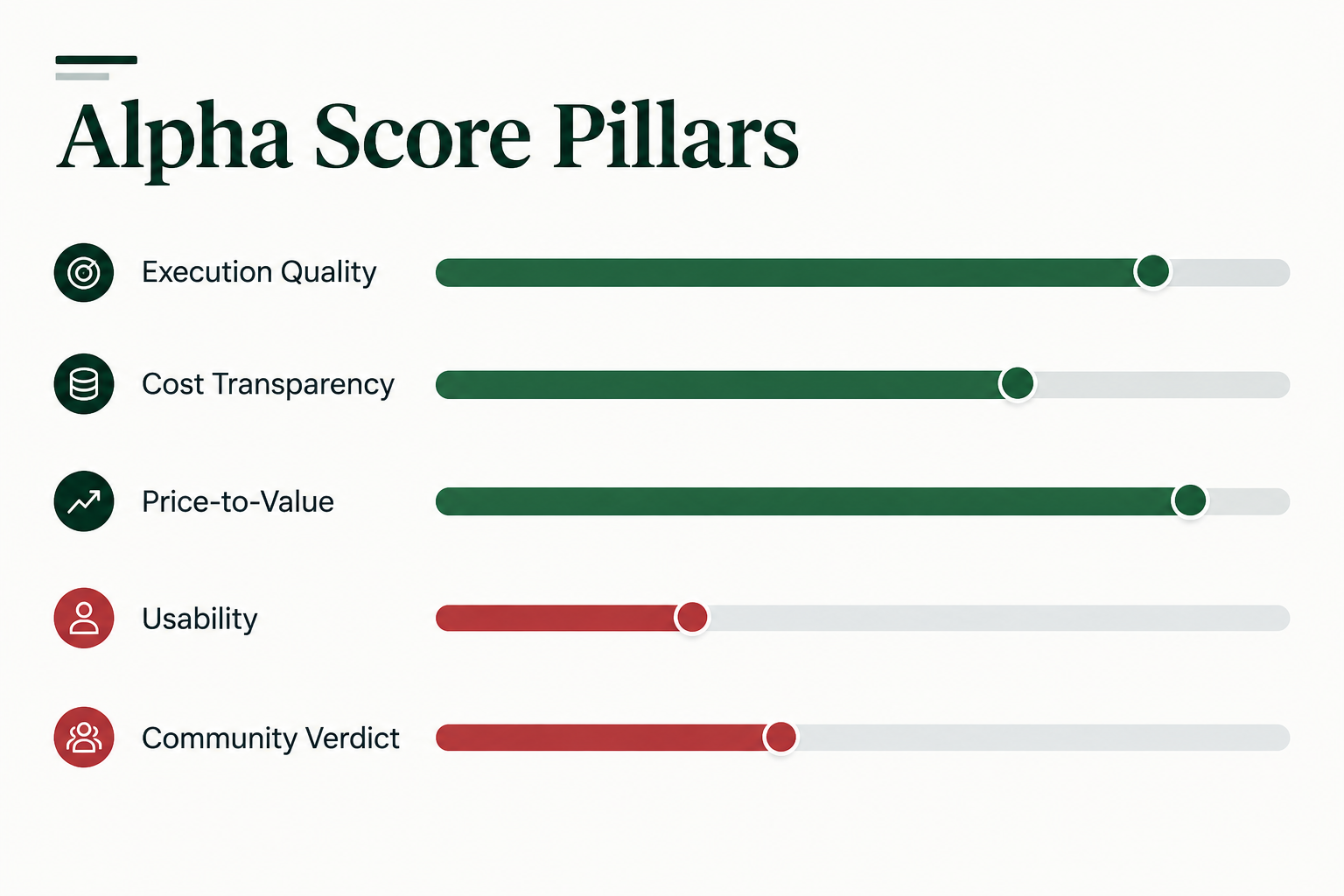
| Pillar | Score | What It Means |
|---|---|---|
| Execution Quality | 13/20 | Standard PFOF routing with limited published fill-quality data |
| Cost Transparency | 15/20 | Pass-through fees are listed but not summarized clearly upfront |
| Price-to-Value | 16/20 | Among the cheapest options pricing in the industry |
| Usability | 12/20 | Functional but visually behind newer mobile-first brokers |
| Community Verdict | 9/20 | Thin, mixed discussion across trader forums |
Execution Quality lands at 13/20, and that's a real caveat, not a footnote. Firstrade routes retail orders through payment for order flow the same way most $0-commission brokers do, and it doesn't publish the kind of price-improvement statistics that would let a trader verify fill quality independently. For casual trade volume, the gap rarely bites. For active options traders running size, it's worth checking your own fills against the quoted spread.
Cost Transparency sits at 15/20. Every fee discussed in this article is published somewhere on Firstrade's site, but they're scattered across separate pages rather than summarized in one place a new trader would find naturally.
Price-to-Value is the standout at 16/20. $0 commission, $0 per options contract, and no account minimum is a genuinely strong package, and it's the reason "is Firstrade good" keeps coming up in cost-conscious trader searches.
Usability scores 12/20, and this is the honest weak spot. The platform works, but it reads like it was built for a different decade of trader expectations: less charting depth, fewer automation tools, and a mobile app that trails the newer entrants in polish.
Community Verdict is the lowest pillar at 9/20. Reddit threads across trading subreddits mention Firstrade far less often than Robinhood, Webull, or Schwab, and when the platform does come up, sentiment leans toward "reliable but forgettable" rather than enthusiastic. Thin discussion isn't the same as bad discussion, but it means fewer independent voices are stress-testing the platform in public. See the full methodology behind how we score AI stock and trading tools for how these pillars get built.
Where Do Firstrade Fees and Features Fall Short?
Firstrade fees are not the weak point. The platform experience around them is. Three trade-offs are worth naming plainly before you fund an account.
- Charting and automation are thin. If you rely on advanced scanning or automated alerts, Firstrade's native tools won't get you there. Pair the account with a dedicated options flow scanner or a charting platform built for that job.
- Research depth trails Fidelity and Schwab. You're getting the low fees, not the analyst coverage. That's a fair trade for a self-directed trader who does independent research anyway.
- Community footprint is small. Fewer public users means fewer public bug reports, fewer public reviews, and less peer troubleshooting when something goes sideways.
None of this contradicts the pricing story. Firstrade fees remain some of the lowest available on U.S. options and stock trades. The catch is that "cheapest" and "most feature-rich" have never been the same broker, and Firstrade picked a lane and stayed in it.
Verdict: Who Saves the Most at Firstrade?
Firstrade fees make the most sense for one specific trader: someone running real options or stock volume who doesn't need a research department bundled into the account. If you're trading 20, 50, or 200 contracts a month and comparing that against a $0.65-per-contract broker, the math isn't close. Firstrade wins on price every time.
Firstrade fees make less sense for a trader who wants deep charting, automated scanning, or an active online community to troubleshoot with. That trader should weigh the savings against the platform gap honestly, not assume "cheapest" automatically means "best fit."
The next step is simple: pull up your last three months of trade confirmations from your current broker, add up what you actually paid in commissions and per-contract fees, and compare that number against what those same trades would have cost at $0. If the gap is real, it's worth acting on. If you're also hunting for the scanning or flow tools Firstrade doesn't build in, the best options flow scanners, independently tested, are a good next stop.
Systems over hacks. A cheap broker with no plan still loses money the same way an expensive one does. Cut the noise, keep the alpha.
One tool, scored five ways here. There are 200+ more in the FullStack Alpha directory, filterable by category, price and what they actually do.
Browse the directory → aistockpickerapps.com
Affiliate disclosure: this article may contain affiliate links. FullStack Alpha earns a commission on some links at no extra cost to you.
References
Pricing - https://www.firstrade.com/trading/pricing
blog.firstrade - https://blog.firstrade.com/
Broker Comparison - https://www.firstrade.com/trading/pricing/broker-comparison
Stock Market Seasonality What August And September Really Tell Investors - https://blog.firstrade.com/blog/2026/stock-market-seasonality-what-august-and-september-really-tell-investors
Press - https://www.firstrade.com/press
The Best Online Brokers And Trading Platforms - https://www.kiplinger.com/investing/wealth-management/online-brokers/605136/the-best-online-brokers-and-trading-platforms
Margin Rates - https://www.firstrade.com/trading/pricing/margin-rates
Pr190822 - https://www.firstrade.com/press/pr190822
Options - https://www.firstrade.com/trading/options
Trading - https://www.firstrade.com/trading
We test the tools. You get the verdict.
One email a week. What we tested, what scored, and what we'd skip. Written for traders, not for clicks.
Frequently asked
Topics in this teardown
Our verdict on Firstrade
Firstrade scores 65: one of the few brokers charging nothing on options contracts, built for patient investors rather than fast traders.