

SpotGamma Review 2026: Is Gamma Exposure Data Worth Paying For?
Short on time? The SpotGamma Alpha Score scorecard covers pricing, the verdict and what traders actually say, in about 90 seconds.
See the score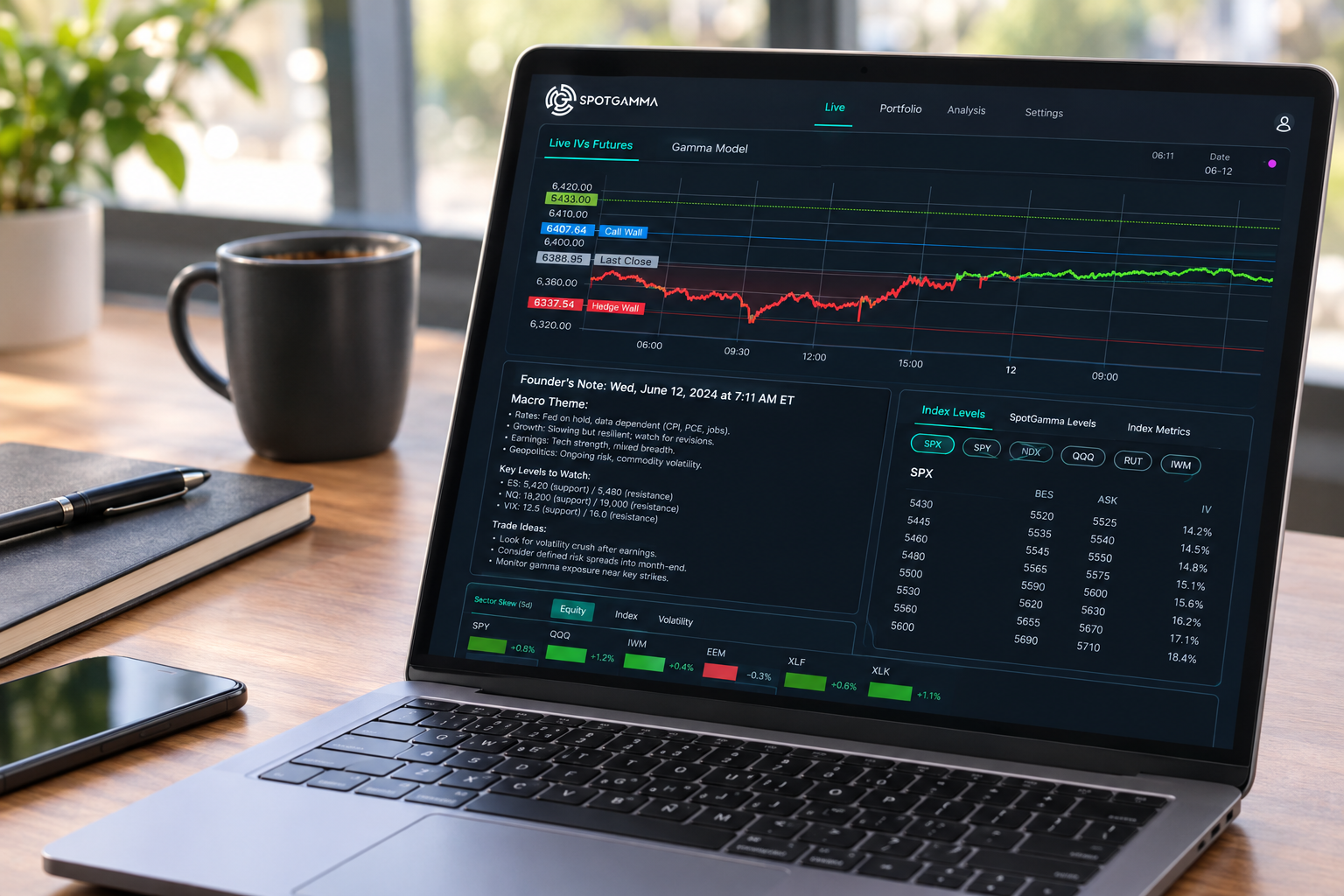
Quick answer
This SpotGamma review scores the platform at 56 out of 100 on our Alpha Score, desk-researched and last tested September 21, 2026: proceed with caution. SpotGamma's dealer-positioning levels (Call Wall, Put Wall, Vol Trigger, gamma flip) are genuinely useful for SPX, SPY, QQQ, and 0DTE traders who already read options flow, but the model is a black box, the price jumps hard at the $299/mo Alpha tier, and there's no independent, audited track record backing the levels.
SpotGamma review: key takeaways
- Standard tier runs $89/mo (or $67/mo billed annually), covering indices only. Alpha tier runs $299/mo ($224/mo annually) and is the only way to get full real-time HIRO and TRACE.
- Equity Hub covers 3,500+ stocks, not just SPX, SPY, and QQQ, but that breadth sits on the Pro tier and up, not the entry Standard plan.
- No iOS app exists. SpotGamma is web-only, which is a real problem if you trade off your phone during the day.
- No Trustpilot profile. Community evidence is Reddit-only, which cuts both ways: less astroturfing, less volume.
- Brand searches are up roughly 50% year over year, which tracks with 0DTE options volume becoming a mainstream retail habit rather than a niche.
- Institutional pricing starts at $1,999/mo, sales-assisted only, aimed at desks that want custom gamma tools.
- TRACE and full real-time HIRO are locked behind the $299/mo Alpha tier. If you only need daily key levels, you're overpaying at Alpha.
What does SpotGamma actually do?
Every SpotGamma review should start by explaining gamma exposure without the jargon, so here it is.
SpotGamma models dealer gamma exposure, meaning it estimates how much stock market makers need to buy or sell to stay hedged as an index or stock moves, then translates that into levels you can trade around. Think of it as a weather map for market makers instead of clouds.
Here's the mechanic in plain English. When you buy a call option, the dealer on the other side of that trade is short the call. To stay neutral, the dealer typically buys the underlying stock. When the stock rises, the dealer needs to buy more (that's positive gamma pinning price toward a level). When the stock falls, the dealer needs to sell more (that's negative gamma, which accelerates a drop). Multiply that across every open contract on SPX, SPY, and QQQ, and you get a map of where dealers are forced buyers or forced sellers. That map is what SpotGamma sells.
Each feature maps to a specific trading benefit:
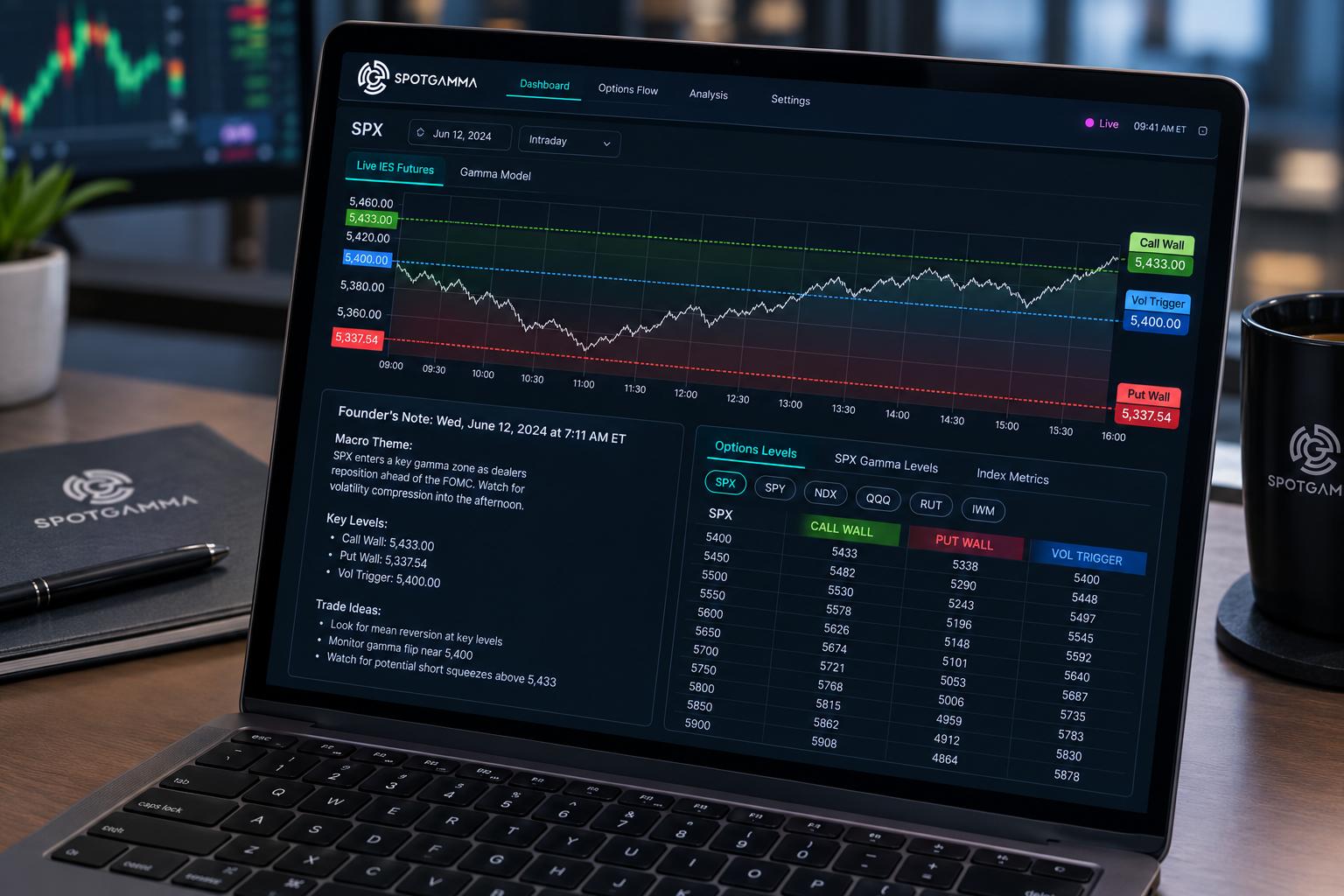
- Key levels (Call Wall, Put Wall, Vol Trigger): give you a dealer-positioning map before the open, so you know where hedging flows are likely to slow a move down or speed it up.
- HIRO: shows hedging pressure updating in real time during the session, not just as a static morning chart, so you can see flow shift before price confirms it.
- Equity Hub: extends the same gamma framework to 3,500+ single stocks, useful if you trade single-name options around earnings, not just index products.
- TRACE: a real-time gamma visualization tool for watching the flip level move intraday, which matters most for 0DTE traders where the gamma profile can change by the hour.
- Founder's Note and twice-weekly Q&As: a daily written take on positioning plus live access to ask the team why a level moved, which shortens the learning curve for a genuinely dense subject.
The honest caveat: none of this tells you what to buy. SpotGamma gives you a map of dealer flows, not a signal. If you're looking for a "buy here, sell here" service, this isn't it, and the company doesn't market it that way.
SpotGamma review: How do the key levels and HIRO work?
The four core levels (Call Wall, Put Wall, Vol Trigger, gamma flip) are the product's entire reason to exist, and each one answers a different question about where the tape might stall, snap, or run.
Call Wall: the strike with the heaviest call open interest, which tends to act like resistance because dealers are short those calls and sell into rallies to stay hedged. Put Wall: the mirror image on the downside, the strike where dealer put positioning tends to slow a decline. Vol Trigger: the level where dealer hedging behavior flips character, often the line between an orderly tape and a choppy one. Gamma flip: the point where the market as a whole moves from dealers being net long gamma (calm, mean-reverting price action) to net short gamma (moves accelerate instead of getting absorbed).
Read this before the open, not during power hour, because levels published pre-market reflect the previous session's close. A practical routine looks like this:
- Check where spot price sits relative to the gamma flip. Above it, expect calmer, more mean-reverting price action. Below it, expect choppy tape and bigger swings.
- Note the Call Wall and Put Wall as your rough day-range brackets, not hard ceilings.
- Watch HIRO once the market opens to see if real-time hedging flow confirms or contradicts the static levels.
- If HIRO shows dealers turning net buyers on a dip that your Put Wall predicted, that's the setup working as designed. If it doesn't confirm, don't force the trade.
Decision rule: if you're not checking HIRO intraday, you're only using half the product, and you're paying for a real-time tool while using it like a static PDF.
Has SpotGamma been backtested?
A SpotGamma review that quotes a hit rate is quoting marketing. Here is what exists and what does not.
There's no independently audited backtest of SpotGamma's levels that we could verify, and the company's own marketing leans on the Founder's Note and case examples rather than a published, third-party-verified hit rate. That's the single biggest transparency gap in the product.
A few things worth knowing before you take any gamma-flip number as gospel:
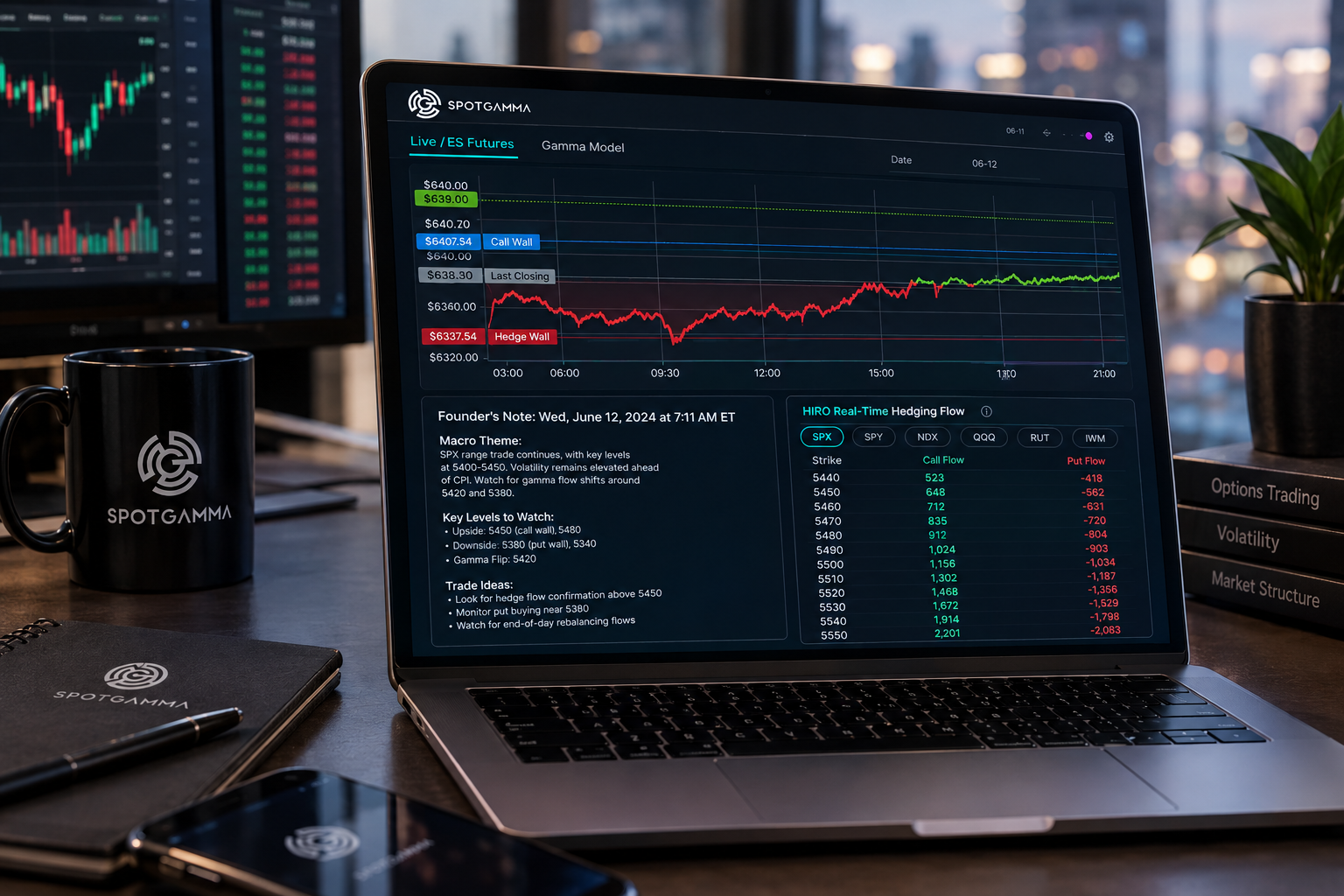
- Different services publish different flip levels for the same day. SpotGamma, Menthor Q, and other gamma shops don't agree on the exact strike, because each firm makes its own assumptions about open interest attribution, dealer positioning by counterparty, and how to treat 0DTE flow. That's not a scandal, it's the nature of a modeled estimate, but it means you should treat any single number as directional, not exact.
- Founder's Note examples read like hindsight. When a level "called" a reversal, it gets featured. Days where the level missed tend not to get the same spotlight. That's normal marketing behavior, but it's not evidence.
- Run your own two-week check. Log SpotGamma's published SPX gamma flip each morning against where price actually changed character that session. Reddit users who have done this describe the level as directionally useful but not a precise pin, and on 0DTE-heavy expiration days the level can move during the session. Two weeks of your own notes beat any hit rate someone else publishes.
We're not going to invent a hit-rate percentage SpotGamma hasn't published, and neither should you accept one from a third party who hasn't shown their math. If a site tells you SpotGamma's flip level is right "87% of the time," ask them to show the methodology. If they can't, that number is marketing, not data.
For a deeper look at how flow-based signals hold up under scrutiny, our options flow scanners guide walks through what a real backtest should include.
What does SpotGamma integrate with?
Integrations decide whether SpotGamma lives on your chart or in another tab, and this SpotGamma review checked each one.
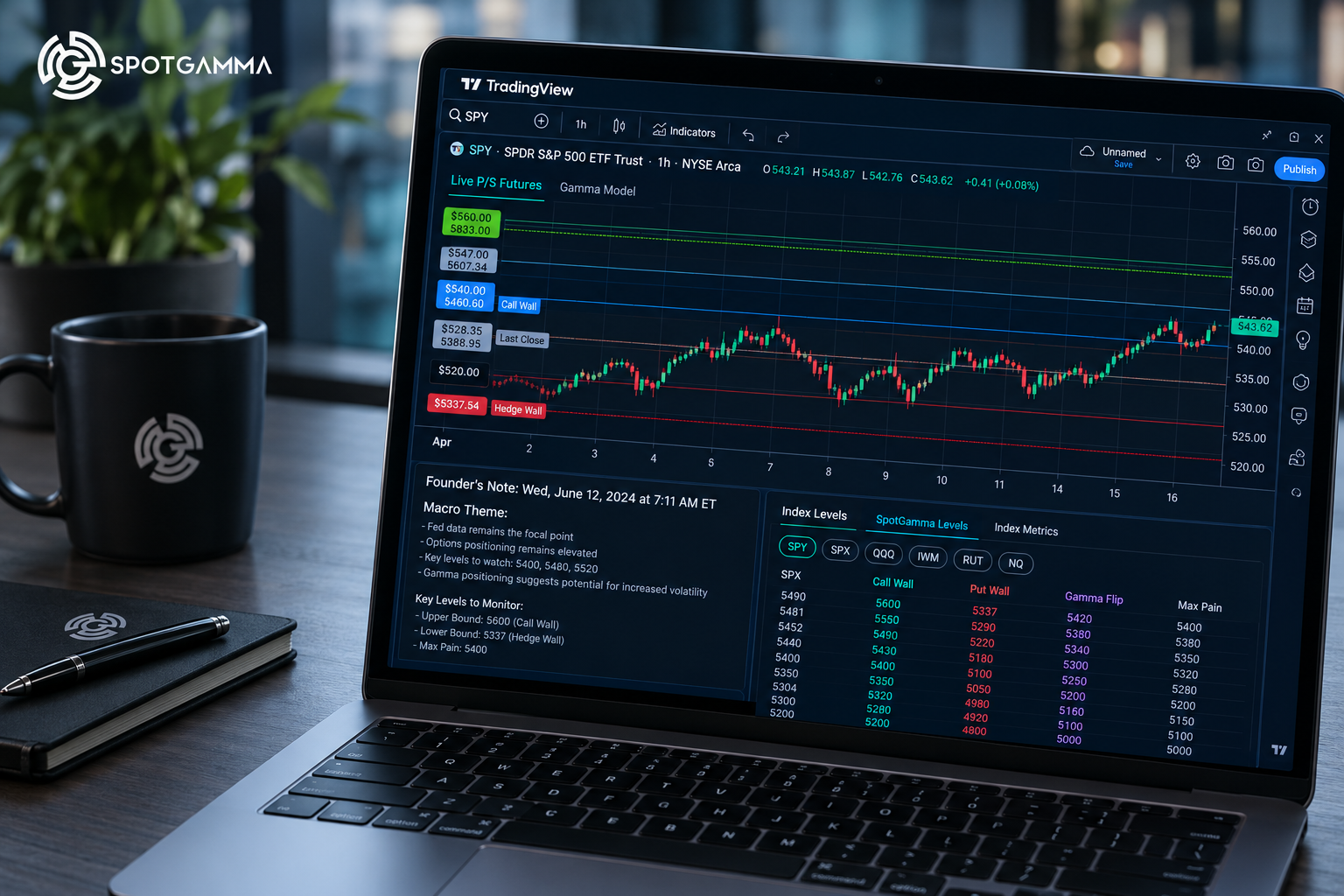
SpotGamma is web-only and plugs its key levels into TradingView, but it doesn't have a native mobile app, which matters if your process depends on checking levels between meetings.
The integration list, as of testing:
- TradingView: SpotGamma's key levels can be plotted directly on TradingView charts, which is the single most useful integration for traders who already live on that platform. If you're comparing chart platforms generally, our TradingView vs. Finviz breakdown is a useful side read.
- Discord: the community and alert channel, where a lot of the "how do I read this" education happens in real time.
- Equity Hub: the 3,500+ stock database, browser-based, no separate app.
- TRACE: browser-based real-time gamma visualization, Alpha tier and up.
- Alerts: configurable notifications for level breaches, delivered through the platform and Discord, not push notifications on a mobile app because there isn't one.
Common mistake: assuming you can run SpotGamma the way you'd run a mobile-first scanner, checking it from your phone during the trading day. You can't, not natively. If you're a desk trader at two monitors, this is a non-issue. If you trade from your phone during a commute or a lunch break, plan around it.
How much does SpotGamma cost, and which tier makes sense?
Pricing is where a SpotGamma review gets practical, with the caveat that promo pricing changes and you should confirm at checkout.
SpotGamma runs five tiers, and the honest starting point is that the marketing page and the checkout page don't always show the same numbers, so the checkout-verified price is what you'll actually pay.
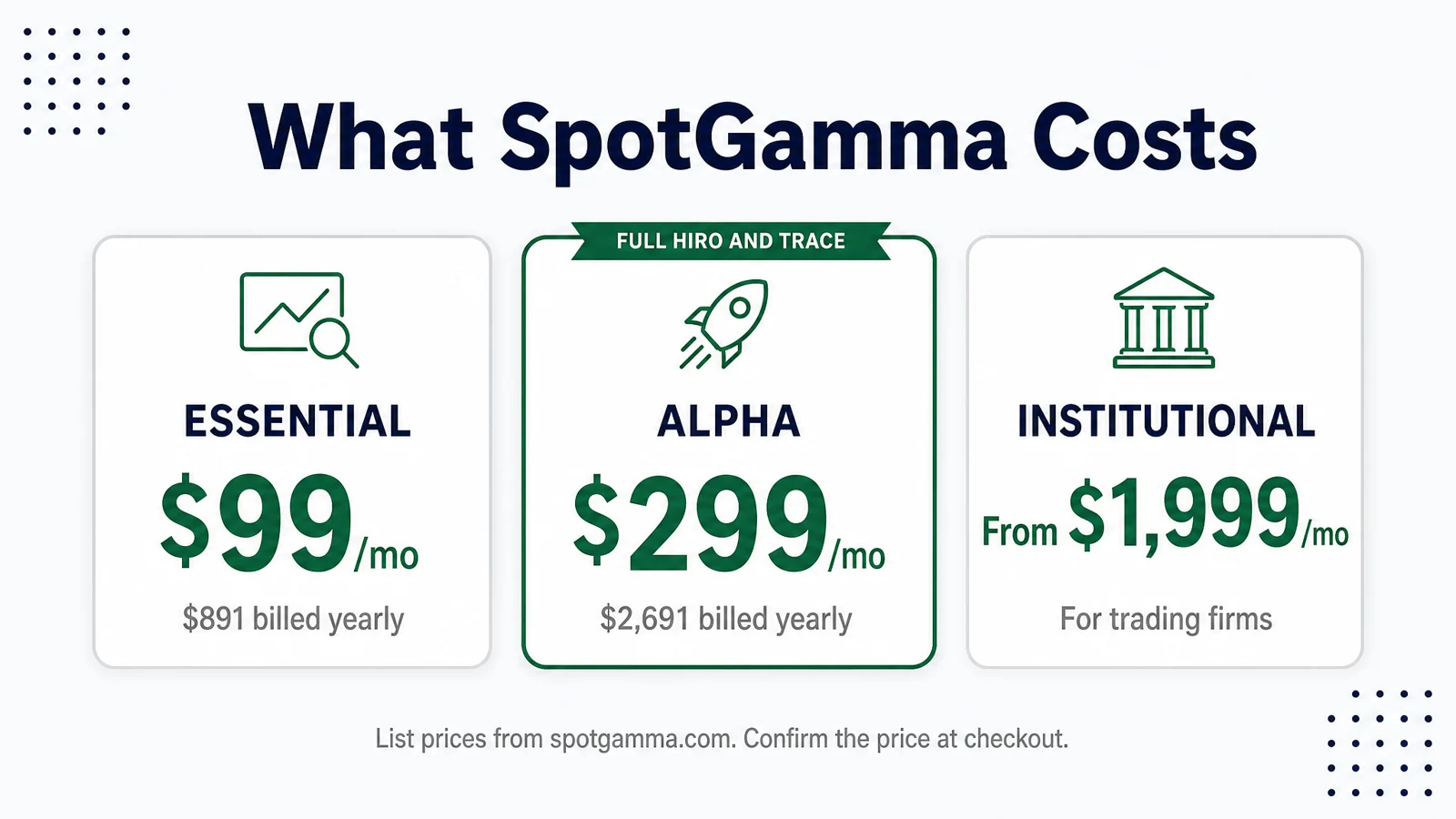
As of September 21, 2026, the checkout-verified structure is:
- Essential: $99/mo or $891/yr (about $74.25/mo)
- Alpha: $299/mo or $2,691/yr (about $224.25/mo)
- Institutional: from $1,999/mo, sales-assisted, custom desk licenses
The marketing/promo ladder still visible on the subscribe page shows a slightly different set of names and numbers:
- Standard: $89/mo (first-month promo often near $17), indices-only
- Pro: $129/mo (first-month promo often near $25), adds the 3,500+ stock Equity Hub
- Alpha (marketing card): shown between $249 and $299/mo depending on the current promo
Here's the practical decision rule. Choose Standard/Essential if you only trade SPX, SPY, and QQQ and you want the daily key levels without the single-stock database. Choose Pro if you regularly trade single-name options and want Equity Hub's 3,500+ stock coverage. Choose Alpha if you're an active intraday or 0DTE trader who needs real-time HIRO and TRACE, because those two tools don't exist meaningfully below that tier. Skip Institutional unless you're licensing for a desk or fund, since it's sales-assisted and priced for that use case.
The jump from Standard/Essential to Alpha is roughly 3x the monthly cost. That's the tier structure's biggest weakness: the tools that make SpotGamma genuinely differentiated (TRACE, full real-time HIRO) sit behind the most expensive retail plan, not the middle one.
Annual billing saves roughly 25% across every tier, and periodic 50%-off annual promos do run, so if you decide to commit, wait for one rather than paying the sticker rate on day one.
SpotGamma vs Unusual Whales vs Menthor Q vs Helios
No SpotGamma review is complete without the alternatives, so here is the side-by-side.
Here's how SpotGamma stacks up against the other names traders bring up in the same breath, on the dimensions that actually change a subscription decision.
| Tool | Data type | Starting price | Transparency | TradingView integration | Best for |
|---|---|---|---|---|---|
| SpotGamma | Dealer gamma exposure, key levels, HIRO real-time hedging | $89/mo (Standard) to $299/mo (Alpha) | Model is proprietary; flip levels not independently audited | Yes, key levels on chart | Index and 0DTE traders who want a dealer-positioning map |
| Unusual Whales | Options flow, dark pool prints, congressional trading, broader alt data | Lower entry tier under $100/mo | Flow data is observable (trade prints); interpretation still subjective | Limited, mostly web dashboard | Traders who want raw flow and broad market alt-data in one place |
| Menthor Q | Gamma exposure and key levels, competing model to SpotGamma | Comparable subscription range | Also proprietary; publishes different flip levels than SpotGamma for the same day | Yes | Traders comparing gamma models rather than trusting a single source |
| Helios | AI-driven market structure signals, positioning overlays | Varies by plan | Newer entrant, less public scrutiny | Varies | Traders exploring newer positioning tools alongside an established one |
The category-defining fact here: SpotGamma and Menthor Q model the same underlying phenomenon and don't always agree on the flip level for the same trading day. That's not a reason to avoid either one, it's a reason to treat the number as an estimate, not a fact carved in stone. If you want a wider look at how flow tools differ by data source, the options flow scanners guide breaks down the category further.
What do real users say about SpotGamma?
A SpotGamma review built from the Founder's Note is a sales page. Here is what traders say on Reddit.
Real user sentiment on SpotGamma is split along a predictable line: traders who put in the time to learn the levels tend to defend the product, while traders who expected a plug-and-play signal tend to bail within the first month.
Across r/options and r/thetagang, the recurring praise pattern centers on the key levels holding up during high-volatility sessions, particularly around FOMC days and monthly expiration, when dealer hedging flows genuinely do move price in ways the levels anticipate. Traders in Discord communities that overlap with SpotGamma's own also describe the twice-weekly Q&As as the thing that got them from confused to functional faster than reading the documentation alone.
The recurring criticism pattern is just as consistent: the price jump to Alpha for real HIRO access, complaints that the free daily commentary reads more like a sales funnel than research, and a general "I didn't get it for the first month" learning curve that some traders describe as steep enough to make them question the subscription before it paid off. A few threads note that SpotGamma's flip level and a competing service's flip level disagreed on the same day, which is exactly why the two-week self-test above is worth running before you pay for a year.
The gap between the praise and the criticism is the finding, not a contradiction to resolve. SpotGamma rewards traders who treat it as a positioning framework to learn over weeks. It frustrates traders who wanted a dashboard that tells them what to do on day one.
Where does SpotGamma fall short?
The honest half of any SpotGamma review lives here.
SpotGamma's biggest weakness is that its core model is a black box wrapped in confident marketing, and the second-biggest weakness is that the price of the genuinely useful real-time tools sits well above the entry tier most new subscribers actually buy.
Specific, named problems:
- Black-box model. SpotGamma doesn't publish the exact methodology behind its gamma exposure calculation, and different services (SpotGamma, Menthor Q) publish different flip levels for the same underlying on the same day. You're trusting a proprietary estimate, not verifying one.
- Hindsight marketing in the Founder's Note. The examples that get highlighted tend to be the ones where the level called the move. That's survivorship bias in the marketing copy, and it makes the product look more predictive than any single day's outcome proves.
- A real learning curve. Expect weeks, not days, before the levels start feeling intuitive enough to trade around confidently. If you're new to options market structure, budget time before you budget capital.
- TRACE and full real-time HIRO sit behind the $299/mo Alpha tier. The tools that make this product different from a static morning PDF cost three times the entry price.
- No mobile app, no Trustpilot profile. Community evidence is Reddit-only, which means you're relying on a narrower slice of feedback than most SaaS products this size would have.
None of this makes SpotGamma a bad product. It makes it a product that needs an honest score, not a hype writeup.
SpotGamma Alpha Score breakdown
This SpotGamma review scores five pillars at 20 points each, and the breakdown sits before any affiliate link on purpose.
SpotGamma scores 56 out of 100 on the Alpha Score, our five-pillar framework (20 points each) built from desk research across six public sources, not vendor claims. Last tested September 21, 2026.
| Pillar | Score | Why |
|---|---|---|
| Signal Quality | 13/20 | The levels are directionally useful, especially around expiration and high-volatility sessions, but there's no independently audited track record and different gamma providers disagree on the same day's flip level. |
| Transparency | 10/20 | The core model is proprietary with no published methodology detail. Founder's Note examples read as selectively chosen after the fact. |
| Price-to-Value | 11/20 | Entry pricing is reasonable for index-only levels, but the tools that justify a premium subscription (TRACE, full HIRO) sit at $299/mo, a roughly 3x jump from Standard/Essential. |
| Usability | 12/20 | Real learning curve, no mobile app, web-only. TradingView integration and Discord support ease the ramp, but this isn't a first-week win. |
| Community Verdict | 10/20 | No Trustpilot profile. Reddit sentiment is genuinely split between traders who defend it after putting in the work and traders who bail before the learning curve pays off. |
| Total | 56/100 | Proceed with caution. |
This is a "learn it before you pay for the top tier" product, not a "subscribe and profit" product, and the score reflects exactly that.
SpotGamma review FAQ
What is SpotGamma?
SpotGamma is a paid options-market analytics service that models dealer gamma exposure and hedging flows to publish key levels (Call Wall, Put Wall, Vol Trigger, gamma flip) for SPX, SPY, QQQ, and 3,500+ single stocks, aimed at active options and index traders.
Is SpotGamma worth it?
It's worth it if you already trade SPX, SPY, QQQ, or single-name options actively and you're willing to spend weeks learning to read the levels against real price action. It's not worth it if you want a signal that tells you what to buy, since SpotGamma explicitly doesn't do that.
What is HIRO?
HIRO is SpotGamma's real-time hedging impact indicator, showing dealer hedging flow as it happens during the trading session rather than as a static pre-market chart. Full real-time HIRO access requires the $299/mo Alpha tier.
SpotGamma vs Unusual Whales, which is better?
SpotGamma focuses specifically on dealer gamma exposure and key levels; Unusual Whales covers broader options flow, dark pool prints, and alternative data across a wider range of tickers. Traders who want a dealer-positioning map choose SpotGamma; traders who want raw flow across more of the market often add Unusual Whales too.
How much does SpotGamma cost?
Checkout-verified pricing as of September 21, 2026 runs Essential at $99/mo ($891/yr), Alpha at $299/mo ($2,691/yr), and Institutional from $1,999/mo. The marketing page also shows a Standard tier at $89/mo and a Pro tier at $129/mo with promotional first-month discounts.
Is there a free version of SpotGamma?
No. SpotGamma has no permanent free tier. Some promotions offer a discounted first month (as low as roughly $17 to $49 depending on the tier and promo), but there's no ongoing free plan.
What does gamma flip mean?
The gamma flip is the price level where the market as a whole shifts from dealers being net long gamma, which tends to dampen volatility and produce mean-reverting price action, to net short gamma, which tends to amplify moves in either direction. Trading above versus below this level often changes how choppy the tape feels.
Does SpotGamma work with TradingView?
Yes. SpotGamma's key levels can be plotted directly onto TradingView charts, which is currently its main third-party integration. There's no equivalent native mobile app.
Is SpotGamma good for 0DTE trading?
It is built for it. Index key levels, HIRO and TRACE all target intraday SPX and SPY positioning. The catch is that full real-time HIRO and TRACE sit on the Alpha tier, so budget for that before assuming the entry plan covers 0DTE.
Who founded SpotGamma?
SpotGamma was founded by Brent Kochuba, a former options market professional who writes the daily Founder's Note. The company is based in the United States and publishes its team on spotgamma.com.
What are the differences between SpotGamma and MenthorQ?
Both publish dealer gamma levels for indices and single stocks, but they use different models, so their gamma flip and key levels rarely match exactly. SpotGamma leads on HIRO real-time flow and its Founder's Note; MenthorQ is usually cheaper and integrates its levels into TradingView. Many traders run both for a month and keep the one whose levels held up on their own charts.
Why do most options traders lose money?
Commonly cited estimates put the share of losing retail options traders near 90 percent, mostly from buying short-dated out-of-the-money contracts, oversizing and trading without a plan. Positioning tools like SpotGamma add context, but they cannot fix position sizing or a missing stop.
SpotGamma review: final verdict
Subscribe if you're an experienced SPX, SPY, QQQ, or 0DTE trader who already reads options flow and wants a dealer-positioning framework to layer onto price action, support and resistance, and your existing setup criteria, and you're willing to spend real time learning the levels before expecting an edge. Skip it if you're new to options, want a buy-sell signal, or you're not ready to pay $299/mo for the tools (TRACE, full HIRO) that actually differentiate this from a free daily gamma chart floating around social media.
One next step: start with the Standard or Essential tier for a full month, track how often the Call Wall, Put Wall, and gamma flip line up with actual intraday behavior on your own watchlist, and only upgrade to Alpha once you can point to specific sessions where the static levels weren't enough. Paper trade the levels first. Data over noise, discipline beats prediction, and no gamma model replaces a stop loss.
One tool, scored five ways. There are 200+ more in the FullStack Alpha directory, filterable by category, price, and what they actually do.
Browse the directory â aistockpickerapps.com
Sources checked for this SpotGamma review
- SpotGamma
- SpotGamma subscribe and pricing page
- SpotGamma Equity Hub
- SpotGamma affiliate agreement
- r/options thread on SpotGamma (praise)
- r/options thread on SpotGamma (Founder's Note critique)
- r/options thread on HIRO examples
- r/options comment on gamma flip disagreements
- r/Daytrading comment on alternatives
- Unusual Whales pricing
- Menthor Q
- TradingView
This post contains affiliate links; we may earn a commission at no extra cost to you.
We test the tools. You get the verdict.
One email a week. What we tested, what scored, and what we'd skip. Written for traders, not for clicks.