

Is Public.com Safe? Every Check That Matters Before You Fund
Short on time? The Public.com Alpha Score scorecard breaks the 74/100 down by pillar, with pricing and the verdict, in about 90 seconds.
See the score
Quick Answer
Yes, Public.com is safe by the standards that matter for a U.S. brokerage: its trading entity is FINRA and SIPC registered, it carries supplemental insurance through its clearing firm, and it uses standard bank-grade account security. Is Public.com safe from every kind of risk? No. SIPC does not cover crypto or market losses, and the platform is younger and thinner on research tools than legacy brokers. Fund it knowing exactly what's covered and what isn't.
Key Takeaways
- Public.com's brokerage arm, Open to the Public Investing, Inc., is a FINRA member with CRD number 127818, and BrokerCheck showed four disclosures as of September 18, 2026.
- SIPC coverage protects up to $500,000 per customer, including a $250,000 cap on cash, if the firm itself fails. It does not cover falling stock or crypto prices.
- Apex Clearing adds supplemental insurance with a $150 million aggregate limit, and eligible customers can access up to $100 million in additional coverage.
- Public.com advertises 99.994% platform uptime for calendar year 2024, a company-reported figure, not an independent guarantee.
- Public's Reserve membership, launched September 22, 2026, costs $20 a month and promotes a 3.75% APY on cash versus 3.30% on the free Core tier.
- More than 20,000 AI Agents were created within the app by September 22, 2026, reportedly managing over $200 million in assets, per Public's own announcement.
- Crypto held through Public.com is not covered by SIPC or FDIC insurance under any tier of the account.
Is Public.com safe?
Public.com is safe in the way regulators define safe for a brokerage: it's registered, insured against firm failure, and subject to the same rules every FINRA member has to follow. That's the floor. Whether it's the right floor for you is a separate question.
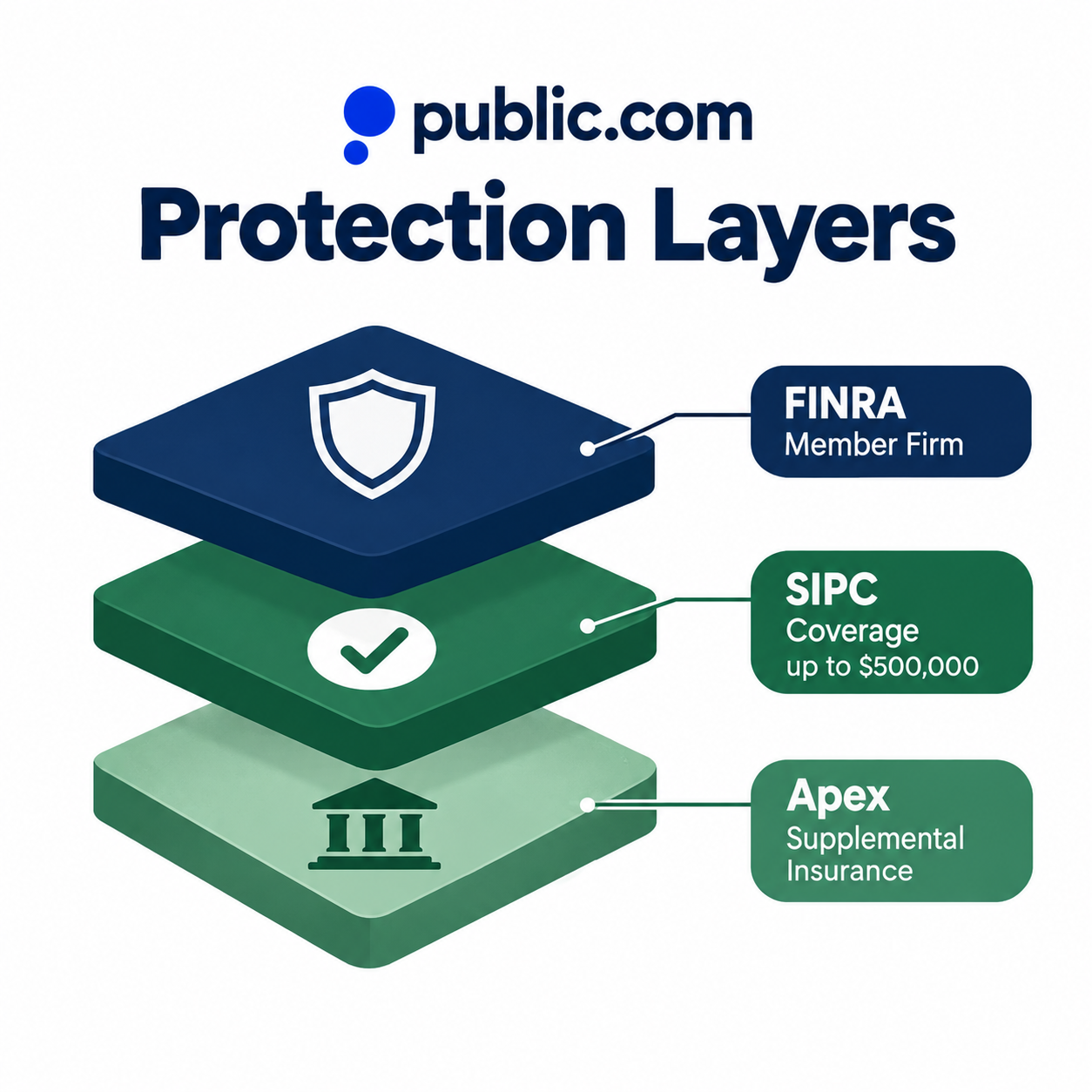
Here's what backs that up. Public.com's brokerage operations run through Open to the Public Investing, Inc., which is registered with the SEC and holds membership in both FINRA and SIPC. You can pull the firm's record yourself on FINRA BrokerCheck under CRD number 127818. As of September 18, 2026, that record showed four disclosures. A disclosure isn't automatically a scandal. Regulators log complaints, arbitration outcomes, and even administrative matters in the same system, so the number alone doesn't tell you guilt or innocence. It tells you where to go read the details before you decide.
SIPC coverage is the piece most people misunderstand. It protects up to $500,000 per customer, with a $250,000 sub-limit for cash, if a member brokerage collapses and customer assets go missing. It does not, under any circumstance, cover a stock, ETF, bond, option, or crypto position that simply drops in value. If Nvidia craters 40% in your account, SIPC does nothing. That's not a Public.com weakness. It's how every SIPC-covered brokerage in the country works.
Public.com layers on more than the SIPC minimum. Apex Clearing, which clears Public's trades, carries additional insurance with an aggregate limit of $150 million across its accounts, and customers may be eligible for supplemental coverage up to $100 million. Same rule applies here too: this covers custody failure, not investment losses, and it doesn't extend to crypto or alternative assets.
Is Public.com a legitimate company?
Yes. Public.com is a legitimate, registered U.S. brokerage, not a fly-by-night app running on a wing and a prayer. It's been operating for years, it files the required disclosures, and its clearing runs through Apex, one of the more established clearing firms in retail brokerage. On September 17, 2026, South Korean firm Mirae Asset Securities discontinued its review of a possible Public.com acquisition, while saying it would keep looking at the U.S. retail market. That's not a red flag on Public's safety. It just means no acquisition-related capital infusion should be assumed right now, and ownership stays where it was.
Public.com scam or real reviews?
Public.com is not a scam. It's a regulated broker with a documented BrokerCheck record and public customer reviews across multiple platforms, some glowing and some frustrated, which is exactly what you'd expect from a real business handling real money. Complaints on the Better Business Bureau site touch on account transfers, support response times, and crypto product changes, the kind of friction that shows up at every growing brokerage, not evidence of fraud. If you're weighing is Public.com safe against "is this a scam," the answer diverges. Scam implies no real regulatory oversight and no recourse. Public.com has both.
Decision rule: if you need a broker with real FINRA and SIPC standing and you're comfortable reading the fine print on what's actually insured, Public.com clears the bar. If you're expecting insurance to protect you from a bad trade, no broker on the market clears that bar, because that's not what SIPC is for.
Who runs Public.com and how does it work?
Public.com is a self-directed investing app built by Open to the Public Investing, Inc., and it makes money differently than most of the "free trading" apps that came before it. The core pitch: no payment for order flow on stock and ETF trades, revenue instead from subscriptions, cash yield spreads, and margin interest.
Payment for order flow (PFOF) is the practice where a broker routes your order to a market maker in exchange for a small payment, instead of routing purely for best execution. It's legal, disclosed, and how Robinhood built its zero-commission model. Public.com's stance is that it doesn't take PFOF on stock and ETF orders, and it built its marketing around that distinction. That matters because PFOF creates a structural incentive to route orders somewhere other than the best price, even if the difference is often small.
How does Public.com work day to day? You open an account, fund it, and trade stocks, ETFs, bonds, and options from one interface. As of September 22, 2026, Public also became part of TradingView's broker-partner network, letting U.S. users place stock, ETF, and options orders straight from TradingView's Supercharts. That's a real convenience for chart-first traders, and it's also one more third-party connection point, so the same account-security habits that apply to Public.com itself apply here too.
The newest layer is AI Agents, rolled out broadly on September 22, 2026. Public calls this an "agentic brokerage": instead of just helping you place one order, you set a condition or a strategy, and the agent acts on it continuously. Public reported more than 20,000 agents created and over $200 million in assets under management through them by launch day. Those are company-reported numbers, not independently audited results, and that distinction matters more than the headline figure. An agent executing your rules isn't the same as an agent generating returns.
Common mistake: treating an AI Agent like a guaranteed autopilot. It runs the rules you give it. If the rules are bad, the agent will faithfully execute a bad plan, fast. Read our breakdown of why AI trading bots often underdeliver on the promise before you hand real money to any autonomous system, Public.com included.
What does Public.com offer?
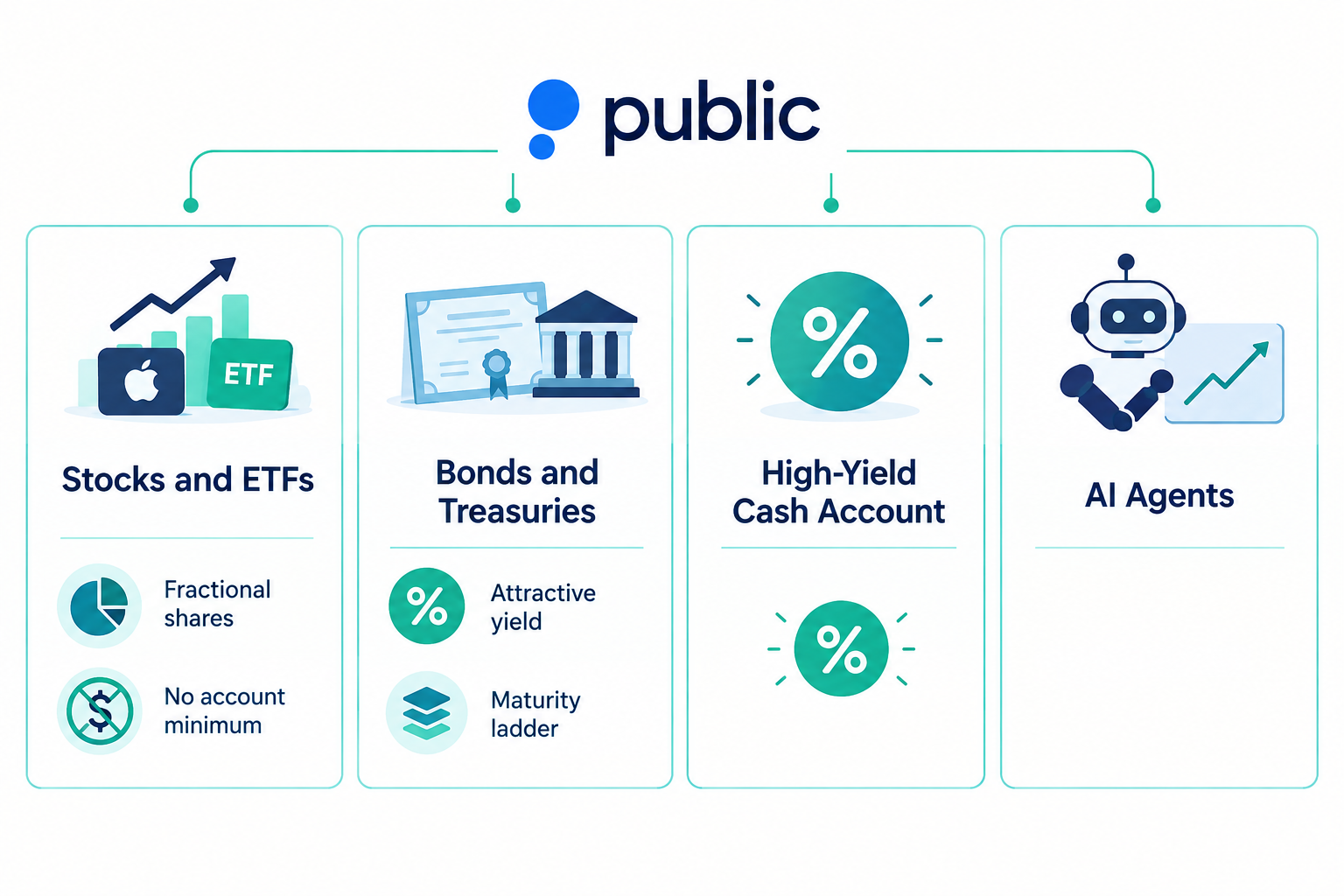
Public.com covers a wider product shelf than most single-purpose trading apps: stocks, ETFs, bonds, options, a high-yield cash account, and now AI-driven automation, all inside one login. That breadth is the pitch, and it's mostly delivered on.
The core product lineup:
- Stocks and ETFs with fractional shares and no account minimum for standard brokerage accounts.
- Options trading for approved accounts, with a standard risk-disclosure flow before access.
- Bonds and Treasuries, a category most competitors bury or skip entirely.
- High-yield cash account, where uninvested cash can earn interest through partner bank sweep arrangements.
- Reserve membership, launched September 22, 2026, at $20 a month, promoting a 3.75% APY on cash versus the free Core tier's 3.30%, plus a 4% IRA match, a 1% Generated Assets match, a 0.5% Treasury or Direct Indexing match, and priority support.
- AI Agents, letting users set monitoring and execution rules across markets and cash.
- Business accounts for single-owner LLCs, C corporations, and S corporations, also added in the September 2026 update.
Two disclosure notes worth flagging before you assume too much about protection. First, the high-yield cash account is not the same as a bank account. Public.com itself isn't a bank; cash swept to partner banks may pick up FDIC coverage there, but the account you're viewing sits inside a brokerage relationship. Second, ordinary securities positions are never FDIC-insured, full stop, no matter which broker holds them. FDIC covers bank deposits. SIPC covers brokerage custody. Neither covers a stock going down.
Edge case: if you're holding crypto through Public.com, none of the above insurance applies. Crypto sits outside SIPC and outside FDIC entirely, on every platform that offers it, and Public.com is no exception.
Public.com vs. Robinhood vs. Webull: which is safer
No single platform "wins" safety outright, because SIPC and FINRA membership are table stakes across all three. The real differences show up in order-routing philosophy, yield, and how much of the toolkit leans on AI.
| Category | Public.com | Robinhood | Webull |
|---|---|---|---|
| FINRA / SIPC member | Yes, via Open to the Public Investing, Inc. | Yes | Yes |
| SIPC coverage | Up to $500,000 ($250,000 cash cap), standard SIPC limit | Same standard SIPC limit | Same standard SIPC limit |
| Supplemental insurance | Apex Clearing, $150M aggregate, up to $100M per eligible customer | Provided through its own clearing arrangement, details vary by disclosure | Provided through its own clearing arrangement, details vary by disclosure |
| Stance on stock/ETF PFOF | No PFOF on stock and ETF orders | Accepts PFOF on equity and options routing | Accepts PFOF on equity and options routing |
| High-yield cash APY | 3.30% Core / 3.75% Reserve (variable) | Varies by tier, check current rate | Varies by tier, check current rate |
| AI investing tools | AI Agents (agentic execution), TradingView order routing | Basic AI-driven insights, no autonomous agent layer at this scope | Basic AI-driven insights, no autonomous agent layer at this scope |
Decision rule: choose Public.com if the no-PFOF stance on stocks and the AI Agent layer matter to you and you're fine with a lighter charting toolkit. Choose Robinhood or Webull if you want a larger, longer-tenured user base and don't mind standard PFOF routing. All three clear the same regulatory floor. None of them insures you against a bad pick.
What do the fees look like on Public.com?
Public.com's fee structure is simple on paper: $0 commissions on stock and ETF trades, a free Core tier, and an optional Reserve membership for higher yield and perks. The catch, as always, is in the optional layer, not the free one.
The basics:
- $0 commission on stock and ETF trades.
- Free Core account, including the 3.30% APY cash rate.
- Reserve membership at $20 a month, unlocking the 3.75% APY rate, the IRA and Generated Assets matches, the Treasury or Direct Indexing match, and priority support.
- Options and margin carry standard contract and interest costs, consistent with the disclosures Public.com publishes for its current rate schedule.
Run the math before upgrading. On a $10,000 cash balance, the gap between 3.30% and 3.75% is roughly $45 a year before the $240 annual Reserve cost is even factored in. Reserve starts paying for itself mainly through the match programs and priority support, not the yield bump alone, so it's a better fit for accounts large enough that the matches move real dollars.
Common mistake: signing up for Reserve purely for the higher headline APY without running the break-even math on your actual cash balance. A $2,000 cash cushion doesn't generate enough yield difference to offset a $240 annual fee.
Public.com fees stay competitive with the rest of the zero-commission field. The honest trade-off is that "free" trading still has to be paid for somewhere, and here it shows up in cash-yield spreads and the optional subscription, not in per-trade tickets.
Our Top 5 Favorite Public.com Features
Public.com earns real credit in a handful of specific spots, and these are the ones worth funding an account for.
- AI Agents. The ability to set a condition and let the agent act on it continuously is a genuinely different model than a static order ticket. More than 20,000 agents were live by September 22, 2026, managing over $200 million by Public's own count.
- No PFOF on stock and ETF orders. A real, verifiable stance that lines up incentives closer to best execution for the trades most retail investors place most often.
- Reserve's match programs. The 4% IRA match and 1% Generated Assets match go further for the right account size than most competing yield bumps.
- Multi-asset breadth in one app. Stocks, ETFs, options, bonds, and Treasuries without bouncing between platforms is a real convenience, and bonds specifically are an underserved category among retail apps.
- TradingView order routing. Chart-first traders can place Public.com orders directly from Supercharts as of September 22, 2026, cutting a step out of the usual workflow.
None of these features change the answer to is Public.com safe on their own. They change whether Public.com is the right safe broker for your specific habits.
Public.com Alpha Score breakdown: 74/100
Signal Quality, 14/20. The core mechanics work: orders fill, the app functions, and AI Agents execute the rules you set. The catch is that Public's AI Agent performance data comes from Public itself, not an independent auditor, so treat the $200 million AUM figure as a usage statistic, not a proven track record.
Transparency, 15/20. Public.com is genuinely upfront about its no-PFOF stance on stocks, and it publishes SIPC and supplemental insurance details clearly. It loses points because agent-level performance reporting isn't independently verified yet.
Price-to-Value, 16/20. Zero-commission trades plus a genuinely useful free Core tier put real value in front of every user before a subscription ever enters the picture. Reserve is optional, and its match programs make the $20 fee earn its keep for the right balance size.
Usability, 16/20. The app is clean, onboarding is fast, and TradingView integration removes friction for chart-first traders. First-week experience is strong, which is exactly where usability scores get made or lost.
Community Verdict, 13/20. This is the pillar that needed to stay honest. BBB-hosted reviews include real complaints about account transfers and support response times, and coverage of Public's crypto IRA changes shows some users walking away from that specific product line. That's a mixed picture, not a five-star one, and the score reflects it.
Where does Public.com fall short?
Public.com's biggest gaps are thinner research and charting tools than legacy platforms, and a shorter public track record than brokers that have been operating for decades. Neither is disqualifying, but both are real trade-offs.
Common problems worth knowing before you fund:
- Charting depth. Public.com's native charts don't match dedicated tools like TrendSpider or Koyfin. The TradingView partnership helps close that gap for order placement, but deep technical analysis still lives better on a specialized platform.
- Smaller community track record. Public.com is younger than Fidelity, Schwab, or even Robinhood in some product lines, so there's a smaller body of long-term user experience to lean on.
- Mixed BBB feedback. Complaints logged on the BBB profile mention transfer delays and support wait times, the kind of friction growing brokerages hit as volume scales faster than support staffing.
- Crypto IRA changes. Some customers reported walking away from Public's crypto IRA product after changes to that offering, a reminder that newer product lines can shift faster than legacy ones.
- Company-reported metrics. The 99.994% uptime figure and the AI Agent AUM numbers both come from Public.com itself. They're not necessarily wrong, they're just not independently audited, so weight them as marketing-adjacent data, not verified fact.
Decision rule: if you're a chart-heavy technical trader who lives in indicator overlays all day, keep Public.com for execution and pair it with a dedicated charting tool for the analysis side. Compare the field in our AI stock screener rankings before assuming one app has to do everything.
Who should use Public.com, and who shouldn't?
Public.com fits self-directed investors who want a broad product shelf, a documented no-PFOF stance on stocks, and a legitimate cash-yield option without needing five separate apps. It's a weaker fit for anyone who needs deep charting, a minor's custodial account, or a decades-long track record to feel comfortable.
Good fit if:
- You want stocks, ETFs, bonds, options, and a high-yield cash account in one login.
- The no-PFOF stance on stock and ETF orders matters to your decision-making.
- You're curious about AI-assisted, rules-based execution and you understand it runs your rules, not a guaranteed strategy.
Weaker fit if:
- You need advanced multi-timeframe charting as your primary tool.
- You want a broker with 20-plus years of public track record behind it.
- You're managing a minor's account. Public.com's standard brokerage accounts require the account holder to be 18 or older, and it doesn't market itself as a custodial-first platform for children, so families wanting that specific structure should compare dedicated custodial apps.
Is Public.com safe for kids?
Not as a direct offering. Public.com is built and marketed for adult self-directed investors. If you're looking for a custodial account structure specifically designed for minors, that's a narrower category of app, and it's worth comparing platforms built around that use case before assuming any general brokerage covers it.
Public.com refund policy if not satisfied
SIPC and supplemental insurance never refund investment losses, because they cover custody failure, not a bad trade. For the Reserve membership itself, cancellation is available inside account settings, and any refund on a partial billing period depends on Public's current terms at the time you cancel, so check the live policy before subscribing rather than assuming a pro-rated refund is guaranteed.
How to delete a Public.com account permanently
Transfer or liquidate your holdings first, then request closure through support or account settings, since most brokerages require a zero balance before they'll close an account outright. If you're moving assets to another broker, an ACAT transfer keeps your cost basis intact instead of forcing a sale. Confirm any pending Reserve billing is settled before you submit the closure request so you're not charged after the account is gone.
For a wider look at what's actually worth paying for across the AI investing tools category, our directory of AI stock picker apps breaks down where each platform earns its subscription price and where it doesn't.
Conclusion
Is Public.com safe? On the regulatory and insurance questions that decide whether your money is protected from firm failure, yes: FINRA membership, SIPC coverage up to $500,000, and Apex's supplemental insurance all check out. On the questions insurance was never built to answer, protection from a losing trade or a thin research toolkit, Public.com is a normal brokerage with normal trade-offs, not a guarantee machine.
The next move isn't blind trust or blind avoidance. Pull up FINRA BrokerCheck yourself, read Public's current disclosures, and paper trade any AI Agent strategy before you let it run with real cash. Systems over hacks, process over prediction, still applies even when the broker is the one offering the automation.
FullStack Alpha tests the AI investing tools layered on top of brokers like this one, so you don't have to find out the hard way which ones actually earn their subscription. See the AI stock tool comparisons and the best AI stock pickers, independently tested before you connect anything to your funded account.
One tool, examined in depth here. There are 200+ more in the FullStack Alpha directory, filterable by category, price and what they actually do.
Browse the directory → aistockpickerapps.com
This article contains affiliate links. FullStack Alpha may earn a commission if you sign up through them, at no extra cost to you. See our full disclosure.
References
Complaints - https://www.bbb.org/us/ny/new-york/profile/investment-management/publiccom-0121-87142673/complaints
Public Com - https://www.investing.com/brokers/reviews/public-com/
Annual Disclosure 2026 - https://public.com/disclosures/annual-disclosure-2026
Public Com - https://www.stockbrokers.com/review/public-com
Customer Reviews - https://www.bbb.org/us/ny/new-york/profile/investment-management/publiccom-0121-87142673/customer-reviews
Public Com Crypto Ira Customers Are Walking Away - https://gritdaily.com/public-com-crypto-ira-customers-are-walking-away/
Public Review - https://www.finder.com/stock-trading/public-review
Public Customer Relationship Summary - https://public.com/disclosures/public-customer-relationship-summary
Public - https://www.nerdwallet.com/investing/reviews/public
Customer Reviews - https://www.bbb.org/us/ny/new-york/profile/investment-management/publiccom-0121-87142673/customer-reviews?page=2
We test the tools. You get the verdict.
One email a week. What we tested, what scored, and what we'd skip. Written for traders, not for clicks.
Frequently asked
Topics in this teardown
Our verdict on Public.com
Public scores 74: a broker building itself around AI agents, with a friendly app and fair pricing underneath.