

Interactive Brokers Fees: The Full Map, No Fine Print Left
Short on time? The Interactive Brokers Alpha Score scorecard breaks the 86/100 down by pillar, with pricing and the verdict, in about 90 seconds.
See the score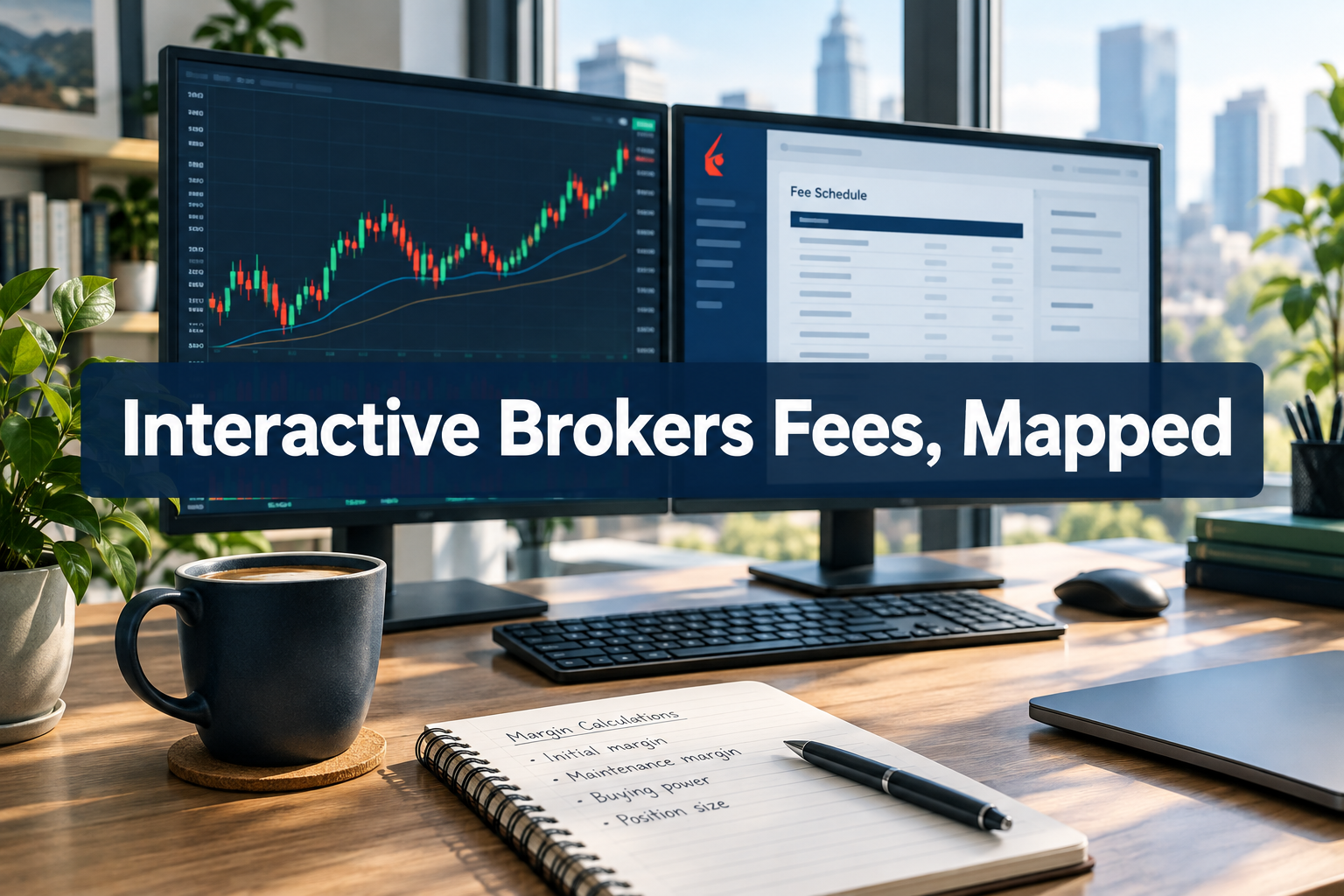
Quick Answer
Interactive Brokers fees run from $0 on U.S. stock and ETF trades under the Lite plan to fractions of a cent per share under Pro's tiered pricing, plus small charges for options, futures, currency conversion, and market data depending on how you trade. There's no account minimum and no inactivity fee anymore, so the real cost conversation is about which plan matches your volume, not whether the broker nickel-and-dimes you for existing.
Key Takeaways
- IBKR Lite charges $0 commission on U.S.-listed stocks and ETFs, with no account minimum and no maintenance fee.
- IBKR Pro fixed pricing runs $0.005 per share, with a $1 minimum per order.
- IBKR Pro tiered pricing drops to $0.0035 per share for monthly volume up to 300,000 shares, and as low as $0.0005 per share above 100 million shares, with a typical $0.35 minimum.
- Options contracts cost $0.15 to $0.65 depending on plan and monthly volume, with Lite generally flat at $0.65.
- Margin rates sit near 5.38% on balances under $100,000 for Pro accounts, dropping to 4.63% above $1 million; Lite margin runs a flat 6.38%.
- Currency conversion costs about 0.08 to 0.20 basis points of trade value, one of the cheapest FX conversion rates among major brokers.
- SEC transaction fees rose in 2026, pushing IBKR's own execution and regulatory pass-through costs up 22% to $142 million in Q2, a reminder that some line items aren't the broker's to control.
What are the interactive brokers fees for stocks and ETFs?
Interactive Brokers fees on U.S. stocks and ETFs come down to a simple fork in the road: pick Lite and pay $0 commission, or pick Pro and pay a small per-share rate that gets cheaper as your volume grows. Most retail traders with modest monthly share counts do fine on Lite. Frequent, large-block traders usually save more on Pro.
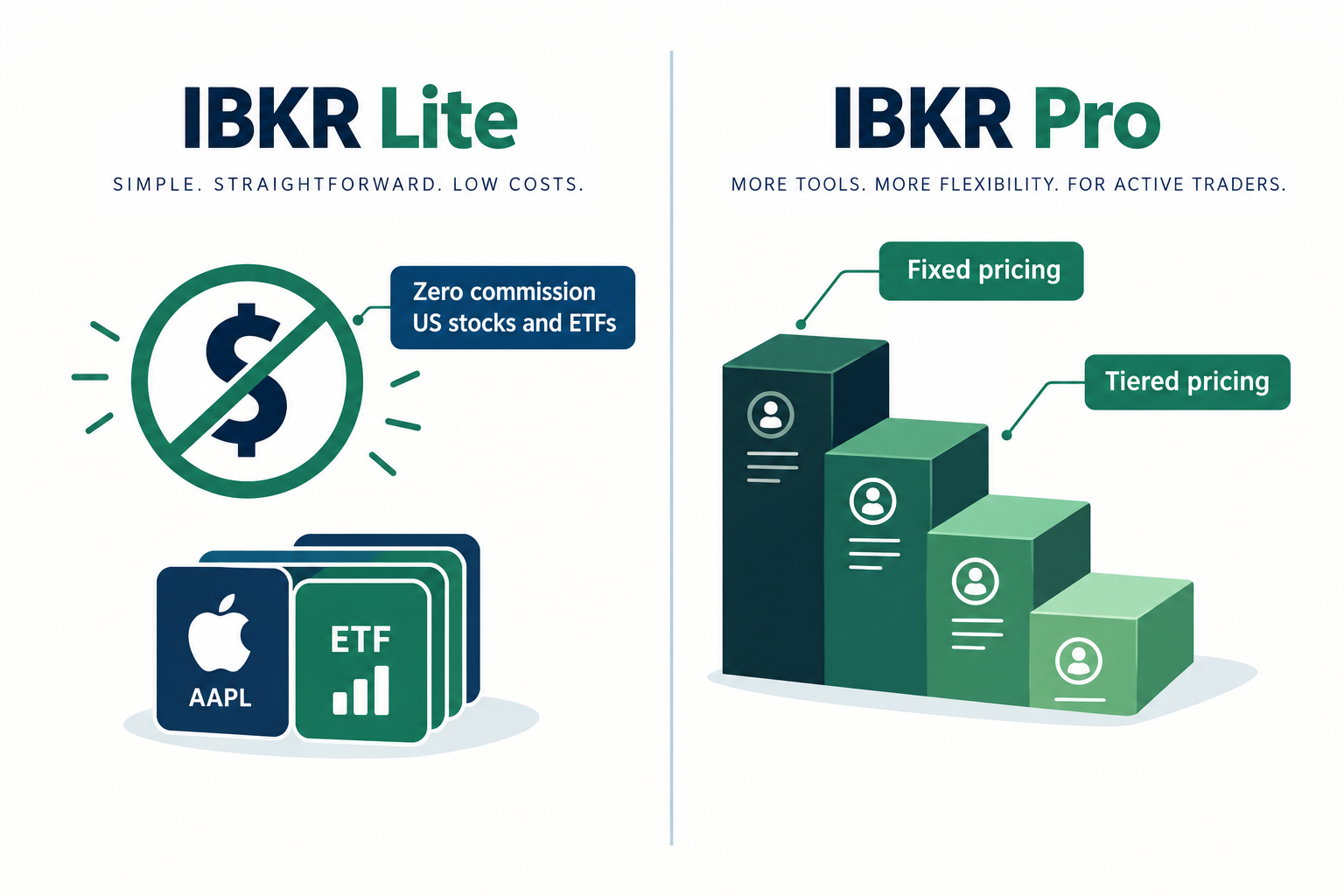
Here's the split in plain terms:
- IBKR Lite: $0 commission on U.S.-listed stocks and ETFs. No account minimum. No maintenance fee. No inactivity fee.
- IBKR Pro: Commission based on shares traded, either fixed or tiered (more on that below), plus possible exchange, clearing, and regulatory pass-through charges.
That last part matters. "Zero commission" and "zero cost" are not the same sentence. Lite trades route through Interactive Brokers' standard execution path, and while the headline commission is $0, order routing quality and price improvement still affect your real fill. Pro traders who want control over routing can pay a small commission and choose SmartRouting or direct routing themselves.
Decision rule: if you trade under a few thousand shares a month and mostly buy-and-hold U.S. equities and ETFs, Lite's $0 commission wins on simplicity. If you're running size, scalping, or need routing control, Pro's per-share model usually comes out cheaper once volume climbs.
Common mistake: assuming Lite is "free" in every sense. Currency conversion, options contracts, and market data subscriptions still apply on either plan.
How do IBKR Pro tiered vs fixed pricing compare?
IBKR Pro tiered pricing rewards volume with a lower per-share rate; fixed pricing keeps the rate flat but simple. The choice between them is really a choice between predictability and scale.
Fixed pricing:
- $0.005 per share
- $1 minimum per order
- No monthly volume tracking required
Tiered pricing:
- Starts at $0.0035 per share for monthly volume up to 300,000 shares
- Drops as low as $0.0005 per share once you clear 100 million shares in a month
- Typical minimum around $0.35 per order
Tiered pricing also unbundles exchange, clearing, and regulatory fees, which show up as separate line items rather than being folded into the commission. That's a trade-off: more transparency, more moving parts to track.
Choose fixed pricing if: you trade small, irregular size and want one predictable number per trade with nothing else to calculate.
Choose tiered pricing if: you're consistently trading enough volume that the per-share rate drop outweighs the added complexity of tracking exchange fees separately.
One Reddit thread in r/algotrading summed up the tiered model well: traders running high-frequency strategies described the unbundled fee structure as annoying to model at first, but cheaper once their spreadsheet caught up. That's the tiered trade-off in a sentence. Interactive brokers fees under Pro reward the trader who does the math, not the trader who guesses.
What do options, futures and forex cost at Interactive Brokers?
Options at Interactive Brokers cost $0.15 to $0.65 per contract depending on plan and volume, futures run roughly $0.25 to $0.85 per contract, and currency conversion runs a tiny fraction of a basis point. None of these are flat-rate the way Lite stock trades are. They scale with what you trade and how often.
Options:
- Pro: $0.15 to $0.65 per contract depending on monthly volume; published fixed rate is $0.65
- Lite: generally $0.65 per contract flat
- Exchange and regulatory charges can apply on top
Futures and futures options:
- Typically $0.25 to $0.85 per contract depending on the product and pricing tier
- External exchange, clearing, and regulatory charges can be a bigger share of total cost here than on equities, since futures markets pass through more third-party fees
Interactive brokers currency conversion fees explained
Currency conversion is where Interactive Brokers quietly separates itself from most retail brokers. The published spot FX commission runs about 0.08 to 0.20 basis points of trade value, subject to account minimums. Translate that: converting $10,000 from U.S. dollars to euros might cost you a few dollars, not the 1 to 2 percent spread a lot of banks and consumer platforms charge for the same conversion.
Who benefits most: international investors funding accounts in one currency and trading in another, or U.S. traders buying shares on a foreign exchange. This is one of the clearest cost advantages in the interactive brokers fees structure, and it's easy to miss if you never convert currency at all.
Edge case: small conversions can get eaten by minimum charges. If you're moving $50 between currencies, the flat minimum can outweigh the basis-point rate. Batch small conversions into larger ones when you can.
IBKR Lite vs IBKR Pro: commissions, margin rates and market data
| Feature | IBKR Lite | IBKR Pro |
|---|---|---|
| U.S. stock/ETF commission | $0 per trade | $0.005/share fixed, or $0.0035 to $0.0005/share tiered |
| Options commission | ~$0.65 per contract | $0.15 to $0.65 per contract |
| Margin rate (typical) | 6.38% flat | 5.38% under $100K, down to 4.63% above $1M |
| Order routing | Standard IBKR routing | SmartRouting or self-directed routing |
| Account minimum | $0 | $0 |
Rates current as of September 2026 and subject to change; verify current interactive brokers fees at interactivebrokers.com before trading.
How do Interactive Brokers margin rates compare to other brokers?
Interactive Brokers margin rates rank among the lowest published by major U.S. brokers, with Pro accounts starting near 5.38% and dropping to 4.63% for balances above $1 million. Most full-service brokers charge a full point or more above that on comparable balances, so the gap compounds fast if you carry margin regularly.
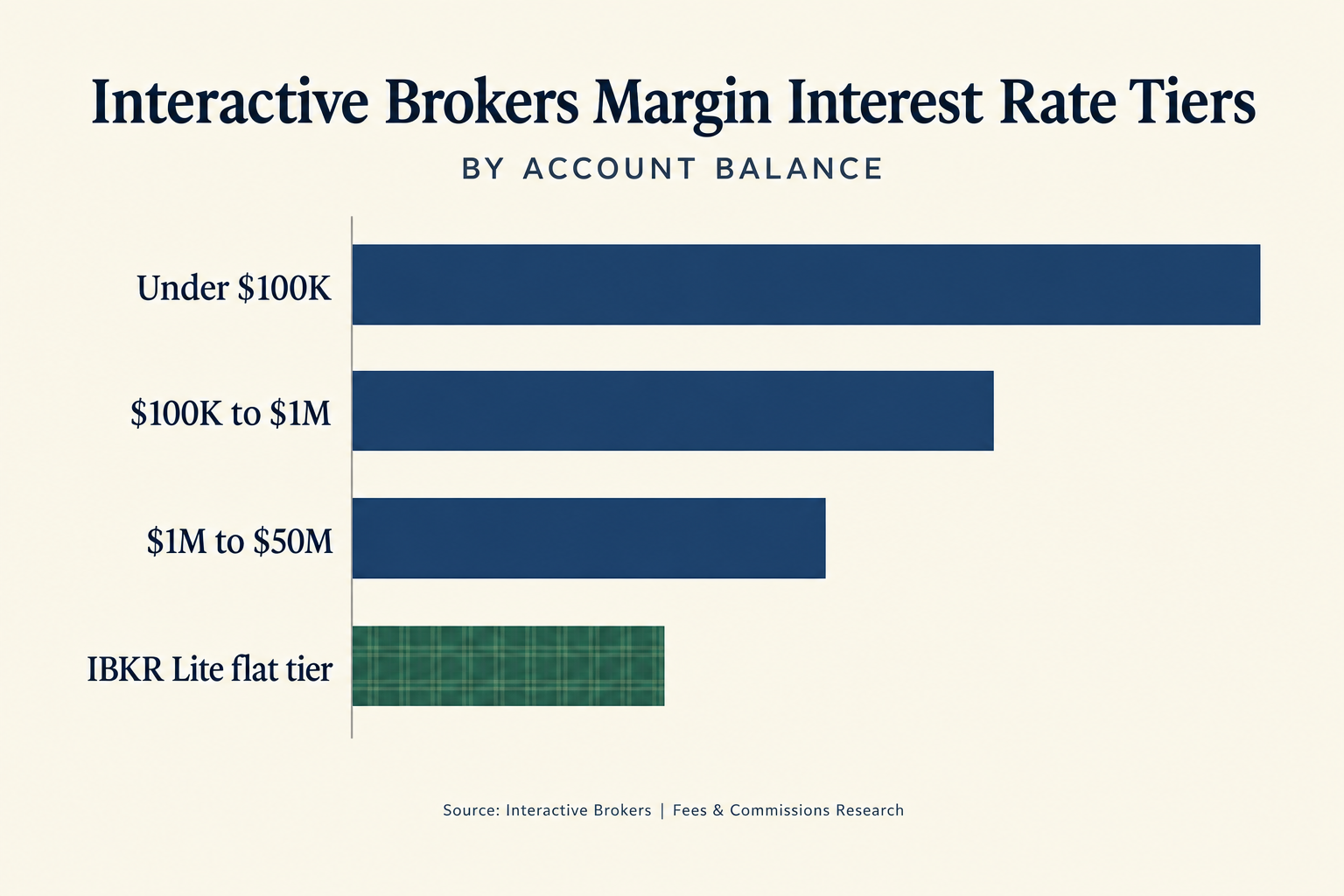
Here's the published tier structure for Pro accounts as of September 2026:
- Under $100,000: approximately 5.38%
- $100,000 to $1 million: approximately 4.88%
- $1 million to $50 million: approximately 4.63%
Lite accounts pay a flat 6.38% regardless of balance. That one-point spread between Lite and Pro margin rates is a real number to sit with if you're a frequent margin user. It can be the difference between Lite's zero-commission convenience being worth it and Pro's per-share cost paying for itself through cheaper leverage.
Interactive Brokers even extended this cost logic overseas. In September 2026, its Japan unit rolled out a margin approach that charges interest only on the financed portion of a position instead of the full position value, citing a Tier 1 rate of 2.466% as of September 11, 2026, alongside updates to its Gaika+ cash-income and stock lending programs (Interactive Brokers announcement). It's a reminder that IBKR treats margin pricing as a competitive lever globally, not just a U.S. talking point.
Decision rule: if you routinely hold margin balances above $100,000, the Pro rate schedule alone can outweigh Lite's zero-commission appeal. Run the math on your average balance, not your best month.
Does Interactive Brokers charge monthly fees or have an account minimum?
Interactive Brokers does not charge a monthly maintenance fee or require a minimum deposit on either Lite or Pro accounts. That's a real shift from the broker's own history, and from the wider brokerage industry's habit of taxing small accounts just for existing.
- Account minimum: $0 on both Lite and Pro
- Monthly maintenance fee: none
- Inactivity fee: removed. IBKR used to charge inactive accounts a monthly minimum activity fee; that structure is gone
This matters for beginners specifically. A $500 account that trades twice a year used to get quietly drained by inactivity charges at some brokers. IBKR closed that gap. If you're paper trading a strategy first, which we'd recommend before committing real capital to any new setup, a dormant IBKR account won't bleed fees while you build conviction. Try running your plan through a free position size and risk calculator before you fund the account at all.
Common mistake: confusing "no inactivity fee" with "no market data fee." Those are separate line items, covered below.
Does Interactive Brokers charge for wire transfers?
Interactive Brokers generally does not charge for the first outgoing wire transfer each month, though additional wires and certain transfer methods can carry a fee depending on currency, destination, and account type. This is a case where the specific cost depends on your situation, so checking the current fee schedule before initiating a transfer is worth the two minutes it takes.
- ACH deposits and withdrawals (U.S.): typically free
- First wire withdrawal per month: typically free, subject to account terms
- Additional wires, international wires, or check requests: fees can apply and vary by currency and destination
International investors should pay closer attention here than domestic ones. Cross-border wires often route through intermediary banks that add their own charges before the money ever reaches IBKR, and those charges aren't part of Interactive Brokers' fee schedule at all. Interactive brokers fees you can control by choosing your funding method wisely; intermediary bank fees you generally can't.
Our Top 5 Favorite Interactive Brokers Features
Interactive Brokers earns its reputation on a short list of features that actually move the needle on cost and access, not marketing copy. Here's what stands out after testing the platform against the fee schedule directly:
- Genuinely global market access. IBKR added the Bucharest Stock Exchange, Brazilian futures for eligible non-Brazilian clients, and a Latin American funding rail using Paysafe's SafetyPay in August 2026 alone. Few retail brokers expand their map this fast (IBKR press releases).
- Fractional shares where it counts. Canadian stock and ETF fractional trading launched August 1, 2026, lowering the entry price on expensive names without changing the underlying commission structure.
- Currency conversion that doesn't punish you. At 0.08 to 0.20 basis points, converting currency at IBKR costs a rounding error compared to what most banks and neobrokers charge.
- Margin rates that reward scale. The 5.38% to 4.63% Pro tier structure beats most full-service competitors by a meaningful margin on carried balances.
- Trader Workstation (TWS) depth. Once you climb the learning curve, interactive brokers TWS gives you order types, algo routing, and multi-asset execution that few retail platforms attempt to match.
Interactive Brokers Alpha Score breakdown: 86/100
Interactive Brokers scores an 86 out of 100 on the FullStack Alpha scale, built from five pillars worth 20 points each: Signal Quality, Transparency, Price-to-Value, Usability, and Community Verdict. This is one of the highest broker scores we've run, and the breakdown explains exactly where it earns that number and where it doesn't.
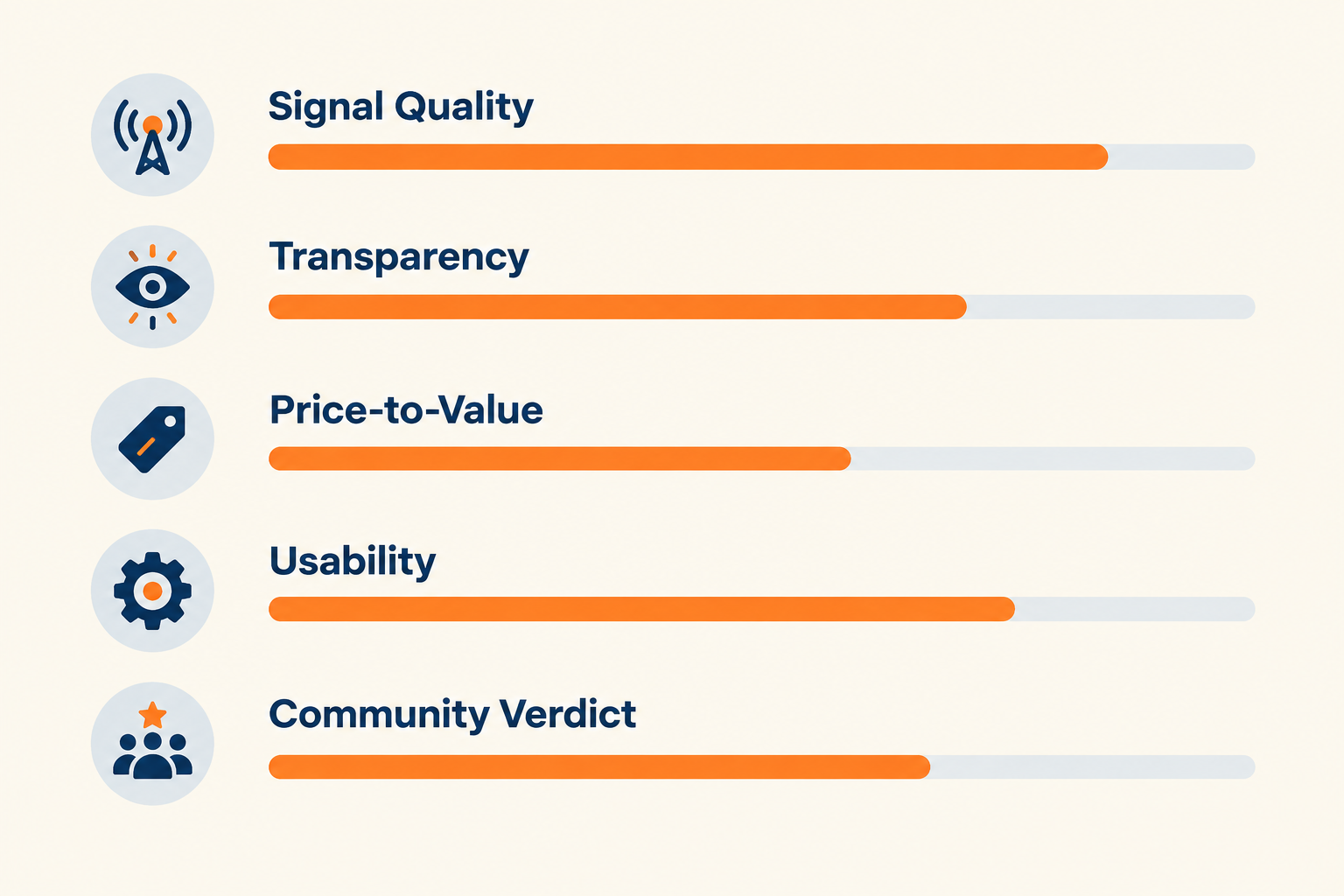
- Signal Quality (execution quality): 19/20. SmartRouting, price improvement stats, and outage history all point to a broker that fills orders the way it says it will. Few retail brokers publish this much execution detail voluntarily.
- Transparency (cost transparency): 17/20. The full fee schedule is public and specific, right down to the basis-point currency conversion rate. The catch: tiered pricing, exchange pass-throughs, and market data bundles mean you need to read three pages, not one, to see your real cost.
- Price-to-Value: 19/20. Between $0 Lite commissions and Pro's per-share pricing that gets cheaper with volume, IBKR is genuinely hard to beat for a cheapest broker for active traders search. Margin rates alone can justify the account for frequent leverage users.
- Usability: 14/20. This is the honest weak spot. Trader Workstation is powerful and dated at the same time. New users routinely describe the first week as overwhelming, and the mobile app, while functional, doesn't match the desktop platform's depth. Interactive Brokers is a tool you grow into, not one you master on day one.
- Community Verdict: 17/20. Sentiment on Reddit's trading and investing communities skews positive on cost and execution specifically, with the recurring complaint being the interface and, less often, support response times on complex account issues. That gap between "great value" and "steep learning curve" shows up consistently across unsolicited discussion.
Total: 86/100. The prose matches the math here: best-in-class execution and cost, held back a notch by a platform that asks more of you upfront than a beginner app would.
Where do interactive brokers fees surprise people?
The interactive brokers fees that catch people off guard aren't hidden. They're just easy to skip past because they don't apply to every account. Four spots deserve a second look:
- Market data subscriptions. IBKR unbundles most real-time market data from the base account. Depending on which exchanges and depth-of-book data you want, ibkr market data fees can range from free (delayed data) to a meaningful monthly charge for full Level II U.S. equity data or international exchange feeds. Check what you actually need before subscribing to everything.
- The exposure fee. This is a risk-based charge applied to accounts holding concentrated or illiquid positions that IBKR considers a risk to the firm's capital. It's not common for diversified retail accounts, but concentrated options or small-cap positions can trigger it.
- Currency conversion minimums. Covered above, but worth repeating: small FX conversions can get eaten by minimum charges even though the headline basis-point rate is tiny.
- Regulatory pass-through fees. These aren't IBKR's to set. The SEC increased its Section 31 transaction fee rate on April 4, 2026, and IBKR reported its execution, clearing, and distribution fees rose 22% to $142 million in Q2 2026 partly as a result, with regulatory fees up $19 million for the quarter (Interactive Brokers Q2 results). Individual traders feel this as small line items on trade confirmations, not a broker markup.
One thing that used to surprise people and no longer does: the old inactivity fee. IBKR removed it, and that history is worth knowing if you're comparing old broker reviews against the current fee schedule. Stale information is its own kind of hidden fee.
How to avoid interactive brokers fees
Most avoidable interactive brokers fees come down to picking the wrong plan for your trading style or subscribing to data you don't use. A short checklist handles most of it:
- Match your plan to your volume. Low-volume traders: Lite. High-volume, routing-sensitive traders: Pro tiered.
- Subscribe only to the market data you'll actually use. Delayed data is free. Real-time Level I or II costs money, so audit what you're paying for every few months.
- Batch currency conversions. Fewer, larger conversions beat several small ones that each eat a minimum charge.
- Use ACH for routine transfers, wires only when you need speed. The first wire per month is typically free, but repeated wires add up.
- Avoid concentrated illiquid positions that trigger the exposure fee, unless the position sizing is intentional and sized within your risk plan.
- Paper trade a new strategy first. Since there's no inactivity fee or minimum, testing costs you nothing but time.
Practical takeaway: the fastest way to cut interactive brokers fees isn't a hack. It's picking the right account type once and reviewing your data subscriptions twice a year.
Is Interactive Brokers worth the fees for beginners and active traders?
Interactive Brokers is worth the fees for both beginners and active traders, though for different reasons. Beginners get a $0-minimum, $0-commission Lite account with no inactivity risk. Active traders get some of the lowest per-share, options, futures, and margin rates in the retail brokerage space.
For beginners: the appeal is the absence of punishment. No minimum to open an account, no fee for trading rarely, no commission drag on small positions. The trade-off is Trader Workstation's learning curve, which is real. A beginner comfortable starting on IBKR's simpler mobile app first, then growing into TWS, avoids most of the early friction.
For active traders: the appeal is compounding savings. Tiered pricing, lower margin rates, and cheap currency conversion all reward volume. If you're running frequent trades, carrying margin, or converting currency across borders, few brokers put up a real fight against IBKR's numbers.
Pairing a low-cost broker with the right execution tools matters too. Traders doing their own screening might compare notes with our breakdown of AI stock scanners for real-time trading or swing trading tools to see where the platform gaps sit, since IBKR's own charting and scanning tools are functional but not best-in-class.
Discipline beats prediction here too. A cheap broker doesn't fix a bad process. It just stops fees from making a bad process worse.
Verdict: who saves the most on interactive brokers fees
Frequent traders, margin users, and international investors converting currency regularly save the most on interactive brokers fees, full stop. The math isn't close: Pro's tiered pricing, sub-5% margin rates at scale, and basis-point currency conversion beat most retail competitors outright. Buy-and-hold beginners with small accounts also do well, mainly because there's nothing left to punish them: no minimum, no inactivity fee, no monthly maintenance charge.
The one honest trade-off is Trader Workstation. It's a serious platform that takes a serious first week to learn. If you're willing to put in that week, the fee structure on the other side is one of the strongest in the business.
Next step: open a Lite account if you're testing the water, or run the numbers on Pro tiered pricing against your actual monthly share volume before you commit either way. If you're still building your process before you build your account, start with a free position size and risk calculator so your plan is ready before your capital is.
FullStack Alpha tests brokers and tools the same way it tests everything else: direct, scored, and never softened for an affiliate check. Browse the independently tested AI stock tool reviews or the best-of guides for what runs on top of a broker like this. For a lower-cost mobile-first alternative worth comparing against IBKR, see our Webull review.
One tool, scored five ways. There are 200+ more in the FullStack Alpha directory, filterable by category, price and what they actually do.
Browse the directory → aistockpickerapps.com
This article contains affiliate links. FullStack Alpha may earn a commission if you sign up through a link on this page, at no extra cost to you.
References
Commissions Home - https://www.interactivebrokers.com/en/pricing/commissions-home.php
Margin Rates - https://www.interactivebrokers.com/en/trading/margin-rates.php
Broker - https://www.interactivebrokers.com/en/accounts/broker.php
Commissionexamples - https://www.interactivebrokers.com/en/accounts/fees/commissionExamples.php
Other Fees - https://www.interactivebrokers.com/en/pricing/other-fees.php
Pricing Interest Rates - https://www.interactivebrokers.com/en/accounts/fees/pricing-interest-rates.php
Other Fees Overview - https://www.interactivebrokers.com/en/pricing/other-fees-overview.php
Commissions Stocks - https://www.interactivebrokers.com/en/pricing/commissions-stocks.php
Low Cost - https://www.interactivebrokers.com/en/whyib/low-cost.php
interactivebrokers - https://www.interactivebrokers.com/
We test the tools. You get the verdict.
One email a week. What we tested, what scored, and what we'd skip. Written for traders, not for clicks.
Frequently asked
Topics in this teardown
Our verdict on Interactive Brokers
Interactive Brokers scores 86, the top broker score on the site, and the AI story is only part of why.