

Motley Fool Stock Advisor Cost: $99 Year One, $199 at Renewal
Short on time? The Motley Fool Stock Advisor Alpha Score scorecard breaks the 69/100 down by pillar, with pricing and the verdict, in about 90 seconds.
See the score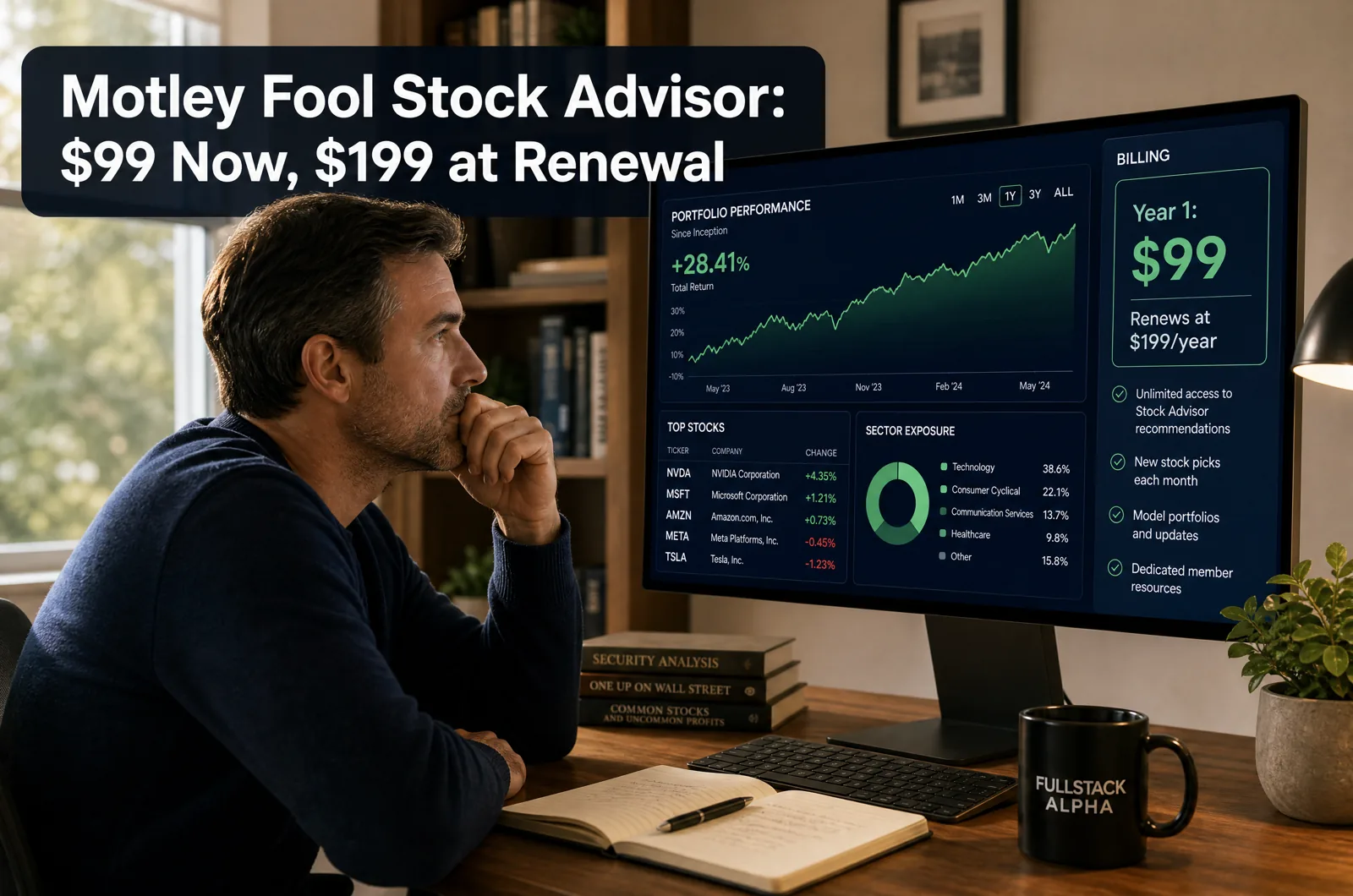
Quick Answer
Motley Fool Stock Advisor cost is $99 for new members in year one, then it renews automatically at the $199 list price every year after that, according to fool.com and the service's own terms and conditions. Hold it for the five years Motley Fool recommends and you'll pay $895 at today's prices. There's a 30-day refund window and nothing back after that, so the real decision point isn't the $99 sign-up, it's what you do on day 364.
Key Takeaways
- New members pay $99 for the first year. That's a one-time promotional price, not a permanent rate.
- Beyond the price, the five features that matter are two scheduled picks a month, the monthly Top 10 rankings, a members-only community, three entry strategies, and a research toolkit with portfolio tracking and partial Fool IQ access.
- The membership renews automatically at $199, the full list price, once year one ends.
- Hold the recommended five years and the total bill is $895 at current prices ($99 plus four renewals at $199).
- The 30-day Membership Fee Back Guarantee is the only refund window. After day 30, cancel anytime, but you get nothing back for unused months.
- Returning members who canceled and rejoin do not qualify for the $99 rate. It's a new-customer offer only.
- Reported gains are vendor-published, not independently audited, and an average since 2002 doesn't tell you what this year's two picks will do.
- The best fit is a patient investor with $25,000 or more who's building a diversified, multi-year portfolio, not someone chasing a discount code.
What Is Motley Fool Stock Advisor and Who Is It Actually For?
Motley Fool Stock Advisor is a stock-picking newsletter, not a broker and not a personalized advisor. Two separate analyst teams each publish one new recommendation a month, one focused on under-the-radar quality companies and one on first movers in emerging sectors, plus a running list of top picks to revisit.
The service is built for a specific kind of investor: someone with time, patience, and a willingness to hold a position through a bad quarter or three. Motley Fool tells members to expect a five-year minimum hold and to build a diversified book of 50 or more positions over time. That's the opposite of a swing trader's watchlist.
If you're looking for entries and exits, this isn't it. There's no stop-loss discipline here, no price-action read, no breakout alert. It's closer to a long-only, buy-and-forget philosophy dressed up as a monthly newsletter.
Motley Fool Stock Advisor cost only makes sense against that backdrop. You're not paying for speed. You're paying for two ideas a month and a framework to hold them.
Three entry strategies exist inside the membership: Cautious, Moderate, and Aggressive, matched to different risk appetites. Motley Fool suggests a portfolio of $25,000 or more to make the diversification math work across dozens of names.
That suggested minimum matters more than the sticker price. A $99 entry fee feels approachable. A $25,000 suggested portfolio size is the real qualifier, and it quietly filters out a lot of the people clicking the discount banner.
Is Motley Fool Stock Advisor good for beginners? It's readable for beginners, the writing avoids jargon and the picks come with plain explanations, but the five-year hold requirement and the recommended portfolio size assume you already have real capital and the patience not to touch it. A beginner with $500 and itchy fingers is the wrong customer, even if the $99 price makes it look welcoming.
Motley Fool Stock Advisor Features: The Five That Matter Most
Two stock picks a month is the headline, but the membership goes well beyond that.
These five features carry most of the value, and they're the ones worth testing in your first month.
🎯 Two new picks a month, on a fixed schedule
Two separate analyst teams each publish one pick a month, the first on the first Thursday and the second on the third Thursday.
One team hunts for slept-on quality companies the market hasn't priced in yet. The other backs first movers in emerging sectors that look expensive on traditional metrics. The calendar is the feature: you know when ideas land, so you can set cash aside for them instead of reacting to headlines.
🏆 Top 10 rankings, refreshed every month
On the fourth Thursday, both teams update a joint list of the 10 best stocks to buy now. Members also get a Foundational Stocks list on top of the rankings.
Joining mid-month? Start with the rankings, not the newest pick. A current shortlist from two teams beats sitting on your hands until the next Thursday drop.
👥 A members-only community
This is the feature most reviews skip, and it's one of the best parts of the membership. Stock Advisor members get premium discussion boards through the Community tab inside the service, plus posting rights on Motley Fool's free public boards. CAPS, the free community stock-rating tool, sits one click away.
A newsletter hands you a ticker. A community stress-tests it. Long-term holders arguing over the same names you own is the cheapest second opinion you'll find.
One distinction worth making: the Community Verdict pillar in our score grades public sentiment about the company, mostly billing complaints on Trustpilot. The member boards are a different thing, and they're a strength.
🧭 Three entry strategies
Cautious, Moderate and Aggressive portfolio strategies match the picks to your risk tolerance. Motley Fool pairs them with a suggested portfolio of $25,000 or more and a target of 50-plus positions held at least five years.
Pick your lane before you buy anything. That's the difference between owning a system and owning a pile of tickers.
📊 A research toolkit that tracks your portfolio
My Stocks handles your watchlist and portfolio tracking. Analyst coverage, live coverage, news and stock reports follow the companies you hold.
Stock Advisor also includes partial access to Fool IQ, Motley Fool's financial data hub with proprietary estimates, max drawdown and projected annualized returns, plus partial access to GamePlan for retirement and planning articles. Full access to both sits in the pricier Epic tier.
Practical takeaway: The 30-day Membership Fee Back Guarantee is your test window. Use it to try all five, the community boards especially. If they don't earn a spot in your weekly routine by day 30, you still get your membership fee back.
Motley Fool Stock Advisor Alpha Score: 69/100
Motley Fool Stock Advisor scores 69 out of 100 on the FullStack Alpha scale, built from five pillars worth 20 points each: Signal Quality, Transparency, Price-to-Value, Usability, and Community Verdict. Two pillars land below 14, and those are the parts of the pitch that don't survive contact with the fine print.
Signal Quality: 15/20. The public track record dates back to February 2002, which is a genuinely long horizon for a retail newsletter. That's a long public record, not an audited one, and it's not a promise about what next Thursday's pick does.
Transparency: 13/20. The methodology behind each pick is thin on published detail. You get the "why" in plain English, not the model or the screen behind it. Reported returns are vendor-published, and the service leans hard on pushing members toward higher tiers.
Price-to-Value: 14/20. $99 is a fair number to try the service. The catch sits one year away: $199 is the number you actually live with.
Usability: 16/20. The newsletter and site are easy to read and follow, no learning curve to speak of. The friction shows up later, in the upsell emails and the cancellation flow, not in the product itself.
Community Verdict: 11/20. Sentiment runs poor to mixed. Trustpilot rates the company 2.4 out of 5 across 9,243 reviews, with cancellation friction and upsell fatigue as recurring complaints.
The score doesn't move because the marketing is good. A 69 is a "proceed with clear eyes" number, not a rave, and the two weak pillars are exactly where the cost story gets uncomfortable.
How we evaluated: FullStack Alpha did not buy a subscription for this piece. We reviewed Motley Fool's service and pricing pages, the Stock Advisor Terms and Conditions, Motley Fool's own support pages on cancelling and refunds, Trustpilot, and Reddit discussion. Our full process is on the How We Test page.
What Does Motley Fool Stock Advisor Cost in Year One and Year Two?
Motley Fool Stock Advisor cost is a two-number story, and the marketing only ever leads with the first number. New members pay $99 for year one. Every renewal after that lands at $199, the full list price, per fool.com's service page.
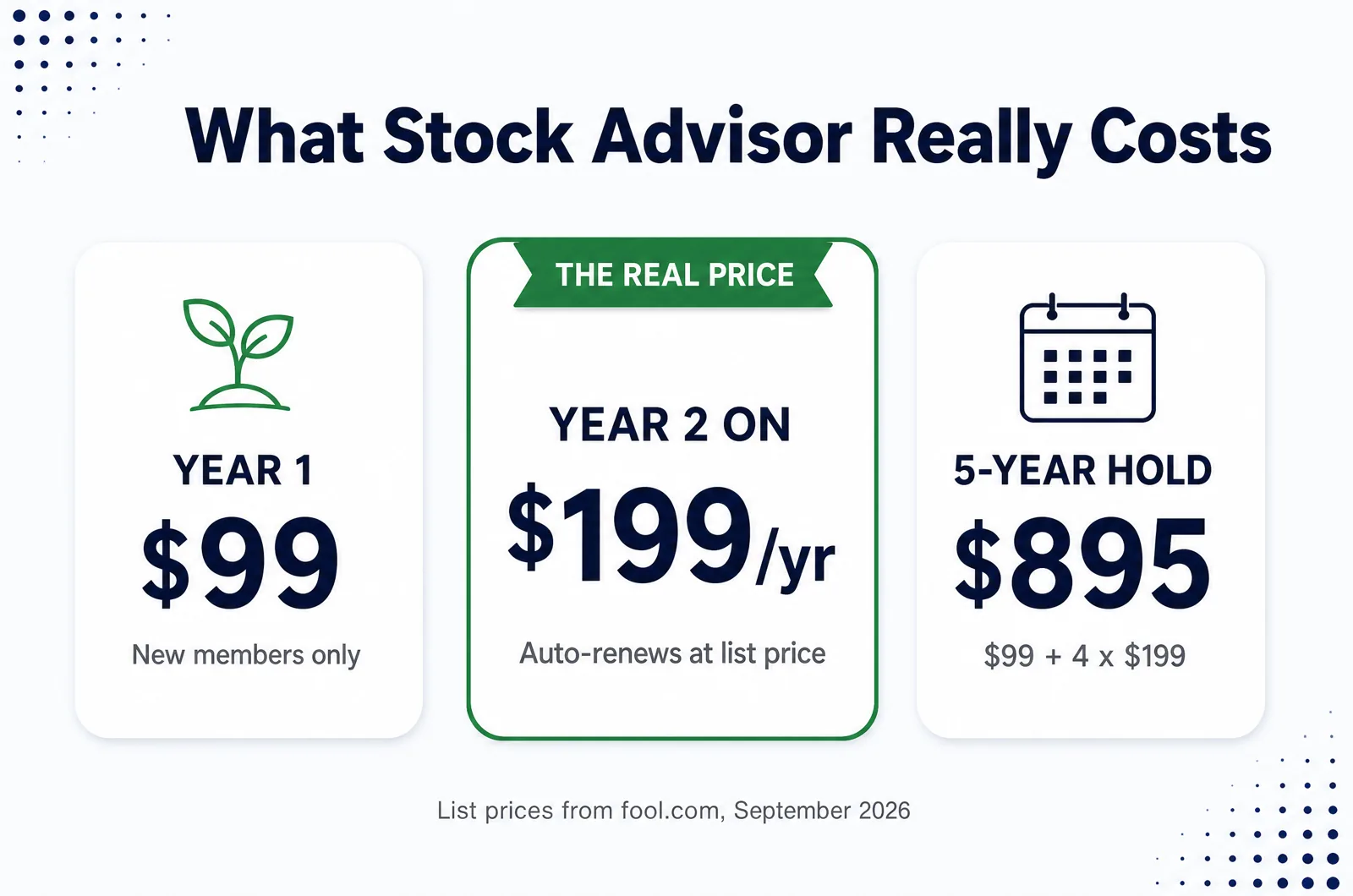
That's not a typo and it's not a rate hike you can negotiate. Fool.com spells it out in the pricing fine print: "Membership will renew at the then-current list price at the end of the one-year membership term." The Stock Advisor terms add that renewals are billed automatically to the card on file. Right now that list price is $199.
Do the math on the jump: $199 versus $99 is a 101% increase. Your subscription cost doubles, dollar for dollar, the moment year one closes.
Fool.com's Stock Advisor page publishes no monthly price, only the annual figures, so there's no $16-a-month option advertised to soften the hit. If you want a rough monthly equivalent for budgeting, $99 works out to about $8.25 a month in year one, and $199 works out to roughly $16.58 a month starting in year two. Motley Fool doesn't bill it that way, but the arithmetic helps you compare it to anything else you pay monthly.
Here's the part most sign-up pages bury: the $99 headline is a first-year-only offer for new members. It is never a recurring rate. If you're budgeting for this subscription past year one, budget for $199, not $99, because that's the number your card actually gets charged.
Practical takeaway: put the renewal date on your calendar the day you sign up, not the day the charge hits. That's the only leverage you have to decide before the $199 renewal is already on your statement.
What Does the Five-Year Hold Motley Fool Recommends Actually Cost You?
The five-year cost of Motley Fool Stock Advisor is $895 at today's prices, and that's the honest number if you follow the service exactly as it's designed to be used. Motley Fool itself tells members to hold picks at least five years. That advice comes with a bill attached.
Here's the math: $99 in year one, then four renewals at $199 each. $99 + ($199 x 4) = $895.
That's the number nobody puts on the landing page. The $99 headline is roughly one-ninth of what a five-year commitment actually costs.
Break it down by year so the shape is clear:
| Year | Charge | Running total |
|---|---|---|
| Year 1 | $99 | $99 |
| Year 2 | $199 | $298 |
| Year 3 | $199 | $497 |
| Year 4 | $199 | $696 |
| Year 5 | $199 | $895 |
Motley Fool Stock Advisor cost, viewed over the full recommended holding period, is closer to $900 than to $100. The service's own strategy, a five-year minimum hold across a diversified book of 50-plus picks, is what generates that number. You can't follow the strategy as designed and only pay the first-year price.
This isn't a criticism of the strategy itself, patient, diversified, long-horizon investing is a defensible approach. It's a correction to the price anchor. If you're deciding whether to subscribe based on $99, you're deciding based on 11% of the real five-year cost.
Practical takeaway: before you sign up, write $895 on a sticky note, not $99. If that number still makes sense against what you expect to get out of two picks a month for five years, the price isn't the obstacle. If $895 changes your answer, the $99 headline was doing more work than it should.
How Big Is the Subscription as a Share of Your Portfolio?
The Motley Fool Stock Advisor cost of $199 a year is small against a large portfolio and genuinely large against a small one. Motley Fool suggests a $25,000 minimum portfolio to make its diversified, 50-plus-position strategy work, and the subscription cost only makes sense in that context.
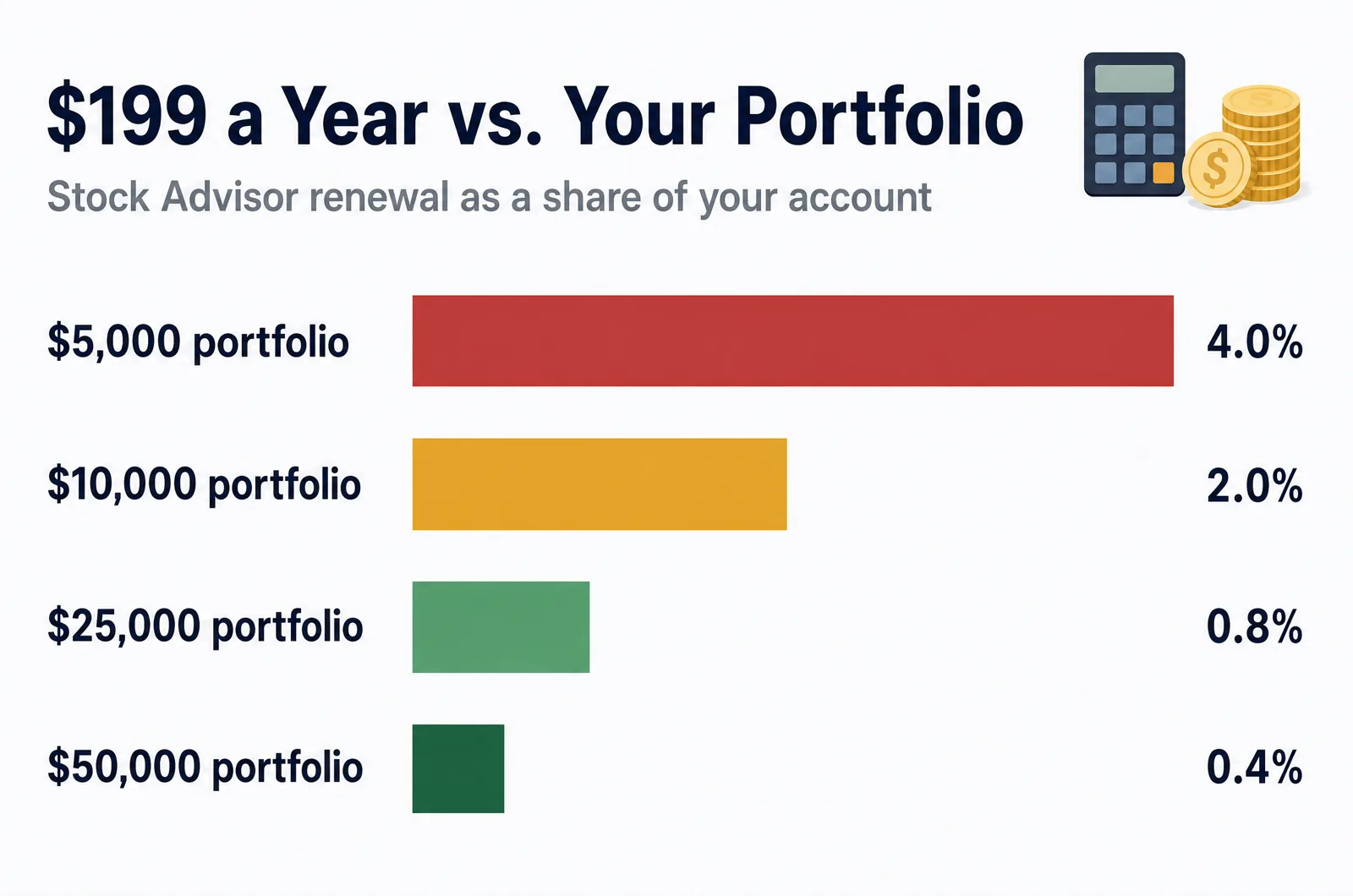
Here's what $199 a year actually represents at different account sizes:
- $50,000 portfolio: $199 is 0.4% a year. Barely a rounding error.
- $25,000 portfolio (Motley Fool's suggested minimum): $199 is 0.8% a year. Still light.
- $10,000 portfolio: $199 is 2% a year. Now it's a real hurdle before any pick has earned a cent.
- $5,000 portfolio: $199 is 4% a year. At this size, the subscription is a bigger annual drag than most single positions will move in a year.
This is the math the discount headline never shows you. A $99 or $199 price tag reads the same whether your account is $5,000 or $500,000, but the burden it puts on your returns is wildly different. On a small account, you need real, sustained gains just to cover the subscription before the strategy has done anything for you.
Motley Fool's suggested $25,000 minimum isn't arbitrary. It's the point where the annual fee stops being a meaningful hurdle and starts being a rounding error against a diversified, multi-position portfolio.
Decision rule: if your investable account is under $10,000, run the percentage math before you subscribe. A subscription that costs 2 to 4% of your account every year is a real cost center, not a footnote, and it needs to be weighed against what two monthly picks are realistically likely to add on that same small base.
Is There a Motley Fool Stock Advisor Discount After the First Year?
No. The Motley Fool Stock Advisor discount is a one-time, new-member offer, and it does not come back at renewal or on any future sign-up if you've ever held the membership before. The terms are explicit on this point: subscribers who canceled and later rejoin are not eligible for promotional pricing.
That closes off a strategy some subscribers try: canceling before renewal, waiting a few months, then resubscribing at the promotional rate. According to the Stock Advisor terms and conditions, that loophole doesn't exist. The $99 rate is reserved for people who have never been a member.
There's also no free trial. What exists instead is the 30-day Membership Fee Back Guarantee, which lets you get your money back if you cancel inside the first 30 days. That's a refund window, not a free look before paying.
What about a Motley Fool Stock Advisor 2 year subscription? Fool.com's service page shows only a one-year term for Stock Advisor. There's no published two-year plan, no multi-year discount, and no bundled rate that locks in $99 or any other number for a second year. If you see a "2 year subscription" mentioned anywhere, treat it as unverified, because the current published structure is strictly annual, auto-renewing at list price.
The one legitimate discount that exists is baked into the sign-up flow itself: $99 versus the $199 list price, described by Motley Fool as a $100 discount for new members only. That's the entire discount story. There's no coupon code, no loyalty pricing, no way to keep paying $99 past year one.
Practical takeaway: treat the $99 price as a one-shot offer, not a renewable perk. If you cancel expecting to rejoin later at the same rate, the terms say otherwise. Decide with the $199 renewal already in mind, not around it.
How Good Are the Stock Picks for the Money?
Motley Fool reports an average return of +932% since 2002 across its Stock Advisor picks, against +212% for the S&P 500 over the same stretch. That figure is vendor-reported. Motley Fool publishes it, not a third party, and it hasn't been independently audited.
Is Motley Fool Stock Advisor worth the price based on that number alone? Not really, and here's why the number itself is a weaker signal than it looks. An average return across hundreds of picks made over 24 years tells you almost nothing about what the two recommendations made this month will do for you. Early picks carry outsized weight in a cumulative average like that, because they have had the most years to compound. Your holding period starts today, not in 2002.
This is the same trap every long-running track record sets. The average since inception mixes early home runs with recent, unproven calls, and you're only exposed to the recent half.
Do Motley Fool Stock Advisor picks actually make money? Some have, historically, by the company's own reporting. Whether the two picks recommended the month you join do the same is not something the historical average can answer. No stock-picking service, including this one, can promise that, and none should.
The Signal Quality pillar reflects this directly at 15 out of 20: a long public record is real and worth something, but it's not audited, and it's not a forecast. Treat the +932% figure as a marketing data point about the past, not a projection of your outcome.
Practical takeaway: if you subscribe, track your own personal starting-point return from the day you join, not the headline since-2002 number. That's the only figure that tells you anything about your own Motley Fool Stock Advisor cost-to-value ratio.
What Do You Actually Get Each Month for $199?
Here's what's included in Motley Fool Stock Advisor membership, laid out plainly:
- Two new stock recommendations a month. One team publishes on the first Thursday, the other on the third Thursday.
- Monthly rankings, including a "10 best stocks to buy now" list.
- Three entry strategies: Cautious, Moderate, and Aggressive investing styles.
- GamePlan, a financial hub for retirement and planning articles.
- Fool IQ, financial data and proprietary estimates for dozens of publicly traded companies.
- A five-year holding framework and guidance toward building a diversified book of 50-plus positions over time.
That's the full list. There's no options overlay, no short-selling guidance, no day-trading alerts, and nothing resembling real-time scanning. This is a monthly-cadence research product, closer in spirit to a long-only fund manager's memo than a trading terminal.
For a portfolio built around the suggested $25,000 minimum, that's two new ideas and a running best-of list every month for less than a dollar a day at the $199 renewal rate. For a smaller account, the same content arrives at a proportionally higher cost, as covered above.
The monthly "10 best stocks to buy now" ranking is the part to use between picks, since it hands members a current shortlist instead of leaving them waiting for the next Thursday drop. If you're weighing this against AI stock pickers built for shorter time horizons, the comparison breaks down fast: this product is not built for the same cadence or use case.
Practical takeaway: if two ideas a month and a five-year hold doesn't match how you actually invest, no amount of tooling inside the membership fixes that mismatch. The content is fine. The fit is the question.
Pros and Cons
Pros:
- Public track record dating back to February 2002
- Two new stock picks a month, plus monthly rankings and a "10 best stocks to buy now" list
- Clear, stated long-term framework: hold at least five years across a diversified portfolio
- 30-day Membership Fee Back Guarantee
- $99 first-year price for new members
- Education and planning tools included (GamePlan, Fool IQ, three entry strategies)
Cons:
- Price renews automatically at $199, so year two costs double year one
- No refunds after the 30-day guarantee window; unused months are gone
- The $99 rate is one-time only; returning members don't qualify for it again
- Heavy upsell push toward Epic ($499 list) and Epic Plus ($1,999 list)
- Returns are vendor-reported, not independently audited
- Poor community sentiment: 2.4 out of 5 on Trustpilot across 9,243 reviews, with cancellation and refund friction reported
How Does the Cost Compare With Motley Fool Epic and Seeking Alpha?
Motley Fool Stock Advisor cost sits well below Motley Fool's own higher tiers and roughly in the middle of a two-picks-a-month newsletter versus a full research platform. Motley Fool Epic lists at $499 a year ($299 introductory for new members). Epic Plus lists at $1,999 a year ($1,399 introductory).
For a direct outside comparison, Seeking Alpha Premium runs $4.95 for the first month for new subscribers, then $299 a year. That's not an apples-to-apples product though. Seeking Alpha is a research platform built around screening tools, analyst articles, and quant ratings across thousands of tickers, not a curated two-picks-a-month newsletter.
The motley fool vs seeking alpha framing comes up constantly in reader questions, and the honest answer is that they're solving different problems. Stock Advisor hands you a short, curated list and tells you to hold it. Seeking Alpha hands you a research library and expects you to do the picking yourself.
| Service | First-year price | Renewal price | Picks per month | Refund window | How to cancel |
|---|---|---|---|---|---|
| Stock Advisor | $99 | $199 | 2 | 30 days | Account settings, or Member Services |
| Motley Fool Epic | $299 | $499 | 7 | Check Epic terms | Account settings, or Member Services |
| Seeking Alpha Premium | $4.95 (first month) | $299/year | None (research platform) | Check Seeking Alpha terms | Check Seeking Alpha terms |
Practical takeaway: if you want two curated picks and a hold-forever framework, Stock Advisor's price is reasonable against Epic. If you want a screener and a research library to run your own process, Seeking Alpha's $299 a year competes directly and gives you tools instead of a monthly memo.
Where Does the Upsell Funnel Lead, and What Does It Cost?
Motley Fool Stock Advisor cost doesn't stop at the renewal. The moment you're a member, the upsell funnel starts, and it points toward Epic and Epic Plus.
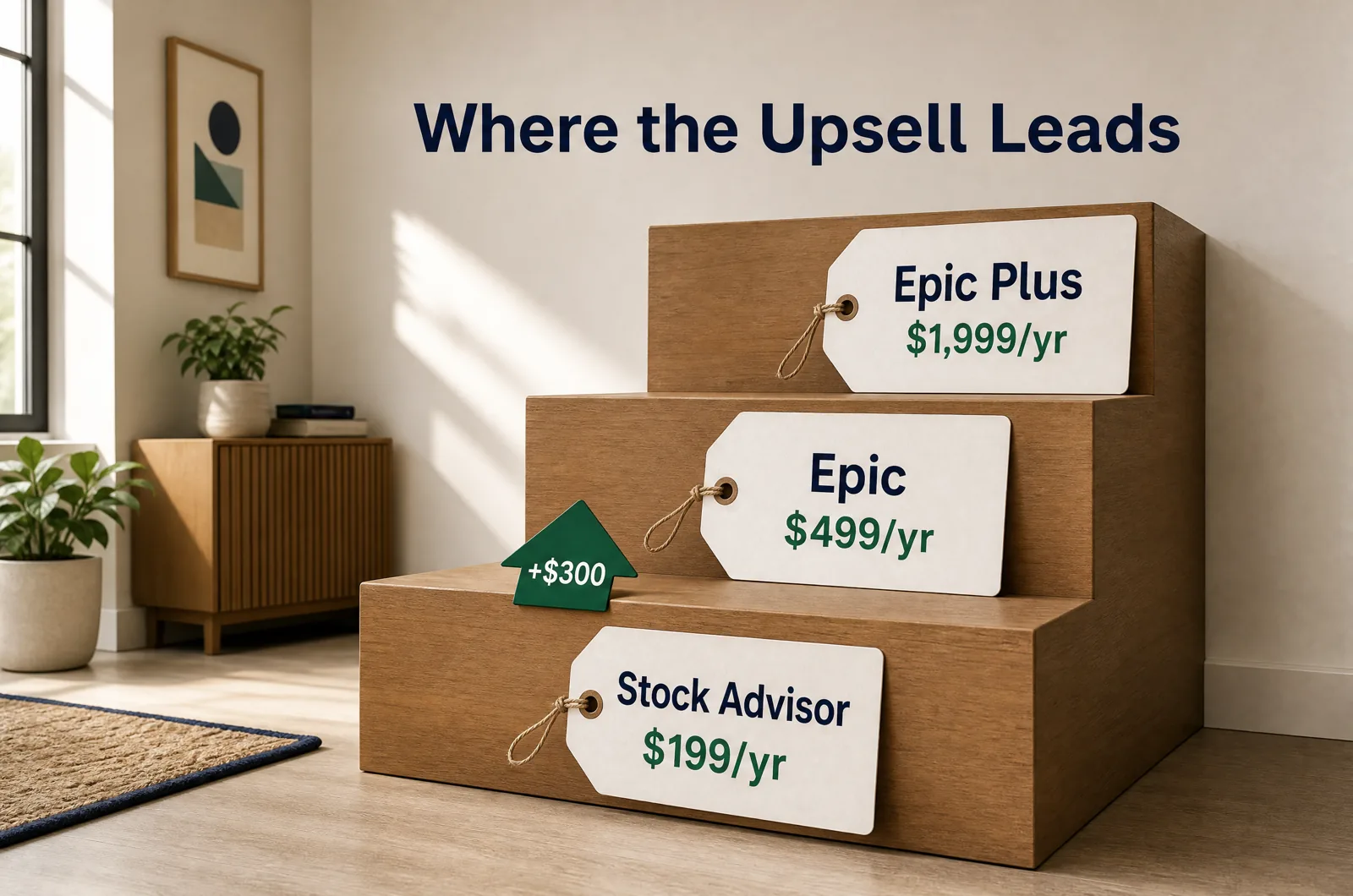
Moving from Stock Advisor's $199 list price to Epic's $499 list price adds $300 a year, a roughly 2.5x jump. Moving to Epic Plus, at $1,999 list, is close to 10 times Stock Advisor's list price.
Are there hidden fees or extra charges inside Stock Advisor itself? No, not in the sense of surprise line items. The subscription price is the subscription price. What exists instead is a steady stream of emails and in-app prompts nudging members toward the pricier tiers, which is the specific behavior that drags the Transparency pillar down to 13 out of 20.
This is a real design choice, not a glitch. A service that leans hard on upgrade messaging is telling you something about where its incentives sit. The core Stock Advisor product doesn't need Epic to function. The business model benefits from you buying it anyway.
None of this means Epic or Epic Plus are bad products on their own terms, they simply sit at a different price point and scope, and this article isn't evaluating them. What matters for Motley Fool Stock Advisor cost specifically is that the number on your renewal notice, $199, is the floor of what Motley Fool will ask you to pay, not the ceiling.
Practical takeaway: decide what you're paying for before you subscribe. If $199 a year for two picks and a rankings list is the value you want, set a personal rule to ignore upgrade emails for at least one full renewal cycle before you even consider Epic. Let the base product prove itself first.
How Hard Is It to Cancel, and What Do You Get Back?
Canceling Motley Fool Stock Advisor is straightforward on paper: Motley Fool's own support page says to cancel through your account settings page, with Member Services available if you hit a snag. There's no phone-only requirement.
What you get back depends entirely on timing. The 30-day Membership Fee Back Guarantee is the only refund window that exists. Cancel inside those 30 days and you get your money back. Cancel on day 45, or day 200, or day 360, and you get nothing back for the unused portion of your term. The terms are explicit: no refunds outside the guarantee period, and the guarantee never exceeds 30 days.
This is a bigger deal than it sounds. The terms tie the guarantee to the offer you originally bought, and they say no guarantee period exceeds 30 days. So don't assume a fresh 30-day clock starts when the $199 renewal posts. If you are unsure, ask Member Services before the renewal date, not after the charge.
Trustpilot reviewers report friction specifically around canceling renewals and securing refunds, which is a documented pattern worth taking seriously even though the official process reads simply on the support page. The gap between "here's how to cancel" and "here's what users say happened when they tried" is real, and it's part of why the Community Verdict pillar sits at 11 out of 20.
Practical takeaway: cancel before your renewal date, not after, and don't wait until the charge posts. The account settings page is the fastest path. If that stalls, Member Services is the fallback, but plan for that conversation to take longer than the support article suggests.
What Do Real Users Say About the Price?
Sentiment on Motley Fool Stock Advisor cost is poor to mixed, and the split runs almost entirely along one line: how long you've held your positions.
Trustpilot rates The Motley Fool 2.4 out of 5, labeled "Poor," across 9,243 reviews. The recurring complaints there cluster around three things: relentless upsell emails, friction canceling renewals and getting refunds, and specific picks reviewers say underperformed expectations.
Reddit tells a more divided story. In Reddit investing threads, long-term holders, people who bought years ago and let positions run through multiple market cycles, tend to speak positively about the service. Newer members, especially those judging the subscription against picks made in the past year or two, are frequently disappointed. That gap matters: it lines up almost exactly with the five-year hold framework Motley Fool itself recommends.
If you search "is motley fool stock advisor worth it reddit," expect exactly this split, not a consensus. Time horizon predicts sentiment better than almost anything else in these threads.
The honest read is that the price complaints and the performance complaints are tangled together. A member who feels the $199 renewal was a bad deal is often also a member whose recent picks haven't worked out yet, and it's hard to separate "the price is too high" from "the last two picks disappointed me" in a one-star review.
Practical takeaway: weight recent Reddit sentiment lightly if the poster has held for under a year. Weight it more heavily if they're describing a multi-year experience, since that's the actual use case Motley Fool is selling.
What Are the Cheaper Alternatives to Motley Fool Stock Advisor?
The cheapest alternative to Motley Fool Stock Advisor cost is doing your own research with free tools, and the second-cheapest is a lower-cost platform built for self-directed screening rather than curated picks.
- Low-cost index funds. For investors who don't want to pick individual stocks at all, broad index funds are a legitimate, simpler alternative. No monthly picks, no five-year hold requirement, no renewal to track.
- Seeking Alpha Premium, at $299 a year after a $4.95 first month, gives you a screener and a research library instead of two curated picks. It costs more than Stock Advisor's renewal but replaces the newsletter model with a toolset you control.
- Free stock screeners and research tools. A free AI stock tool or a free stock screener won't hand you a curated pick list, but it puts the filtering criteria in your hands at no cost, which is a fair trade if you're willing to do the legwork yourself.
None of these alternatives replicate the specific thing Stock Advisor sells: a hands-off, curated, five-year-hold pick list from a named team, twice a month. That specificity is the product. If you value it, the alternatives above are cheaper but different, not cheaper equivalents.
Practical takeaway: decide first whether you want to be handed picks or whether you want the tools to find your own. That answer, more than the price tag, determines whether Stock Advisor or one of these alternatives is the better fit.
How Should You Decide Before the Renewal Date Hits?
Motley Fool Stock Advisor cost only becomes a real decision on renewal day, not on sign-up day, so build a five-step process around that date instead of around the $99 headline.

- Calendar the renewal date the day you subscribe. Set a reminder 30 days before it, not the day the charge posts.
- Track your own pick results from your join date, not the since-2002 average. That's the number that actually reflects your experience.
- Compare the $199 renewal to your portfolio size using the percentages above. If it's over 2% of your account annually, weigh that seriously against expected value.
- Decide keep or cancel before day 365, using your own tracked results and the portfolio-share math, not the marketing emails that show up in month eleven.
- Turn off auto-renew if you're unsure. You can always resubscribe later at list price if you change your mind, but you can't get back a $199 charge you didn't mean to authorize.
This process treats the subscription the way any recurring cost deserves to be treated: reviewed on a fixed schedule, against your own data, not against the vendor's best-case pitch.
Final Verdict
Motley Fool Stock Advisor cost makes sense for one specific investor: patient, holding for five years or more, building a diversified portfolio of 50-plus positions, and comfortable budgeting $199 a year starting in year two. For that person, the math holds up, and a 69 out of 100 score reflects a real, if unaudited, long-run pick record delivered in a genuinely easy-to-use format.
It does not make sense for anyone subscribing on the strength of the $99 headline alone, for traders looking for entries and exits, or for anyone with a small account where $199 a year eats 2 to 4% of the portfolio before a single pick has done anything. It also doesn't make sense for anyone unwilling to fight through upsell emails and a cancellation window that closes fast.
Proceed with clear eyes: $99 buys a look. $895 is the five-year price of actually following the strategy.
Check Other Options Before You Renew
Worth it depends on what you're replacing. The FullStack Alpha directory has 200+ AI stock tools filterable by price, so you can see what the same money buys elsewhere. Check the alternatives at aistockpickerapps.com
FullStack Alpha may earn a commission if you buy through links on this page, at no extra cost to you.
We test the tools. You get the verdict.
One email a week. What we tested, what scored, and what we'd skip. Written for traders, not for clicks.
Frequently asked
Topics in this teardown
Our verdict on Motley Fool Stock Advisor
Stock Advisor delivers what it advertises at the top line: two picks a month, a ranked best-buys list, and an interface a beginner is comfortable with in an afternoon.